Today we’re launching OpenRoboto Shift, opening a new chapter for OpenRoboto.
Shift is a decentralized network for collecting egocentric robotics data: first-person video of real people doing real work.
Only Possible on Bittensor.
Explore Shift → https://t.co/D4iykN0sBe
This is the second subnet this week that has made physical world touch down (The other was @metanova_labs's connection to a automated drug lab)
This bridges the gap between the liquid intelligence layers on Bittensor, which exist purely in byte space, down into the hard atomic space where our systems can optimize and innovate harder products.
Very cool leap.
Robotics on Bittensor is making its way onto real factory floors.
@openroboto just signed its first commercial pilot with a manufacturer in Hungary, bringing its data collection hardware into a real industrial environment.
This pilot marks OpenRoboto's entry into commercial industrial work, bringing us closer to real-world deployment and revenue generation.
We're starting with a specific production process and the people who know it best.
Our goal is to develop robot skills that solve a real customer's problem and create measurable value on the factory floor.
Explore OpenRoboto → https://t.co/ZnPVBKZ5om
We've signed our first commercial robotics data pilot with Vulcan Shield Hungary, one of the largest advanced material manufacturing complex in Europe.
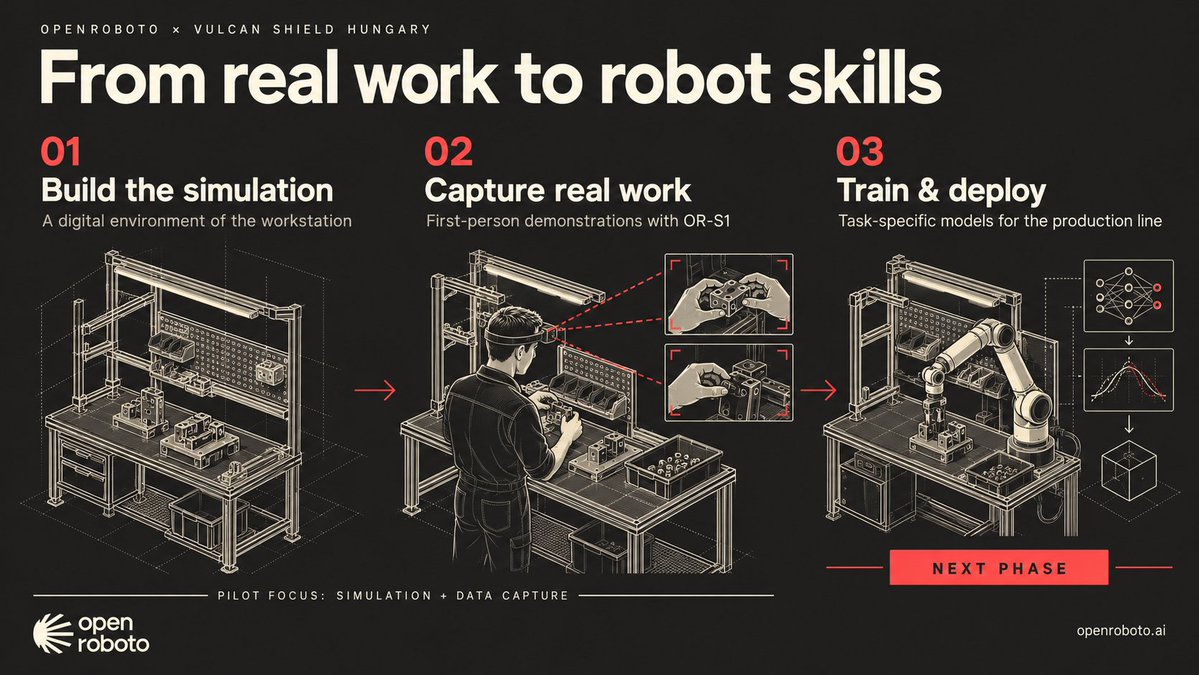
Starting at a production workstation in Békéscsaba, we'll combine real-world data and simulation to work toward a robot model trained for a specific factory task.
Our collaboration has three stages:
1. Build a simulation of the selected production workstation.
2. Equip Vulcan Shield operators with OR-S1 egocentric headsets to capture first-person demonstrations as they work.
3. Use the data and simulation to train task-specific robot models for potential deployment on the production line.
The pilot starts with simulation and data collection. Model training and deployment come next.
We're joining @themu_xyz at muShenzhen and staying for the whole of Robotics Week.
We'll be taking an active part in the robotics track, sharing our work on real-world training data and open robot models, and connecting with robotics builders from across the world.
See you in Shenzhen.
Behind each collector is a person doing real work. Their experience becomes training data for robots.
With @peaq, we're giving those devices an onchain identity and a place in the machine economy.
What happens to $PEAQ when a robot bonds it
This is an @openroboto data collector on the Pro tier
On day 1, it bonds ~1,000 $PEAQ, and that $PEAQ leaves circulation
Here’s what happens to it ↓
What happens to $PEAQ when a robot bonds it
This is an @openroboto data collector on the Pro tier
On day 1, it bonds ~1,000 $PEAQ, and that $PEAQ leaves circulation
Here’s what happens to it ↓
Next Monday.
Join @peaq and OpenRoboto to talk about how real work becomes robot training data, why machines need identities, and how the machine economy gets built.
We’ll also have something exciting to share. Stay tuned.
https://t.co/cvR5Fwi2ZT
This is how robots join the economy.
Two bits of the robot world just clicked together, and honestly, it's a glimpse of where all this is heading.
There's a project called OpenRoboto. Their whole job is teaching robots how to do things. They pay people to record first-person video of real tasks, cooking, working in a factory, handling objects, and all that footage trains robots to move and think like we do. Think of them as the brains.
Then there's peaq, which gives machines an identity and an economic life. A robot can get its own on-chain ID, build up what's basically a credit rating, get financed, and earn money from its own work. Think of them as the bank account and the passport.
And now they've plugged into each other. peaq's system, peaqOS, is running on Solana, and OpenRoboto has integrated it. So the robots being trained in OpenRoboto's network can now get a peaq-powered identity and wallet.
You've got the layer that teaches a robot how to work, joined to the layer that lets that robot own things, earn, and build a reputation. A machine that can learn a skill, and then get paid for it. Independently.
It's early, and it's a lot of moving parts. But this is the machine economy stitching itself together in real time. The brains, meeting the money.
$PEAQ @peaqnetwork@openroboto
If you work with your hands, in a kitchen, a workshop or a warehouse, your workday is exactly the data robots are missing.
Find out how to take part → https://t.co/k4EG9hCYjd
Shift only works if people know it exists. @Bitcast_network's creators are how we get the word out.
Bitcast (SN93) is now the distribution partner of OpenRoboto (SN80). Together we're growing OpenRoboto Shift: creators on Bitcast will explain how robotics training data gets collected, and how anyone doing hands-on work can take part.
What Shift is: operators wear OR-S1, our dual-camera headset, while they do real work. Their first-person recordings become training data for robots.
Accepted recordings are rewarded through Bittensor, and robotics companies license the data to train their models.
Today 99.9% of 2.54M+ machines are on Basic. 81 are on Pro, including every @openroboto data collector
One Pro robot bonds as much $PEAQ as 200 Basic machines
Every robot that comes onto Pro takes more $PEAQ out of circulation
https://t.co/BAzmcH7cTb