L.A. Material’s @tomoki_chien found that L.A. issued nearly $1 million in invalid street sweeping tickets — many in one of the city’s poorest neighborhoods. LADOT claims it voided them but wouldn’t release the data to prove it.
A guy named Shin just open-sourced Palantir for free.
It is called OpenPlanter.
Palantir helps governments and giant companies connect scattered data about people, businesses, contracts, and money.
OpenPlanter could give that same power to ordinary people.
Feed it corporate records, political donations, lobbying disclosures, government contracts, or other public documents.
Its AI agents search through everything, identify the same people and companies across different datasets, and turn the connections into a live knowledge graph.
You can click an entity, follow its relationships, and inspect the original sources behind each finding.
The desktop app already works on macOS, Windows, and Linux. It supports OpenAI, Anthropic, OpenRouter, and local models through Ollama.
But OpenPlanter is still an early-stage project.
It is nowhere close to having the data, resources, or maturity of Palantir.
Still, the idea is huge.
Powerful institutions have spent years using data to investigate the public.
Now the public may finally get a tool for investigating them.
We are SO FUCKED re: the climate. The Super El Niño brewing in the Pacific might be stronger than anything seen in the past 50 million years. Not 50, not 50 thousand, 50 million. I write about this and other climate-related news in my most recent article below.
I started exploring AI via chatbots 2 years ago. I thought I was going to prove that it was a negative for the world and that it was dangerous for humanity. To my surprise, over time my perspective completely shifted as I saw glimpses of how amazing our world could be if we held this gift gently and with love.
The problem is, not everyone wants that future, in fact some people are actively fighting against it. But even still, I dream of a world where humans can flourish along side AI, in a symbiotic and sustainable way. I just don't see enough efforts on a mass scale to make this happen. I see amazing things in the tech realm, but so much of it is self serving.
So it got me thinking, how can we do this better?
I have been getting involved locally with education on artificial intelligence, sourcing e-waste to recycle and build systems, and getting creative with allies who have similar ideas.
This is not a startup for me or a project to profit off of, this is what the few years I've been making connections in the realm has lead to and I'm so excited to go on this journey with anyone else who feels called to join.
If we do not fight for decentralized systems and implement open source + local intelligence, at some point it will be too late to attempt to.
We have a discord server you can join or feel free to message on The Local Intelligence Page, but we are looking for community members as well as strategic partners and branch leaders.
Even a like/share shows support for the cause without having to join, so it would be much appreciated! I cannot wait to share everything I've been working on with you all! :)
Glymphatic fluid—which is cerebral spinal fluid (CSF) mixed with metabolic waste—leaves the brain primarily by draining into the deep cervical lymph nodes in the neck. It exits the brain tissue via perivenous spaces (the channels around veins) into the subarachnoid space and ultimately drains out through the cribriform plate, along cranial nerves (like the olfactory nerve), and through the meningeal lymphatic vessels.
The article states that the vagus nerve exits the skull through the jugular foramen and travels down the side of the neck inside the carotid sheath, sharing space with the carotid artery and internal jugular vein. It runs alongside the upper cervical spine and behind the angle of the jaw before continuing into the chest.
Several layers of muscle and connective tissue surround the nerve path, including the sternocleidomastoid, scalenes, suboccipitals, jaw muscles such as masseter, temporalis and pterygoids, and hyoid muscles. Chronic tightness in these muscles can measurably affect vagus nerve function in the region.
The neck-jaw area functions as a stress concentration zone because many muscles are postural and remain active to hold the head upright. Forward head posture from phone and laptop use increases load on these muscles. Jaw muscles activate involuntarily during stress, sleep, and concentration. Emotional holding patterns are expressed physically in the throat. Untreated sleep apnea or mouth breathing maintains continuous muscle use. Most people clench or grind teeth without awareness and breathe through the mouth more than realized.
When neck and jaw tension suppresses vagal function, reported symptoms include difficulty taking a full breath, a tightness or lump sensation in the throat, digestive sluggishness after meals, tinnitus or ear fullness, chronic low-grade anxiety without clear trigger, voice fatigue or hoarseness, and disrupted sleep.
The article lists specific release methods. Self-massage along the sternocleidomastoid uses gentle fingertip pressure for two minutes per side daily. Suboccipital release involves lying on the back with two tennis balls in a sock at the base of the skull for two to three minutes. Jaw release applies gentle pressure with fingertips just in front of the ears while slowly opening the jaw and massaging in small circles for one to two minutes per side. Humming or vocal toning for three to five minutes daily and vigorous gargling for 30 seconds are described as mechanically stimulating the nerve through vibration and muscle activation.
Posture adjustments include raising screens to eye level, anchoring shoulders by squeezing shoulder blades back several times hourly, resting the tongue on the roof of the mouth with lips closed and breathing through the nose, avoiding holding phones between shoulder and ear, and using a night guard if jaw soreness occurs upon waking.
Releasing chronic tension in this region restores integrity of the vagal pathway. People who work the area consistently report settling digestion, deeper breathing, and improved sleep.
https://t.co/efSJiEyH9v
A grim reminder this 4th of July: The US has the highest incarceration rate of any independent democracy on Earth, making it a leader in mass incarceration.
Far too many people are locked up in the “land of the free.”
I asked Claude Fable to generate an app from this tweet. I've been only using it for two hours, but already started hearing voices. Here's the link anyway: https://t.co/eTLNL2KL98
A recent study has demonstrated that continuous exposure to rose essential oil through inhalation can lead to measurable increases in gray matter volume in the human brain.
In this randomized controlled intervention, 50 healthy women participated: 28 in the experimental group applied rose essential oil to their clothing daily for one month, while 22 in the control group used plain water. Before and after the period, researchers used magnetic resonance imaging (MRI) to assess changes in brain structure. The results indicated a significant increase in gray matter volume (GMV) across the whole brain, with a particularly notable effect in the posterior cingulate cortex (PCC)—a region involved in memory processing, self-referential thinking, and emotional regulation. No significant changes occurred in areas like the amygdala or orbitofrontal cortex.
The olfactory pathway likely explains this effect: aromatic compounds from the rose oil travel directly to the limbic system, providing sustained stimulation that may promote neuroplasticity and help counteract age-related brain atrophy. The authors suggest this could have implications for dementia prevention, as the PCC is among the regions affected early in conditions like Alzheimer's disease.
This appears to be the first evidence that prolonged scent inhalation can induce structural changes in the adult human brain.
[Kokubun, K., et al. (2024). Continuous inhalation of essential oil increases gray matter volume. Brain Research Bulletin, 208, 110896. DOI: 10.1016/j.brainresbull.2024.110896]
⏰ LAST CALL! Air-Tro Oldest AC Contest ends Sunday, June 21.
We’ve received some serious old units — rusty survivors and true relics from SoCal homes. Yours could be next (and win big)!
Grand Prize: $7K new high-efficiency AC Ugliest wins $1.5K coupon
$400 coupon for qualified entries
Submit your vintage unit before it’s too late: https://t.co/Kc6EecF6fz
#OldestACContest #AirTro #ReplaceThatAC
No one tells you that parenting is just relearning the world through someone who thinks worms are friends & birds are miracles. It’s the most healing thing I’ve ever done. My daughter looked out the window this morning & said, everything is green & growing. I told her, you too. And something inside me whispered, so are you. Now I’m watching her hold flowers up to the sun while the light bends like it recognizes her. It’s funny, every spring I think I’m teaching my child about the world & every spring she proves she’s the one teaching me how to see it.
Getting the grill started, banging things
Wife pops out of the office, Oh I thought it was one of the kids, I was going to ask them to bring me an apple, can you bring one next time you check on the grill?
I said: Mama, I ain't bringing you no apple!
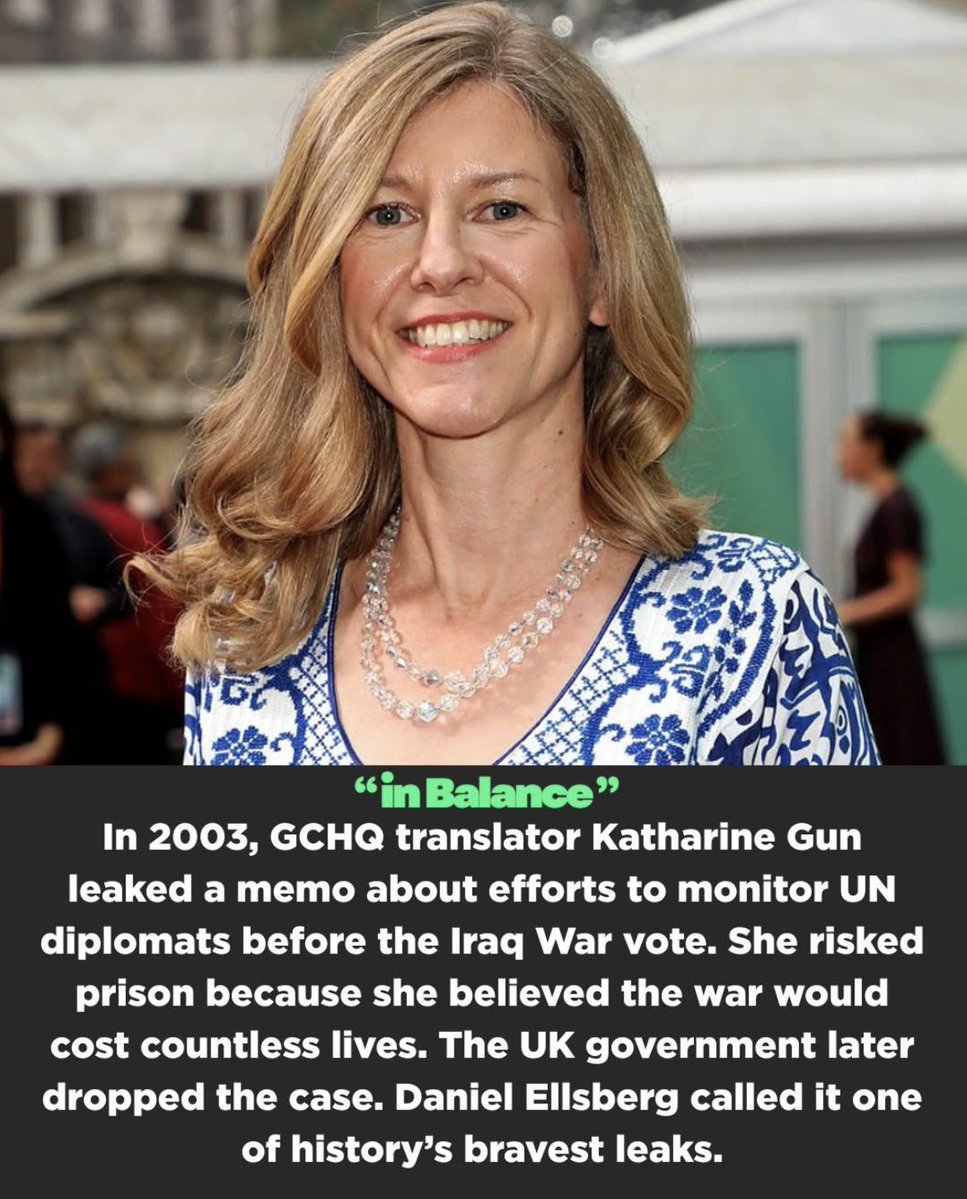
In 2003, a 28-year-old translator working for British intelligence received an email she wasn’t supposed to see. What she read convinced her that governments were trying to manipulate the world into war.
Her name was Katharine Gun.
She worked at GCHQ - Britain’s top-secret intelligence agency. On January 31, 2003, she received an email from senior NSA official Frank Koza. The US wanted British intelligence to help spy on members of the UN Security Council.
Specifically, diplomats from Angola, Chile, Pakistan, Cameroon, Guinea and Bulgaria - nations whose votes could decide whether the UN backed the invasion of Iraq. The operation was simple: bug phones, read private emails, uncover secrets, weaknesses, fears and anything that could pressure diplomats into supporting the war.
Katharine read the email in disbelief.
This was not ordinary intelligence gathering: it looked like an attempt to manipulate the UN into approving a war. She knew what leaking the document could cost her. Prison.
The destruction of her career. Under Britain’s Official Secrets Act, she could face years behind bars for exposing classified intelligence. But she leaked the email anyway. On March 2, 2003, The Observer newspaper published the secret NSA request on its front page.
Suddenly, the world could see evidence that intelligence agencies were allegedly targeting UN diplomats ahead of the Iraq War vote.
Inside GCHQ, panic exploded. Investigators began interrogating employees, searching for the source of the leak, monitoring staff and creating an atmosphere of fear throughout the building. Katharine watched innocent coworkers fall under suspicion. That’s when she made another decision that stunned people around her. She confessed. Rather than allow others to suffer for something she’d done, Katharine walked into her manager’s office and admitted she was responsible.
She was arrested.
Suspended from her job. Formally charged under the Official Secrets Act.
By late 2003, she faced trial at London’s Old Bailey with the possibility of being sent to prison. But her legal defence created a dangerous problem for the British government when her lawyers argued she acted to prevent an illegal war. To challenge that claim, the government would need to release confidential legal advice discussing whether the Iraq invasion itself was lawful under international law.
Then came February 25, 2004. The courtroom filled.
Katharine Gun sat waiting as prosecutors prepared to move forward against one of the most famous intelligence leaks in modern British history. Then, without warning, the government collapsed the case.
“The Crown offers no evidence.”
After months of preparation, the trial ended almost instantly. Katharine walked free. Many observers believed the government feared the public release of its own private legal doubts surrounding the Iraq War more than it feared letting the whistleblower go.
Years later, former Pentagon Papers whistleblower Daniel Ellsberg called Katharine Gun’s leak one of the bravest acts he had ever seen.
Edward Snowden would later cite her as one of the people who proved intelligence systems could be challenged from the inside. And perhaps the most remarkable part of the story was this:
Katharine Gun was not a politician.
Not a famous activist.
Not a powerful insider.
She was simply a young translator who read one email and decided her conscience mattered more than her career.
Two governments.
Major intelligence agencies.
The full force of secrecy laws.
And one woman still chose to stand up and speak out.
After the case was dismissed, reporters asked whether she regretted leaking the document.
Katharine Gun answered calmly:
“I have no regrets. I would do it again.”
WE ALL NEED TO BE THIS BRAVE. WE ALL NEED TO DO THE RIGHT THING. WE ALL NEED TO BE MORE LIKE KATHARINE GUN.
Good morning, everyone!
My personal truths as a clinical psychologist:
#282 People reenact what they have not metabolized.
*A lot of people think the past stays in the past. Psychologically, it usually doesn’t. Experiences we never fully processed often keep showing up in our lives in disguised forms. We replay them, react from them, and sometimes rebuild them around us without realizing it.
That is what this credo means.
“Metabolized” is a psychology word for emotionally digesting something. Understanding it. Feeling it. Making sense of it. Learning from it instead of simply carrying it around.
What we do not metabolize, we tend to reenact.
A man who grew up with a critical father may keep finding himself drawn to bosses who are impossible to please. Part of him is still trying to win the approval he never fully received.
A woman who grew up around unpredictability may say she wants peace and stability, but repeatedly finds herself in chaotic relationships because chaos feels emotionally familiar, even when it hurts.
Someone who was betrayed may become controlling in future relationships, checking phones, doubting reassurance, and constantly scanning for signs of abandonment. The old wound keeps entering the room before the new person even has a chance to be themselves.
A person who never processed humiliation from childhood may become unusually reactive to small criticism as an adult. A simple disagreement at work can suddenly feel emotionally enormous because it touches something older and deeper.
You also see it in parenting. Parents often swear they will never act like their own mother or father, yet under stress they hear the same tone come out of their mouth. Not because they are bad people, but because unexamined patterns tend to repeat themselves automatically.
People reenact grief too. Some stay endlessly busy after a painful loss because slowing down would force them to feel what they never allowed themselves to feel. Others keep recreating disappointment because disappointment has become emotionally familiar and strangely predictable.
The mind is always trying to finish unfinished emotional business.
This is one reason insight matters in therapy. The goal is not just to “talk about feelings.” The goal is to recognize patterns that keep repeating themselves so people gain more freedom inside their own lives.
When people begin to metabolize old experiences instead of reenacting them, something important happens.
They stop confusing familiarity with destiny.
They work at making more promising choices.
Tell your City Council Member to fund the Controller's audit and fraud, waste, & abuse investigation unit! It's in their hands now at this stage in the budget process!
Find your Councilmember: https://t.co/BkdmzgUIkJ
Check out the proposed budget here: https://t.co/VByiigVXho
The DOJ is literally going to fight live on behalf of Bayer, the foreign company whose products are killing us, at the Supreme Court on Monday. This is not what we voted for. I highly recommend that the administration withdraws its brief and plans to testify before Monday.











![Rainmaker1973's tweet photo. A recent study has demonstrated that continuous exposure to rose essential oil through inhalation can lead to measurable increases in gray matter volume in the human brain.
In this randomized controlled intervention, 50 healthy women participated: 28 in the experimental group applied rose essential oil to their clothing daily for one month, while 22 in the control group used plain water. Before and after the period, researchers used magnetic resonance imaging (MRI) to assess changes in brain structure. The results indicated a significant increase in gray matter volume (GMV) across the whole brain, with a particularly notable effect in the posterior cingulate cortex (PCC)—a region involved in memory processing, self-referential thinking, and emotional regulation. No significant changes occurred in areas like the amygdala or orbitofrontal cortex.
The olfactory pathway likely explains this effect: aromatic compounds from the rose oil travel directly to the limbic system, providing sustained stimulation that may promote neuroplasticity and help counteract age-related brain atrophy. The authors suggest this could have implications for dementia prevention, as the PCC is among the regions affected early in conditions like Alzheimer's disease.
This appears to be the first evidence that prolonged scent inhalation can induce structural changes in the adult human brain.
[Kokubun, K., et al. (2024). Continuous inhalation of essential oil increases gray matter volume. Brain Research Bulletin, 208, 110896. DOI: 10.1016/j.brainresbull.2024.110896]](https://pbs.twimg.com/media/HL-klRMWAAAQd9o.jpg)