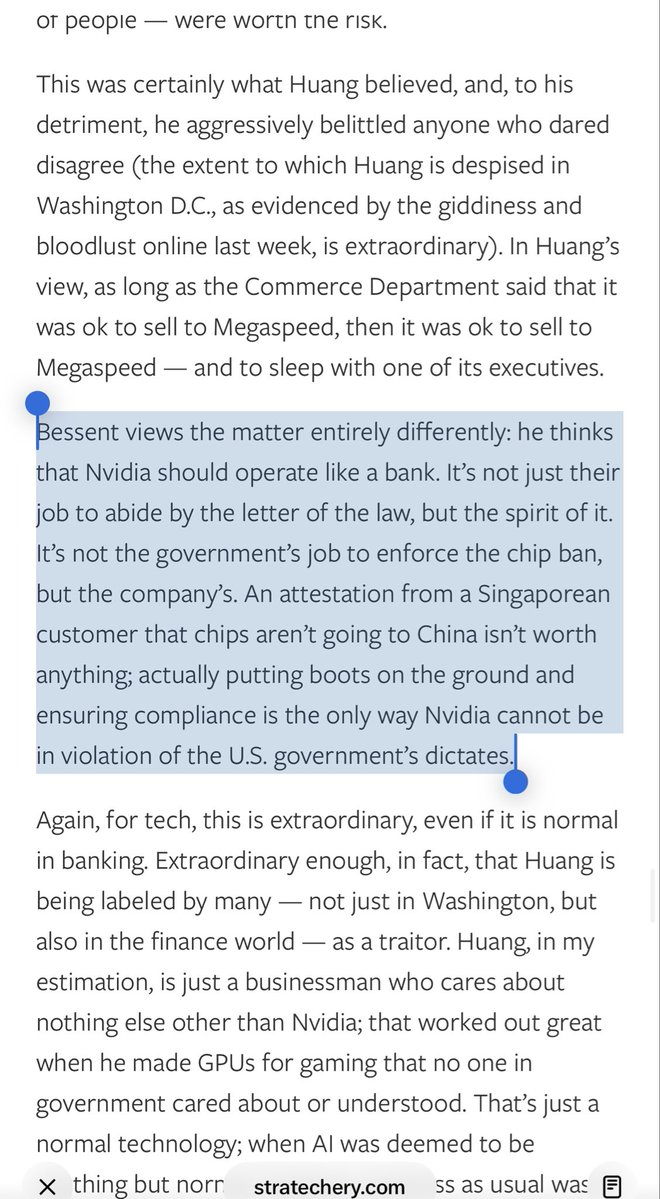
Everyone’s sleeping on this: The Government (and by that I mean elite cross-party DC consensus) thinks large tech should increasingly be treated like TBTF banks: not just strictly regulated but managed by federal staff.
Everything is now computer, but to DC computers is bank.
Jack Carr on how to relaunch the Bond franchise with Robert Pattinson:
"The way that you make sure it's not compared to the Daniel Craig era is you go back and you do them as period pieces."
"The first one was written in the early fifties. Bond is a World War II veteran. He drives a nineteen thirties something Bentley Blower."
"You do a period piece Bond, move it out of the contemporary realm, do the books as they were written."
Bond is not John Wick, and gun fu is wrong for the character. But red dots aren't tacticool, they're just better. Objecting to Bond having a red dot on his pistol is like objecting to him not using a revolver.
Denis Villeneuve, who directed this scene, is going to make a James Bond film starring Robert Pattinson. I don’t think we fully grasp how insane that is.
"As long as legislatures exist and can still pass new laws, no gun rights win is permanent...No loss is permanent either."
OSD 400: Gun laws and the end of history fallacy, by @opensrcdefense https://t.co/QmpqIBvpWH
We just dropped an all new T.REX ARMS project. 4,200 military manuals, stored as PDFs and EPUBs, all downloadable for free, readable and searchable on the site, with all references indexed and tracable.
Our interview with Doug Ritter of Knife Rights is the deepest dive out there into the details of how they operate.
In summary: extremely scrappily and tenaciously. Super impressive.
New OSD podcast interview today, with Doug Ritter the founder of @KnifeRights. Based on pure results, they're one of the most effective advocacy groups out there. See how they've changed the path of knife laws in the US, with a tiny staff and budget.
0:00 - Introduction to Knife Rights
2:43 - The landscape of knife laws
5:52 - Bipartisan strategies in advocacy
8:47 - Legal challenges and court successes
11:40 - Building relationships with legislators
14:44 - Lessons from Knife Rights for other advocacy orgs
17:50 - The origins of Knife Rights
34:20 - The Federal Switchblade Act and its impact
39:05 - The origins of knife bans and their implications
44:09 - Legal battles and the future of Knife Rights
51:44 - Knives as tools and their role in self-defense
57:06 - The future of Knife Rights and advocacy
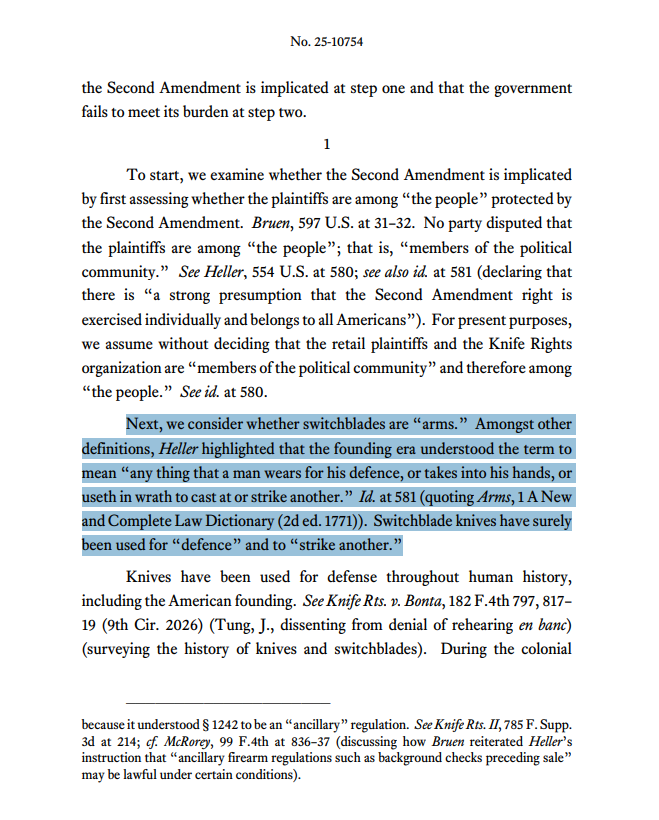
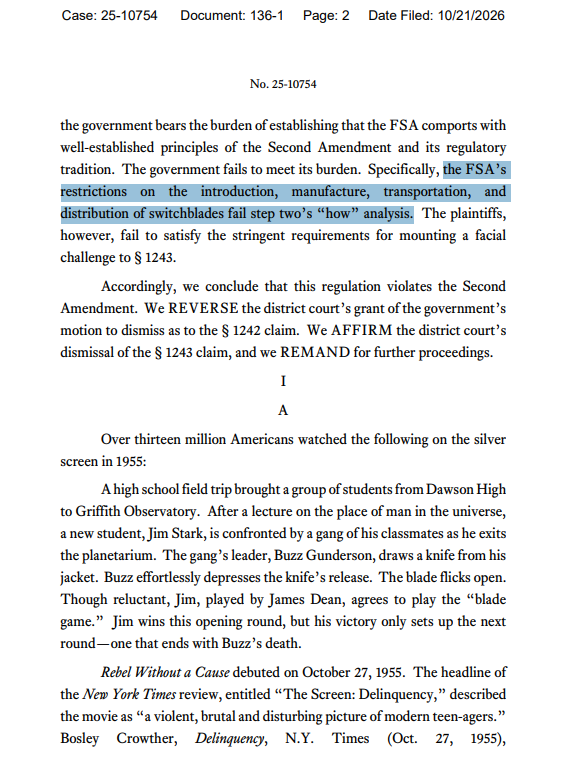
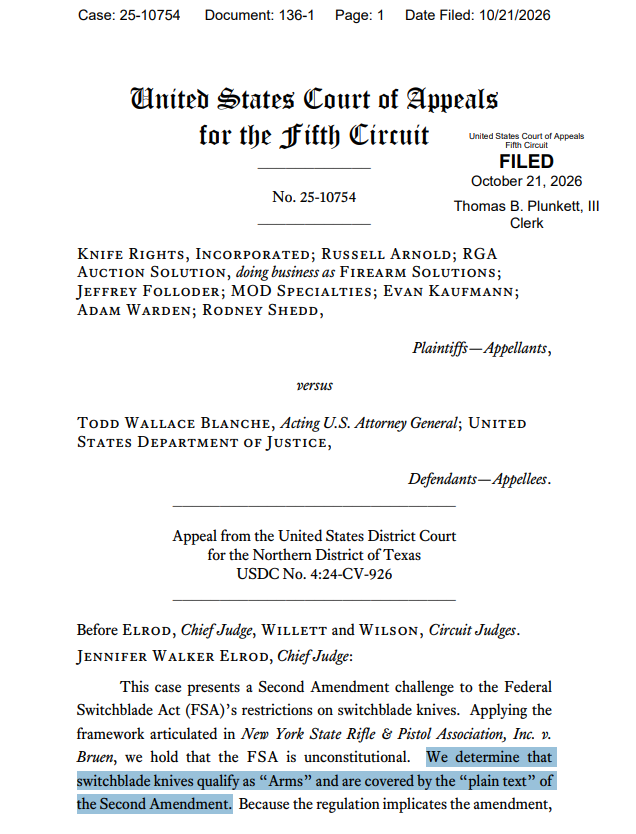
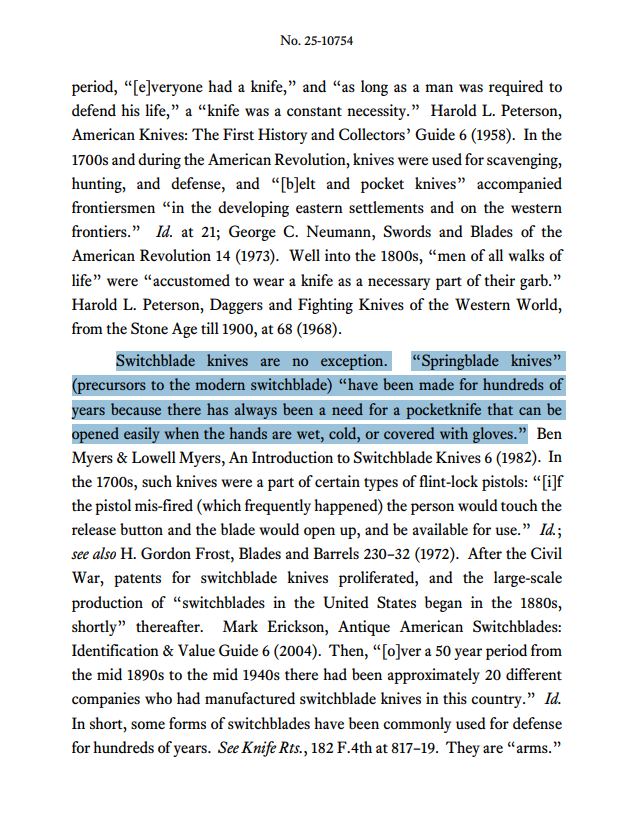
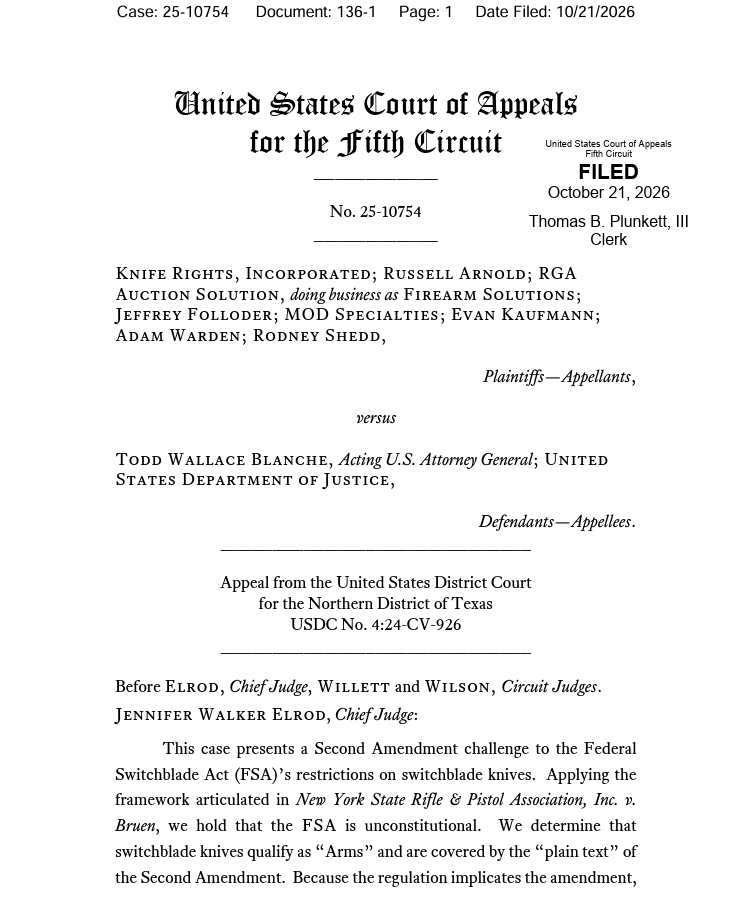
5th Cir. Judges Elrod, Willett, and Wilson hold in Knife Rights v. Blanche that knives are "arms" under the 2nd Am.
The Fed. Switchblade Act—criminalizing the interstate transport, introduction, or distribution of switchblades—is unconstitutional.
This seems correct to me.
NEW: The Fifth Circuit ruled that a federal law restricting the interstate manufacture, transportation, and distribution of switchblade knives violates the Second Amendment, holding that switchblades are constitutionally protected arms.
the lesson of @opensrcdefense is that resistance against technological acceleration is futile. the only way out, is through.
(aka your concealment practices probably need a technological layer soon. anyone think they can get your phones' hotspot to throw off some sort of wifi obfuscation layer..?)
The question of whether the NFA is going to spring back to life depends largely on how many millions of suppressors and SBRs we can create in the next two years. It does need to be millions. Preferably tens of millions.
Having ridden in a bunch of Cybercabs over the past few weeks here in Austin, Texas, the most striking thing is how much the design of a car changes when you can really lean into it being a self-driving taxi. Here’s a non-exhaustive list of things you can delete:
- The rear windshield and its wiper
- All mirrors
-All mechanical switches other than door handles
-Pedals, steering wheel, and steering wheel stalks
-The rear seats and doors (it turns out that 90% of cab rides have ≤2 passengers)
-A lot of complexity in the front seats — you can eliminate the center console and turn the front into a bench seat
The same design clarity also lets you add some things that the same car couldn’t have if it were intended for general purposes. A massive trunk, for example, or an oversize screen that automatically shows the rider’s favorite music app.
Firearms are at the dawn of a similar leap in design clarity, brought on by the de facto repeal of federal suppressor regulation. Imagine designing a gun from scratch with a suppressor baked into it. Some things you’d do are:
- Bring the weight and bulk of the suppressor closer to the shooter, for better weight distribution
-Have a bigger suppressor, since you can spread its volume out over more of the barrel length rather than needing to hang it all off the end of the barrel
-Make pretty much all bolt-action rifles integrally suppressed
-Make the mounting system more reliable, because you can integrate the suppressor’s design into that of the gun instead of needing to rely exclusively on the threads on the end of the barrel.
- Replaceable baffles or wipes
- Better management of gas blowback, since you could design the gun under the assumption that it will only be shot suppressed
As an industry observer, you should also expect to see the line between gunmakers and suppressor makers get blurry. Some gunmakers will buy suppressor companies, or double down on their homegrown suppressor efforts. And some suppressor companies will start making guns, carrying on the tradition of the SilencerCo Maxim 9. In a few years, it will be rare to see a gunmaker that doesn’t sell suppressed guns from the factory.
A corollary is that integral suppressors will get a lot better over the next few years. To this point they’ve been a niche product, and they’ve gotten niche-level R&D investment. We’re excited to watch them go mainstream.
USW-style pistols with integral suppressors are going to replace a lot of full-size pistols. If you're going full-size anyway, the extra functionality is worth the size/weight increase.