This is the story of Hyperliquid, the most profitable startup per employee on earth, told from a guarded office in Singapore.
Last year, its team of 11 generated $900 million in profit. It's 3 years old, has never taken a dollar of venture capital, and is beginning to change how century-old markets work.
Its founder, Jeffrey Yan (@chameleon_jeff), had never taken a physics class when he picked up a textbook at 16. Two years later, he won gold at the International Physics Olympiad. In 2019, he started trading with $10,000 from a living room in Puerto Rico—working off a television because he didn't own a monitor.
Within 3 years, he was running one of the largest anonymous crypto trading firms.
Then he shut it down. Yan was rich and free, but he had spent years inside crypto, watching it betray itself. Bitcoin's central premise was decentralization. Yet the biggest exchanges were centralized. Crypto kept reintroducing the dependence on trust it was built to eliminate. He set out to create what should have existed.
Hyperliquid is a blockchain with a trading exchange on top, and anyone can build on it. Yan's vision is to house all of finance. In 3 years, it has done over $4 trillion in volume. And in the past few months, it has begun to outgrow crypto.
Markets for oil, silver, and the S&P 500 now trade on Hyperliquid around the clock, weekends included, and are growing roughly 40% week on week. When the US and Israel bombed Iran on a Saturday in February, Hyperliquid was the venue traders turned to.
Hyperliquid's success has cost Yan his freedom. He works out of a secret office in Singapore and cannot travel without two bodyguards. Even the team's housekeeper doesn't know what they do.
In January, @domcooke spent a week at their office. Read his profile on Yan and @HyperliquidX below.
Colossus covers the frontier
We are about to expand into new formats, and we need:
-Writers writers writers
-Multimedia producers
-Art and design
We want to see how great we can be making media about tech, business, and markets.
We need help.
Reach out to @JeremySternLA
This is the story of Hyperliquid, the most profitable startup per employee on earth, told from a guarded office in Singapore.
Last year, its team of 11 generated $900 million in profit. It's 3 years old, has never taken a dollar of venture capital, and is beginning to change how century-old markets work.
Its founder, Jeffrey Yan (@chameleon_jeff), had never taken a physics class when he picked up a textbook at 16. Two years later, he won gold at the International Physics Olympiad. In 2019, he started trading with $10,000 from a living room in Puerto Rico—working off a television because he didn't own a monitor.
Within 3 years, he was running one of the largest anonymous crypto trading firms.
Then he shut it down. Yan was rich and free, but he had spent years inside crypto, watching it betray itself. Bitcoin's central premise was decentralization. Yet the biggest exchanges were centralized. Crypto kept reintroducing the dependence on trust it was built to eliminate. He set out to create what should have existed.
Hyperliquid is a blockchain with a trading exchange on top, and anyone can build on it. Yan's vision is to house all of finance. In 3 years, it has done over $4 trillion in volume. And in the past few months, it has begun to outgrow crypto.
Markets for oil, silver, and the S&P 500 now trade on Hyperliquid around the clock, weekends included, and are growing roughly 40% week on week. When the US and Israel bombed Iran on a Saturday in February, Hyperliquid was the venue traders turned to.
Hyperliquid's success has cost Yan his freedom. He works out of a secret office in Singapore and cannot travel without two bodyguards. Even the team's housekeeper doesn't know what they do.
In January, @domcooke spent a week at their office. Read his profile on Yan and @HyperliquidX below.
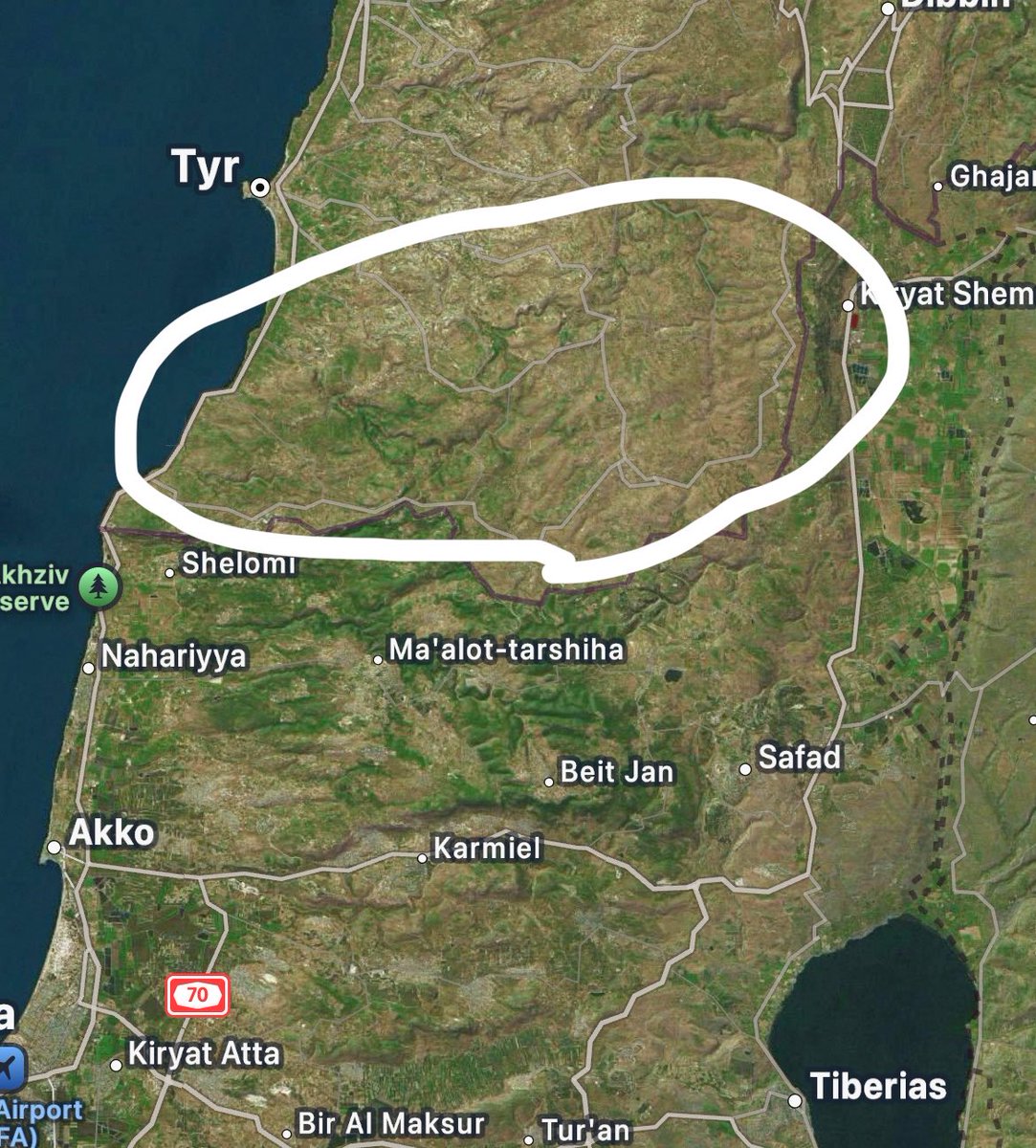
Apple has removed Lebanese village names in Southern Lebanon.
As Israel invades, they are already setting the state to justify occupation.
I’ve never seen something like this.
Over the past year, many people I talk to have expressed worry about two topics:
* Various aspects of the way the world is going: government control and surveillance, wars, corporate power and surveillance, tech enshittification / corposlop, social media becoming a memetic warzone, AI and how it interplays with all of the above...
* The brute reality that Ethereum seems to be absent from meaningfully improving the lives of people subject to these things, even on the dimensions we deeply care about (eg. freedom, privacy, security of digital life, community self-organization)
It is easy to bond over the first, to commiserate over the fact that beauty and good in the world seems to be receding and darkness advancing, and uncaring powerful people in high places are making this happen. But ultimately, it is easy to acknowledge problems, the hard thing is actually shining a light forward, coming up with a concrete plan that makes the situation better.
The second has been weighing heavily on my mind, and on the minds of many of our brightest and most idealistic Ethereans. I personally never felt any upset or fear when political memecoins went on Solana, or various zero-sum gambling applications go on whatever 250 millisecond block chain strikes their fancy. But it *does* weigh on me that, through all of the various low-grade online memetic wars, international overreaches of corporate and government power, and other issues of the last few years, Ethereum has been playing a very limited role in making people's lives better. What *are* the liberating technologies? Starlink is the most obvious one. Locally-running open-weights LLMs are another. Signal is a third. Community Notes is a fourth, tackling the problem from a different angle.
One response is to say "stop dreaming big, we need to hunker down and accept that finance is our lane and laser-focus on that". But this is ultimately hollow. Financial freedom and security is critical. But it seems obvious that, while adding a perfectly free and open and sovereign and debasement-proof financial system would fix some things, but it would leave the bulk of our deep worries about the world unaddressed. It's okay for individuals to laser-focus on finance, but we need to be part of some greater whole that has things to say about the other problems too.
At the same time, Ethereum cannot fix the world. Ethereum is the "wrong-shaped tool" for that: beyond a certain point, "fixing the world" implies a form of power projection that is more like a centralized political entity than like a decentralized technology community.
So what can we do? I think that we in Ethereum should conceptualize ourselves as being part of an ecosystem building "sanctuary technologies": free open-source technologies that let people live, work, talk to each other, manage risk and build wealth, and collaborate on shared goals, in a way that optimizes for robustness to outside pressures.
The goal is not to remake the world in Ethereum's image, where all finance is disintermediated, all governance happens through DAOs, and everyone gets a blockchain-based UBI delivered straight to their social-recovery wallet. The goal is the opposite: it's de-totalization. It's to reduce the stakes of the war in heaven by preventing the winner from having total victory (ie. total control over other human beings), and preventing the loser from suffering total defeat. To create digital islands of stability in a chaotic era. To enable interdependence that cannot be weaponized.
Ethereum's role is to create "digital space" where different entities can cooperate and interact. Communications channels enable interaction, but communication channels are not "space": they do not let you create single unique objects that canonically represent some social arrangement that changes over time. Money is one important example. Multisigs that can change their members, showing persistence exceeding that of any one person or one public key, are another. Various market and governance structures are a third. There are more.
I think now is the time to double down, with greater clarity. Do not try to be Apple or Google, seeing crypto as a tech sector that enables efficiency or shininess. Instead, build our part of the sanctuary tech ecosystem - the "shared digital space with no owner" that enables both open finance and much more. More actively build toward a full-stack ecosystem: both upward to the wallet and application layer (incl AI as interface) and downward to the OS, hardware, even physical/bio security levels.
Ultimately, tech is worthless without users. But look for users, both individual and institutional, for whom sanctuary tech is exactly the thing they need. Optimize payments, defi, decentralized social, and other applications precisely for those users, and those goals, which centralized tech will not serve. We have many allies, including many outside of "crypto". It's time we work together with an open mind and move forward.
⚡️ LATEST: Vitalik Buterin says Ethereum should focus on building “sanctuary technologies” that protect freedom, privacy, and coordination as government and corporate control expands.
ETHDenver 2026, in one video.
A week of BUIDLing, late nights, insightful conversations, and the kind of energy you only really understand if you were there.
From Camp BUIDL to the final celebration, this is a look back at everything we created together.
See you next year. 🦄
In 2026, I plan to be fully back to decentralized social.
If we want a better society, we need better mass communication tools. We need mass communication tools that surface the best information and arguments and help people find points of agreement. We need mass communication tools that serve the user's long-term interest, not maximize short-term engagement. There is no simple trick that solves these problems. But there is one important place to start: more competition. Decentralization is the way to enable that: a shared data layer, with anyone being able to build their own client on top.
In fact, since the start of the year I've been back to decentralized social already. Every post I've made this year, or read this year, I made or read with https://t.co/BJ3J4TvNNu, a multi-client that covers reading and posting to X, Lens, Farcaster and Bluesky (though bluesky has a 300 char limit, so they don't get to see my beautiful long rants).
But crypto social projects has often gone the wrong way. Too often, we in crypto think that if you insert a speculative coin into something, that counts as "innovating", and moves the world forward. Mixing money and social is not inherently wrong: Substack shows that it's possible to create an economy that supports very high-quality content. But Substack is about _subscribing to creators_, not _creating price bubbles around them_. Over the past decade, we have seen many many attempts at incentivizing creators by creating price bubbles around them, and all fail by (i) rewarding not content quality, but pre-existing social capital, and (ii) the tokens all going to zero after one or two years anyway.
Too many people make galaxy-brained arguments that creating new markets and new assets is automatically good because it "elicits information", when the rest of their product development actions clearly betray that they're not actually interested in maximizing people's ability to benefit from that information. That is not Hayekian info-utopia, that is corposlop.
Hence, decentralized social should be run by people who deeply believe in the "social" part, and are motivated first and foremost by solving the problems of social.
The Aave team has done a great job stewarding Lens up to this point. I'm excited about what will happen to Lens over the next year, because I think the new team coming in are people who actually are interested in the "social": even back when the decentralized social space barely existed, they were trying to figure out how to do encrypted tweets.
I plan to post more there this year.
I encourage everyone to spend more time in Lens, Farcaster and the broader decentralized social world this year. We need to move beyond everyone constantly tweeting inside a single global info warzone, and into a reopened frontier, where new and better forms of interaction become possible.
Announcing the Go To Market Summit! 📊
This summit covers practical strategies for taking crypto products from zero to users, including growth, distribution, and adoption in today’s market.
What is harder right now, building or finding users?
🔥 BUTERIN: GOING MAINSTREAM IS HURTING ETHEREUM
Vitalik Buterin warned Ethereum compromised decentralization and privacy to chase mainstream adoption.
He said reversing this will be a priority in 2026.
LATEST: 📈 Ethereum daily transactions hit a new all-time high of 2.8 million as active addresses doubled to 1 million, driven by surging stablecoin usage, according to Glassnode.
We're fundamentally changing how the world interacts with money.
Open. Interoperable. Global. Onchain.
Polygon will be the payments solution for all payments solutions.