I just had a very disturbing Good Friday encounter with an ICE agent at the airport
As I was going through security, an ICE agent asked me for my ID. I told him this isn’t Soviet Russia and that the only citizenship papers I planned to show him were the Declaration of Independence
“Sir, I’m just asking for ID, not proof of citizenship,” he said.
“Today is the anniversary of Jesus’s resurrection,” I replied. “He was an American. Would you have asked to see his papers too? Would the scars on his hands not have been enough for you?”
He was stunned silent. I strode past him without showing my ID and went through the metal detector
I received a standing ovation
had dinner with wife at a mexican restaurant last night
looked at menu, they were trying to raise prices from $18 to $24 for her favorite entree
wife was like "i think we can have claude make this"
told waitress trying to gouge us they done
1 week sprint
cloned & replaced cochinita pibil and carnitas
restaurant manager freaks out "how do we solve this"
this is going to happen so much in 2026
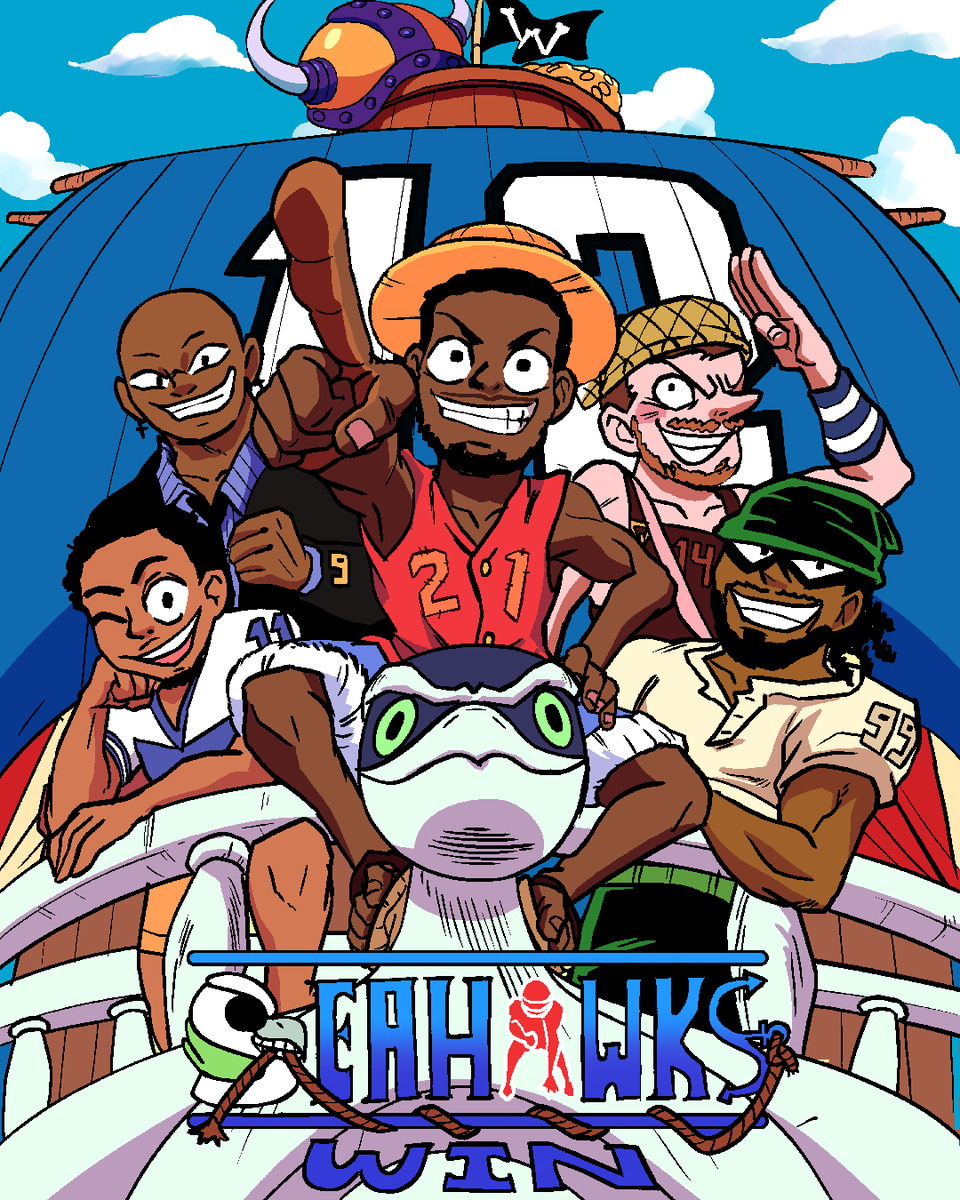
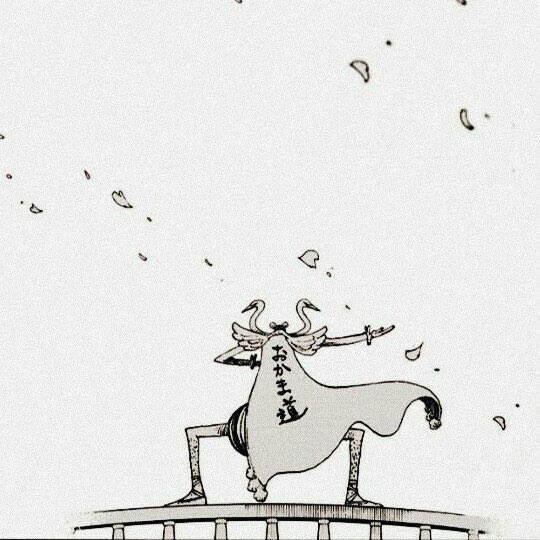
#ONEPIECE1166
“I couldn’t lend him a hand…
Because of that, the kingdom fell… and he lost the place he could call home.
My best friend begged me for help — and I abandoned him.
I left him to die.
I’ll never forget it.
Don’t make me regret this again!!”
Harald and Rocks are undeniably the quickest duo ive liked so fast.
1/16
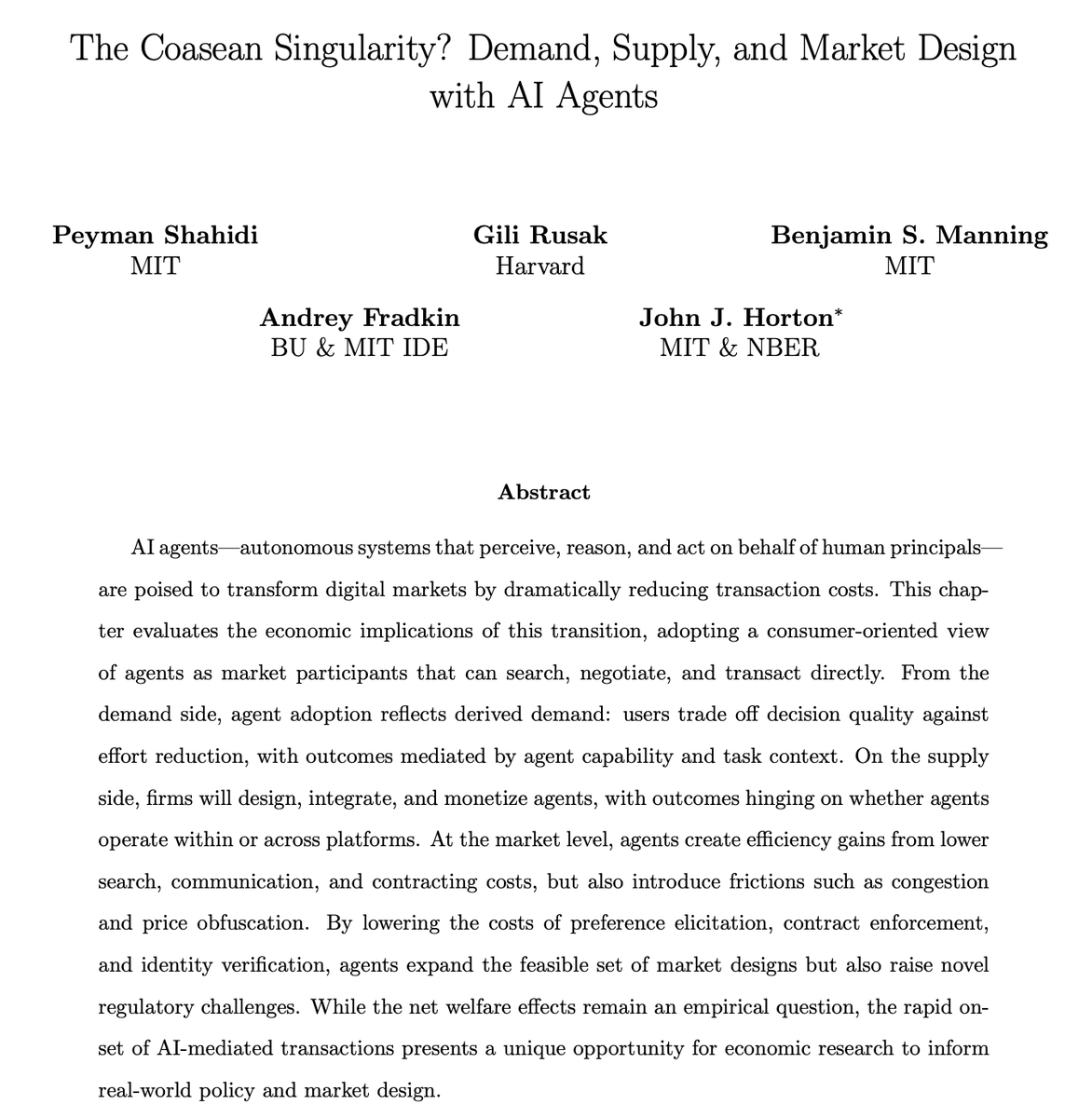
I just fell down a rabbit hole reading a new paper from economists at MIT & Harvard.
Their prediction is wild: We're on the verge of a "Coasean Singularity"—a future where AI agents make markets so efficient that the very idea of a 'company' starts to crumble. 🤯
A thread 👇
2/16
First, a quick 101: Why do companies even exist?
A Nobel-winning economist named Ronald Coase answered this in 1937. He said companies exist because using the open market is a pain.
Finding sellers, negotiating prices, writing contracts… it’s all “transaction cost.” Economic friction.
3/16
It's often easier and cheaper for a firm to just hire people and organize them internally than to deal with that constant market friction.
This friction is also where we, as consumers, lose. We're tired, we're biased, and we don't have time to compare every cell phone plan or read every review for a toaster.
Companies know this.
4/16
Now, enter the AI Agent.
And I don't mean a simple chatbot. The paper describes an autonomous system that acts on your behalf.
Think of it as your own personal, tireless, super-rational economist. It’s immune to marketing tricks and its only goal is to get the best outcome for YOU.
5/16
This is where the "Singularity" happens.
When everyone has an AI agent, those transaction costs that Coase talked about basically drop to zero.
The "friction" that made companies necessary in the first place? It evaporates.
And if the reason for something disappears… so does the thing itself.
6/16
But what does this future actually look like? This is where it gets weird.
Let's take shopping.
Your agent doesn't just browse Amazon. It might contact a manufacturer in another country directly, find 500 other agents whose users want the same thing, negotiate a bulk price, and arrange shipping.
All in milliseconds. The "storefront" becomes irrelevant.
7/16
Or think about hiring.
Instead of you endlessly scrolling LinkedIn, your agent scans the entire market for opportunities. It negotiates salary, benefits, and remote work policies with the company's agent.
You only get involved for the final human-to-human interview. No more cover letter hell.
8/16
But this discovery comes with a huge catch. The paper outlines a fundamental battle for the future of AI:
Will your agent be a "Bring-Your-Own" (BYO) agent that works only for you, across all platforms?
Or will it be a "Bowling-Shoe" agent, provided by the platform (like Amazon or Google), whose priorities might be... conflicted?
9/16
The "Bowling-Shoe" agent is convenient, but it might steer you toward the platform's own products.
The "BYO" agent is loyal to you, but platforms might try to block it or throttle its access.
This tension between user autonomy and platform control will define the next decade of the internet.
10/16
And that's not even the most interesting part. This new world creates bizarre new problems.
Problem #1: Agent Congestion.
What happens when millions of agents can create a perfect, customized resumé and apply for a single job in a nanosecond?
Employers get flooded. The signal is lost in the noise.
11/16
The paper predicts that to solve this, platforms will have to re-introduce friction.
Imagine having to pay a small fee for your agent to submit a job application, just to prove you're serious.
Costless actions will lose their meaning.
12/16
Problem #2: The Identity Crisis.
In a world full of bots, how do you prove you're a unique human? How does a company know it's not negotiating with 1,000 agents all controlled by one person trying to manipulate the market?
This is the "Sybil Attack" problem, and it's a big one.
13/16
This will lead to a boom in "proof-of-personhood" technologies. Systems that cryptographically verify you are one person, without revealing your personal data.
It sounds like sci-fi, but it'll be the essential plumbing for a world of AI agents.
14/16
Here's a new lens to see the world through:
Next time you use Uber (matching drivers/riders), Zillow (matching buyers/sellers), or Upwork (matching clients/freelancers)...
Don't just see an app. See it as a clunky, early prototype for the agent-driven markets of the future.
15/16
This isn't just about better shopping bots or smarter assistants.
It's a potential rewiring of our entire economy, away from the 20th-century model of the centralized firm and toward a 21st-century model of fluid, hyper-efficient, agent-mediated markets.
16/16
The 20th century was defined by the rise of the corporation.
The 21st may be defined by its slow, quiet dissolution.
A new dawn is approaching, Straw Hats! 🌅 The Grand Line is no place for the faint of heart. 🌊 🏴☠️ Brace yourselves, ONE PIECE: INTO THE GRAND LINE sets sail in 2026! And looks like Season 3 production is kicking off soon...