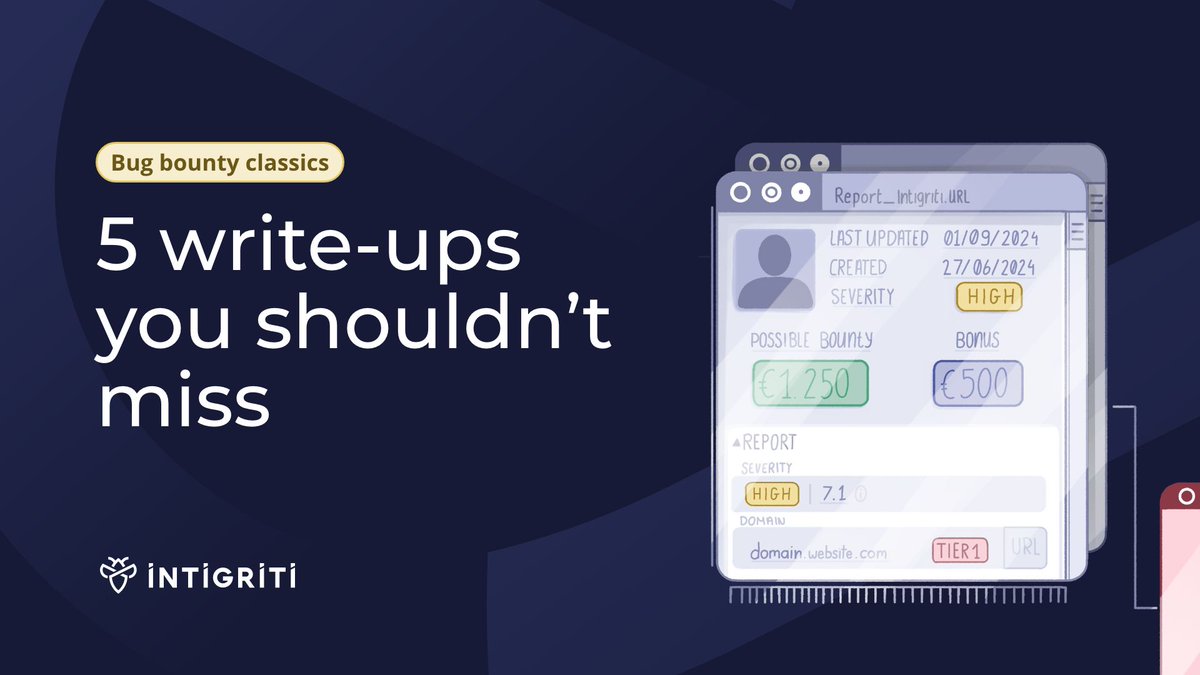
We just dove into our shelf of archived bug bounty write-ups from the most notable hackers! 🤠
In this issue, we selected 5 compelling articles (that are still relevant today) to share with you, from which you can learn something new! 😎
🧵 👇
3️⃣ Into the Borg: SSRF Inside Google Production Network
@opnsec found an SSRF vulnerability that allowed access to Google's internal Borg cluster management system, revealing infrastructure details including CPU usage, RAM allocation, and active services (Gmail, Ads, Video encoding).
https://t.co/F4JzHbrxD0
As part of the release of Llama 3.1, we also released new trust & safety research including CyberSecEval 3. We've published our research on this work to continue the conversation on empirically measuring LLM cybersecurity risks & capabilities.
Paper ➡️ https://t.co/kjbMYvrIDn
🥁 Llama3 is out 🥁
8B and 70B models available today.
8k context length.
Trained with 15 trillion tokens on a custom-built 24k GPU cluster.
Great performance on various benchmarks, with Llam3-8B doing better than Llama2-70B in some cases.
More versions are coming over the next few months.
https://t.co/EkU9aIHdZE
We remain committed to our partnership with OpenAI and have confidence in our product roadmap, our ability to continue to innovate with everything we announced at Microsoft Ignite, and in continuing to support our customers and partners. We look forward to getting to know Emmett Shear and OAI's new leadership team and working with them. And we’re extremely excited to share the news that Sam Altman and Greg Brockman, together with colleagues, will be joining Microsoft to lead a new advanced AI research team. We look forward to moving quickly to provide them with the resources needed for their success.
@alxbrsn Paste the introspection into POSTMAN and it'll generate all the queries and mutations into a collection that makes it much easier to work with.
Meta is recruiting for several Web Security Engineer roles in US for working on product security of billion-users products!
If you are interested and want to know more about the job, please reach out :)
Security Engineer: https://t.co/edHAEzGiCY
Senior position: https://t.co/HzcwKF5TvV
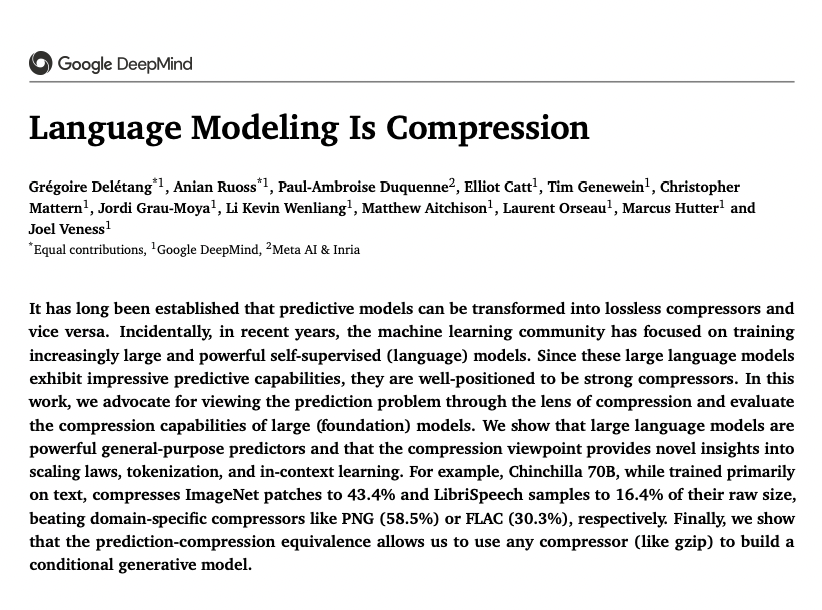
Language Modeling Is Compression
paper page: https://t.co/tECPHg8y8S
It has long been established that predictive models can be transformed into lossless compressors and vice versa. Incidentally, in recent years, the machine learning community has focused on training increasingly large and powerful self-supervised (language) models. Since these large language models exhibit impressive predictive capabilities, they are well-positioned to be strong compressors. In this work, we advocate for viewing the prediction problem through the lens of compression and evaluate the compression capabilities of large (foundation) models. We show that large language models are powerful general-purpose predictors and that the compression viewpoint provides novel insights into scaling laws, tokenization, and in-context learning. For example, Chinchilla 70B, while trained primarily on text, compresses ImageNet patches to 43.4% and LibriSpeech samples to 16.4% of their raw size, beating domain-specific compressors like PNG (58.5%) or FLAC (30.3%), respectively. Finally, we show that the prediction-compression equivalence allows us to use any compressor (like gzip) to build a conditional generative model.
What is ChatGPT doing ... and why does it work? From the lore of neural nets to what Aristotle didn't get to ... here's my version of the story: https://t.co/J1YVJvumEp