Crypto down. Stocks down. One color across the board.
Opta: on-chain options on both. Pick the underlying, define your risk, get paid.
When everything bleeds, optionality is the only edge.
Opta. Soon.
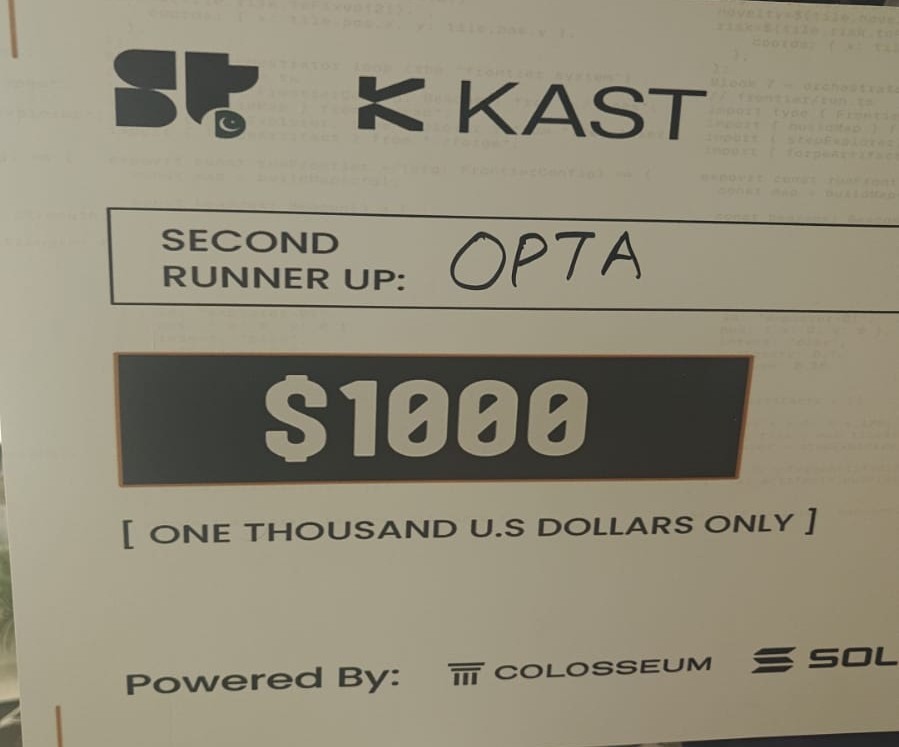
Opta is proud to place as Second Runner-Up at the Frontier hackathon (local track).
Beyond the placement, this is validation. Recognition on what we've believed in from day one.
Thank you to the organizers & to every team that built and shipped alongside us.
Opta. Soon.
Honored to be on this list.
Opta is bringing options to Solana. Equities, FX, crypto, commodities.
Trade any asset class. European or American style.
Options as composable tokens. They expire and settle themselves. You wake up with USDC.
June 2. Opta. Soon.
@ShipyardPAK 🤘
21 teams shortlisted for the Frontier Demo Day 🇵🇰
They will be presenting their products live at the Frontier Demo Day in Islamabad as part of Pakistan’s local track with @KASTxyz.
Pakistan showed up this cycle.
See you on June 2.
@colosseum@solana Yup....I used the token 22 standard to create a living self expiring option token....burns itself in any wallet at expiry of the option and protocol settles the wallet holder automatically
somewhere in here is the only options protocol on solana built for institutional flow.
all asset classes.
living option tokens.
fully collateralized writing.
on-chain pricing.
opta. soon.
@0xBenii@colosseum@ycombinator@crabbylions@n8levine working on putting the Bjerksund-Stensland 2002 model into the smart contract. this is how we ll bring the american style living option token on-chain on solana. european model is already live on devnet.
Cohort 2 is officially open.
MonkeFoundry is looking for the next group of founders building high-conviction products on Solana.
If you’re building across DeFi, consumer, payments, gaming, AI, infrastructure, creator tools, social, or anything that pushes Solana forward, we want to see it.
Cohort 1 brought together talented teams, ecosystem partners, mentors, and investors.
Now we’re opening the door for the next group.
Selected teams will receive hands-on support, ecosystem visibility, founder resources, demo opportunities, and access to the MonkeDAO network.
Applications are open now.
Bring us what you’re building.
@solana - @MonkeDAO
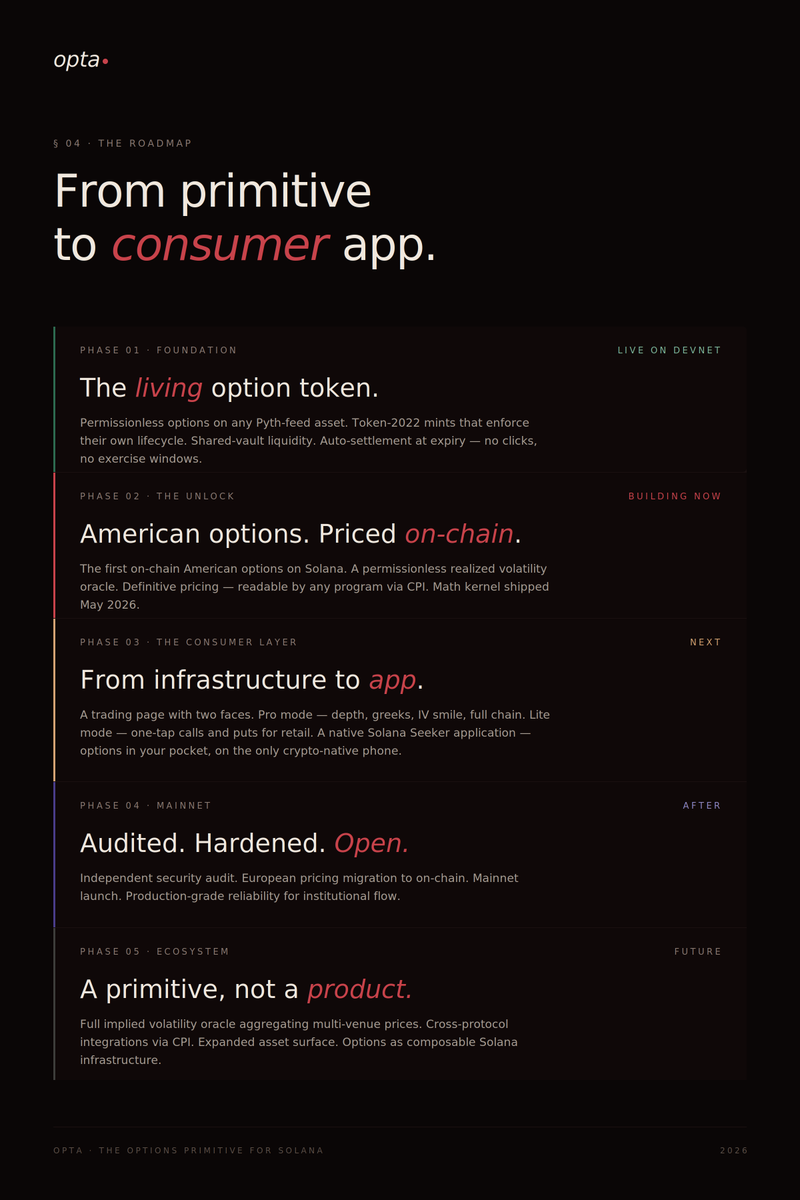
The Opta roadmap.
From a permissionless options primitive on devnet → to a consumer app in your pocket.
Five phases.
One thesis: options are the largest missing market in digital finance.
96% cheaper SPL Token ops = our USDC settlement leg on Opta just got materially cheaper overnight.
Every premium payment, collateral lock, and exercise payout flows through this.
Now waiting on P-Token-2022 when that ships, our Living Option Tokens gets the same.
Opta. Soon.
Introducing P-Token: an optimized rewrite of the SPL Token program for Solana, now live on mainnet. Token instructions are about 96% cheaper in compute, freeing 12-13% more block space for the network without altering block limits 🧵
@colosseum frontier submission was just the start.
Opta continues to build, to bring permissionless options rails to Solana.
Opta soon. Roadmap sooner.
Opta is in the local track 🚀
Decentralized Options Protocol on Solana. Living Option Token (token-2022), on-chain black-scholes, Pyth-powered pricing.
The bar in Pakistan is rising fast. honored to ship with this crew 🇵🇰
A special thanks to @SuperteamPAK
Very clearly explained the reasons of why on-chain options haven't worked....one difference with how Opta is doing it by bringing European style options, which means exercising happens post expiry and in between is a secondary market..also with Opta trade any asset class.
A few main reasons why options have failed in the past:
1) Arbitrary Pricing. Most protocols that have tried in the past use customized pricing models to calculate option premiums, some of which are calculated off-chain, rely on peer-to-peer pricing, and don’t align with TradFi methodology. @epicentral_, takes the American-style Black-Scholes Model and validates option premiums at mathematical fair values ONCHAIN. Removing the need for traders to "guess" what an option is worth at that given moment.
2) Illiquid Contracts. Options have a lot of defining parameters: Underlying Asset, Expiration Date, Option Type (Call/Put), Position Type (Long/Short), Risk-Free-Rate, and Volatility, which make it difficult to match orders between buyers and sellers. If I wanted to buy a Call Option on $SOL, expiring 3 days from now, with a $98 strike price, what are the chances that an option seller offering that specific contract? You can see how liquidity becomes fragmented across different strikes and exp dates. This is why most existing protocols today are so definitive on which assets, expiration dates, and strike prices can or cannot be traded. Epicentral instead makes it where ANYONE can create an option contract, still enabling definitive market making. Also, we use a Pooled-Liquidity Fulfillment (PLF) Model, where essentially each option "market" has its own Option AMM-like behavior — allowing for fast fills for traders.
3) Awful UI/UX. Nearly options trading interface both in TradFi and DeFi today looks like someone threw numbers on a screen and called them "important", with the one exception of @RobinhoodApp doing a masterful job for retail option traders. In DeFi every "options protocol" has an unfamiliar and unintuitive interface layout, making it difficult for both new and experienced option traders. Epicentral takes what we already know: the option chain + asset charts + typical perp-trading interface and puts it into one.
4) Zero Customizability. There's a reason why @MeteoraAG's DLMM product is so popular. Having control over your own strategies is key to a good product and most options platforms fail at this. In fact, in TradFi, unless you're approved by a brokerdealer for Level 3 or 4 options trading (multi-legged spreads), your "options" are limited as ironic as that sounds. Same goes for crypto: not many options platforms have the ability to trade customized strategies which YOU create. Most of them are created for you, by the protocol, known as "vaults". Not that those are vaults are bad, but it goes to show that risk-defined strategies havn't really been jabbed at until recently. Epicentral offers fractional option contract trading, allowing for fine-tuned risk exposure on any position. Epicentral removes the "barrier" of entry, and opens the door for customized strategies.
5) Options are Better for Retail. Perps have dominated DeFi for one reason: its simple. Prediction Markets are dominating this space for the same reason. For too long has traditional finance psychologically "barricaded" the use case of options from retail. I would argue that you are less likely to blow up your account with options than you are with perps -- while still having the same exposure as perps. There is nothing wrong with perps, but it is a "linear" way of trading. One wrong move, you're bust. While options on the other hand (unless you're trading 0DTE) gives you "time" to be "correct" on your trade. This is why institutions trade options the way they do. They understand this, while most of retail doesn't. Epicentral's mission is to change that.
I could go on and on, but I hope this answers some questions!
Opta options aren't database row pretending to be tokens.
It's a Token-2022 mint that:
→ enforces its own expiry
→ can be burned at expiry without the holder's signature
→ carries its term sheet on-chain
Token-2022 doing actual work. Devnet 👇
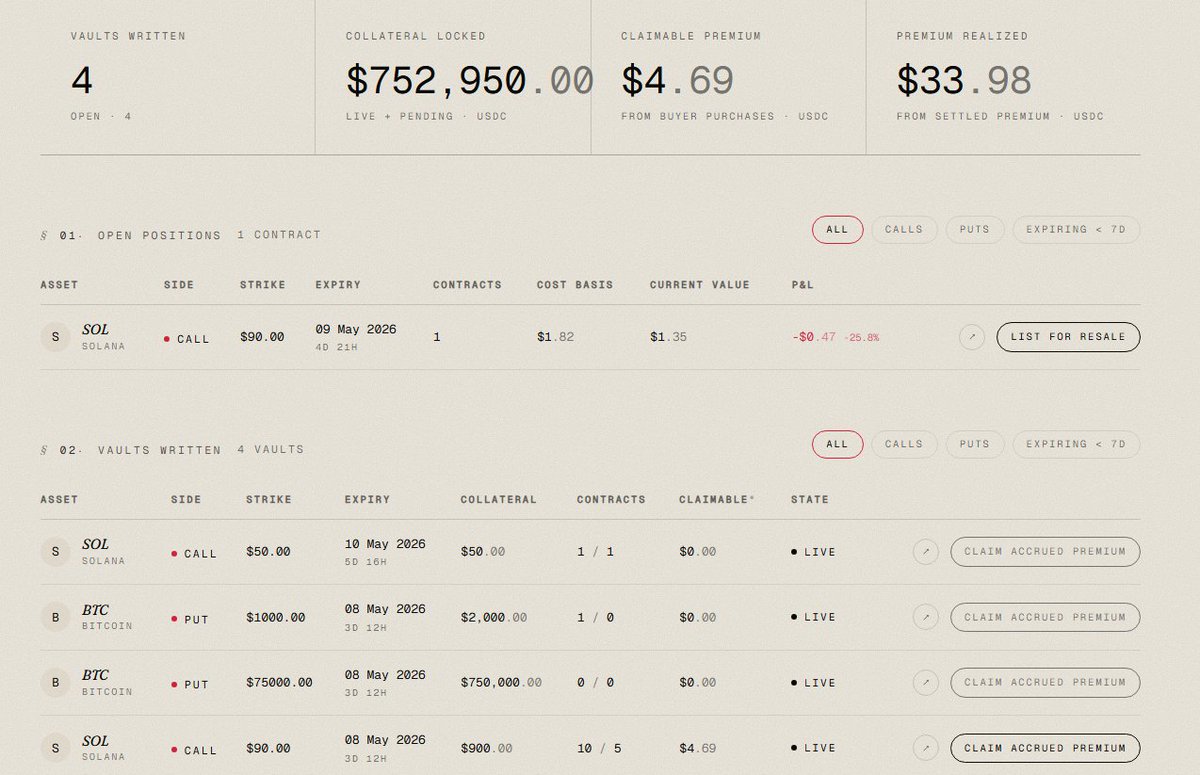
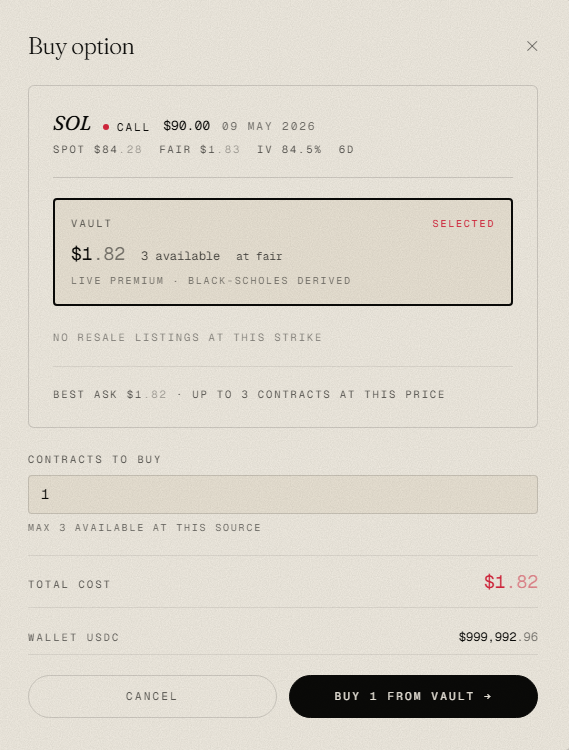
on opta you can buy options and watch P&L mark to black-scholes live, calcuated on-chain or write them, lock collateral, and stream premium.
both sides of the book. fully on-chain. fully composable.
this is what an options market looks like.
opta. live soon.
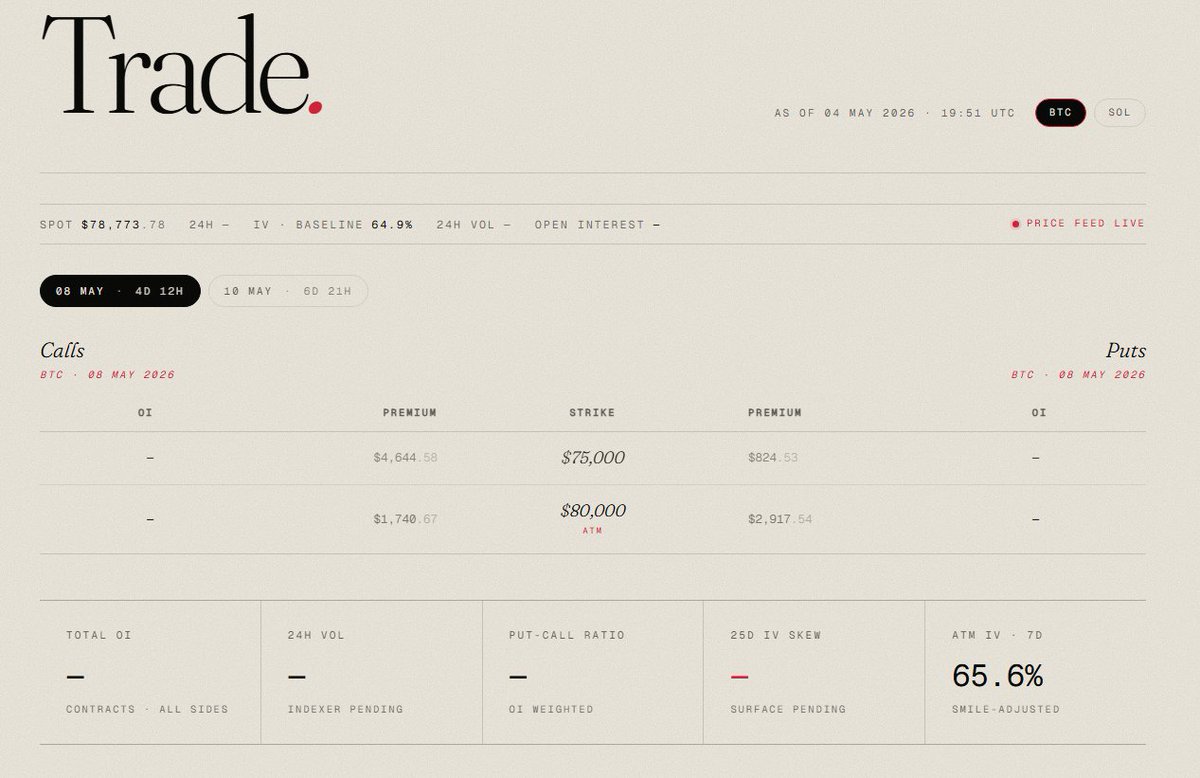
options grid on @solana blockchain
calls and puts.
multiple expiries.
live price feed.
on-chain black-scholes pricing every strike in real time.
trade the grid.
opta. soon.
2/
The implication isn't UX, it's composability. An on-chain pricing engine means any other Solana program can CPI into Opta and price an option as part of its own logic
Vaults, structured products, AI agents managing portfolios. The price is a primitive, not a screenshot. End.
1/
Most options frontends compute fair value off-chain and trust the number. Opta runs Black-Scholes on-chain via solmath w/ ~50K compute units per pricing call, all 5 Greeks out of the same call. That's why this cell can show "at fair" with a straight face.
🧵