Once more into the fray.
Into the last good fight I'll ever know.
Live and die on this day.
Live and die on this day.
Joe Carnahan in The Grey (2011) starring Liam Neeson
He's Tukaram Mundhe, a 2005-batch IAS from Maharashtra.
Over the last few weeks, you might have heard his name. That is because he was recently appointed Commissioner of State’s Food and Drug Administration (FDA). Since taking charge, the FDA has been on an absolute warpath, raiding illegal, fake, synthetic, and adulterated products. From synthetic milk networks and adulterated paneer to illegal gutkha and unhygienic eateries, nothing has escaped his radar.
Mundhe has made it clear that even the most famous names will not get a free pass. His department shocked Mumbai by suspending the food licenses of iconic establishments, such as the 73-year-old Marine Drive ice cream parlor K. Rustom & Co., alongside famous eateries like Shalimar Hospitality, Noor Mohammadi Hotel, and Rahmaniya Restaurant, after surprise inspections uncovered severe hygiene violations, including live pests and expired ingredients.
Such is the fear of his crackdowns that, just two days ago, dairy farmers were caught on video spilling hundreds of liters of synthetic milk after rumors of an impending FDA raid spread.
This is his 25th transfer in a 21-year career, a testament to his refusal to bend to political pressure. It makes you wonder: if just one IAS officer can bring about so much change, where would our country be if every bureaucrat were as uncompromising and proactive as him?
The biggest BJP propaganda on social media is: “If not BJP, then who?”
Do you really think a country of 1.5 billion should be run by a teleprompter PM, an incompetent Petroleum Minister, a tax terrorist FM, and an Education Minister known for repeated paper leaks?
(1/5)
@Kamru_Choudhury@PadmajaJoshi The trek from the peaks of appeasement [unabashed & relentless population jihad, love jihad, land jihad, etc.] down to true secularism feels like insolent intolerance.
US lawmakers push for law that imposes 100% tariffs on countries who import Russian Energy like China, India, Slovakia, Hungary, Azerbaijan (with narrow wavier authority) but makes exceptions on European countries
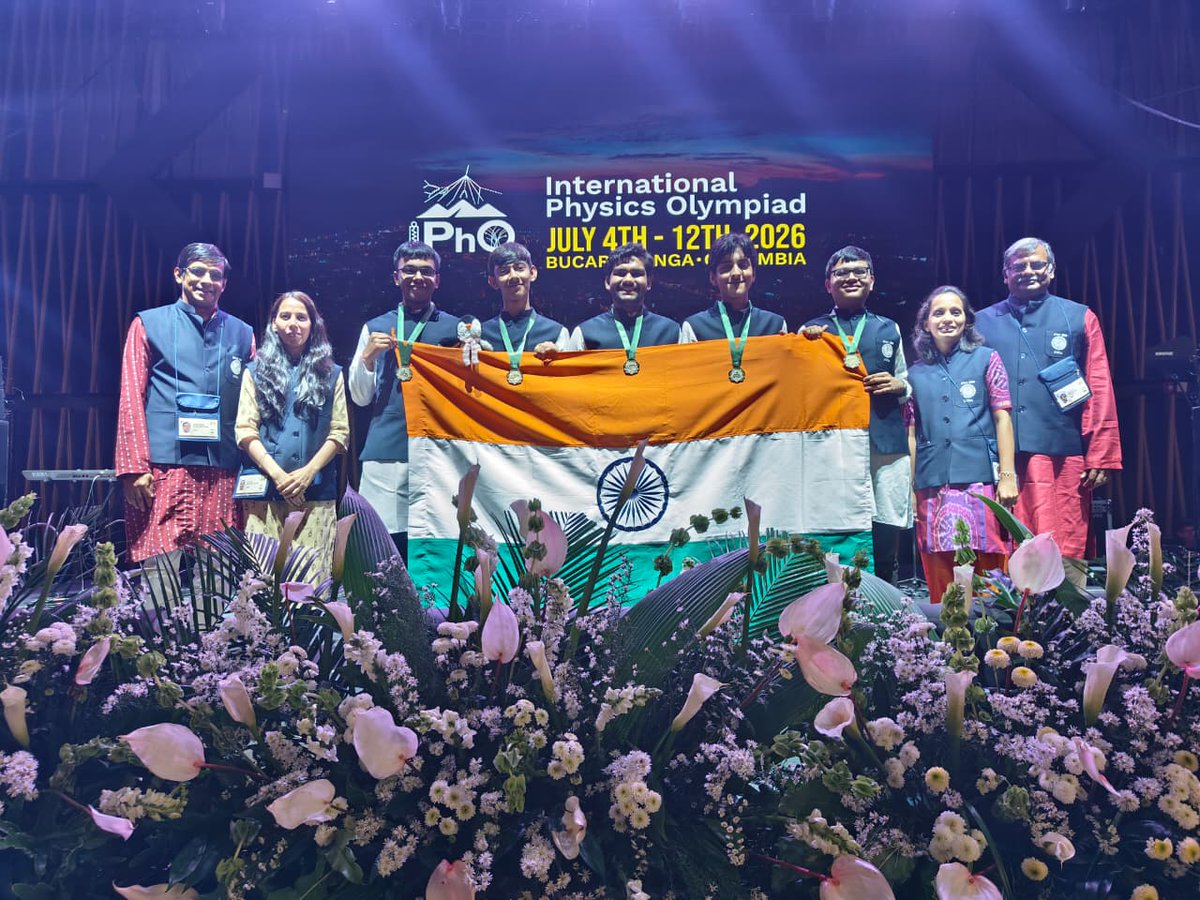
🇮🇳GOLDEN SWEEP FOR INDIA 🏆
All 5 Indian students win GOLD at the 56 International Physics Olympiad (IPhO) 2026 in Bucaramanga, Colombia -placing India at Rank #1 in the world (jointly with China, Kazakhstan, Russia, South Korea & Taiwan) among 381 students from 87 countries 1/5
He was Satyendra Nath Bose, an Indian physicist whose quiet brilliance in the 1920s forever altered our understanding of the quantum world.
In 1924, Bose, then a 30-year-old professor in British India, sent a groundbreaking manuscript directly to Albert Einstein. The paper offered a novel, more elegant derivation of Planck's law for blackbody radiation by treating light quanta (photons) as indistinguishable particles—a radical departure from classical statistical methods. Impressed by its insight, Einstein personally translated the work into German and facilitated its publication in the prestigious Zeitschrift für Physik.
This exchange sparked a brief but profound collaboration. Einstein extended Bose's statistical approach to material atoms, predicting a bizarre new state of matter at ultra-low temperatures: what we now call a Bose-Einstein condensate (BEC), where particles behave as a single quantum wave. Bose's original framework became known as Bose-Einstein statistics, and the class of particles that obey it—those with integer spin, including photons, gluons, W and Z bosons, and the Higgs boson—was later named bosons in his honor by Paul Dirac.
Unlike fermions (matter particles like electrons), which obey the Pauli exclusion principle and cannot occupy the same quantum state, bosons can pile into identical states en masse. This "social" behavior underpins extraordinary macroscopic phenomena: the coherent light of lasers, the zero-resistance flow in superconductors, and the collective quantum coherence in BECs.
Despite the monumental impact—his statistics describe half of all fundamental particles and enabled key advances in quantum field theory, condensed matter physics, and particle physics—Bose remained remarkably unassuming. He continued teaching at universities in Dhaka and Calcutta (now Kolkata), mentored students, pursued ideas in X-ray crystallography, unified field theory, and other areas, and never sought the spotlight. Nominated several times for the Nobel Prize (notably for Bose-Einstein statistics and his later work), he was never awarded it, and his name rarely appears in popular accounts of 20th-century physics.
There's a poignant humility in his story: a man whose legacy literally names one of the two fundamental families of particles in the universe, yet whose personal fame never matched the scale of his contribution. Bose reminds us that true influence often arrives without fanfare. Some breakthroughs echo through textbooks and technologies, while their creators work in the background, content to let the universe carry their ideas forward—even if history's spotlight rarely finds them.