Inspired from @investingluc and @ohiain , I am planning to use my X as my personal trading journal!
It’s Jun 1, 2026 and I actively started trading the market with intention since Nov’25. Veterans would know what a time that was 1/n
A Momentum Trader's Guide to Mastering Quality Setups is now available to download.
This book is a complete breakdown of the process I use to identify and trade high-quality momentum stocks. My hope is that it helps you build a process you can trust and execute with confidence.
A sincere thank you to @PradeepBonde@Scot1andT@LeifSoreide and @801010athlete for contributing to the Praise section, and for the support and influence you've had on my development as a trader over the years. It means a lot to have your names in these opening pages.
The book is 100% free, as my token of appreciation to the amazing trading community.
https://t.co/nUnczrkiNr
The market is run by algos, something like 80% of the volume.
When you're building a technical system, you want to be flipping through charts and seeing what indicators and spots the algos almost always respect on the liquid leaders. From there, consistency and edge is born.
When I say "study the greats," I don't mean watch 1 interview and call it a day.
I mean, obsess over their lives... write pages of notes, study their psychology, invert their thinking, understand their habits, beliefs, routines, mistakes, and why they made the decisions they did.
I have 1000s of pages of notes because I genuinely believe depth beats speed, and understanding how someone thinks is infinitely more valuable than copying what they do.
This is just the tip of the iceberg...
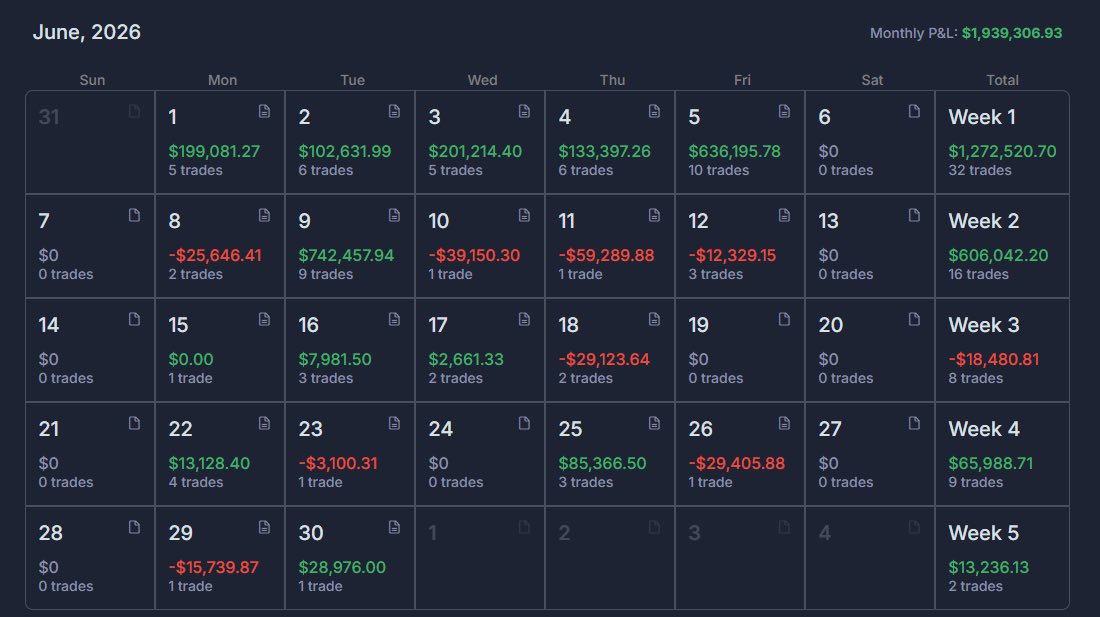
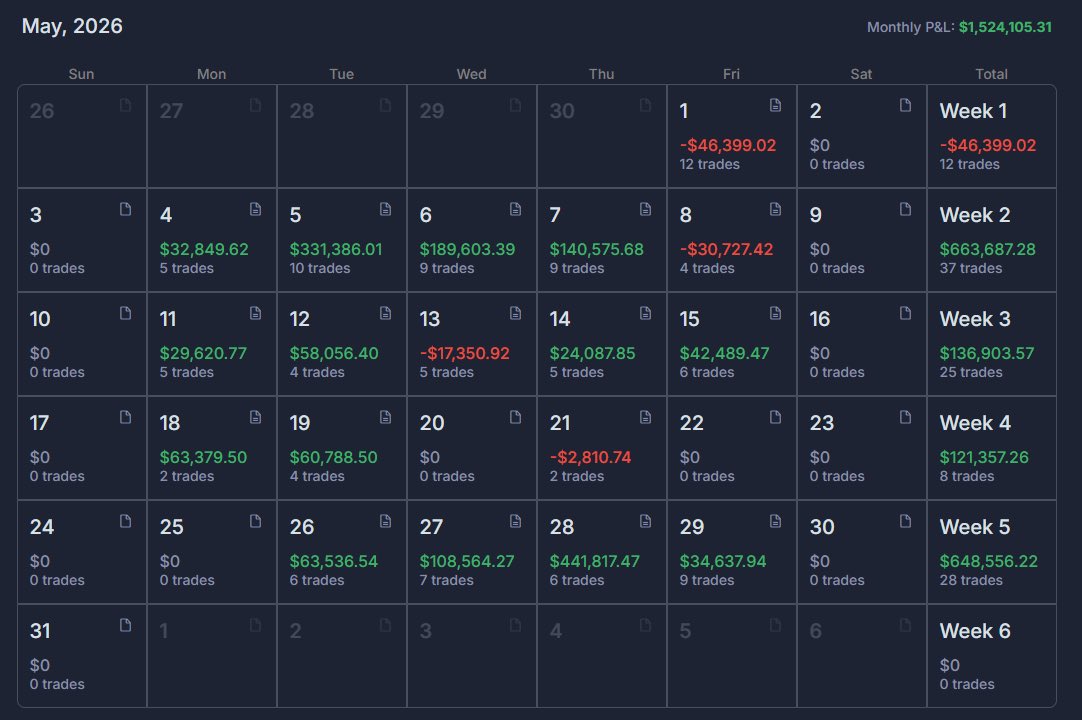
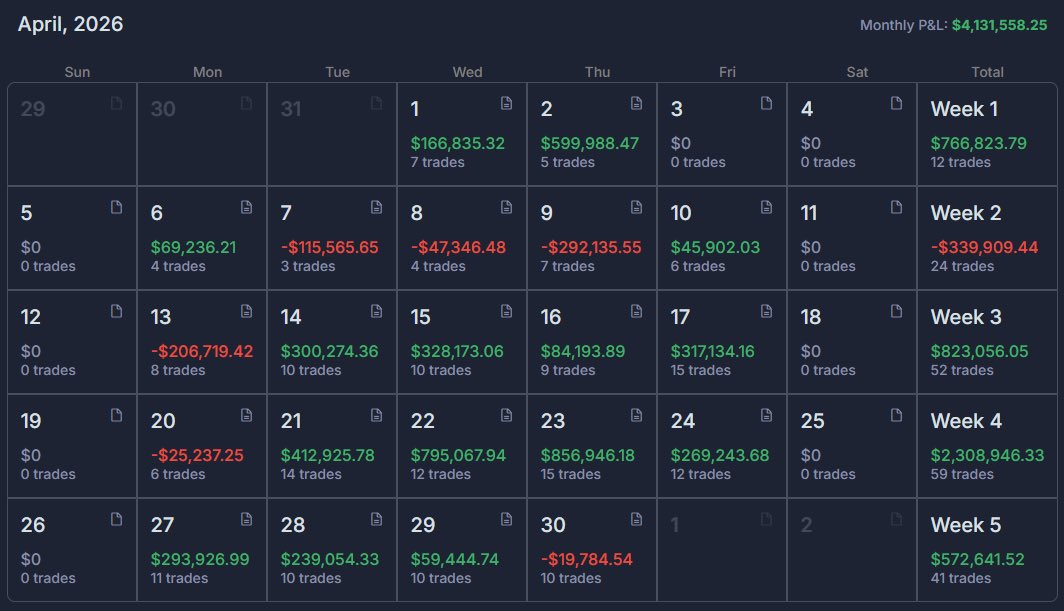
My biggest quarter EVER
$1.3m in realized profits in Q2
I never thought I would be able to see these type of numbers
Let alone in a single quarter...
The power of compounding is real
Keep pushing until you crack the code
Build a Cushion So Fat you can Sleep On
How NOT to be a Nervous Position Trader
Is there anyone who go into the market and say they want to be a 100% position trader (typically longer timeframe using 50sma as a reference) on the first day of their trading?
You could be a 100% investor.
A 100% swing trader (typically shorter timeframe using 21ema as reference).
Or you want to do a hybrid, something like 1/3 position and 2/3 swing.
But IMO your position trades have to be "earned", instead of "wanted".
For me, most of my meaningful entries and sizes are made not during "easy dollar environment" where every names are rosy and floating above 10sma. On the contrary they emerged during extremely challenging environment, when index was below 200sma, and leaders were mainly struggling around 50sma.
That's the period and price level that I really put on size (sometimes after a shameful account reset e.g. in 2025 Tariff Debacle, and the November AI Capex fear), because the biggest invalidation condition on higher timeframe is often near and clear (like a do or die, bull or bear situation).
Naturally, if those were the lows, I have secured low cost entries with decent size (if not, I am out of the bear market and bye), and I start my position trades with a decent profit cushion, which gets thicker over time when the trend is going up.
What if buying at difficult time is simply not your thing, do you still have the luxury of trying a position trade? Yes, but you have to build up enough cushion for it.
The thing is, when a stock is in a good market and if you make your fresh buys above 21ema, the 50sma could be far far below. So either your size will be too big for you to cushion a loss to the 50sma, or your size is too small to be meaningfully split into position/ swing. A hybrid might work, provided you manage to generate enough swing profits to cover for sitting with the position, but generally I don't like to babysit unrealised losses.
So, a more logical way is to let the uptrend works its magic, and once you build up enough profit cushion and the 50sma naturally catch up to above your buy cost, you can be a more relaxed in segregating your swing/ position mix. If you get stopped out before 50sma catch up, next!
(Chart: $SNDK as a position trade)
@wey_how12640 I have a 4 hour flight and was hoping to read it then but somehow the download option on substack isn’t working for me! Hoping there is free-wifi, but saved the post for later reading. Excited to go through it and find parallels and aha moments from my own journey
Average Daily Range (ADR) is a purely backward-looking indicator.
It cannot predict future price directions or sudden market shocks.
When markets suddenly have momentum burst the ADR increases as stock moves in the direction of the breakout.
Low ADR stock becomes high ADR once momentum comes in.
Similarly a high ADR stock can become low ADR if it goes in to consolidation.
You can deep dive and quickly find this.
Here are 12 Market Wizards and the 12 lessons that have had the biggest impact on my own trading:
1. Paul Tudor Jones:
"Defense wins championships."
Survival > Profits... Always, because you can't compound if you keep blowing up!
--
2. Ed Seykota:
"Cut losses quickly. Let winners grow."
Probably the simplest quote in trading... and the hardest 1 to consistently follow. My entire system revolves around this idea!
--
3. Bruce Kovner:
"Know exactly where you're wrong before entering."
Every trade begins with my stop (not my target). If I can't define my risk, I don't have a trade.
--
4. Richard Dennis:
"Trading can be taught."
Great trading isn't about your IQ!! Focus on following a repeatable process with discipline.
--
5. Marty Schwartz:
"Trade what you see, not what you think."
Opinions don't pay me (price does) + the chart is always my final decision maker.
--
6. Stanley Druckenmiller:
"Press your winners."
My biggest months came from getting aggressive when my positions were already working... not when I was trying to make back losses.
--
7. Michael Steinhardt:
"Adapt or die."
Every market has a different personality & the best traders evolve with it instead of fighting it.
--
8. Larry Hite:
"If you don't bet, you can't win. If you lose all your chips, you can't bet."
Position sizing + risk management matter just as much as finding great stocks.
--
9. Tom Baldwin:
"Size comes after consistency."
Bigger positions are earned... they should be a byproduct of good habits.
--
10. Mark Minervini:
"Protect capital above everything."
Small drawdowns allow you to capitalize when the environment improves.
--
11. William O'Neil:
"Buy the best companies, not the cheapest."
Leadership almost always outperforms laggards. I want the strongest stocks in the strongest groups!
--
12. Oliver Kell:
"Relative strength shows you tomorrow's leaders."
During corrections, I'm not trying to predict the bottom... I'm building a watchlist of the names refusing to go down.
--
I've read multiple trading books over the years, but these 12 ideas have shaped the way I think about the market more than I give credit.
Funny enough, none of them are about getting rich quickly... they're about surviving long enough to let compounding do its job!
Save & bookmark this for reference.
Godspeed!
Like everyone else, Q2 was nothing short of incredible thanks to the historic trend that began in April.
June, however, was a much slower month. My best trade, $AXTI on the short side, is still open, but most of the month was spent taking profits on some incredible winners like $MU, $NBIS, $DELL, $DOCN, and $ARM.
The extended, choppy nature of the market has made it difficult to get re-engaged with the prior leaders. A day like today is a great reminder of why progressive exposure is such an important part of my process.
I’m not in the business of giving back gains after what was arguably the greatest two-month stretch most of us have ever experienced.
I’ll put together a full Q2 recap this weekend.
Looking back, some of the hardest nights of my life came after losing money.
Not because of the money, but because I tied my self-worth to my portfolio.
I wish someone had told me earlier that you're allowed to be wrong, but you just can't STAY WRONG.
Every losing trade goes through the same process now.
1) Did I follow my plan?
If yes... Great, onto the next trade!
If no... Fix it.
Either way, I don't sit there beating myself up all day. The lesson taken away matters, but the self-pity doesn't.
In business, losses are the rent we pay to participate in the market!
Stop beating yourself up.