Inspired from @investingluc and @ohiain , I am planning to use my X as my personal trading journal!
It’s Jun 1, 2026 and I actively started trading the market with intention since Nov’25. Veterans would know what a time that was 1/n
There's only been about 8 weeks of pure "risk on" market action since October 10th, 2025. Pretty challenging environment outside of April/May this year.
10 years ago when I first started trading, I was losing $100K a year on a good year, now I clear $100K on a bad month.
1 year ago when I first started posting on X, I was getting 150 views on a post, now I clear 15,000 views on average.
1 year ago when I first started Skylit, we had 30 users, now we have over 3,000 users.
The only thing standing between where you are today and where you want to be is yourself.
Put in the work, discipline, and effort.
The rest will take care of itself.
If you're not seeing the results you believe you deserve, you're not doing enough.
Want to Know If the Bottom Is In? Read this.
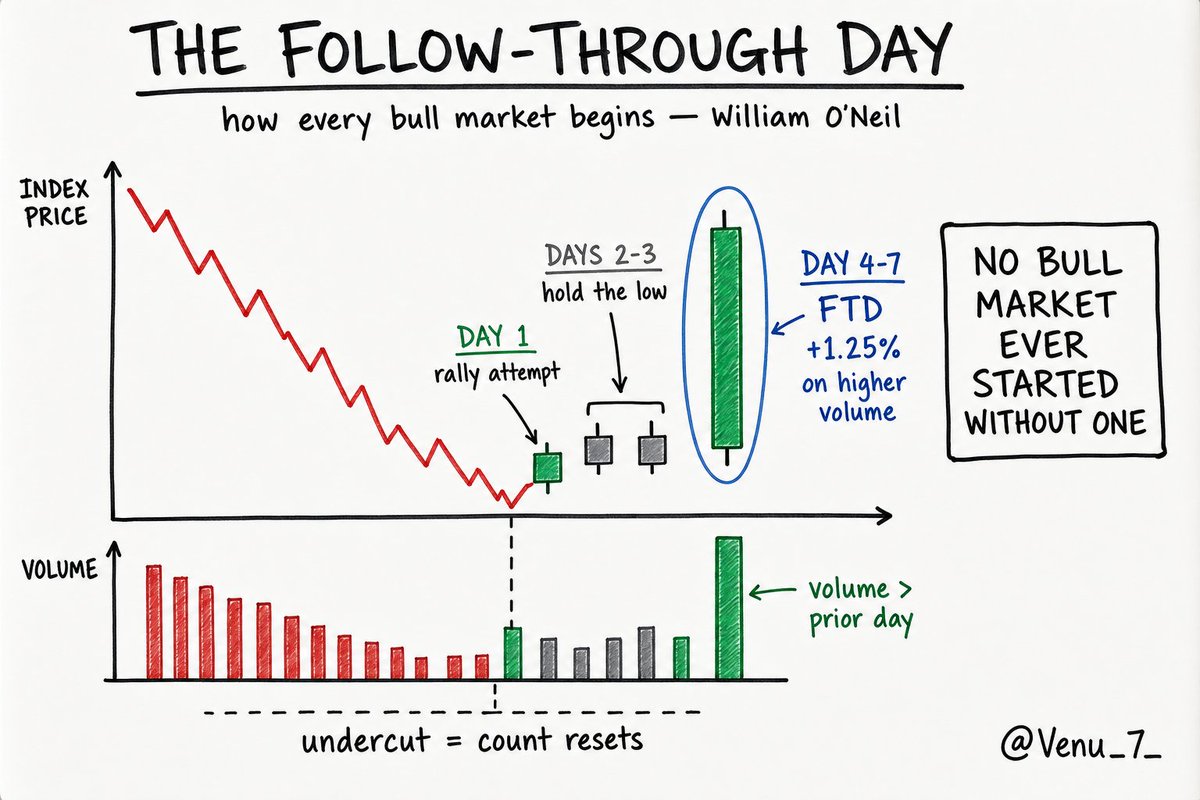
Since $QQQ just printed a gap-up candle, the next thing I'll be watching is the Follow-Through Day (FTD).
One of William O'Neil's most important rules for confirming a market bottom.
How it works:
- Market is in a correction. The first day an index closes higher = Day 1 of a rally attempt.
- Days 2-3 don't need to be up. The rally stays alive as long as Day 1's low holds.
- Then on Day 4-7, watch for one major index (S&P 500 or Nasdaq) to gain 1.25%+ on volume higher than the day before.
That's the follow-through day. Downtrend over. Confirmed uptrend.
The rules that matter:
- Not every FTD works - many fail
- But no bull market has EVER started without one.
- Undercut Day 1's low -> the count resets
- FTDs after Day 10 carry lower success rates
What to actually do on an FTD:
Don't go all in. Buy starter positions in leading stocks breaking out of sound bases. If the rally is real, they work - and you add. If it fails, you're barely exposed.
O'Neil's whole point: you don't predict bottoms. You confirm them.
Corrections are for building the watchlist. The FTD tells you when to use it.
as a rule, if you are going through any changes in life-take time off from trading. If you get married, take a bit of time away. If someone dies, take time away. If you have a baby, take time away. If you buy a car, or a house, take some time. If you are going through a divorce take a LOT of time off. This is NOT the last day of trading. But if you trade in the midst of change-it might be for you. Give the market your time, not your money!!
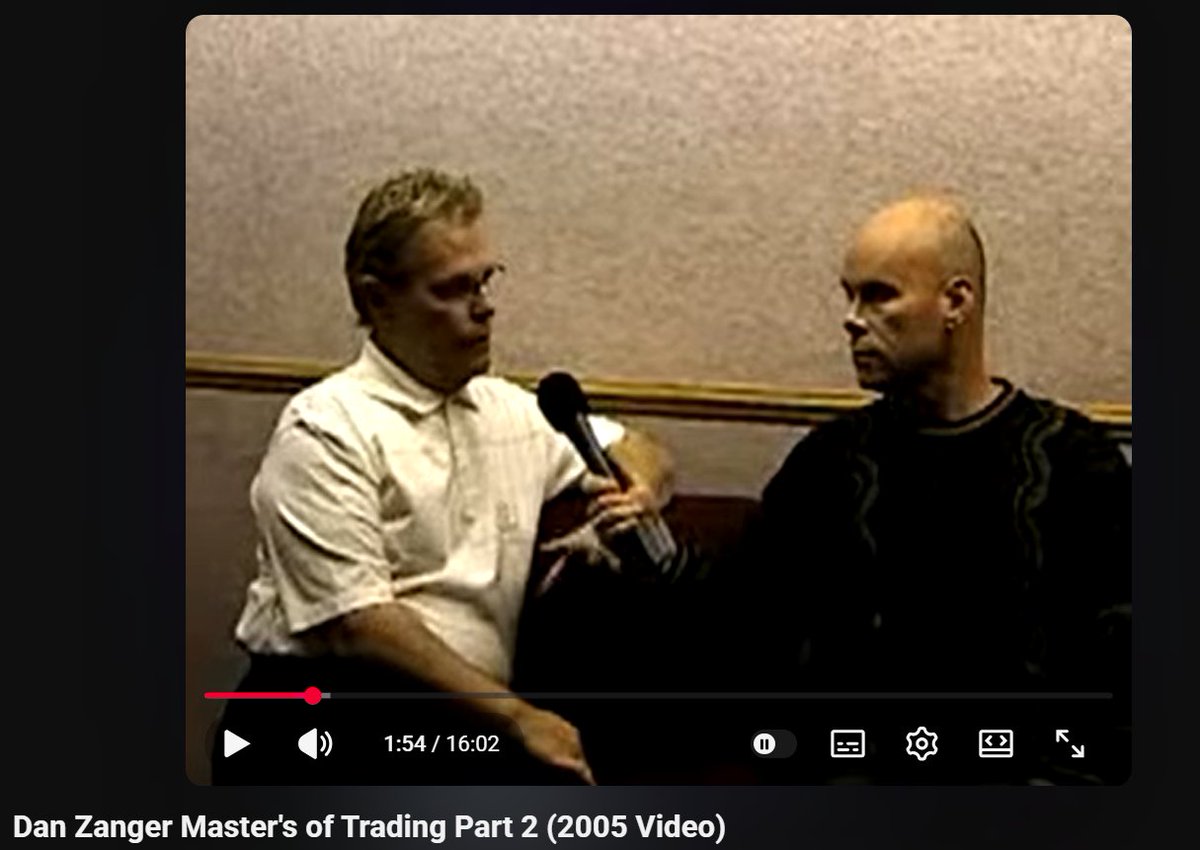
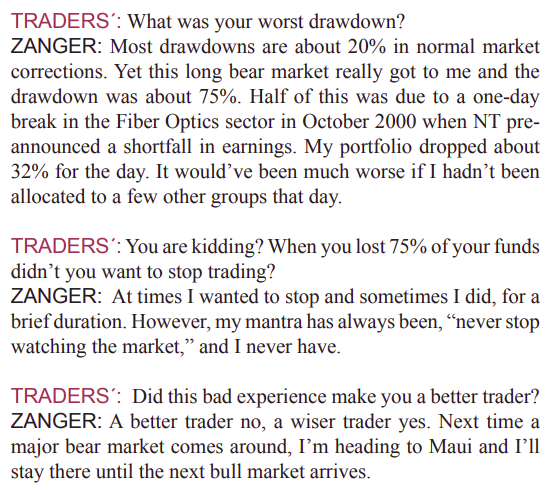
Dan Zanger famously made his initial fortune in the internet bubble, and since he lost a large chunk of it, most people assume that happened when the bubble popped.
Actually, he was in cash then.
But he lost 32% of his portfolio in ONE day when, later that year, he went heavily long fibre optic stocks, which all gapped down when Nortel Networks announced it was going to miss earnings. Dan’s size pushed price even lower as he tried to get out.
After that, he learnt to prioritise liquidity and never put his entire account in one stock or group.
But the more interesting lesson was how he got himself chopped up, trying to trade the 2000–2003 bear market.
Later in 2003, he said in an interview: “Next time a major bear market comes around, I’m heading to Maui and I’ll stay there until the next bull market arrives.”
In 2005, Dan shared in an interview that his biggest lesson from that year is to (still) trade “far less” than he did. He shared that the market may make only 2 big moves annually, each lasting maybe 6–12 weeks, after which it needs time to set up again while you go to cash.
TEN years later, Dan goes on a live Benzinga broadcast (30 Sep 2015), and no matter what the host tries, Dan isn’t interested in participating in anything.
Fascinating how long he needed to truly internalise this lesson.
Then again, it also took him a decade of serious study and hard-earned lessons to achieve his ‘overnight success’ in the internet run.
When you study successful traders, forget about trying to find the ‘secret formula’.
But it’s absolutely worth digging into how they arrived at their rules, and how they made those rules work for THEM in spite of their suboptimal outcomes.
It’s your stepping stone to figuring out how to make common ideas your own.
The concept a lot of people struggle with is the ability to do nothing for weeks or months at a time. To sit there and know a better wave or market cycle maybe around the corner.
Most of that comes from learning it through pain and drawdowns. Honestly that’s the best type of learning there is. You trade a topping market, you get burned and there’s a lesson on the other end of it.
Folks screaming into a keyboard telling you don’t do this, don’t do that. That’s fine and peer knowledge is good wisdom. But the real learning comes from actually messing up. Feeling the pain, feeling the disappointment, going through the low yourself. Others can mask it or reduce it for you, sure.
The best traders out there, the ones whose word you actually respect, were all at some point trading this same chop. Trading a mess. Sitting in a drawdown. Giving back gains in a year that was going well. Taking a big gap down. Those emotional experiences harden how you approach the markets. You end up battle-tested because you’ve been through situation A, B, and C yourself instead of someone telling you to avoid them.
You can avoid some of it. But the best traders have always been through it. They know how it feels to be down and out and they know how it feels to be sky high, and those extremes build your emotional, psychological, and systematic ability to handle future cycles.
If you’re going through it right now, it’s not the end of the world. It’s making you a better trader. Better to learn in choppy water than in a market that only goes up, because that’s what breeds nonsensical risk management long term.
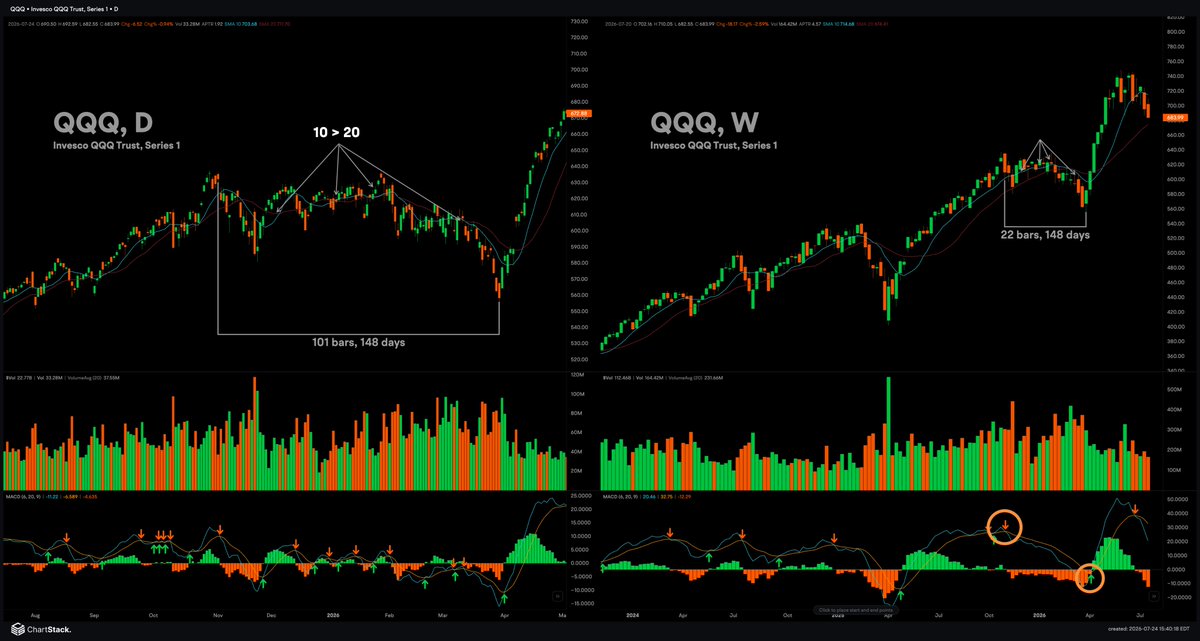
In my experience, 10 > 20 alone adds quite a bit of noise and headache.
If you look at the attached screenshot, the left pane is QQQ daily and the right pane is the weekly. Using the weekly MACD 6/20 cross would have saved you months of headache trying to trade through chop from December 25' through 26' april lows off the 10 > 20 alone.
Waiting for a weekly MACD 6/20 close may get you to the party a little late, but it does a much better job of confirming there’s actually a party worth going to in the first place.
I started as a Qullamaggie purist, but over my career and studies, I’ve refined and, in my opinion improved, some of his lesser-defined or under-optimized rules.
Thanks for the great discussion James, you are both a scholar and a gentleman and your dedication to studying the markets is truly impressive.
p.s.
This example may seem cherry picked, but if you're interested in gaining your own conviction around this concept open the charts study all the past periods where this risk filter is relevant and lmk what you find.
$DDOG could easily become another $DELL if you don't use some form of entry criteria as part of your execution to filter yourself from the crowd.
A good setup alone isn't enough. Long-term profitability comes from combining quality setups with quality execution. Without an execution filter, you're simply buying the same pattern everyone else sees and grinding suboptimal result.
PS: 5 years is too long to spend doing the same thing repeatedly and expecting a different outcome https://t.co/IoQZMPf3VT
The Calm Before the Calm | OneOption - Stocks. We need three consecutive decent sized D1 candles of the same color on good volume. That would indicate a shift in sentiment. Until we get that you trade as if programs will continue to dominate activity. The price action will be choppy and you need to trim your trade size and count. When you have profits, take them.https://t.co/3fTApbQsjD
@GnT_Trades How do you know when the trend has changed? I have encountered three seasons of trends so far (Nov - Mar and Apr - June and Jun- present). I was not able to identify the last market change sooner and wondering if you have things you look for? Ty