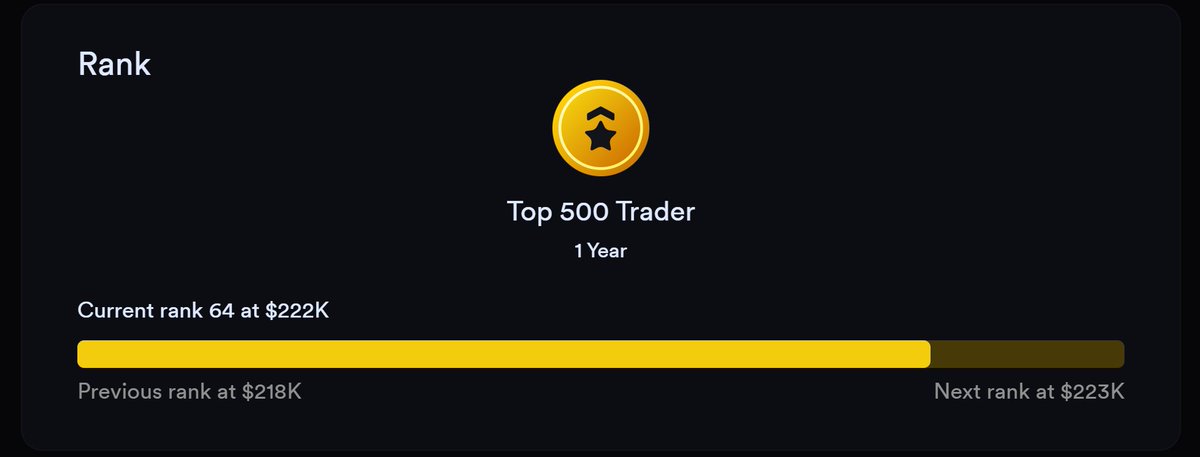
Almost $350K total stock realized gains since I started stock trading last April, 2025 around Liberation Day.
From just 2 accounts -->
1) My main option wheel trading account (the one where I post my weekly/monthly/YTD results here on X:
--> $98,102 realized gains in 2025 tax year
--> $172,680 realized gains so far in 2026 tax year
2) A smaller IRA account where I had rolled over a small 401(k) from a company where I was at for just a couple yrs --> Started w/ the $57K rollover IRA on June 2025 and the account is now sitting at ~$121K.
@Kinfo verified results.
Simple math. If the portfolio falls buy 50% and you get assigned on the full $500K, you are essentially selling your entire $500K VDO shares to take assignment of the new put assigned shares.
If you decide to roll the position, then you will need to sell some shares to raise minimal cash to buyout the existing options to roll.
Here's a headscratcher for the day.
Brandon focuses on outperforming the S&P, yet his strategy is to sell leaps puts and to buy long-dated calls primarily on the S&P.
Also, focuses his pitch on portfolio margin, and positioning this as cashless requirement, as it's secured by the portfolio.....which is not that much different if one put their existing shares in collateral in a traditional T-margin account (note, putting into a margin acct is NOT the same as trading on margin).
His strategy is basically a simple compounding one on top of existing S&P positions. Similar to going with a leveraged S&P ETF, but of course a bit safer with the longer duration and no daily price reset that you get with the leveraged ETFs.
https://t.co/DlC3nlrUGQ
I had a post about portfolio secured puts blow up recently, and there are a bazillion questions about how this actually works.
So let’s make this crystal clear.
Someone has $1,000,000 invested in the S&P 500.
They sell puts with a total assignment value of $500,000.
They have ZERO cash sitting in the account. Just shares.
Now imagine the S&P 500 gets absolutely smoked and falls 50%.
Their $1,000,000 portfolio is now worth roughly $500,000.
How much are they potentially on the hook to buy through their puts?
$500,000.
So where does the cash come from?
They sell shares from the existing portfolio, raise the cash, and take assignment.
ZERO margin borrowing required. ZERO margin interest.
Now I already know what some people are thinking.
“But Brandon, you’re selling your stocks after they crashed!”
RIGHT.
But think about what is actually happening.
My base portfolio is primarily the S&P 500, Nasdaq and high quality individual companies.
And what am I generally selling puts on?
The S&P 500, Nasdaq and high quality individual companies.
So I’m basically selling one group of beaten down assets to buy another group of beaten down assets that I already wanted to own at lower prices.
I’m not selling everything and running into cash at the bottom.
I’m reallocating capital.
And yes, you also have to be smart about taxes and wash sale rules. You can potentially switch between investments that are not considered “substantially identical,” but that is something everyone should understand for their specific situation.
Now let’s back up and explain WHY I do this in the first place.
A normal cash secured put works like this:
You sell a put, collect premium, and keep enough cash sitting there to buy the shares if assigned.
My problem with that is simple.
Selling a put is a bullish strategy.
So if I’m bullish enough on something to sell puts on it, why would I want $100,000, $200,000 or more sitting in cash doing basically nothing?
That’s why I use what I call a portfolio secured put.
Instead of keeping the money in cash, I keep my capital invested in my base portfolio.
That portfolio creates buying power that can secure the puts.
So my base portfolio stays invested AND I collect premium from selling puts on top of it.
And simply using buying power does NOT automatically mean I am borrowing money or paying margin interest.
The entire strategy comes down to one thing:
POSITION SIZING.
I do NOT look at how much buying power Schwab gives me and say:
“Sweet, let’s use all of it.”
That would be insanely stupid.
I look at the TOTAL assignment value of every put I have open relative to the value of my portfolio.
Then I stress test it.
With my current positioning, my portfolio can fall more than 50% and I can still raise enough cash from the portfolio to cover the assignment value of my puts.
And that assumes I literally sit there and allow everything to get assigned.
In reality, I also have the ability to roll contracts down and further out, which can buy me more time & if it came down to it, I would likely do this.
But I NEVER build the trade assuming rolling will magically save me.
The math needs to work BEFORE I make the trade.
That is what “portfolio secured” means to me.
The puts aren’t secured by a giant pile of cash sitting there doing nothing.
They are ultimately secured by assets I already own.
That’s also why I think the capital efficiency is so powerful.
With a cash secured put, you could have hundreds of thousands of dollars sitting in cash waiting for an assignment that may never happen.
With a portfolio secured put, my money stays invested while I collect put premium on top of it.
So if you calculate the premium against the incremental cash I specifically had to set aside for the put, that number is basically $0.
That’s why I sometimes say the theoretical cash on cash ROI is “infinite.”
Obviously that does NOT mean infinite profits.
It does NOT mean free money.
And it DEFINITELY does not mean there is no risk.
It simply means I’m generating additional cash flow without having a giant pile of cash sitting idle.
It’s almost like having my money working in 2 places at once.
The goal here is NOT maximum leverage.
The goal is maximum capital efficiency while keeping the risk controlled enough that a massive market crash does not wipe me out.
I’ve had plenty of “hot shot” know it alls try to poke holes in this over the years.
I even spent hours discussing it with a trader at Citadel a few years ago.
The conclusion always comes back to the same thing:
The strategy lives or dies based on POSITION SIZING.
If you sell way too many puts, this can absolutely blow you up. So it should be no surprise that I have a very simple way to ensure your ratios are good and I even made an app that you can link your broker in to and it does all the ratios for you so you sleep well at night! Its very simple and takes 3 min.
If you size them so the portfolio can withstand a massive decline and still cover assignment, it becomes a completely different strategy.
And yeah…
This is one of the ways I’ve been able to smoke the S&P 500’s ROI over the last decade.
I have multiple YouTube videos where I actually show how I do this visually, which is probably the easiest way to understand it.
See my YouTube below to learn more:
https://t.co/QJxYdUHUXE
@WealthCoachMak Why close out your $AMZN 10/23 put early that you had at $245 only to buy the long shares at $260? Seems like you could have held the 10/23 to exp for max gain.
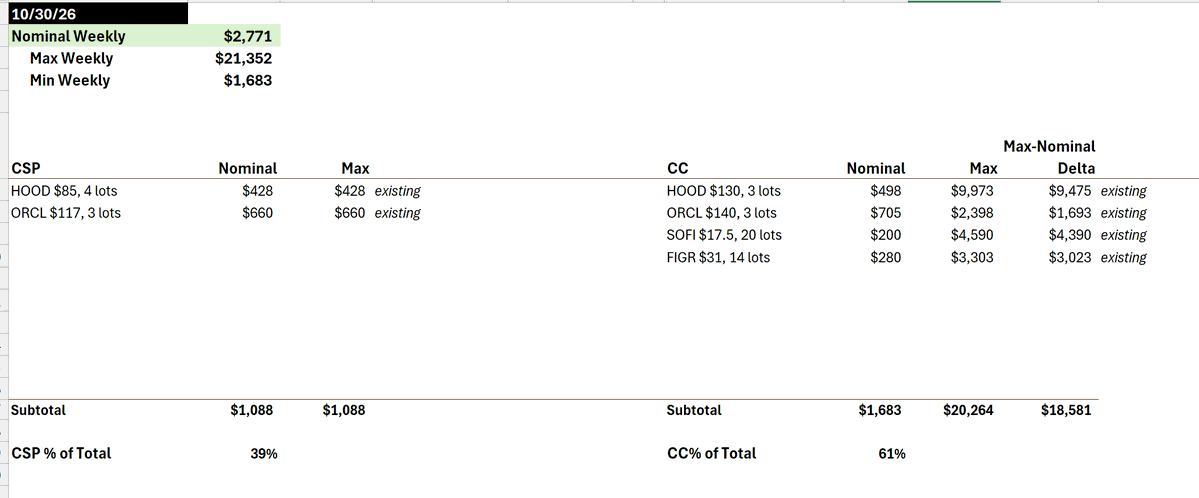
Setting up for the big event next week, w/ FOMC, PCE, and key tech earnings ($AAPL, $AMZN, $MSFT, $HOOD, $SOFI, etc).
This is just what I have on deck so far. Beauty of selling CCs is it's guaranteed on the minimum profit PLUS the upside potential if any of them get assigned & called away.
I will likely add additional CCs as we head into the close of this week and even Mon. next week. Additional CC action I will sell on $INTU, $HOOD, $SOFI, $BMNR, $FIGR.
I'm not worried about topline, as it actually helps $META with their quality of revenue story going forward. Instead of being highly reliant on advertising revenue today (across FB, Insta, etc), w/ Muse they unlock the oppty for a high volume subscription revenue base (i.e., your classic value prop on why SaaS companies got high multiples).
On the fcst, they probably show high growth % fcst on Muse as it's growing from a small base. This revenue is sticky however (or at least should be vs. ad revenue predictability) so this is all goodness for $META here.
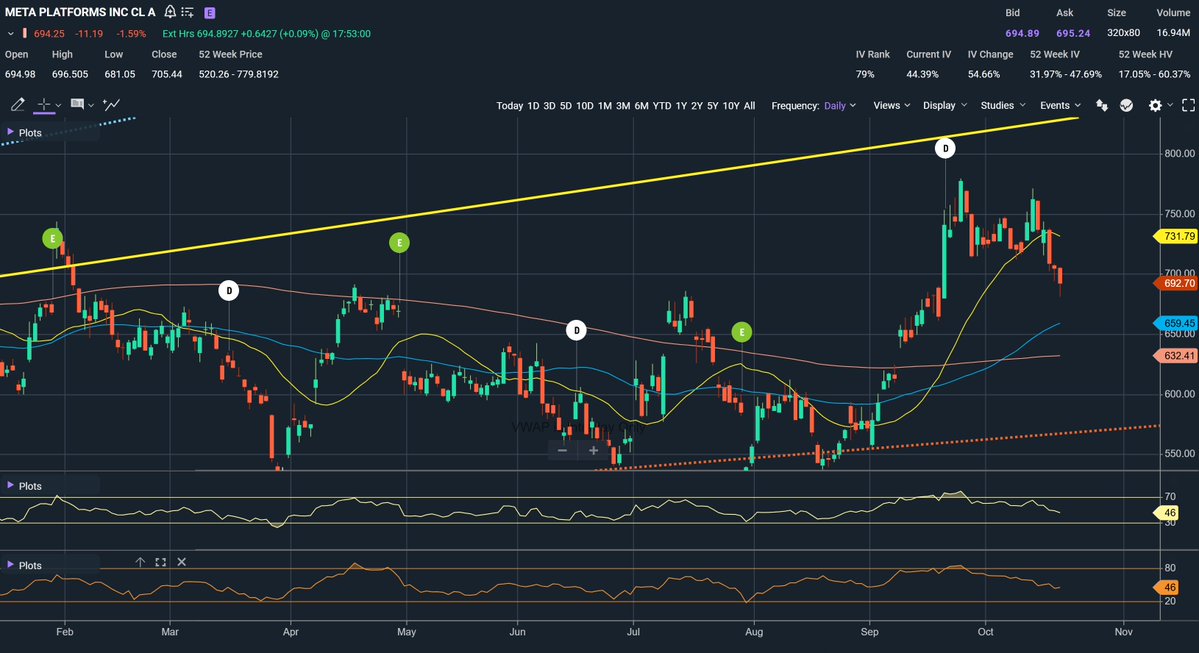
The worry is more of near-term if people are already antsy on AI spend & the time to ROI on AI spend, then I potentially see a short-term overcorrection on $META IF they were to announce large CapEx & OpEx numbers this quarter and the go-forward. Obviously, in the desire to launch Muse on time, I potentially see some near-term overspend there.
$META price action horrible leading up to their earnings tomorrow on 10/21. I wonder if massive CapEx numbers will dwarf the recent positive news from the Muse launch.
This is relevant not only for $META but the overall AI-trade thesis across tech (beyond just AI chips & HW).
Selling options? Definitely learn how to read the IV Constellation map. Helps to spot volatility spikes and to fine tune expiration targets.
While have been typically selling 1 wk out DTE, for $ORCL, I might consider selling the 2 wk out 10/30 exp as volatility is spiking likely around FOMC & other tech earnings that week.
@lalalachan46 I find these Q&A very interesting as you have a good sense of humor and have very strong wit answers which appear straight forward and genuine.
@darkminer FYI, I believe massive lockup shares being released 2 business days after earnings. So trade accordingly. My gut is Q3 earnings and fwd looking forecast should be good though.
Week 42 results:
Interesting week. At one point, it looked like I would be taking CSP assignments across most of my plays but ended up the week converting on my $TSLA & $QCOM plays (although on $TSLA even getting assigned as head into earnings week wouldn't' have been bad at all).
On $FIGR, my $27 put actually did expire out of the money, but it looks like some buyers decided to exercise, so 4 out of 10 lots got assigned.
I've been building up a nice position on $FIGR and will be exploiting a mix of CCs on them at medium aggressive to more conservative strikes next week and the weeks to come (so targeting $31-32 range).
$SOFI and $MP, I have some existing positions so wanted to get a nice lower entry. I have optionality here (no pun intended) and can either use these shares as DCA or to just do short term CC swing trades, like targeting +$1-2K gain per transaction for a quick stock trade flip.
But definitely for week 43, I see my mix leaning towards CC premium selling. So so far $8.7K realized for the month of Oct w/ 2 more weeks to go.
- Conservatively, I'm seeing $12K min. for Oct and potential for big upside on some of my CC plays on some of the Tech earning plays.