I wrote an intro blog post to async IO. Covers completeness vs readiness, edge- vs level-triggering, short desriptions of poll/select, epoll, iocp, and io_uring: https://t.co/bAIR6MSEhC
The Sensory Neuron as a Transformer: Permutation-Invariant Neural Networks for Reinforcement Learning
We explore RL agents that still work even when their observations get shuffled around a lot!
A fun paper w/ @yujin_tang
web https://t.co/rBsJeSNswA
pdf https://t.co/Ti5qZqtCIK
Today is the day! Crafting Interpreters is available for purchase in print, Kindle, ebook, and PDF! Behold: https://t.co/BXuTOXtDin
It took a lot longer than I expected, but it's all done now. So long that I wrote a blog post about it: https://t.co/oAygYH44A9
🎉📖🎉📖🎉📖🎉📖🎉
Big announcement time 📢 For a while now, I've been working on a book that covers the next steps of @rustlang after "the book" — everything from API design to error handling to concurrency to async to FFI. And the early access was just released over at https://t.co/A6Ox1QNxeV! 🎉
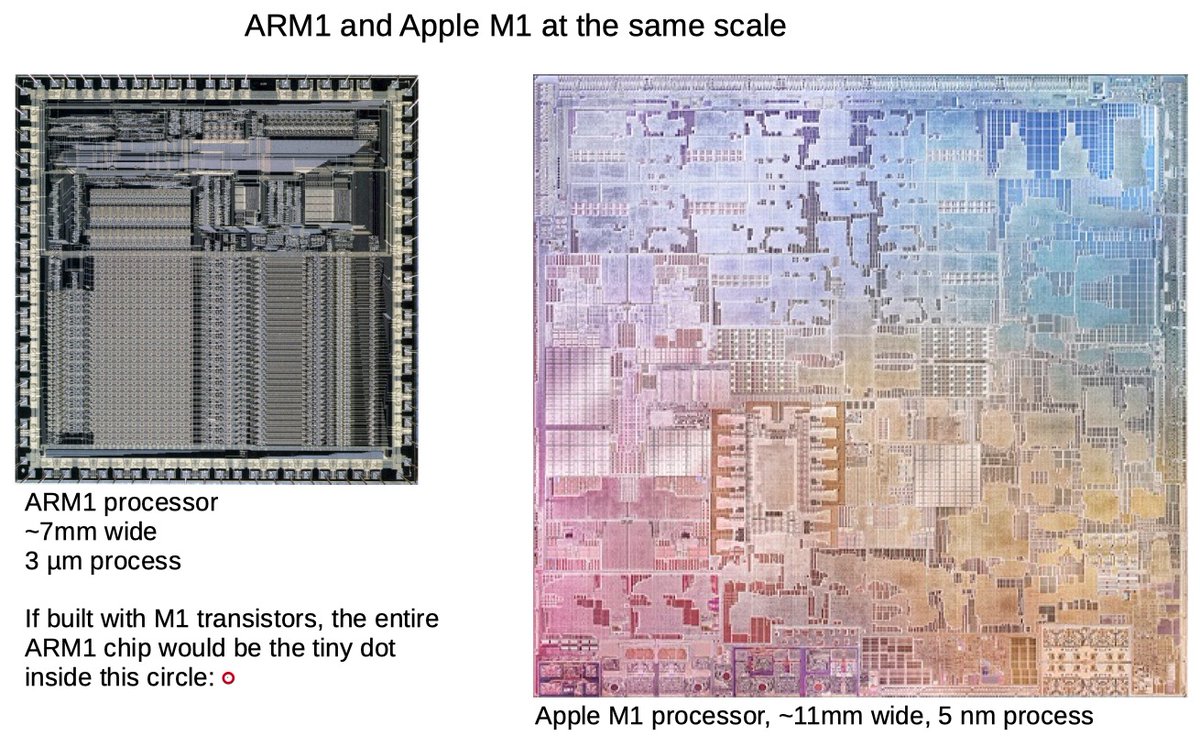
Here are the two dies at the same scale. The M1 is over twice as large physically as the ARM1. It has 16 billion transistors vs 25,000 for the ARM1. If you built the ARM1 using the same technology, it would be a pixel-sized speck.
he went to the king with a chessboard and said "put one transistor on the first square, and then every 18 months put twice as many transistors on the next square"
Hot take: deep RL research has stagnated because conferences have created bad incentives, rewarding researchers for vacuous claims of novelty, tenuous-at-best theoretical connections, or SOTA, while punishing boring analysis of the empirical tricks that actually make things work.
recently, some Rust programmers started doing something I think is quite harmful: `unsafe` zealotry. it is harmful for three reasons:
1) #![forbid(unsafe)] doesn't make your code memory-safe;
2) memory-safe code can have equally harmful bugs;
3) Rust is useful beyond safety.
🧵
Thrilled to be releasing Alchemy, a new benchmark task for meta-RL, abstract structure learning, & latent-state inference. In the paper, researchers show that Alchemy presents a formidable challenge even for state-of-the art RL agents. Game on! https://t.co/eZuPkBKuak
We’ve developed two neural networks which have learned by associating text and images. CLIP maps images into categories described in text, and DALL-E creates new images, like this, from text.
A step toward systems with deeper understanding of the world. https://t.co/rppy6u1zcn
Just finished editing the last chapter of "Crafting Interpreters". I have a few issues to resolve and a copy editor is doing a pass over everything. Soon I get to concentrate on typesetting. I can't wait to hold this thing in my hands.
Excited to share Evaluating Agents without Rewards!
We compare intrinsic objectives with task reward and similarity to human players. Turns out they all correlate more w/ human than w/ reward. Two of them even correlate more w/ human than reward does.
https://t.co/hctzH7cWFz
👇
Naturally Occurring Equivariance in Neural Networks -- A new Distill article by @ch402, @nickcammarata, @csvoss, @ludwigschubert, and @gabeeegoooh. This is the fourth article in the circuits thread.
https://t.co/eeBuNI2D8g
How can we move deep RL beyond games, without having to hand-build a simulator that covers real-world complexity? We adversarially generate a curriculum of challenging yet feasible environments by maximizing regret between a pair of agents, with PAIRED... https://t.co/i11pkeLNku
Excited to announce our NeurIPS paper on ReBeL, an algorithm similar to AlphaZero that plays *imperfect-information* games like poker and Liar's Dice! Joint work with @anton_bakhtin, @adamlerer, Qucheng Gong.
YouTube Video: https://t.co/3zc8qCZVgk
Paper: https://t.co/byZTE2bcpl