@imGopalTiwari@unusual_whales Guess you havent heard of the Cuban missile crisis. Dont think its them we are worried about but an enemy using them as a launchpad
Just got an airdrop of $TRIA from staking my $MON on @monprotocol. Many more airdrops incoming. Should I paint a Kevin on my lambo? #monprotocol
https://t.co/GFk1TfFlH8
.@wardensascent is now live on Android and iOS and playable worldwide. The game has a singleplayer mode - with campaign expansions added every month by our live ops team - and an endgame multiplayer challenge mode (Arena) where you can pit your @Pixelmon against other players.
All web payments going through the $MON - ID wallet system will automatically onramp to $MON @avax and reflect in app as in game purchases.
Try it. Links in comments.
I’ve been a Hyperliquid maxi for a long time, and HL still remains my largest position in Web3. But a recent decision by the team has been extremely disappointing to see.
Earlier this year, @monprotocol acquired the $MON ticker on HL for ~500k:
https://t.co/5TnzDkOB86
The rationale was that CEX interactions were frustrating, and the Pixelmon team wanted to align with a fully decentralized venue. The token ultimately didn’t gain much traction on HL (very low volume, practically a waste in hindsight), but at least the team had secured an immutable asset.
Fast forward to Monad’s launch, and suddenly the MON ticker on Hypercore now refers to Monad, not Pixelmon. So I checked with the Pixelmon team assuming they must have sold the ticker.
Turns out they didn’t.
Hyperliquid simply changed the frontend names:
Pixelmon is now shown as “Monpro” on UI (but still $MON on-chain).
Monad is shown as “Mon” on UI (but is actually $UMON on-chain).
So technically the ticker is immutable, but from a consumer perspective the actual UI identity has been reassigned. And realistically, no one cares what the ticker is on-chain when the UI shows something else.
If this isn’t effectively a ticker grab, what is it?
Pixelmon paid 500k for something that the frontend can override at will, while Monad (or rather @unitxyz, who is clearly closer to the HL team) gets the visible name without paying for it.
To be clear, this doesn’t materially affect Pixelmon’s future. But on principle, it’s wildly disappointing.
Is this the ethos Hyperliquid wants to stand for?
Centrally aligned players first?
What message does this send to smaller teams who choose HL because they believed “listings without fuss” meant UI consistency and fairness? Are we now saying:
“You can buy the on-chain ticker, but we’ll decide the visible name depending on who we talk to”?
Tagging @chameleon_jeff@iliensinc because this seems like a serious breach of HL’s own stated values, and I’m not sure whether this decision was fully acknowledged at the top.
For clarity:
Pixelmon ($MON): 0x622cf551933f19f9136303dcab56488c
Monad ($UMON): 0x58dae745c8c5fed4012f35ef39829c2d
Frontend:
This requires an explanation imo and its not about this particular case but more problematic for the overall direction team wants to take. To me this is a clear slap on the face of smaller teams being allowed to be strong-armed by privileged partners.
@sershokunin can you also pitch in as to what happened here?
Web 3 Gaming Isn’t Dead — It Just Moved On-Chain
Every few months, someone tweets “Web3 gaming is dead.”
They point to quiet Discords, fallen tokens, and half-finished metaverses.
But they’re looking in the wrong place.
Web3 gaming didn’t die — it just stopped looking like games.
The Hidden Revival
In 2021–2022, gaming projects were about “play-to-earn.”
Tokens, NFTs, unsustainable rewards.
Everyone was a farmer, not a player.
Then the market crashed — and attention vanished.
But under the surface, something important happened:
blockchain quietly became a game infrastructure, not a game genre.
The shift wasn’t hype. It was architecture.
From Play-to-Earn to Play-for-Value
Developers realized players don’t want DeFi with skins.
They want ownership, not spreadsheets.
That’s why the best-performing Web3 games in 2024–2025 aren’t branded “crypto” at all.
They’re free-to-play, on-chain under the hood, with assets that move between games or into wallets.
Ownership is invisible — not advertised.
The Data Says Otherwise
If gaming were “dead,” the numbers wouldn’t look like this:
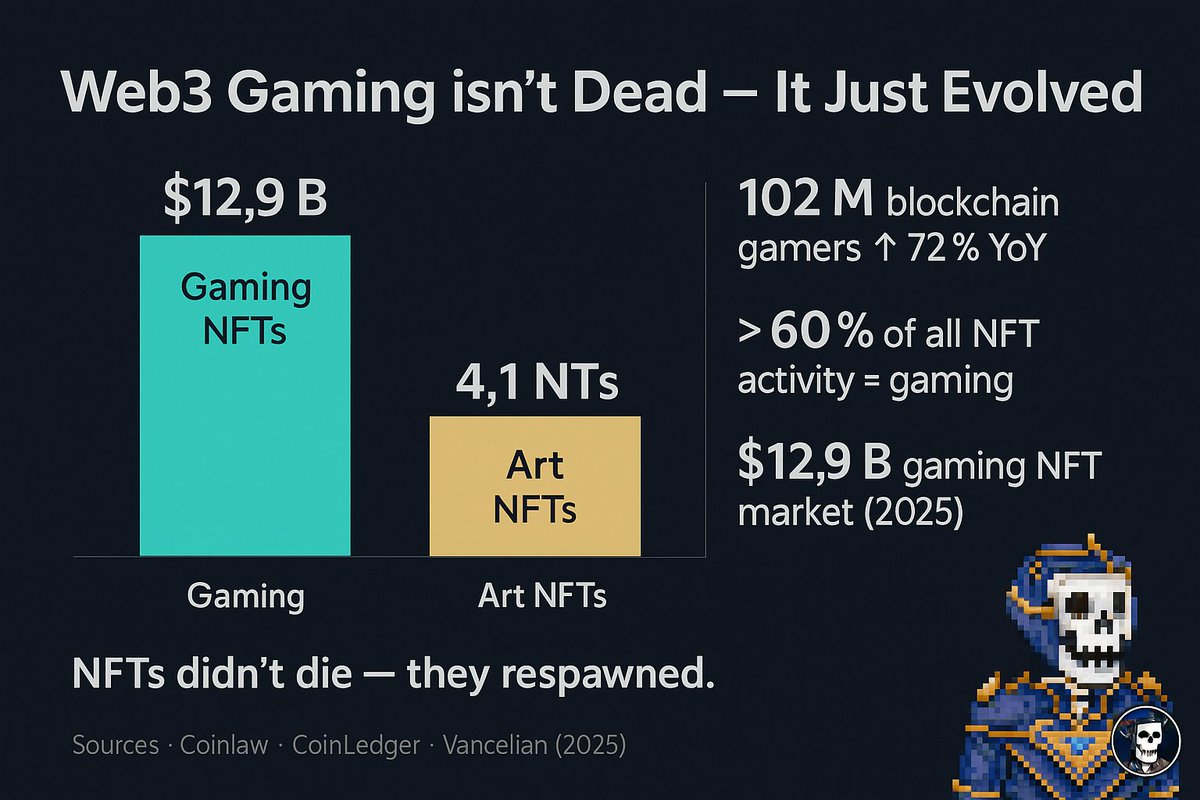
Blockchain gamers: ~102 million in 2025 — up 72 % YoY. (https://t.co/tOOca7FXhX)
Gaming NFTs: ~$12.9 billion market value in 2025 — 3× higher than “art NFTs.” (https://t.co/tOOca7FXhX)
NFT users total: ~11.6 million globally, majority linked to gaming or identity, not art. (https://t.co/Qvrs0l5eei)
Active gaming wallets: >60 % of all NFT activity. (https://t.co/iGAEg1kDrK)
The “JPEG economy” collapsed.
The gaming economy replaced it.
The New Player Economy
Gaming is now where NFTs make sense:
You earn through time and skill, not speculation.
Assets are composable — skins, weapons, and currencies exist across titles.
Communities act like DAOs — guilds, staking pools, co-ownership.
Gamers aren’t flipping JPEGs.
They’re farming time value.
What Critics Miss
Most “Web3 gaming is dead” takes come from investors who lost token bets, not from players who stayed.
The new generation doesn’t talk about tokenomics.
They talk about progression, ownership, portability.
Crypto didn’t kill gaming.
It infected it — quietly, irreversibly.
Why This Matters
If DeFi financialized money,
then gaming financialized time.
That’s a bigger idea than any token airdrop.
It’s a re-definition of digital labor.
Gaming is the first place where crypto utility feels natural — not financial.
It’s the bridge between users and on-chain economies.
Web3 gaming isn’t dead.
It just stopped calling itself Web3.