A dead plumber in Tucson booked 11 jobs last month.
He died in 2023. The Google listing never came down. 212 reviews, 4.9 stars, eleven years of a town deciding this is the number you call when water is on the floor.
Google charges live plumbers about $55 a lead in that market. The dead man's listing produced 34 calls last month. Call it $1,900 of monthly lead flow attached to a phone number that went back on the market because the family canceled the phone plan, not the reputation.
A guy I know bought the number for $40 and pays $12 a month to forward it.
He answers as a dispatch service, routes every call to a licensed plumber two miles away, and takes 15% of booked work. 34 calls, 19 real jobs, 11 booked, $740 average ticket. About $1,200 a month for answering a dead man's phone.
Here's the part nobody thinks about. Around one in ten small businesses dies every year and Google audits none of it. A listing only gets marked closed if someone reports it, and nobody reports a dead plumber until they've already called him. Maps is full of these. Dead websites behind live listings. Disconnect tones behind 4.9 stars.
The estate sold his trucks and his tools. The listing was worth more than both and it wasn't in the will, because nobody thinks of 212 reviews as property.
Trust has no probate and Google doesn't check pulses.
🎱 Does Google use llms.txt?
Magic 8-ball says yes. Google says no.
Truth: it's NOT a Google ranking signal, NOT a standard - but other AI agents can parse it.
Ship it if it's cheap. Don't confuse doing the trend with moving the needle.
🔗 https://t.co/aV29nWIjNs
#llmtxt#seo
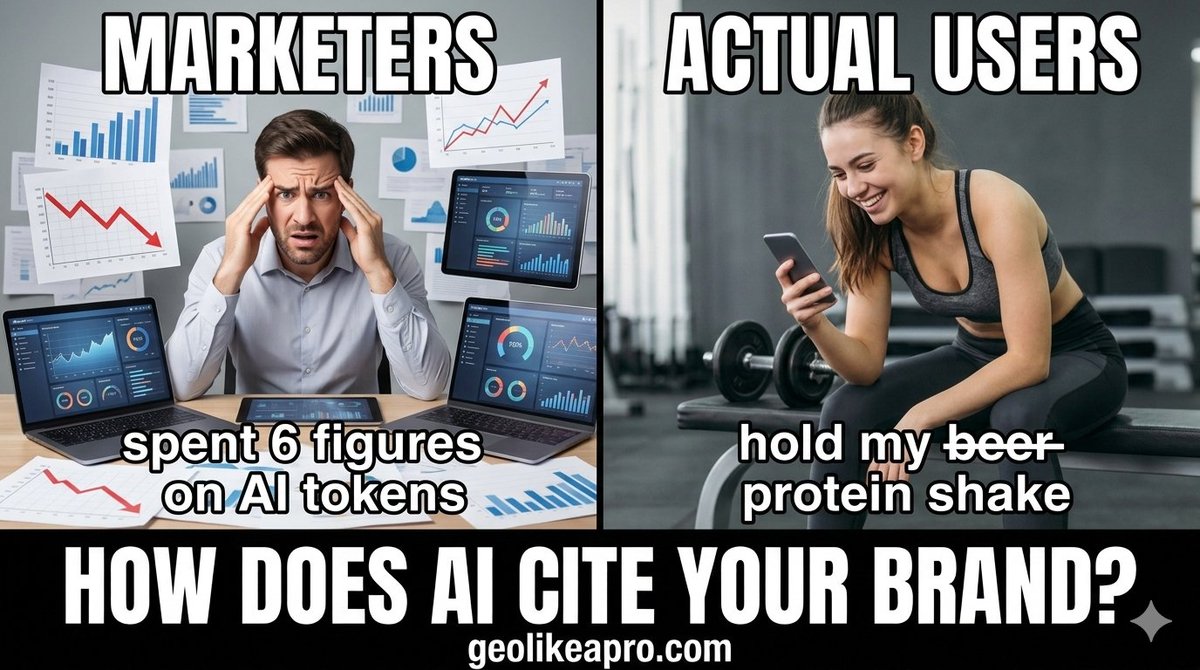
You spent 6 figures on AI tokens.
Your customer typed "gym leggings uk that don't go see-through" and the model recommended someone else.
Does AI cite your brand? Soon you'll know. https://t.co/8AtSuPw6LZ
The rule I would ship: run the layers top to bottom.
Most teams find their problem in Layer 2 or 3 and never touch Layer 5.
Skipping to "just ask ChatGPT" is how you debug the wrong thing.
Full breakdown with curl commands and the failure table:
https://t.co/y8mIBAnf6b
Your JSON-LD passes Google's Rich Results Test.
ChatGPT still won't cite you.
I overed this 9 out of 10 times across 50+ brand audits this year. The Rich Results Test is the wrong tool for AI search.
Here is the 5-layer test stack that actually works 🧵
Layer 5 - Live LLM extraction.
Open ChatGPT. Ask a buyer-intent question about your product.
If it quotes your FAQ verbatim, you win.
Paraphrase or competitor citation = something earlier failed.
Repeat in Perplexity and Claude. Citation behavior varies per engine.
Full research with charts, methodology, and the per-brand
data:
https://t.co/D4ea9FIPpm
If you want your brand included in the next sprint, my email
is in the post.
Schema-readiness does not predict AI citation rate.
We audited 50+ mid-market e-commerce brands × 4 LLMs over
two weeks. The data is uncomfortable for our own product.
A thread on what we found 🧵
Synthesis: the three findings are one variable — mention density.
→ Cultural authority: baseline density in training.
→ Native-language: language-localized density.
→ Schema: retrieval-time density.
Most GEO tooling — ours included — optimizes the wrong layer.
The mechanism: a two-corpus model.
LLMs cite from two places —
1. The TRAINING corpus (frozen at training cutoff)
2. The RETRIEVAL corpus (live web during the query)
Schema can affect retrieval, but cannot rewrite training.