@mattvanswol Even I know that the 14th Amendment has been in the constitution since the 19th Century and Im not even American.
The US education system really is fucking shit if Americans dont know their own constitution and history.
His pal Murdo has lost every single election and gets in through the List. Let's review and shakeup the voting system and drop the list part of the vote altogether.
The voting system for Scottish Parliamentary Elections needs review.
Parties from across the political spectrum have tried to mis-use the system by encouraging voters to tactically vote one party on the first ballot and for another on the second- essentially doubling the voting power of a smaller group of voters.
The Scottish Greens are the biggest winners from this- standing aside in all but 6 constituencies to allow the SNP to win, while standing full slates on the list.
The result? The SNP's list vote was 11% lower than their constiteuncy, the Green's list was 12% higher than their constituency. I'll leave you to figure out what happened!
Perhaps a change could be that in order for a candidate to appear on the list, they would need to stand in a constituency.
@JoshMacLd Tory boy forgets that before his Da spanked in his mum that the top 10 poorest cities in the UK was full of Scottish cities (4 or 5 places I believe) now Scotland has no city in the top 10. Yet tory boy here tell us scotland has declined.
Never.
I’m sick of ambitious young Scots having to leave Scotland to make a success of themselves.
I don’t want them to have to go to London to make their money, like I did, or be drawn to Dubai.
I’ll not be going anywhere until Scotland works for those who work.
@CaptainFalke A quisling is a traitor who collaborates with an enemy occupying force to rule their own country, often serving in a puppet government. The term is synonymous with a collaborator, turncoat, or puppet ruler, and connotes extreme betrayal.
Soldiers acting within orders os not a great out of jail free card. The nazis found that out at Nuremburg. Countless war criminals have found that out at the Hague over the years. So why should British soldiers be exempt for committing murder?
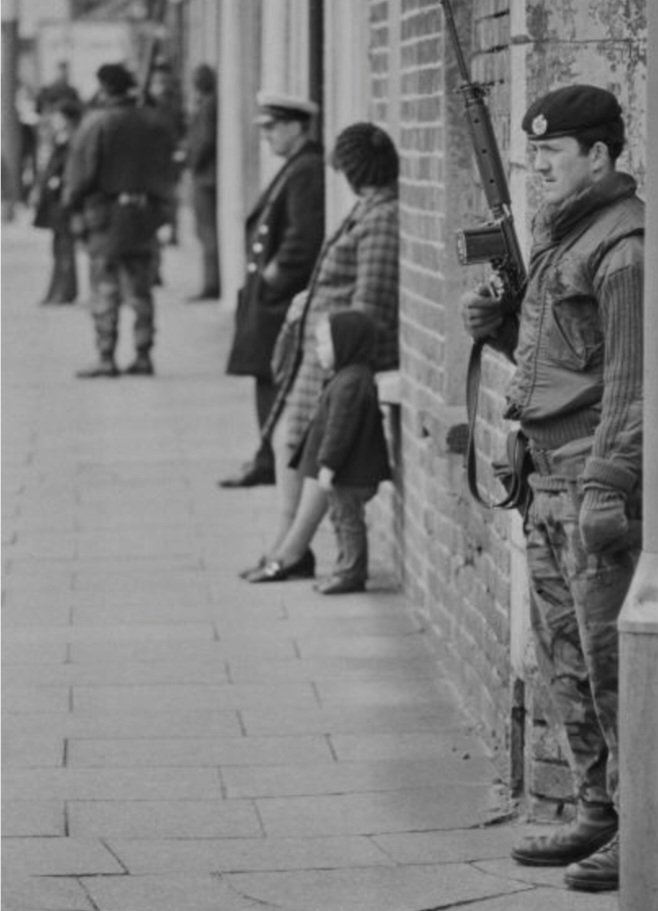
Three former soldiers will appear at Belfast magistrates court on April 20th. One is charged with a killing that took place in May 1972. He is not accused of acting outside his orders. He is accused of acting within them. The distinction no longer appears to matter.
This is the reality behind Labour's Northern Ireland Troubles Bill, a piece of legislation dressed in the language of reconciliation that functions, in practice, as an engine of persecution. The state that sent these men to Northern Ireland, that gave them their orders, that relied on their judgment in circumstances no minister has ever faced, is now the state that funds the machinery pursuing them through the courts half a century later.
That is not a technicality. It is the central fact. Taxpayer money flows to the lawyers challenging the actions of soldiers whose actions were sanctioned by the taxpayer. The government calls this justice. General Sir Peter Wall, who commanded the British Army for four years, calls it something without moral backbone. He is right.
The operational consequences are already visible. Elite soldiers are leaving the SAS and SBS rather than face the prospect of prosecution decades hence for missions carried out under government orders. The crisis has become sufficiently acute that reservists are being brought into the regular SAS to fill roles vacated by those walking out. Britain's most capable fighting force is being quietly hollowed out by a bill whose architects appear indifferent to the result. Seven former SAS commanders have warned that the legislation is doing the enemy's work, that operational secrets exposed through inquiries give hostile states a narrative of lawless troops. Moscow, Tehran and Beijing do not need to discredit British special forces. Westminster is doing it for them.
The asymmetry at the heart of this legislation is not incidental. It is structural. IRA members were released under the Good Friday Agreement. Many destroyed evidence, stayed silent, or received letters guaranteeing they would not be pursued. Soldiers kept records, gave statements, and remained traceable. Decades later, only one group remains available for scrutiny. Not because they are more culpable, but because they are more reachable.
The Coagh ambush of June 1991 illustrates the logic perfectly. Three IRA men were stopped by the SAS on their way to murder someone. A coroner ruled the force used was justified. Years later a family challenged that ruling, arguing the soldier should have paused after each shot to consider whether to fire the next one. A judge described that argument as ludicrous and utterly divorced from reality. The challenge continues, funded by legal aid, heard at the Court of Appeal just days ago. No verdict ends the process. The process is the punishment.
Keir Starmer has said publicly he is absolutely confident there will be no vexatious prosecutions. Three soldiers will be in a Belfast court in sixteen days. His confidence has not reached them.
The government insists its bill provides robust protections for veterans. General Sir Nick Parker, who oversaw the final operations in Northern Ireland, says ministers do not understand the duty of the state to stand by those who serve it. The duty to stand by those who serve is contractual, not sentimental. A soldier who follows orders in a war the state authorised cannot later be offered up as payment for political convenience.
What is being constructed here is not a legacy process. It is a permanent legal industry, sustained by public money, targeting the most traceable participants in a conflict the state itself waged. The soldiers kept their records. That is now their liability.
A serious country does not behave this way. This one, apparently, does.
"Keir Starmer has said publicly he is absolutely confident there will be no vexatious prosecutions. Three soldiers will be in a Belfast court in sixteen days. His confidence has not reached them."