🦔Nvidia spent the last two years acting like the AI industry’s bank. It invested in its own customers, promised to buy their unused capacity, and guaranteed up to $105 billion in rent on a data center built for OpenAI. Those customers then bought Nvidia chips.
This week the guy who built that loop resigned, and the CFO now running Nvidia once pushed back on an even bigger OpenAI backstop. I made a video on how the money circles, where it already cracks, and who gets hurt if it breaks. Nvidia itself has the profits to ride out a slowdown (for now...), but a lot of the companies that run on its checks don’t.
Hedgie🤗
The AI agent market is not zero sum market. I believe each of us will want at least two seperate AI assistants in their life. One being a personal one covering their personal life and the other being work-related. $META and $MSFT are well positioned and made the first moves.
The reason why we will want to seperate those two roles is because each agent must prioritize different goals and objectives:
1. A personal assistant is meant to optimize and take in account your life goals and preferences. It should also be high in privacy and not meant to be observed, audited or transfered.
2. A work agent will probably be a owned and shared with your employer. Once you leave a company or change jobs the agent will get deprovisioned and the memory will stay with the employer (that is why you don't want any of your personal stuff in there). The employer wants the agent to be observed, audited all the time. Because of privacy and safety your employeer will also not approve of all the integrations and connectors that your personal agent would want because it poses a risk to company data and cyber risk.
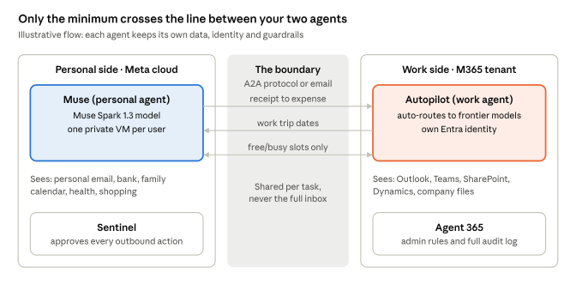
The way I believe we will have these agents is that the personal and the work agent will communicate on matters that they need to like calendar scheduling or other tasks, but each keep their own data seperate and siloted from each other.
I made an image of an example I made for $META's Muse potentially communicating with $MSFT Autopilot.
For the personal assistant having the best IQ model doesn't matter its more a skillset similar to human assistants: knowing the boss's preferences, holding the keys to the calendar and inbox, knowing when to interrupt and when not to, being fast, being discreet, and being reliably available. $META is in my view positioned great for this as it is the closest to the current system of "knowing your preferences" from the social algo that they have on us.
For the work agent it does seem like companies will want to be independent and not reliable on only one model vendor so an orchestration layer (between models & model companies) is almost needed here, especially as the workers tasks can change over time and different models are good at different things.. Here the companies that are very well positioned are the hyperscalers and especially $MSFT because they have many of the integrations that the assistants needs (human tools) + they have already established relationships and trust from companies. $MSFT again doesn't need to own their own frontier model they just need to be the best router and keeper of context and data (harness).
The point I wanted to get across is that the AI assistant market is not there is only going to be one AI assistant that wins, as we will soon get a flurry of different AI assistants.
Today, we're unveiling the all-new https://t.co/nXVMBhAv7M. It's been 8 months in the works, hand-crafted to represent what Acquired has become today.
Enjoy :)
@ojansat@FrankTornen El porfolio és complementari però no em quadra pq serà difícil que Puig obtingui una posició dominant amb el tamany d'Estee Lauder...
the SaaS to AI transition is going to be lot messier and less straightforward than people will admit
the CRM to AI CRM trope sounds really nice on paper, but the reality is a lot more complex
but because people like digestible narratives, those are the ones that persist 🧵
With Cursor/Lovable/Claude Code, the cost of software creation is approaching zero. I think this will fundamentally change software business models over the next decade.
Software itself will be less differentiated, meaning differentiation will have to come elsewhere; in many cases, the software itself will be "free" in order to charge for another offering.
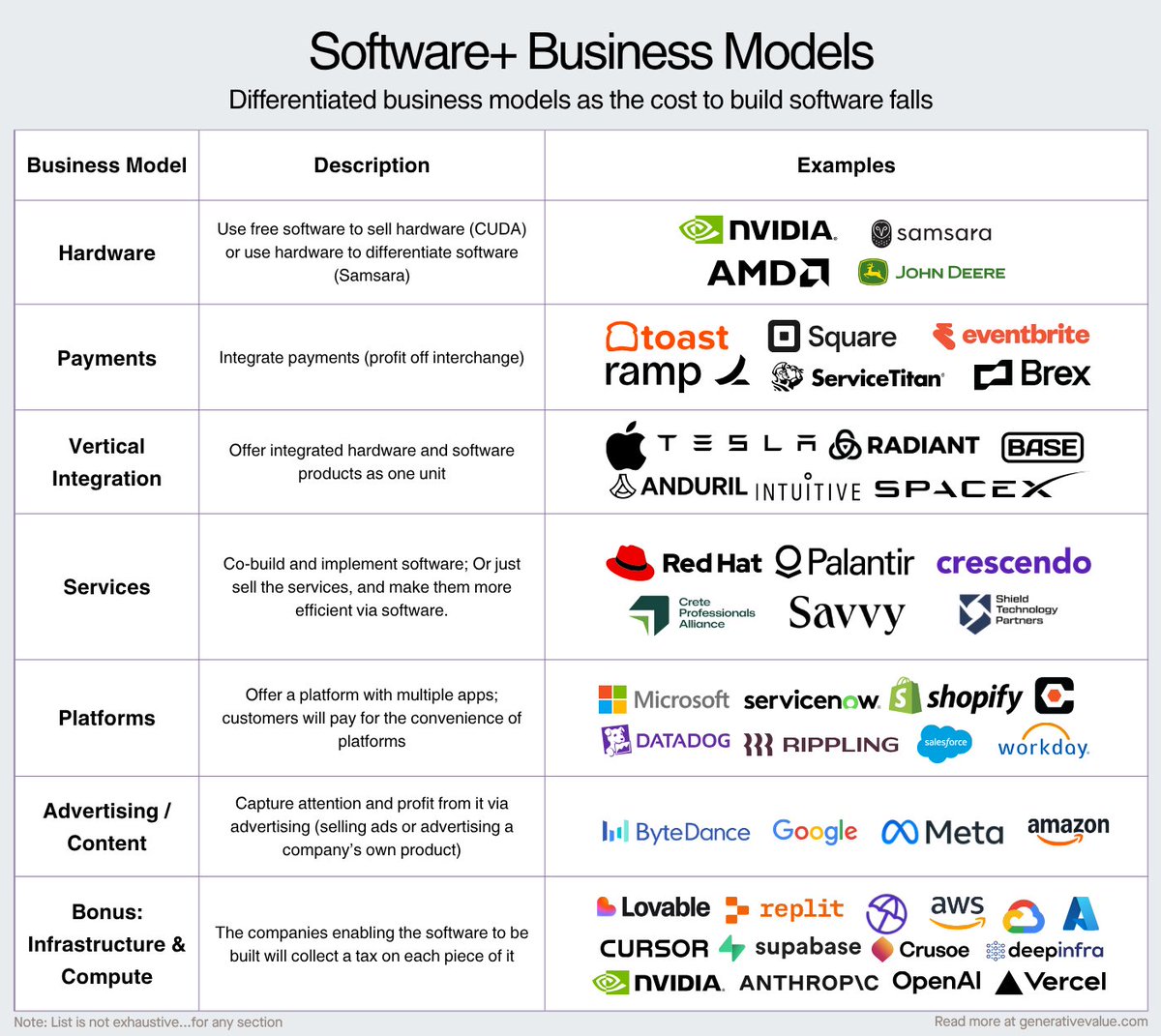
As I see it, there are seven business models that benefit from this:
1. Hardware: Use software to sell hardware (or vice versa)
2. Vertical Integration: Offer vertically integrated hardware and software
3. Services: Charge for the work itself (accounting, legal) or offer services to integrate software into complex, custom deployments
4. Payments: Give away software, charge for interchange fees
5. Platforms: Customers will pay for the convenience of platforms, not the functionality of point solutions
6. Advertising: Software essentially becomes “interactive content.” Infinity bonus points if network effects are involved
7. Infrastructure / Compute: The platforms that enable software creation will collect their tax on each piece of it
So I’m writing a several-part series laying out a framework for business models in the age of “free software"
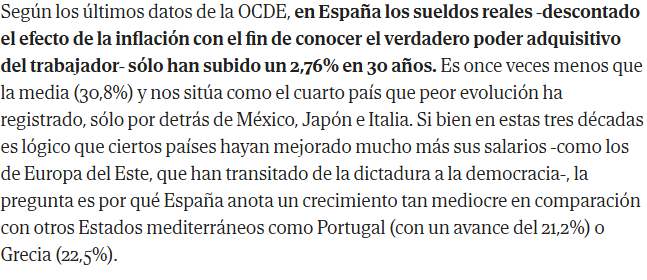
En España los sueldos reales sólo han subido un 2,76% en 30 años, 4º peor país, sólo por detrás de México, Japón e Italia. 11 veces menos que la media (+30,8%) y menos que Portugal (+21,2%) o Grecia (+22,5%)
(El Mundo)
¿Qué pasa si la IA llega a ser más inteligente que nosotros?
¿Sabemos qué significa ser inteligente?
🧵 Un hilo sobre inteligencia (y qué pasa cuando ya no somos los únicos que lo somos).
Big Tech is entering a new era of higher net income margins, driven by AI, as the need for workers is reduced:
- $MSFT just announced it is laying off 4% of its workforce.
- $GOOGL offering buyouts to more workers
- $META tightening performance standards for employees (might be an early sign of layoffs)
- $AMZN Jassy saying: "...It’s hard to know exactly where this nets out over time, but in the next few years, we expect that this will reduce our total corporate workforce as we get efficiency gains from using AI extensively across the company"
While the valuation multiples on these businesses may seem historically high at face value, the margin expansion could mean the multiples are actually at an average or low level.
Today we launched a new product called ChatGPT Agent.
Agent represents a new level of capability for AI systems and can accomplish some remarkable, complex tasks for you using its own computer. It combines the spirit of Deep Research and Operator, but is more powerful than that may sound—it can think for a long time, use some tools, think some more, take some actions, think some more, etc. For example, we showed a demo in our launch of preparing for a friend’s wedding: buying an outfit, booking travel, choosing a gift, etc. We also showed an example of analyzing data and creating a presentation for work.
Although the utility is significant, so are the potential risks.
We have built a lot of safeguards and warnings into it, and broader mitigations than we’ve ever developed before from robust training to system safeguards to user controls, but we can’t anticipate everything. In the spirit of iterative deployment, we are going to warn users heavily and give users freedom to take actions carefully if they want to.
I would explain this to my own family as cutting edge and experimental; a chance to try the future, but not something I’d yet use for high-stakes uses or with a lot of personal information until we have a chance to study and improve it in the wild.
We don’t know exactly what the impacts are going to be, but bad actors may try to “trick” users’ AI agents into giving private information they shouldn’t and take actions they shouldn’t, in ways we can’t predict. We recommend giving agents the minimum access required to complete a task to reduce privacy and security risks.
For example, I can give Agent access to my calendar to find a time that works for a group dinner. But I don’t need to give it any access if I’m just asking it to buy me some clothes.
There is more risk in tasks like “Look at my emails that came in overnight and do whatever you need to do to address them, don’t ask any follow up questions”. This could lead to untrusted content from a malicious email tricking the model into leaking your data.
We think it’s important to begin learning from contact with reality, and that people adopt these tools carefully and slowly as we better quantify and mitigate the potential risks involved. As with other new levels of capability, society, the technology, and the risk mitigation strategy will need to co-evolve.
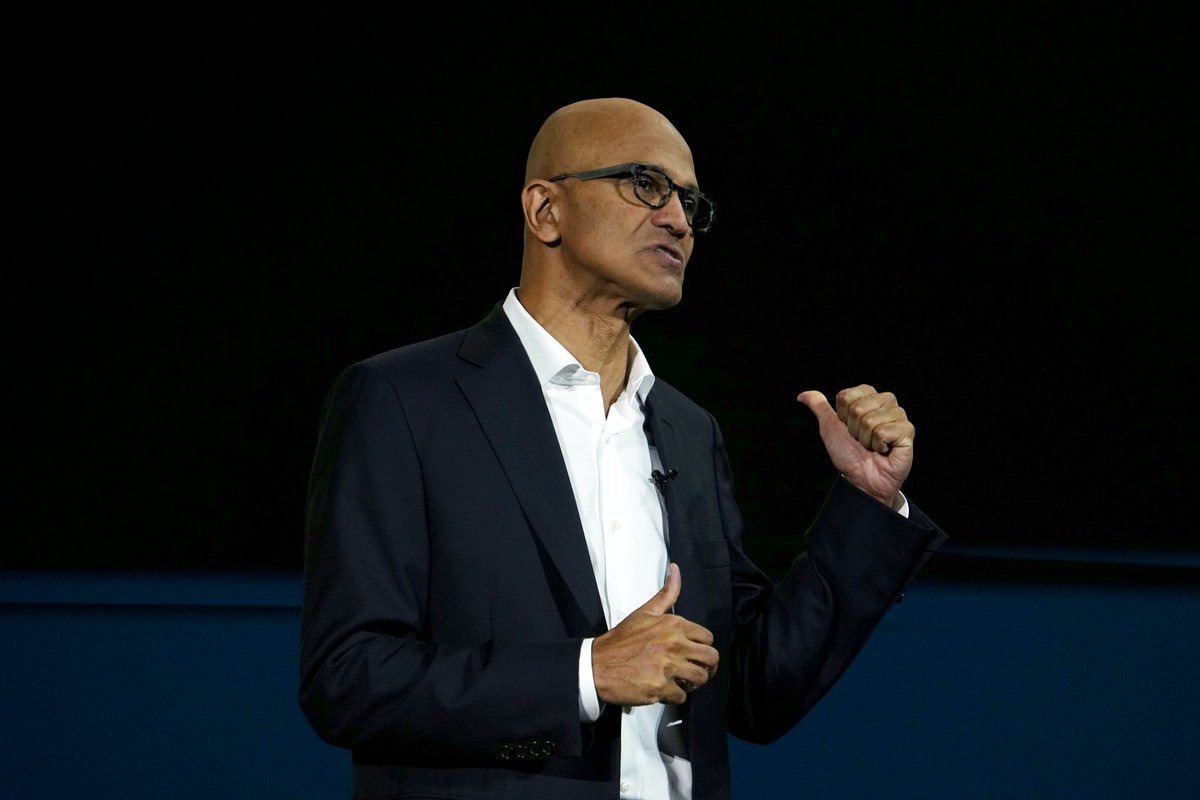
Satya Nadella, CEO of Microsoft, just made a bold prediction:
"The application layer is collapsing into agents."
Translation? Your apps are obsolete.
In a recent interview, he revealed the ONE shift that will redefine AI’s future...
Here's everything you need to know:🧵
Porsche Shifts Course, Leans Into Hybrids Instead of EVs
Porsche planned to go almost all-in on EVs. Customers had other ideas.
#oott
https://t.co/dqEDJPVvL4
Jevons paradox strikes again! As AI gets more efficient and accessible, we will see its use skyrocket, turning it into a commodity we just can't get enough of. https://t.co/omEcOPhdIz
1/ Some thoughts on hyperscaler earnings:
They’re at the heart of the ROI debate because they sit in between “AI Supply” (compute, data centers, energy) and “AI Demand” (cloud rentals/inference/applications).
On “AI Supply”, the final numbers for CapEx came in at 55% Y/Y growth for 2024 and 68% Y/Y growth for this quarter’s CapEx.
Currently, the hyperscalers are all capacity constrained, but hinted to those supply constraints easing by the end of the year:
- “We're still growing at a pretty reasonable clip, as I mentioned earlier, but I do think we could be growing faster if we were unconstrained. I predict those constraints really start to relax in the second half of '25.” - Andy Jassy (AMZN CEO)
It'll be an important moment for the ecosystem when supply catches up to demand, and we see current demand (unhindered) for AI applications.
LVMH, the luxury Giant, ( $MC / $LVMH) is down about 20% this year, and about 35% from the all-time high.
The richest European man is actively buying the dip.
Should we? Let's find out.