The best way to code with AI right now is:
Pair Fable with GPT-5.6 Sol and have them create a loop where they come up with ideas on what to build and a cheap and fast cheaper model implements them (right now I'm using Devin Cloud + SWE-1.7-Lightning).
The frontier models come up with the ideas on what to build and keep each other in check. They then deploy swarms of cheap agents to actually build their ideas to see what they look like in practice (this works especially well for frontend). Then after, they should spawn fresh frontier agents who are designed to criticize the agents ideas + their implementation from a fresh perspective (so they are not polluted by having context to what was being accomplished).
I call this Agent Recursion: nesting agents from the idea all the way down to the validation of the actual production.
The reason this works and can be done well is that with how good the newest cheap models are (SWE-1.7-lightning is Opus tier w/ 1,000 tokens a second), you're no longer limited by the actual frontier model implementing the work itself. Instead, it's just responsible for idea generation (which is why pairing adversarial frontier models with each other is advantageous as they often catch each others mistakes).
We've seen an exponential increase in output quality by encoding this across all functions in our company.
Have fun!
Nexus (@TheCryptoNexus) is $3.7M short hyperliquid:native and keeps adding to the position as the price moves higher.
On the other side of the trade, qianbaidu (@qianbaidueth) just bought $584K worth of HYPE spot.
One keeps shorting the strength. The other is buying it.
Who will be right?
Africa's largest crypto exchange will power their core perps offering directly using Hyperliquid's onchain liquidity. This is a major milestone that will redefine how the next generation of financial applications are built.
The breakthrough of cloud computing was that any startup could quickly test their idea, with the comfort that the infrastructure would scale with their business. As the most liquid global venue for assets such as BTC, Hyperliquid will play the same role in the global economy. By tapping into the deepest onchain liquidity, builders can instead focus on their product and users.
Huge congratulations to the VALR team. We are honored that they chose to build on Hyperliquid. Excited to scale together!
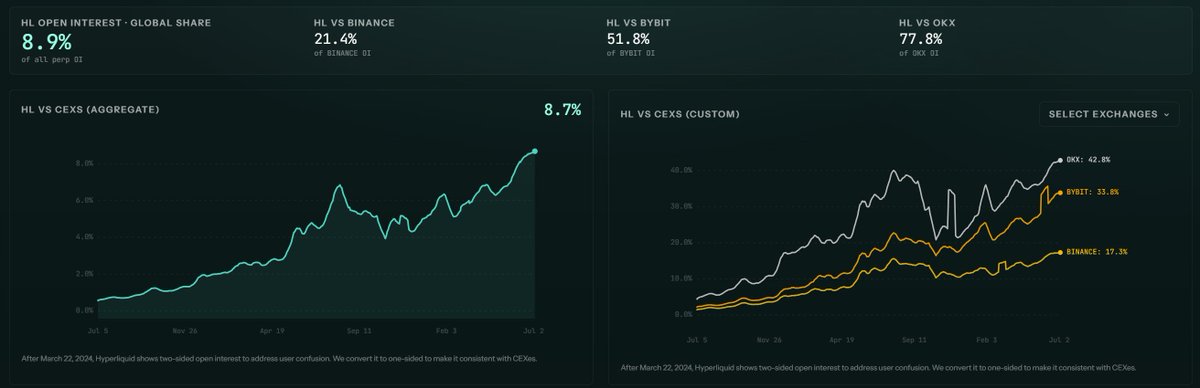
Hyperliquid has reached a new all-time high in global perpetual open interest market share vs. CEX, climbing to 8.9%.
Its open interest is now equivalent to:
- 21.4% of Binance
- 51.8% of Bybit
- 77.8% of OKX
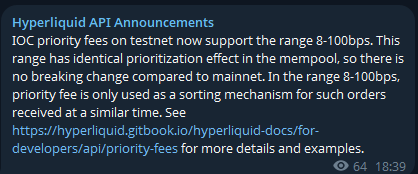
Over the last 30 days, only 244 wallets paid write priority fees on Hyperliquid, and just 6 paid read fees, burning over $2M of HYPE.
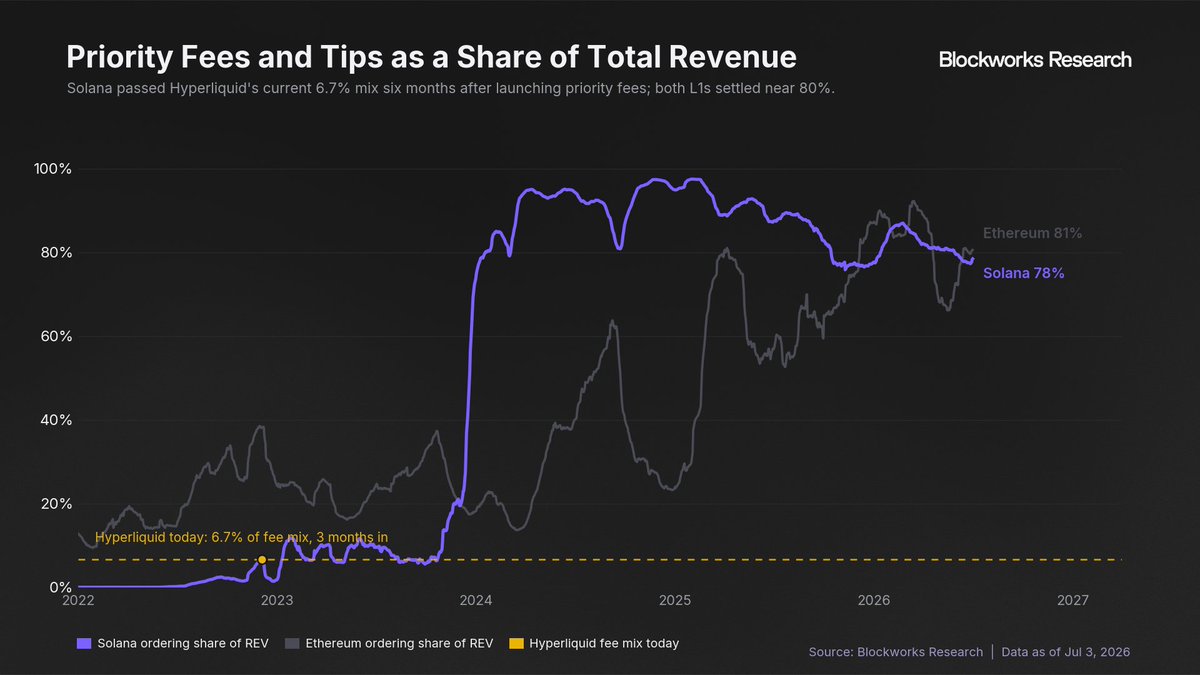
Only three months after launch, priority fees already make up 6.7% of Hyperliquid's revenue.
Where will we be in a year?
HyperSwap UI v2
The most HyperLiquid-aligned AMM, distributing over $20,000 in monthly LP incentives while allocating 75% of protocol revenue to token buybacks
Job's not finished.
I've been enjoying Victoria Whitworth's new work, The Book of Kells: Unlocking the Enigma.
I've actually never seen the Book of Kells in person, somewhat to my embarrassment. I've been doing some reading about the origins of Christianity this year, however, and I figured I should know something about the most famous Irish manuscript. (Perhaps the most famous manuscript, full stop.)
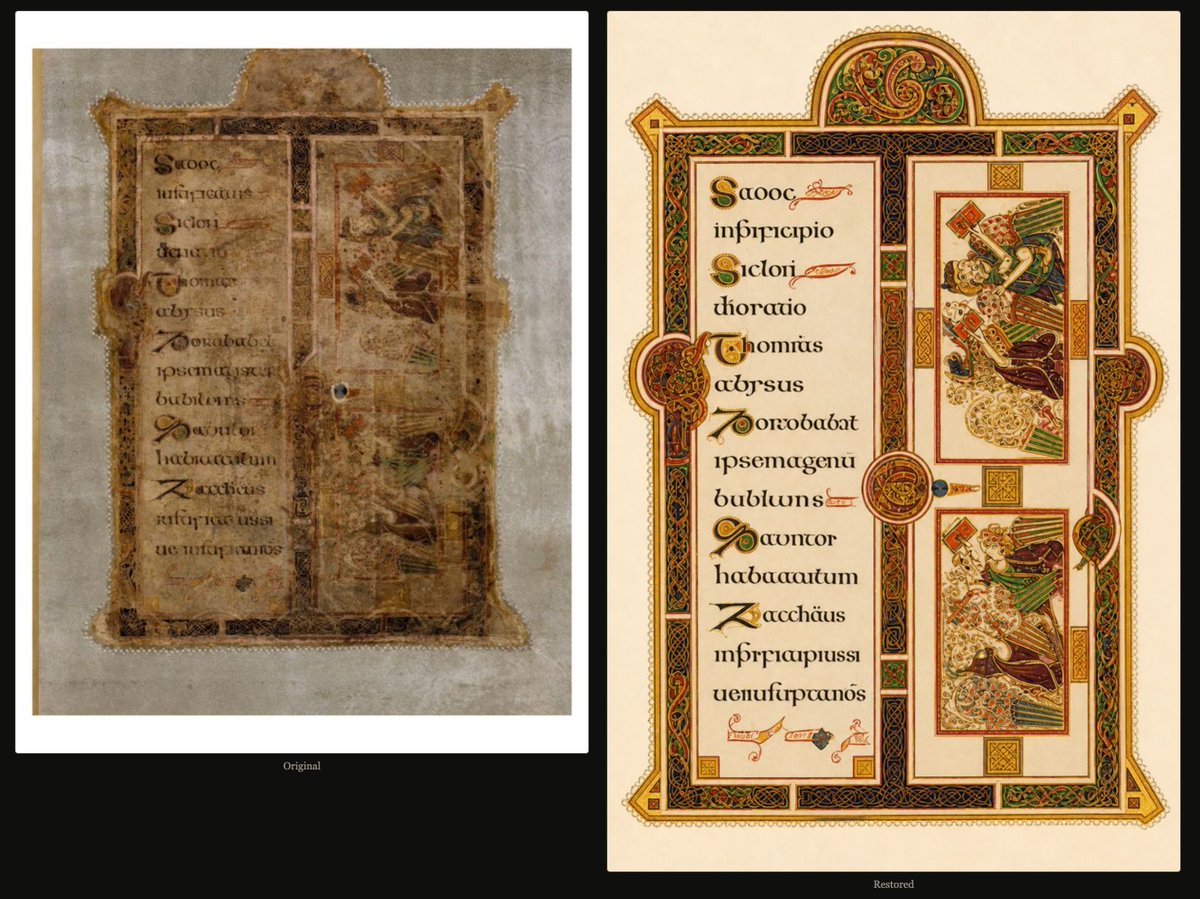
Reading the book, I was struck by how much the contents have suffered over the past ~1200 years (enduring everything from water damage to reckless malfeasance in attempted nineteenth century restoration), and I wondered whether AI could help give a sense for how the work might originally have appeared.
I downloaded the Internet Archive's PDF and asked my friendly neighborhood agent to use gpt-image-2 to render each page the way it imagines it might have originally appeared. Remarkably, this all worked with a single prompt, with the agent spinning up 48 workers, since each page took a minute or two. (I'm sure that someone wiser than me could prompt the model better, ensuring somewhat more historical accuracy in color restoration and so forth. There is no gold leaf in the Book of Kells!) This part of the project went from conception to completion before I'd finished my morning coffee.
I then wanted some easy way to view the results online, so I asked Stripe Projects (https://t.co/1tSgGbSLxM) to host the result on Vercel. That also worked in basically a single prompt: https://t.co/5ED9TM7lJB.
I also figured that people might want an easy way to download the full PDF of updated images, but it's a large (~200MB) file, so I decided that I should charge $0.10 to cover bandwidth costs using @MPP. I asked my agent to set this up, and it basically worked smoothly, though I had to tell it what MPP is (I guess it's not yet in the pretrain) and also manually set up the Cloudflare account that actually hosts the PDF and configure the API key. (Vercel seemingly has a 100MB limit.) The purchases now show up in my Stripe account alongside all other activity.
The site now has a ready-made agent prompt for anyone who wants to download the whole thing. I'm guessing that we'll see a lot more UIs like this in the future.
I remain pretty intrigued by the intersection of agents, micropayments, and stablecoins. I don't know much about managing crypto wallets from the CLI, but now AI can do that for me, while Stripe seamlessly handles turning it all back into fiat.
So what is the moral of the story?
• Whitworth's book is very good, and you should buy it.
• The Internet Archive continues to be wonderful and a civilizational treasure.
• While there are rough edges, setting up third-party services via the CLI now basically works. I'm pretty sure I wouldn't have bothered with any of this if I couldn't have outsourced almost all of the work to AI.
• The image models have gotten very good.
• There will probably continue to be all kinds of interesting applications of AI to history. (The Vesuvius Challenge of course being a shining pioneer.)
• These days, I often find myself building single-use sites for things I'm learning or for books I'm reading. I think this is a cool new category of software.
Knowing the setup is the easy part.
The hard part is trading real size, taking the loss, and not forcing the next one just because someone else is making money.
@nobraintrader1 on why execution and psychology are the real skill in trading.