To all the addiction medicine and harm reduction people out there who say that pain patients are the one who put us in separate groups, I’d like for you to listen to this video and think of it from the point of view of a chronic pain patient and a chronic pain patient advocate who hears about clinic closures every day across the country were hundreds or thousands of patients are left abandoned and there’s absolutely zero done for them. How we hear from hundreds daily across social media who have lost access to care for multiple reasons and they have zero programs, there are no doctors to take them, and the emergency room treats them like criminals. Humor me and listen to this video keeping that in mind and tell me how pain patients were the ones who put us in separate groups . UW Telebuprenorphine Program Webinar https://t.co/hS2bh5LzPN via @YouTube
Distress in postural orthostatic tachycardia syndrome (POTS) is largely driven by ineffective healthcare, not patients' attitudes
https://t.co/5ytoGN4OEP
@PainNewsNetwork to this very relevant topic (shows how multilayered this is).
(OEDSA put together to get word out)
YouTube link:
https://t.co/jg359HJBii
Why Long Term Opioids and Pain RCTs Fail the Ethics Test - In this clip from Episode 57, "20+ Years Fighting Opioid Myths: Dr. Chad Kollas on the FDA’s Latest Move," Dr. Kollas explains why randomized controlled trials on opioids for pain aren’t just impractical, they’re unethical. His “parachute” analogy says it all.
The full early version (with unedited pre-show chatter and PDFs/links to every source mentioned) will be available during the day tomorrow for all paid patrons. The regular version will be out for everyone else on August 26. @ChadDKollas
You’re far closer to becoming disabled or homeless than you are to becoming a billionaire.
They’re not choices or moral failings.
They can happen in an instant from an infection, accident, job loss or sudden illness.
They’re minority groups you can join at any time.
Crystal Lindell thought getting a diagnosis would finally end the stigma and judgement she faced from doctors about her unexplained chronic pain. It didn't change a thing. https://t.co/9BmGbYbmhc
Support Act letter to Senate Help Committee members:
[Your Name] [Your Address] [City, State, ZIP Code] [Email Address] [Phone Number] [Date: June 19, 2025] Re: Amendment to H.R. 2483 – Addressing Harmful Opioid Restrictions Dear Senators,
Approximately 50 million Americans endure chronic pain daily, with 20% of those experiencing “high-impact pain” that severely limits their ability to work, socialize, or engage in everyday activities. For many, prescription opioid medications are essential to manage this debilitating pain and maintain a meaningful quality of life. The FDA’s recent 10-year study, encompassing 11 post-marketing reviews, confirmed that the rate of persons properly using prescription pain medications who develop Opioid Use Disorder (OUD) remains quite low, affecting just1.4%–1.6% of such users. These findings align with prior research, including the $1 billion, five-year HEAL grant studies. Yet Section 112 of H.R. 2483 unnecessarily mandates further post-marketing studies on the same issue. A growing body of evidence, including a 2019 FDA warning, highlights the harm caused by reducing or discontinuing opioid prescriptions for patients with severe pain. Documented consequences include loss of function, increased disability, higher healthcare costs, mental health challenges, suicide, and accidental overdoses. Since 2012, opioid prescribing has dropped by over 50%, yet overdose rates continue to rise, driven by an unregulated illicit drug market, not prescribed medications. Current policies fail to address the root causes of substance use disorders or the needs of pain patients, leaving neither group better off. A new approach is urgently needed. Sacrificing the well-being of one population to address the challenges of another is neither effective nor just. To better serve all Americans, I respectfully urge you to: 1. Remove Section 112 of H.R. 2483, currently under review by the HELP Committee, to eliminate redundant studies. 2. Insert the following language into the bill: “The FDA shall conduct a risk report on opioid analgesics, focusing on the harms of dose reduction and discontinuation, particularly in patients stable on long-term therapy. This report shall evaluate outcomes such as overdose, suicide, loss of function, treatment disengagement, and newly acquired disability among these patients.” This amendment prioritizes patient safety by addressing the real harms of restrictive policies while ensuring resources are used effectively. Thank you for considering this critical request. I am eager to discuss this further and can provide all referenced studies upon request. Sincerely,
[Your Full Name] [Your Title/Organization, if applicable]
A new review found little evidence that opioid prescribing leads to addiction & overdoses. The author says many patients use opioids “successfully and appropriately,” but have been adversely affected by "misinformation surrounding the use of opioids." https://t.co/70UWmfbsH8
"We all are going to die."
Sen. Joni Ernst caught a lot of flak for saying those words while talking about Medicaid cuts. PNN's Crystal Lindell says the remark also describes how many politicians and healthcare providers view pain patients. https://t.co/0ZEIhDZGoM
💥The inspiration for the study was my very own Fibromyalgia. I am a healthcare providers/pain researcher and probably one of the most educated persons on earth with regard to pain (in the 99th percentile). Yet, somehow, my fibro prevails. If I cannot “retrain my brain,” to “think pain away,” I reckon no one can! 💥
🟥 Double Standards in Opioid Care: Pain Patients Pay the Price
One thing I find fascinating and infuriating is how the exact same behaviors are treated completely differently depending on whether a patient is on Suboxone (MOUD) or prescribed opioids for pain.
🔻 For pain patients, these are red flags.
🟢 For MOUD patients, they’re green flags or even rewarded with $.
Let’s break it down:
Picking up meds monthly
🔻 Pain pt: Red flag : "You're drug-seeking."
🟢 MOUD pt: Green flag: "You're compliant and stable."
Going to therapy
🔻 Pain pt: Red flag: "You must have mental health issues driving your pain."
🟢 MOUD pt: Green flag: "Great work, part of recovery!"
Long-term use
🔻 Pain pt: Red flag: "You've been on this too long. Time to taper."
🟢 MOUD pt: Green flag :"This is a lifelong treatment. Keep going."
But somehow, pain patients are still blamed for “division” between these groups?
I hear it constantly:
“Pain patients are stigmatizing people on MOUD.”
But have you ever stopped to consider
It’s not the patients we resent.
It’s the system.
A system that rewards one group while punishing the other.
A system that celebrates MOUD while putting its boot on the necks of pain patients.
Maybe, just maybe that’s what we resent.
And it gets worse in a recent clip at FDA meeting about buprenorphine access, a pharmacist suggests NarxCare should give Suboxone users green flags while keeping pain patients flagged and denied care. That’s not care. That’s cruelty.
This isn’t about patient vs. patient.
It’s about a broken system.
And we’re done being silent about it. And I'm done watching my community be blamed for it.
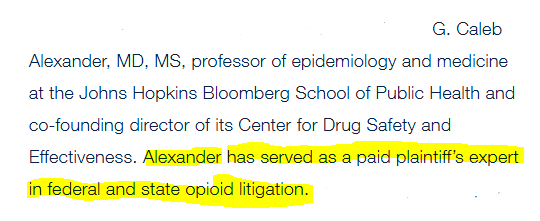
@ChadDKollas@JohnsHopkinsSPH I remember reading that Dr. Alexander didn't take the law firms' money in cash, but had them funnel it directly into his research org. So in effect the law firms involved in opioid litigation are funding anti-opioid research studies. Conflict of interest anyone?
You buried the lede, @JohnsHopkinsSPH...
Dr. Alexander gets paid to testify against opioid manufacturers and distributors.
He's no hero... he's a mercenary.
“There‘s not one moment I‘m not in pain. The medication simply allows pain to be at a level where I don’t absolutely lose my mind… Sometimes my pain‘s so intense that [#opioids] don’t even touch it. Anyone with severe #ChronicPain will tell you the same.” https://t.co/d3IYttSwvH