Not every foot and ankle case asks for the same tray.
Samir Mehta, MD, explains why PACE’s modular design was built for different surgeons, different settings, and different case demands without adding unnecessary room complexity.
Hospitals. ASCs. Trauma centers. Community settings.
The tray has to move with the work.
Learn more at https://t.co/Zr3IeFGZL0
In a small SPD, efficient tray setup is crucial.
Alex Nielsen, MD, describes a setting where SPD resources are limited and the instrumentation setup has to match the reality of the room. His point is practical: fewer trays do not just clean up the back table. They can make a lean surgical setup feel manageable.
From the Total Joint Orthopedics Masterclass.
Watch the full video: https://t.co/O49G2uTDCY
Orthopedic conferences and events are easy to find. Finding the ones relevant to your subspecialty, your role, and your schedule is the actual problem.
OTW built an events page at https://t.co/OFcplDfeqW where upcoming conferences and medical education events are listed in one place. If you are organizing something that belongs there, you can submit it directly. If you are looking for what is coming up in your subspecialty, it is already there.
One less tab.
https://t.co/Bx7dPwCOrT
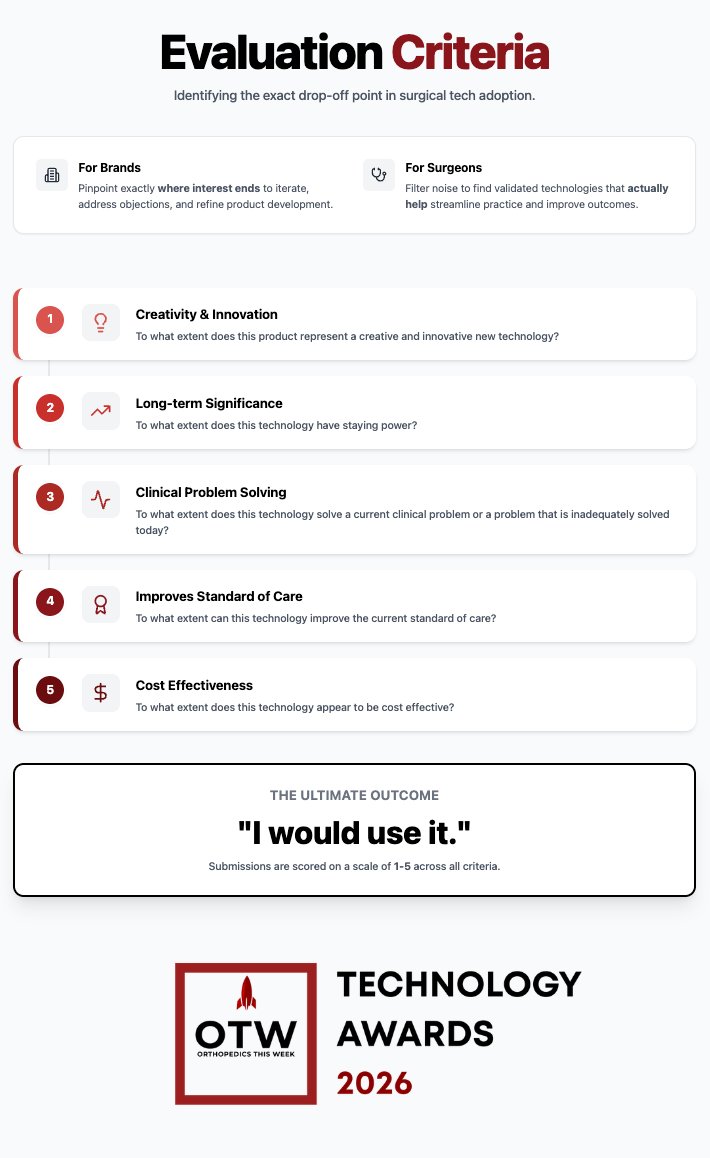
If you are a spine or pain management surgeon and there is a technology in your practice that you believe the broader orthopedic community has not adequately evaluated, the OTW Technology Awards exist as a formal mechanism to change that. Submissions are scored by an independent surgeon panel across five criteria - innovation, long-term significance, clinical problem-solving, standard of care improvement, and cost effectiveness.
The technologies that come out of that process with strong scores are not the ones that spent the most on marketing. They are the ones that held up to clinical scrutiny from peers. The Spine & Pain Management track closes July 31. The evaluation process is designed to surface exactly the kind of technology that tends to get overlooked when market presence is a proxy for clinical quality.
If you are a surgeon and would like to recommend a technology, email us at [email protected]
The foot does not give hardware much room to hide.
James C. Krieg, MD, explains why plate design has moved past simply making implants smaller and thinner. In the foot, contour, profile, and fit can matter fast because even a small prominence can feel like a much bigger issue.
Learn more at https://t.co/Zr3IeFGZL0
Tray count can be boring until someone puts a dollar figure next to it.
Jason M. Hurst, MD, explains how moving from six to eight trays down to one can create meaningful case-level savings. The point is not that sterilization suddenly became exciting. It is that tray efficiency can quietly become a serious financial variable for a busy joint center.
From the Total Joint Orthopedics Masterclass.
Watch the full video: https://t.co/2FPLDnFt6e
OTW rebuilt https://t.co/OFcplDfeqW so that what you see reflects your subspecialty and your interests. Twenty years of independent coverage organized around what you actually want to see -not what an algorithm decided was probably relevant to someone with your job title.
Follow the ones relevant to your practice and your personal feed updates to match, so every time you log in you are starting from the right place.
https://t.co/OFcplDfeqW
Tired of not seeing the content you want to see on social media?
The new https://t.co/OFcplDfeqW has a personalized feed. It shows content from the subspecialties, companies, and people you follow. No algorithm deciding what is probably relevant to someone with your job title, no irrelevant sponsored content wedged between two things you actually wanted to read.
You follow what matters to your practice and your feed reflects that.
https://t.co/OFcplDfeqW
Christopher E. Pelt, MD, had a specific concern when he started using a symmetric implant: what would happen to patellar tracking?
Looking back at his own data, the answer was not what he initially expected.
Learn more at https://t.co/uxUajKTT9x
A full OR day should not turn into a tray-management exercise.
Nicholas M. Romansky, DPM, explains why PACE was designed around the reality of back-to-back foot and ankle cases: different needs, quick room turnover, and the importance of having the right backup close by.
Modular where it needs to be. Practical where it counts.
Learn more at https://t.co/Zr3IeFGZL0
We rebuilt Orthopedics This Week. For you.
After 20+ years covering this industry, we wanted the experience to match the work. So we started over.
Specialty home pages.
A private community for surgeons and industry. No ads. No algorithm.
A new Editorial Advisory Board. (content for you by you).
Just the people and ideas moving musculoskeletal care forward.
It's live today.
https://t.co/OFcplDfeqW
The orthopedic technology market produces more product launches than any surgeon can reasonably evaluate. Most of what gets marketed aggressively has the budget to get marketed aggressively, which is not the same thing as having the clinical evidence to back it. The OTW Technology Awards run an independent surgeon panel through five scored criteria - innovation, staying power, clinical problem-solving, standard of care impact, and cost effectiveness - and the ultimate question each judge answers is whether they would use it in their own practice.
That means the technologies that come out of the evaluation have been assessed on clinical utility by peers, not on marketing spend by the company. The 2026 awards run across four subspecialty tracks. Spine & Pain Management closes July 31. https://t.co/lAfBp9uoUk
Thomas Bradbury, Jr., MD, pushes back on the idea that high-throughput arthroplasty is mainly about surgeon speed.
Learn more about TJO at https://t.co/uxUajKTT9x
A foot and ankle tray should not feel like a scavenger hunt.
Stephen S. Soondar, DPM, talks about the thinking behind PACE: take the useful parts surgeons recognize across systems, bring them into one place, and make the feel of the screw-plate interface more predictable.
Approachable does not mean basic. It means the right options are easier to reach.
Learn more at https://t.co/Zr3IeFGZL0
The 2026 OTW Orthopedic Technology Awards are accepting submissions for the Spine & Pain Management track through July 31.
The program expanded this year to four subspecialty tracks - Spine & Pain Management, Extremities, Trauma, Foot and Ankle, Sports Medicine & Orthobiologics, and Total Joint Arthroplasty - each evaluated by an independent panel of practicing surgeons. Submissions are scored on creativity and innovation, long-term clinical significance, clinical problem-solving, improvement of current standard of care, and cost effectiveness.
The ultimate organizing question for every judge is whether they would use the technology in their own practice.
The program was built so that a company with strong technology and limited marketing resources can access the same independent clinical evaluation and surgeon audience as a company with a full commercial infrastructure. Spine & Pain Management closes first. July 31. https://t.co/lAfBp9uoUk
Fewer trays in the room and the flexibility to respond when the case calls for more.
Thomas Bradbury, Jr., MD, explains how a primary knee setup can stay organized while still allowing for constraint, augments, stems, cones, and revision tibial options when the case demands more. Fewer pans matter, but only because they keep the room simple without taking useful choices off the table.
From the Total Joint Orthopedics Masterclass.
Watch the full video: https://t.co/O49G2uTDCY
SurGenTec, LLC today announced that the FDA has granted 510(k) clearance for its ION-C™ navigation instruments for use with the ION-C™ posterior cervical facet fixation implant. https://t.co/GR4OvbrGNT
Hammertoe fixation happens in a very small space, where design details matter fast.
Stephen S. Soondar, DPM, explains what made ZipToe stand out from what he had used before, especially when the case needs to stay controlled without limiting the surgeon’s options.
Learn more at https://t.co/9TX0XV1LbF
Samir Mehta, MD, sees foot and ankle fixation moving toward smaller fragments, more specific constructs, and implants that let surgeons match the injury instead of forcing the injury to match the implant.
Contourable plates. Pre-contoured options. Screw placement where it actually helps the construct.
Learn more at https://t.co/Zr3IeFGZL0
The 2026 OTW Orthopedic Technology Awards expand to four subspecialty tracks for the first time: Spine & Pain Management, Extremities, Trauma, Foot and Ankle, Sports Medicine & Orthobiologics, and Total Joint Arthroplasty. Each track runs its own submission window, judge panel, and evaluation cycle, with the first closing July 31.
The evaluation criteria are the same across all four: creativity and innovation, long-term clinical significance, clinical problem-solving, standard of care improvement, and cost effectiveness, each scored on a 1-5 scale by a panel of practicing surgeons.
The program was designed specifically so that the quality of a technology, not the size of a company's marketing budget, determines which products the orthopedic surgeon community hears about.
If you are in any of these subspecialties and have a product worth putting in front of an independent clinical panel and an audience of 30,000 orthopedic professionals, the Spine & Pain Management window closes first. https://t.co/lAfBp9uoUk