📜✨ “Foreign to Scripture? (Relics)” — apparently we’re doing a surprise Friday-night Peter’s Barque drop.
This song has been a LONG time coming. Relics have been sitting in my song queue for ages.
But then the internet spent the last few days losing its collective mind over the veneration of the relics of Saint Agatha.
“Pagan.”
“Idolatry.”
“Morbid.”
“Foreign to Scripture.”
So… I bumped this one WAY up the queue.
And I’m dropping it now.
On a Friday night.
Because apparently that’s what we’re doing. 😂
The funny thing is, Scripture itself is remarkably comfortable with holy things getting very, very physical.
Joseph makes Israel promise to carry his bones out of Egypt—and centuries later, Moses does.
A dead man touches the bones of Elisha—and gets back up.
People reach for the garment of Jesus and are healed.
The sick are laid where Peter’s shadow might fall across them.
Cloths that touched Saint Paul are carried to the sick—and God works miracles through them.
And the Jewish world itself was far less squeamish about human remains than modern Western Christians often are. Around the time of Christ, families could return to tombs after decomposition, gather the bones of their dead, and place them in ossuaries. What feels “morbid” to modern American sensibilities is not therefore foreign to the biblical world.
Then there’s the early Church.
Saint Polycarp—a disciple of Saint John—was martyred around A.D. 155. The Christians gathered his bones, describing them as more precious than jewels and finer than gold, and preserved them in a suitable place where they could gather to commemorate his martyrdom.
That’s not medieval Catholicism.
That’s Christianity with barely enough room between it and the Apostles for the ink to dry.
And here’s the deeper point:
Christianity is an Incarnational religion.
Mud on blind eyes.
Water. Oil. Bread. Wine.
Hands laid upon heads.
A garment. A shadow. A handkerchief.
Flesh and blood and dust and bone.
There is no magic in marrow. Relics aren't lucky charms. Saints aren't little gods. God owes us no miracle because we touched the right object.
But the God who created matter has never seemed particularly reluctant to use it.
And the Word became flesh.
So when someone tells me relics are “foreign to Scripture”…
🎶 That’s a curious claim.
“Foreign to Scripture? (Relics)” — surprise release from Peter’s Barque. Out now.
#Catholic #CatholicFaith #PetersBarque #CatholicMusic #Relics #Saints #SaintAgatha #BibleStudy #CatholicApologetics #ChurchHistory #EarlyChurch #Theology
🔗 FOLLOW PETER’S BARQUE
Website: https://t.co/Qa1ku0gbXh
X: https://t.co/inh9EFXylP
Instagram: https://t.co/ZYoE5fL0jX
TikTok: https://t.co/CceRbO7MWn
Facebook: https://t.co/cmEIdtRMo5
🎧 LISTEN TO THE MUSIC (This will get to spotify etc. late)
Apple Music: https://t.co/WkxdMHLT2F
Spotify: https://t.co/Koi6MV8YqG
☕ SUPPORT THE PROJECT
Ko-fi: https://t.co/adtVXqy2ij
Peter’s Barque is a catechetical musical project by Justin West. He’s a catechist, not a musician. The music is created principally through digital means, and the art is AI—but the words, heart, and soul are still all him.
This is the way. Accreditation monopolies have been the vehicle by which the Marxists have seized the means of professional production. Competition in the accreditation space can actually fix a lot and is a minimally necessary requirement to recovery.
True, and knowing that is a spiritual profession not a purely reasonable deduction.
"We know that all things work for good for those who love God, who are called according to his purpose." — Romans 8:28
The Most Destructive Intellectual Project of the Twentieth Century.
The Frankfurt School. You should know what it was, what it built, and why you are still living inside it.
1. The Institute for Social Research was founded in Frankfurt in 1923 and relocated to Columbia University in 1934 when Hitler came to power. The civilization they had decided to dismantle gave them refuge when another tried to kill them. They spent the next five decades producing the theoretical infrastructure for that dismantling. Western civilization itself was the problem: reason, the Enlightenment, the family, tradition, authority. Not reformed. Dismantled.
2. They called it Critical Theory – and the name is the program. Everything is to be criticized; nothing is to be built. In The Dialectic of Enlightenment (1944), Adorno and Horkheimer argued that Western reason — the reason that produced Newton and the rule of law — contained the seeds of Auschwitz. Not that reason had been misused, but that reason itself, taken to its conclusion, produces the death camp. This was not a critique of institutions. It was an indictment of the civilization itself.
3. Adorno gave them the psychological weapon. The Authoritarian Personality (1950) classified conservatism, religious faith, patriotism, and the traditional family not as political positions but as symptoms of a proto-fascist personality. If you believe in the nation or the father’s authority, you are pre-fascist. The opponent was no longer wrong – he was sick. You don’t argue with a pathology. You treat it.
This made dialogue impossible. You don’t persuade someone who is wrong; you diagnose someone who is sick. Politics becomes therapy, and disagreement becomes pathology.
4. Marcuse gave them the political weapon. Repressive Tolerance (1965) argued that tolerating wrong ideas is itself oppression. True tolerance therefore requires suppressing intolerant ideas. The left decides which ideas are intolerant. Everyone else is silenced – not despite tolerance, but "in its name." Censorship dressed in the vocabulary of liberation.
5. The generation that read Marcuse at Columbia, Berkeley, and Yale went on to run universities, media, foundations, NGOs, content moderation departments, and the EU regulatory apparatus. They implemented the argument sincerely because they had been taught it as philosophy. This was the Frankfurt School’s greatest achievement: it produced true believers.
6. French Theory picked up the tools and made them aesthetic. Foucault made the critique of power literary. Derrida made the critique of meaning philosophical. Deleuze made the critique of identity elegant. A political program became a cultural sensibility. You can argue with a program. A sensibility is in the air you breathe. By the time these ideas reached the American campus through the French conduit, they were no longer ideology. They were the water. The fish did not know they were wet.
7. A civilization stands on three pillars: truth exists and is accessible to reason; good is distinguishable from evil; and there is an inheritance worth transmitting. The Frankfurt School attacked all three – systematically and with considerable intellectual sophistication. It produced a generation that knows how to deconstruct and has forgotten how to build. That sees power everywhere and beauty nowhere.
The ultimate achievement was to make destruction feel like progress. Every inherited institution became suspect; every constraint became oppression; every act of preservation became reactionary. Deconstruction became the default, while construction became something that needed to justify itself.
The answer is not another theory.
It is the thing the Frankfurt School most feared: the builder who simply builds, the scientist who follows the evidence, the father who transmits what was transmitted to him.
The deconstruction machine runs on the assumption that nothing is worth building.
Prove it wrong.
Tell the truth, have courage, and build.
Considered not as a physical action but as an anthropological declaration made by the legal system, abortion translates as "The right to have no rights" and is best understood as a colossal power grab.
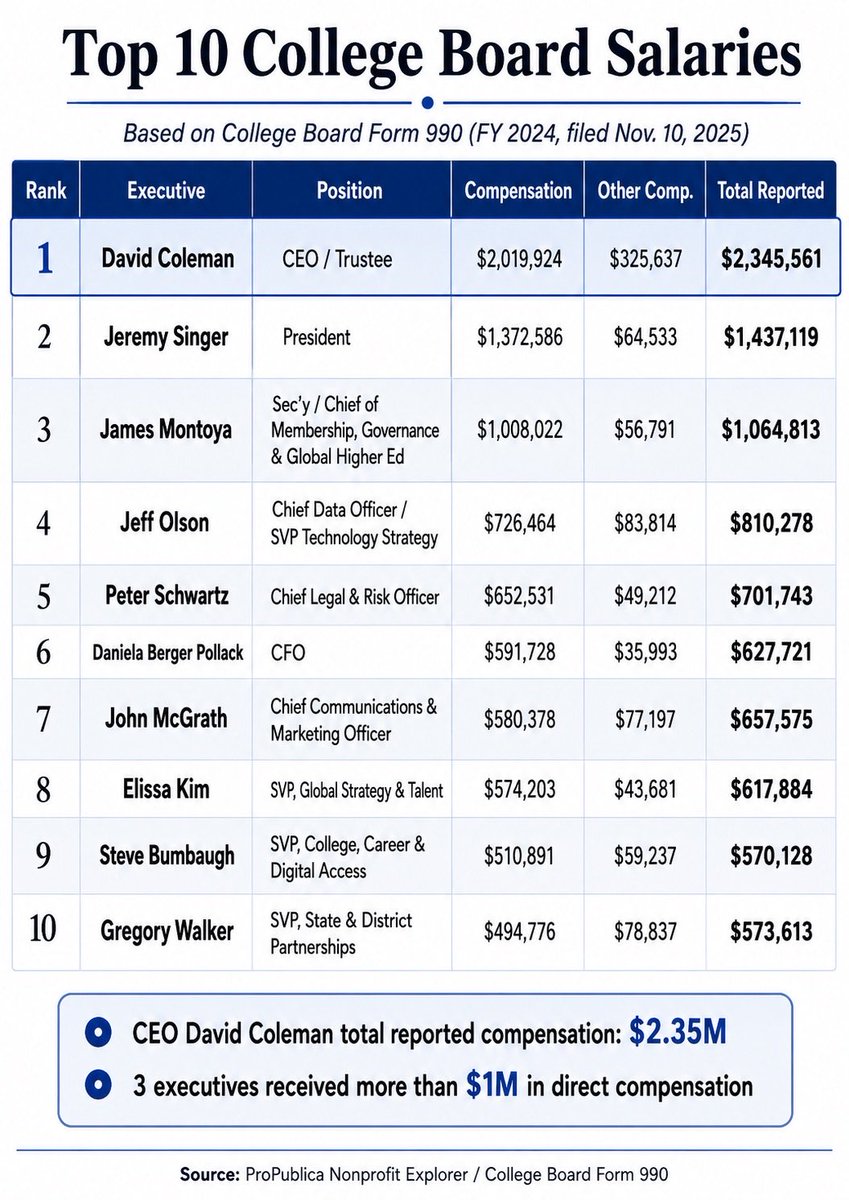
College Board, thank you for introducing me to this public records concept. It’s amazing what you can find.
David Coleman makes 50 teacher salaries combined.
I just realised that many people don't know what pride actually means. No wonder so many people think I'm talking nonsense. If we don't know what pride really is, we can't recognise it, which means we can't solve anything. This is a critical consequence of the abuse of language.
The "Cluster-B" diagnosis emerged from Leftist psychotherapists, clinicians & other ideologues in a last-bid, desperate attempt to divert people from the true root cause, which is pride (superbia). They will do anything in their power to remove God & virtue from the conversation.
@DefiyantlyFree Could you explain how his translation was more accurate than others?
@catholiccom gave an example of a poor translation. Do you agree or disagree with that example?
I totally agree that when the state and church fully merge, both will likely be corrupted.
Cannonball to the Knee — bonus drop 💥🦵
I missed July 31.
Unlike the cannonball.
🎶 “Cannonball to the Knee” is a dusty saint ballad for Saint Ignatius of Loyola — the soldier who thought he was chasing glory until God used a shattered leg to redirect the whole campaign.
Ignatius wanted honor, battle, reputation, and worldly greatness.
Then Pamplona happened.
A cannonball broke his leg, wrecked his plans, trapped him in recovery, and left him with nothing to do but read the lives of Christ and the saints.
Which is a dangerous thing to give a bored, ambitious man.
Because slowly, he started to notice something:
The fantasies of worldly glory made him feel empty afterward.
But the thought of serving Christ, imitating the saints, and giving everything to God left behind a deeper fire.
That’s discernment.
Not “follow your feelings.”
Not baptized indecision.
Not a spiritual fog machine.
Discernment is learning which desires lead you toward God and which ones just flatter your ego while marching you toward ruin.
Ignatius lost the old war.
Then he entered the real one.
And from that broken soldier came pilgrim, penitent, founder, missionary, and saint.
🎶 “Cannonball to the Knee” — a track for converts, cradle Catholics, Catholic school survivors, Jesuit appreciators, Jesuit worriers, discernment overthinkers, and anyone who has ever had God mercifully wreck their plans.
Peter’s Barque is a catechetical musical project by Justin West. He’s a catechist, not a musician. The music and the art created principally through digital means, including AI—but the words, heart, and soul are still his.
And next week, on August 28, another saint gets the Peter’s Barque treatment.
Any guesses?
#Catholic #CatholicFaith #SaintIgnatius #IgnatiusOfLoyola #Jesuits #Discernment #SpiritualWarfare #CatholicMusic #PetersBarque #AdMajoremDeiGloriam
🔗 FOLLOW PETER’S BARQUE
Website: https://t.co/y5UrSwgqJH
X: https://t.co/OtbQSF9kiu
Instagram: https://t.co/QrmQBImayO
TikTok: https://t.co/529rX37pdA
Facebook: https://t.co/DEUCrXfeFn
🎧 LISTEN TO THE MUSIC
Apple Music: https://t.co/Dbdr7XgB1v
Spotify: https://t.co/1SbSjqT9cj
☕ SUPPORT THE PROJECT
Ko-fi: https://t.co/7OyFMEkkp4
The last time I was with Charlie, I didn’t want the afternoon to end.
But it did end.
I was thrilled listening to Charlie as he Moderated a discussion. He was exceedingly fair and gave each arguing participant equal time and respected their positions.
But this time listening to Charlie felt different. I had come to recognize a true genius on a par with our Founding Fathers: A modern day Alexander Hamilton or James Madison.
His breadth of knowledge on our Constitution, our Founding documents and especially on biblical texts was like watching a Chess champion dismantling an inferior opponent, easily accessing verifiable facts from that incredible brain of his was breathtaking to watch.
That he was taken from us, is a great loss that is insurmountable.
Charlie Kirk would have been our President one day. And ALL Americans would have benefited from his leadership.
Charlie asked that each of us just be one percent more courageous. One percent a year. He put it this way: “The cool thing about courage is that it actually doesn’t require any talent. It is just a choice.”
He wanted to be remembered for courage for his faith, and that courage is doing something without knowing the consequences.
As we approach the one year anniversary of his assassination at the hands of violent Leftist who was indoctrinated with Leftist lies and hate, let us find that one percent more courage in ourselves and re-engage in our shared country: vote, participate, volunteer, show up at your local school board meeting, have difficult conversations and remember that a great person, a Christian, died trying to have a conversation with young fellow Americans who he cared for dearly and wanted them to know and appreciate that they lived in the greatest experiment in Freedom the world has ever known: a nation under God, indivisible with liberty and justice for ALL!
God bless you,
Rob
https://t.co/37UiYAzdx3
The tragic case of the young Cambridge professor, Jason Arday, has shed new light on the moral vacuity at the heart of Wokeism.
If I can state the matter abstractly, one should never place relative values in the center of one’s ethical concern. Only absolute goods belong in that location.
Diversity, equity, and inclusion are values, but only, as the medievals would have said, secundum quid and not in se. That means they are worthwhile sometimes and under certain conditions, but not in themselves.
In contrast, love and justice are absolute moral principles, for they are always applicable, no matter the circumstances.
Wokeism relativized justice (rendering to each his due) and love (willing the true good of the other) and absolutized diversity, equity, and inclusion. The result is the moral shipwreck that we have been witnessing the last ten years.
What makes things even sadder is that lots of people have been profiting off of this moral confusion.
Back in 2020, Fr Thomas Joseph White OP warned that our response to Covid risked disordering the hierarchy of goods.
And it did.
Even eight centuries on, Thomism still diagnoses what goes wrong when lower goods displace higher ones - and shows us how to put them back in order.
A neat summary of my new essay @11thBlog@bjportraits ✅
Are 'sex' and 'gender' synonymous for legal purposes?
That's a yes/no question. But the mainstream critique of "gender ideology" is divided: Instead of yes *or* no, it says yes *and* no 🤔🤨🧐
10 years ago, the Internet caught on fire. A Notre Dame professor posted an article he didn’t expect would gain much attention. A decade everyone is still talking about what @PatrickDeneen wrote.
Here it is
My students are know-nothings. They are exceedingly nice, pleasant, trustworthy, mostly honest, well-intentioned, and utterly decent. But their brains are largely empty, devoid of any substantial knowledge that might be the fruits of an education in an inheritance and a gift of a previous generation. They are the culmination of western civilization, a civilization that has forgotten nearly everything about itself, and as a result, has achieved near-perfect indifference to its own culture.
It’s difficult to gain admissions to the schools where I’ve taught – Princeton, Georgetown, and now Notre Dame. Students at these institutions have done what has been demanded of them: they are superb test-takers, they know exactly what is needed to get an A in every class (meaning that they rarely allow themselves to become passionate and invested in any one subject); they build superb resumes. They are respectful and cordial to their elders, though easy-going if crude with their peers. They respect diversity (without having the slightest clue what diversity is) and they are experts in the arts of non-judgmentalism (at least publically). They are the cream of their generation, the masters of the universe, a generation-in-waiting to run America and the world.