US May PCE Inflation: take a look at the year over year increase of 4.8% in goods,3.3% in durables and 5.6% in non-durables. That is tariffs and AI related pricing pressures.
Second, look at the increase in service sector prices that advanced 3.8% from one year ago in contrast with 3.5% previously.
Falling oil prices will not impact those sticky service costs nor will it provide relief to trade policy induced inflation and the cap-ex supercycle driven by AI.
Finally, there is a large increase in US defense spending on the way to replenish the weapons stock and address the revolution in military affairs around drone and robotic warfare-which will draw on many of the same resources that are in demand from tech companies to support the AI buildout-will put pressure on core and topline inflation going forward.
Well... this has to be the scariest chart I've ever seen.
Free cash flow and the S&P 500 will eventually converge. The question is where?
HT @renewableworks
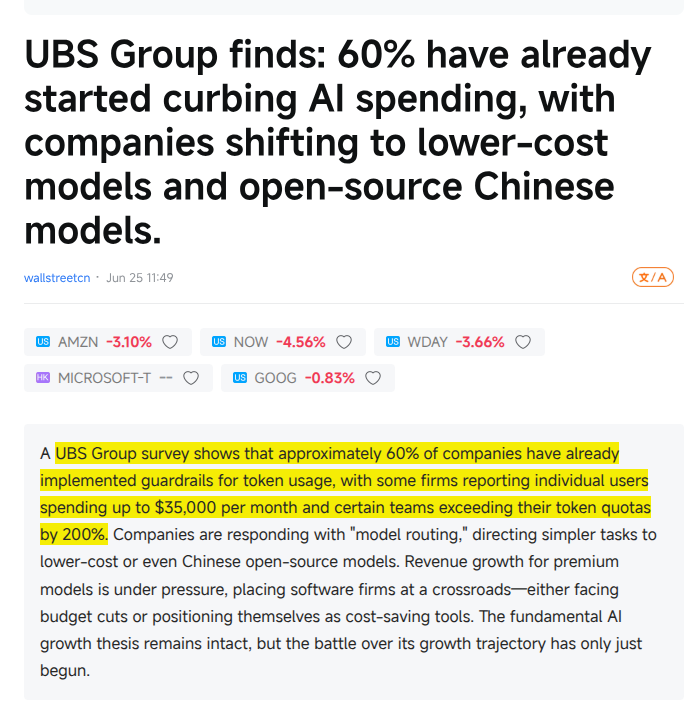
UBS says 60% of companies now watching AI budgets are moving to cheaper models and open-source Chinese models
The pressure is coming from extreme bills, including users spending up to $35K/month, teams exceeding quotas by 200%, and companies cutting internal AI tools from 5 to 2.
Companies are not abandoning AI, they are using model routing, which sends easy tasks to cheaper models and saves premium models for hard reasoning, code, and long-context work.
Chinese open-source models such as Qwen, DeepSeek, MiniMax, GLM, and Kimi now fit the enterprise cost curve because they can be run locally or used through cloud catalogs.
---
news .futunn.com/en/post/75068082/ubs-group-finds-60-have-already-started-curbing-ai-spending?level=2&data_ticket=1780870170397383
The End of Financial Engineering
For the first time in over a decade, the center of gravity in American capitalism is shifting from financial engineering back to the real economy.
For years, the dominant corporate playbook was simple: keep capital expenditure lean, recycle excess cash into share buybacks, and let multiple expansion and shrinking share counts do the heavy lifting. Capex was treated as a drag; buybacks were hailed as shareholder discipline. That framework is now colliding with a new political and strategic reality.
Scott Bessent has given that shift its intellectual anchor, invoking Alexander Hamilton’s dictum that every nation ought to endeavor to possess within itself all the essentials of national supply. The point is not autarky. It is that a nation cannot remain prosperous, secure, and sovereign if it outsources the foundations of industrial power.
That is also the logic of Trump’s America First economics. Reshoring supply chains, rebuilding manufacturing, expanding energy production, and accelerating permitting all push capital toward productive assets at home rather than paper gains on the balance sheet. The policy hierarchy is clear: national resilience, industrial capacity, and worker prosperity come before abstract efficiency.
Trump has also long complained that buybacks reward executives more than workers. Whether one agrees with every formulation or not, the instinct captures something important about this moment. The old model favored balance-sheet management over capital formation. The emerging one rewards building.
The AI buildout makes the investment case obvious. Markets may punish rising capex and reduced buybacks, but that capital is not disappearing. It is moving into concrete, steel, copper, power, logistics, and machinery. The same is true of energy security, agricultural capacity, and domestic supply chains more broadly.
Investors who cling to the low-capex, high-buyback playbook are effectively betting on a shrinking productive base in a world that is relearning the value of physical capacity. The better opportunity is to invest where capital is now flowing: the companies and sectors building the real economy.
$XLI
El BCIE se apresta mañana a proponer reducir la participación de los países fundadores de 10.2% a 7.0% diluyendo su control, además de eliminar la fundación que provee becas para la agricultura y educación secundaria pública, y finalmente, subirle el sueldo a su ejecutiva por arriba de $250,000 porque no rinde los mismos colones... y ella se supone reside en #Tegucigalpa.
🇺🇸 The US bank stress test results did not get a huge amount of attention but it signals that the US banking system is not the weak link in the cycle today.
📊 The Fed tested 32 large banks under a severe recession scenario, with unemployment rising to 10%, a sharp correction in both residential and commercial real estate, and significant credit stress. Despite more than $700bn in hypothetical losses, the aggregate capital ratio would only fall from 12.8% to 11.2%.
✅ This is clearly bullish for financials but also positive for the broader US market because a solid banking system reduces the risk of a credit crunch. If banks are well capitalized, they can continue financing the economy instead of sharply cutting credit to households and businesses. This supports risk-on sentiment and reduces the risk of a systemic accident.
🏦 An other important point is that banks can also restart capital returns to shareholders. Several major institutions have already announced dividend increases or share buyback programs. Therefore, banks are not only just surviving the test but they have enough excess capital to reward shareholders.
The United States remains firmly in a position of economic and financial resilience.
*Fed link: https://t.co/7thuva3KJa
🚨 SOUTH KOREA JUST PROPOSED TAXING UNREALIZED GAINS.
And this is one of the major reasons behind today's massive selloff in the Korean market, now being called BLACK TUESDAY in Korea.
At a forum hosted by South Korea's ruling Democratic Party, lawmakers called for comprehensive taxation that would treat unrealized gains on stocks and real estate as taxable income, even before the asset is ever sold.
The ruling party has pushed escalating wealth tax measures throughout 2026, including a February forum proposing to lower the real estate capital gains exemption threshold from 1.2 billion won to 800 million won, and an April push to abolish the long term holding tax deduction entirely.
Today is the first time this campaign has explicitly extended to taxing unrealized stock gains.
Under current law, investors are taxed only when they sell a stock and realize a profit.
Under this proposal, investors could owe tax on paper gains they have not sold or collected, simply for holding a stock that went up in value.
The Netherlands tried almost this exact policy four months ago.
On February 12, 2026, Dutch lawmakers passed a law taxing unrealized gains on stocks, bonds, and crypto at a flat 36% every year, whether or not anything was sold.
The backlash was immediate. A petition against it gathered more than 61,000 signatures, and Shopify CEO Tobi Lutke called it "the dumbest thing any government on planet earth is pursuing right now."
Just 13 days after the bill passed, the Dutch finance minister announced the government would scrap the unrealized gains portion entirely, admitting the law "cannot pass as is."
This lands directly on a South Korean market that just ran up nearly 95% over the past year, built largely on heavy retail buying with borrowed money.
A tax on gains that exist only on paper is a direct threat to the exact rally that created that exposure in the first place.
Aquí las empresas que más riqueza han generado.
Hay compañías más jóvenes tecnológicas $NVDA $META o $GOOGL y los típicos "stalwarts" como $KO $PG o $JNJ
Introducing Sakana Fugu: A full multi-agent orchestration system accessible via a single model API.
Our ‘Fugu Ultra’ model matches the performance of Fable and Mythos, delivering frontier capability without the risk of export controls.
Try it: https://t.co/hhO6qTawgb 🐡
Vessels continued to enter and exit the Middle East Gulf on June 20, data from Lloyd's List Intelligence shows. Despite Iran claiming it was closing the strait, traffic was seen moving with AIS on via the northern route and also the southern route for the first time in weeks
El tipo que puso el deep state para situar a Google como la mayor empresa de espionaje del mundo justo antes del 11S revela una de las claves de la IA:
Perplexity CEO on China catching up in AI:
“Whatever you did to not let them catch up didn’t even matter. They ended up catching up anyway.
What’s more dangerous is they have the best open-source model. And all the American developers are building on that.”
That was DeepSeek.
Now https://t.co/4mU5qMAq5u just dropped GLM-5.2:
• MIT open weights
• 1M context
• 81.0 on Terminal-Bench 2.1
• within a few points of Claude Opus 4.8
The open-source AI race is not theory anymore.
Chinese AI models are no longer catching up. They're almost at the same level
Kimi K2.6 became the first open-weight model to beat GPT-5.4 on SWE-Bench Pro
GLM-5.1 beat Claude Opus 4.6 on a key coding benchmark
Meanwhile DeepSeek is 36x cheaper than Claude Opus per token
So who's the best Chinese model for June?
$117k in volume. The market is confident in Alibaba
For now this is one of the models that can actually compete with the best from Anthropic and OpenAI
Canaccord Genuity: "The market currently suffers from Zoolander syndrome: it appears to have only “one look”: AI. We’ve thrown endless warning flags about the grid’s inability to sustain data center deployments. but the market couldn’t care less – for now. The AI trade rolls on. Non-stop. More cowbell. We, too, feel like we are taking crazy pills."
Las universidades de China han eliminado o suspendido 12.200 programas de pregrado entre 2021 y 2025, al tiempo que crearon más de 10.200 nuevas carreras, modificando más de 30% de su oferta académica, de acuerdo con el Ministerio de Educación de China https://t.co/uiMsMkxBtL