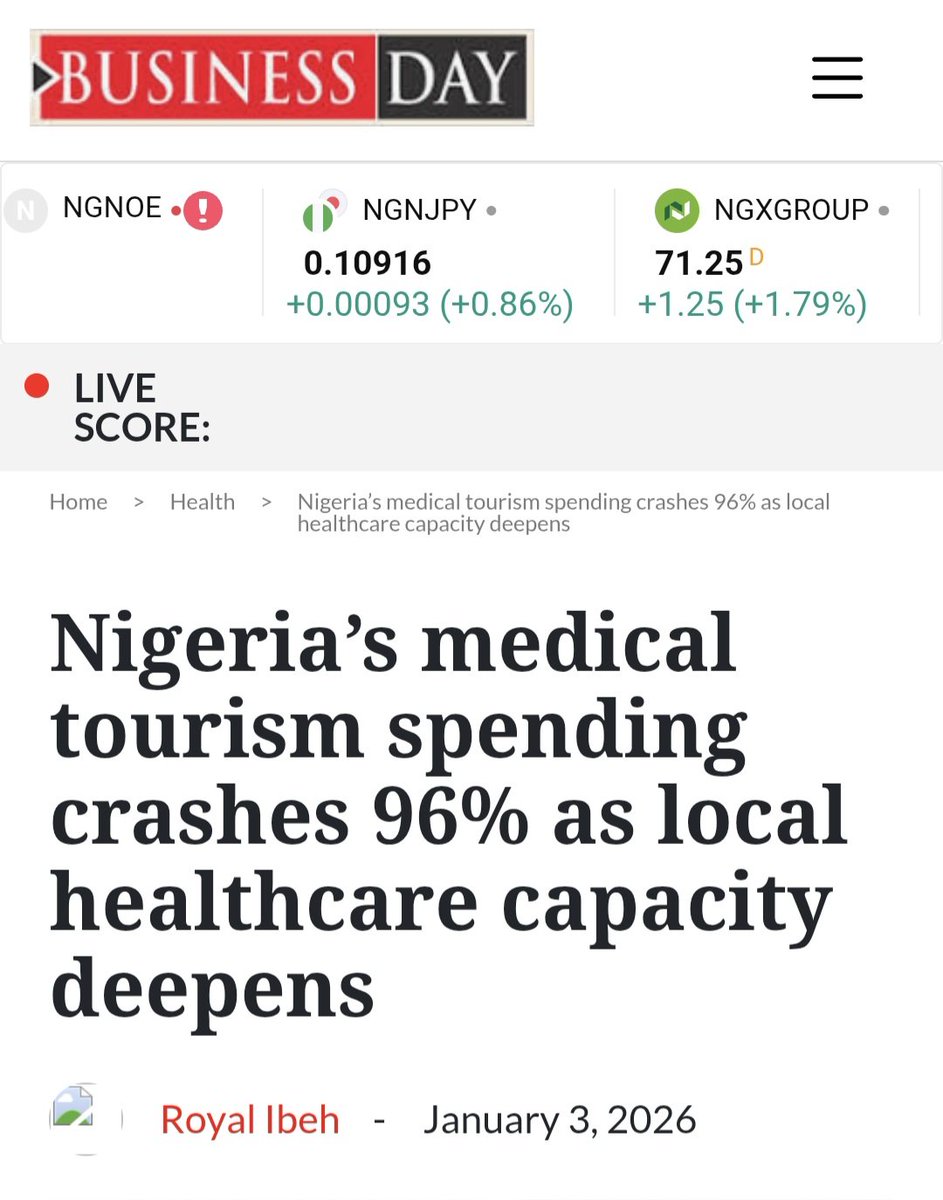
@Jerrykel80610@renoomokri You only saw the "may be", right? May be if you purge yourself of wanting bad news from Nigeria, you will see "a spate of painful reform is beginning to show results"... That didn't have "may be" that you decided to twist to suit your narrative. #GreaterNigeria
After Ojukwu ran away, Obasanjo captured the remaining Biafran commanders. They surrendered and pronounced the end of Biafra. Biafra was declared nonexistent from that day.
This video should be on constant replay on giant screens across the Southeast.
Have you experienced injustice from any Lagos State Police personnel? We say NO to impunity. The Command’s Complaint Response Unit is available 24/7 to listen, respond, and take action on your complaint.
09111111150
09111111151
08090277711
08090277712
08090277713
08090277714
09111991116
How come this cheery news isnt a viral news?
Oh i forgot...they are ONLY interested in negative news to feed their toxic ecstacy that Nigeria is failing😅😅😅
This is PRIVATE SECTOR driven..
Yes it is only affordable for middlevand upper class...but the economic benefits affects macro economic indices...
1) REVERSE Medical Tourism, as diaspora nigerians are increasingly coming home for medical help, since sometimes it takes months to get consultant appointment abroad...So MORE FOREX SUPPLY
2) Drop in FOREX demand for medical tourism by Resident Nigerians ...LESS DEMAND
3) More and more Doctors in Nigeria are getting better paying jobs and opportunities to work with modern medical tools....
4) Some of the Hospitals are partnering with global health focused NGOs to get grants to subsidize medicare for some low income earners that qualify for available limited spaces
So my next question...Why can't medical practioners partner with SOCIAL INVESTORS and State Governments to offer Primary Healthcare for low income earners via AI-POWERED TELEMEDICINE ?
𝐌𝐨𝐬𝐭 𝐖𝐨𝐫𝐤𝐞𝐫𝐬 𝐖𝐢𝐥𝐥 𝐏𝐚𝐲 𝐋𝐞𝐬𝐬 𝐓𝐚𝐱 𝐅𝐫𝐨𝐦 𝐉𝐚𝐧𝐮𝐚𝐫𝐲 2026
Under the new tax laws, about 98% of workers in both the public and private sectors are expected to pay less or no PAYE/personal income tax.
This short video explains how Personal Income Tax is calculated under the new law and what the changes could mean for you.
Calculate your tax under the old and new tax laws here: https://t.co/Q27358EXlf
𝑲𝒏𝒐�� 𝒕𝒉𝒆 𝒇𝒂𝒄𝒕𝒔. 𝑫𝒐 𝒕𝒉𝒆 𝒎𝒂𝒕𝒉
#FactNotFear #TaxReforms #Nigeria
𝐅𝐈𝐅𝐓𝐘 (50) 𝐓𝐀𝐗 𝐄𝐗𝐄𝐌𝐏𝐓𝐈𝐎𝐍𝐒 𝐀𝐍𝐃 𝐑𝐄𝐋𝐈𝐄𝐅𝐒 𝐓𝐇𝐀𝐓 𝐖𝐈𝐋𝐋 𝐁𝐄𝐍𝐄𝐅𝐈𝐓 𝐓𝐇𝐄 𝐌𝐀𝐒𝐒𝐄𝐒 𝐔𝐍𝐃𝐄𝐑 𝐓𝐇𝐄 𝐍𝐄𝐖 𝐓𝐀𝐗 𝐑𝐄𝐅𝐎𝐑𝐌 𝐋𝐀𝐖𝐒
From 1 January 2026, the new tax laws will provide many reliefs and exemptions for low-income earners, average taxpayers, and small businesses including:
𝐏𝐞𝐫𝐬𝐨𝐧𝐚𝐥 𝐈𝐧𝐜𝐨𝐦𝐞 𝐓𝐚𝐱 𝐨𝐫 𝐏𝐀𝐘𝐄
1. Individuals earning the national minimum wage or less (exempt)
2. Annual gross income up to ₦1,200,000 (translating to about ₦800,000 taxable income) is exempt
3. Reduced PAYE tax for those earning annual gross income up to ₦20 million
4. Gifts (exempt)
𝐀𝐥𝐥𝐨𝐰𝐚𝐛𝐥𝐞 𝐃𝐞𝐝𝐮𝐜𝐭𝐢𝐨𝐧𝐬 & 𝐑𝐞𝐥𝐢𝐞𝐟𝐬 𝐟𝐨𝐫 𝐢𝐧𝐝𝐢𝐯𝐢𝐝𝐮𝐚𝐥𝐬
5. Pension contribution to PFA
6. National Health Insurance Scheme
7. National Housing Fund contributions
8. Interest on loans for owner-occupied residential housing
9. Life insurance or annuity premiums
10. Rent relief - 20% of annual rent (up to ₦500,000)
𝐏𝐞𝐧𝐬𝐢𝐨𝐧𝐬 & 𝐆𝐫𝐚𝐭𝐮𝐢𝐭𝐢𝐞𝐬 - 𝐄𝐱𝐞𝐦𝐩𝐭
11. Pension funds and assets under the Pension Reform Act (PRA) are tax-exempt.
12. Pension, gratuity or any retirement benefits granted in line with the PRA
13. Compensation for loss of employment up to ₦50 million
𝐂𝐚𝐩𝐢𝐭𝐚𝐥 𝐆𝐚𝐢𝐧𝐬 𝐓𝐚𝐱 (𝐂𝐆𝐓) - 𝐄𝐱𝐞𝐦𝐩𝐭
14. Sale of an owner-occupied house
15. Personal effects or chattels worth up to ₦5 million
16. Sale of up to two private vehicles per year
17. Gains on shares below ₦150 million per year or gains up to ₦10 million
18. Gains on shares above exemption threshold if the proceed is reinvested
19. Pension funds, charities, and religious institutions (non-commercial)
𝐂���𝐦𝐩𝐚𝐧𝐢𝐞𝐬 𝐈𝐧𝐜𝐨𝐦𝐞 𝐓𝐚𝐱 (𝐂𝐈𝐓) - 𝐄𝐱𝐞𝐦𝐩𝐭
20. Small companies (turnover not more than ₦100 million and total fixed assets not more than ₦250 million) pay 0% tax
21. Eligible (labelled) startups are exempt
22. Compensation relief - 50% additional deduction for salary increases, wage awards, or transport subsidies for low-income workers
23. Employment relief - 50% deduction for salaries of new employees hired and retained for at least three years
24. Tax holiday for the first 5-years for agricultural businesses (crop production, livestock, dairy etc)
25. Gains from investment in a labeled startup by venture capitalist, private equity fund, accelerators or incubators
𝐃𝐞𝐯𝐞𝐥𝐨𝐩𝐦𝐞𝐧𝐭 𝐋𝐞𝐯𝐲 - 𝐄𝐱𝐞𝐦𝐩𝐭
26. Small companies are exempt from 4% development levy
𝐖𝐢𝐭𝐡𝐡𝐨𝐥𝐝𝐢𝐧𝐠 𝐓𝐚𝐱 - 𝐄𝐱𝐞𝐦𝐩𝐭
27. Small companies, manufacturers and agric businesses are exempt from withholding tax deduction on their income
28. Small companies are exempt from deduction on their payments to suppliers
𝐕𝐚𝐥𝐮𝐞 𝐀𝐝𝐝𝐞𝐝 𝐓𝐚𝐱 (𝐕𝐀𝐓) - 0% 𝐨𝐫 𝐄𝐱𝐞𝐦𝐩𝐭
29. Basic food items - 0% VAT
30. Rent - Exempt
31. Education services and materials - 0% VAT
32. Health and medical services
33. Pharmaceutical products - 0% VAT
34. Small companies (≤ ₦100m turnover) are exempt from charging VAT
35. Diesel, petrol, and solar power equipment - VAT suspended or exempt
36. Refund of VAT on assets and overheads to produce VATable or 0% VAT goods and services
37. Agricultural inputs - fertilizers, seeds, seedlings, feeds, and live animals
38. Purchase, lease or hire of equipment for agric purposes
39. Disability aids - hearing aids, wheelchairs, braille materials
40. Transport - shared passenger road transport (non-charter)
41. Electric vehicles and parts - exempt
42. Humanitarian supplies - exempt
43. Baby products
44. Sanitary towels, pads or tampons
45. Land and building
𝐒𝐭𝐚𝐦𝐩 𝐃𝐮𝐭𝐢𝐞𝐬 - 𝐄𝐱𝐞𝐦𝐩𝐭
46. Electronic money transfers below ₦10,000
47. Salary payments
48. Intra-bank transfers
49. Transfers of government securities or shares
50. All documents for transfer of stocks and shares
Share this good news with everyone you care about who needs to know.
𝐈𝐍𝐅𝐋𝐔𝐄𝐍𝐂𝐈��𝐆 𝐅𝐎𝐑 𝐆𝐎𝐎𝐃
Nominate a content creator who’s been educating their audience about Nigeria’s new tax reform laws or someone you’d like to see do so.
We’ll be selecting the top 20 creators with the most nominations for a special training to help them share accurate, balanced, and useful tax information with their followers.
Misinformation spreads fast, often to the author’s benefit but to the audience’s loss. Accurate information may travel slower, but it empowers everyone, and earns lasting trust.
Tag or mention your favourite influencer to nominate or fill the nomination form https://t.co/D9EeMyy0gL. Nomination closes on 9 November 2025.
- 𝘗𝘳𝘦𝘴𝘪𝘥𝘦𝘯𝘵𝘪𝘢𝘭 𝘍𝘪𝘴𝘤𝘢𝘭 𝘗𝘰𝘭𝘪𝘤𝘺 & 𝘛𝘢𝘹 𝘙𝘦𝘧𝘰𝘳𝘮𝘴 𝘊𝘰𝘮𝘮𝘪𝘵𝘵𝘦𝘦
Ordinarily, I would let such ahistorical claims pass, but given their capacity to mislead, a correction is unavoidable. The tweet below is not just inaccurate; it is a deliberate inversion of historical cause and effect. What transpired at the Universities of Ibadan and Lagos was not an unprovoked Yoruba assault on Igbo academics, but a corrective response to entrenched Igbo nepotism and institutional capture. Unfortunately, much of Nigerian historiography has relentlessly painted the Yoruba as the primary aggressors in ethnic struggles, a narrative even echoed by some Yoruba intellectuals who neglect these critical antecedent events.
So let’s set the record straight.
First, a factual correction: Richard Akinjide became the Federal Minister of Education in 1965. The claim that he was "pushing against Igbo academia" at the Universities of Ibadan and Ife in 1962 is chronologically impossible and factually incorrect. The central events revolve around Ibadan and Lagos; the inclusion of the University of Ife here is a red herring.
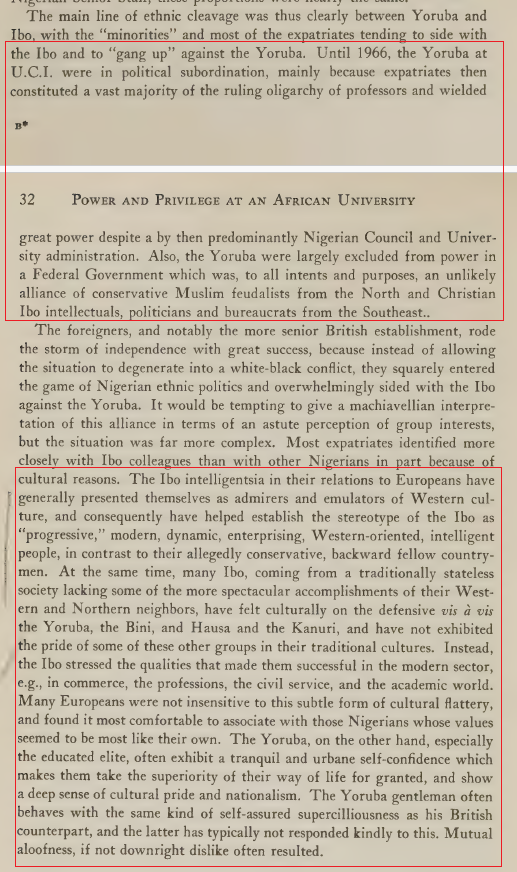
To understand the events at Ibadan, one must turn to the eyewitness account of Pierre van den Berghe (Power and Privilege at an African University), a visiting professor during this turbulent period. He identified the central dynamic: “The main line of ethnic cleavage was clearly between Yoruba and Ibo, with the ‘minorities’ and most of the expatriates siding with the Ibo and ‘ganging up’ against the Yoruba” (pg. 31).
This alliance was rooted in a cultural clash. Van den Berghe observed that the Yoruba, with their centuries-deep intellectual tradition, carried a natural cultural confidence that "makes them take the superiority of their way of life for granted, and show a deep sense of cultural pride and nationalism". The educated Yoruba often displayed a self-assurance that the expatriates found off-putting, seeing themselves as equals with no need to ape European manners (pg. 31).
The Igbo intelligentsia, by contrast, presented themselves as eager emulators of Western culture, measuring progress by proximity to European norms. Van den Berghe notes that this posture ingratiated them deeply with expatriates and helped entrench the stereotype of the Igbo as “progressive, modern, dynamic, enterprising, Western-oriented, intelligent people”, in contrast to their allegedly “conservative, backward” compatriots. This cultural flattery forged a comfortable British–Igbo partnership that became the backbone of campus politics (pg. 31).
This dynamic took on institutional consequence in 1962 when the University College, Ibadan, became an independent university. The Vice-Chancellorship went to Professor Kenneth Dike, an Igbo historian favored by expatriates and the NCNC-led federal government, rather than to an equally qualified Yoruba candidate, Professor Ajose. This appointment was made by Aja Nwachukwu, the Igbo Minister of Education. At the same time, another Igbo academic, Professor Eni Njoku, was appointed Vice-Chancellor of the University of Lagos. In a country with only two federal universities, both were now headed by Igbo men.
Furthermore, the University of Ibadan Act, crafted by Minister Nwachukwu, appointed Dike as VC without specifying any time limit. Thus, barring removal for misconduct, Dike became, in effect, Vice-Chancellor for life.
Yet despite this glaring imbalance, there was not a single Yoruba riot, not a single newspaper meltdown, not a single declaration of persecution. The Yoruba intelligentsia accepted the situation as part of the politics of the time.
But Dike’s tenure quickly revealed a systematic pattern of ethnic preference. Van den Berghe reports that he “systematically favored fellow Ibo,” placing them in strategic positions: the Deanships of Agriculture and Medicine (both held by his relatives), the Headship of the History Department, and other key administrative offices (pg. 37 - 38). Dike’s stated goal was “ethnic balance,” but in practice, it meant prioritizing Igbo candidates even when better-qualified Yoruba candidates were available. Under him, UI increasingly resembled an Igbo fiefdom.
Dike’s methods were subtle but effective. He would promote Yoruba and Igbo candidates to the professorial level to create an appearance of fairness but reserve the real levers of power — the chairmanships, deanships, and strategic administrative roles — for Igbos (pg. 38). When obstructed, he undermined the officeholder. His campaign against the Registrar, Nathaniel Adamolekun, was the most egregious example. Dike saw Adamolekun as the final obstacle to his full consolidation of the university into an ethnic patronage system (pg. 39). His solution was to remove academic affairs from the Registry's jurisdiction by creating an “Academic Office” under an Igbo loyalist and to bypass Adamolekun in major decisions (pg. 40).
The result was a spiraling administrative crisis. By 1966, the feud had descended into a grotesque spectacle - countermanding memos, press leaks, court injunctions, threats, office lockouts, and even police involvement.
The crisis came to a head in June 1966, when a trivial disciplinary action against an Intermediate Staff clerk, most liklely a non-Yoruba, accused of fornication in a university office escalated into a violent strike and demonstration by the non-Yoruba faction of the University Workers’ Union against Adamolekun, demanding his resignation. The University Council, effectively captured by Dike’s faction, obliged by suspending Adamolekun. The injustice was so transparent that Bola Ige, a personal friend of Dike's, represented Adamolekun against him. When Ige later recounted the story, he described Dike’s shock that he would defend a man subjected to such plainly unfair treatment.
The crisis only ended when Dike resigned in late 1966 and returned to the East in the aftermath of the coup. The Gowon administration reinstated Adamolekun, restoring administrative order. Yet in Chinua Achebe’s telling, Dike becomes the victim of Yoruba small-mindedness. It is therefore laughable to read Chinua Achebe’s portrayal of Dike as a victim of "tribal small-mindedness." To Achebe, this blatant nepotism was acceptable, the resistance to it was the sin. (Achebe, There was a Country, pg. 77)
The crisis at the University of Lagos was a direct parallel. The law establishing UNILAG set a four-year term for the Vice-Chancellor. Professor Eni Njoku, appointed by fellow Igbo, Aja Nwachukwu, completed his full term on May 31, 1965. By then, Chief Richard Akinjide had become Minister of Education. Exercising his lawful discretion, he chose not to renew Njoku’s contract and appointed Dr. Saburi Biobaku. Njoku was not fired; he was offered a professorship and allowed to retain his VC salary. But the reaction from Igbo students and certain expatriate staff was immediate, violent, and politically choreographed. Riots broke out. Picketing intensified. Expatriate deans (mostly British) staged a rebellion against the Federal Government. Zik’s West African Pilot flooded the public space with inflammatory editorials about “tribalism” and “Igbo victimization,” weaponizing the press to manufacture outrage.
The Federal Government’s response was unequivocal: accusations of tribalism were baseless. Both federal universities had previously been under Igbo leadership; if anything, the Igbo had been favored. The government described the behavior of the foreign agitators as “a naked form of neo-imperialism" (Vickers & Post, Structure and Conflict in Nigeria 1960-1966, pg. 210). Chief Akinjide, not one to tolerate such interference, terminated the appointments of the expatriates who had fomented the crisis. Despite riots and an attempted murder, Prof. Biobaku eventually assumed his position.
The fundamental flaw in lies such as the one in this tweet is the neglect of antecedents. The story did not begin with Akinjide’s decision; it began with the lopsided appointments engineered by Nwachukwu, the systemic ethnic favoritism of Kenneth Dike, the patronage network built between British academics and Igbo elites, and the entrenched administrative capture at Ibadan and Lagos. But the revisionists skip all this. They begin the story at the point of correction, erase the provocations, cast Akinjide as the villain, and sanctify the architects of the imbalance.
It is therefore a profound historical misrepresentation to claim that “Akinjide’s actions remain central to the Yoruba–Igbo academic struggle.” The truth is the reverse: the ethnic tensions were set in motion long before Akinjide entered the story. The actions of men like Dike and Nwachukwu, who first entangled these institutions in ethnic competition, are the true origins of the conflict. Akinjide’s role, in contrast, was an attempt to recalibrate a balance that had already been severely compromised and to reassert rightful federal oversight over institutions that had drifted into ethnic capture.
Anyone insisting otherwise is not recounting history — they are manufacturing myth.
@ibidunniOodua@patrickanum@naija1babe
@Sirvicsoncrypt1@Sistaliano How many IPOB kill for una region? Remove the stick wey dey your eyes first before u go help another person. No use this one console urself! If your Messiah were in charge, u would claim it was orchestrated to frustrate him... We will overcome insecurity by His grace!
It is amazing to me that one Goldie Ghamari that was removed from Doug Ford's Conservative caucus for her islamaphobic remarks and whose law licence was revoked by the Law Society of Ontario because of professional misconduct and corruption against one of her own clients can be given the opportunity to express her manifest ignorance and perverse views about Nigeria and world affairs on a platform like @PiersUncensored.
She was kicked out of Canadian politics after being an MP precisely because everyone stopped taking her seriously and recognised her for the puerile, infantile and emotionally unbalanced harpee that she is.
Not only is she a vicious and unrepentant extremist and religious bigot but she is also given to stoking fear and division wherever she goes.
Her views on the Palestinians, Gaza, Iran and Israel confirm the fact that she is not only an ignorant and hate-filled Zionist but also that she is a genocide-enabling, child-killing and ethnic-cleasing beast who thrives on mass murder and the slaughter of innocents.
She is war-mongering political harlot, cheerleader and tout that has been bought and paid for lock stock and barrel by the Zionists who encourage, fund and support her.
Her misplaced and insane views on her native Iran and now Nigeria are fuelled by hate, ignorance and a level of malevolence and malice that is rarely seen and I am glad that my brother, @YusufTuggar, not only excoriated her before the entire world during the show but also put her in her place despite her gratuitous insults and insufferable insolence.
He exposed her lies, perfidy and ignorance, skinned her alive, chewed her up and spat her out and I enjoyed every moment of it.
An emotionally unstable and vulgar creature from hell deserves no less and a debilitating fool that can open her stinking mouth and claim that Nigeria has an "Islamist" Government simply because our people chose to elect a same faith ticket and that erroneously trumpets the nonsensical notion that only Christians are being subjected to genocide in our nation, that Muslims are not being subjected to the same genocide as well and that our people are somehow working with the Islamic Republic of Iran to undermine democracy and destroy the world cannot be taken seriously.
How Piers could tolerate such a patently dishonest, morally bankrupt, intellectually challenged and savagely uncouth creature on his show that is endowed with such miniscule brain cells beats my imagination.
Surely he could get people that are guided by facts and not emotion and individuals that do not have such a low intelligence quotient and low self esteem.
I thank @AdamAbiAji and others for exposing her and telling us who and what she is. Outside of that I would have never heard of her.
(FFK)
@masuzafi@YusufTuggar@PiersMorgan@PiersUncensored@gghamari
We have long been in the know and we have consistently maintained that IPOB is orchestrating this entire campaign against the Nigerian state. The BBC has already conducted detailed fact-checks that validated and confirmed exactly what we have been saying. It is encouraging to see a national media like The Guardian also rising to the occasion to set the record straight. History will surely be kind to you for taking this principled stand at a time when misinformation spreads so easily like wildfire.
I beg you, in the name of Allah, to repost this tirelessly, let this be in history.
This is Governor Soludo saying 99.9% of terrorists arrested in his state are Igbo and Christians. These people are behind all this, trying to destroy Nigeria. @SKefason@ZariyiYusufu@bellosaleh @ray_noOnes
⚠️ 𝐁𝐫𝐞𝐚𝐤𝐢𝐧𝐠 𝐍𝐞𝐰𝐬 ⚠️
🇺🇸🇳🇬 | Why Washington is Confronting Nigeria…
Nigeria has become China’s top African investment hub — $21B in 2025 construction deals + a new $3.5B partnership for solar plants, rail modernization, and industrial expansion under Beijing’s Belt & Road.
China is locking Nigeria into its economic orbit — and Washington sees it as a strategic threat.
I beg you in the name of Allah to repost and listen to this.
I know we don't have access to mainstream media, and our people may not be aware of the power of social media. But please understand the importance of reposting to share this knowledge with our people.🙏