Artista, ingeniero, web developer. Papá y Soñador. Signos de fuego cuya verdad duele, de éter al revelar otro mundo. Ante mi: Signos misteriosos de fuego y eter
🚨Agricultores Ingleses DENUNCIAN que le ofrecen dinero para que no produzcan alimentos
2.500 libras durante tres años para los agricultores que participen en el programa para dejar de suministrar alimentos.
Un granjero británico describe cómo el gobierno del Reino Unido está ofreciendo a los agricultores dinero por no producir alimentos.
🔴Estos Agricultores nos están ALERTANDO que está en el desarrollo del plan para causar hambruna mundial⚠️
LA UE/NOM , SEÑORES 🔥
🚨🚨 En los años 1920, Justin Christofleau, un panadero francés, descubre que la Tierra y la atmósfera forman una pila eléctrica natural...
Planta en su jardín antenas de cobre, alambres de hierro e imanes… y ahí, el milagro:
Patatas de 1 kg
Zanahorias de 2 kg
Puerros gruesos como brazos
Cero fertilizantes químicos...
Rendimientos ×3...
Cosechas 3 semanas antes.
Alemania le ofrece 10 millones de francos por su patente. Él se niega por patriotismo...
¿Resultado? Sus máquinas son destruidas, sus publicaciones prohibidas, y la palabra "electrocultura" es borrada de los diccionarios franceses...
Hoy, miles de jardineros lo hacen de nuevo en secreto...
Scientists have created one of the most detailed 3D reconstructions of a human cell (eukaryotic cell) ever produced.
This groundbreaking model, often termed a "Cellular Landscape Cross-Section Through a Eukaryotic Cell," combines data from X-ray tomography, nuclear magnetic resonance (NMR), and cryo-electron microscopy to map molecular structures in extreme detail.
I finally found this video after months of searching.
They've tried to keep this off of social media because it exposes all of the young people who died suddenly because of the jab.
ARREST FAUCI AND BILL GATES
Tengu....
A demon from Japanese mythology dating back about 1,300 years. According to folk tales, the Tengu was known for its long nose and its strange little hat, for stirring up wars among neighboring villages, & for kidnapping children from villages at night.
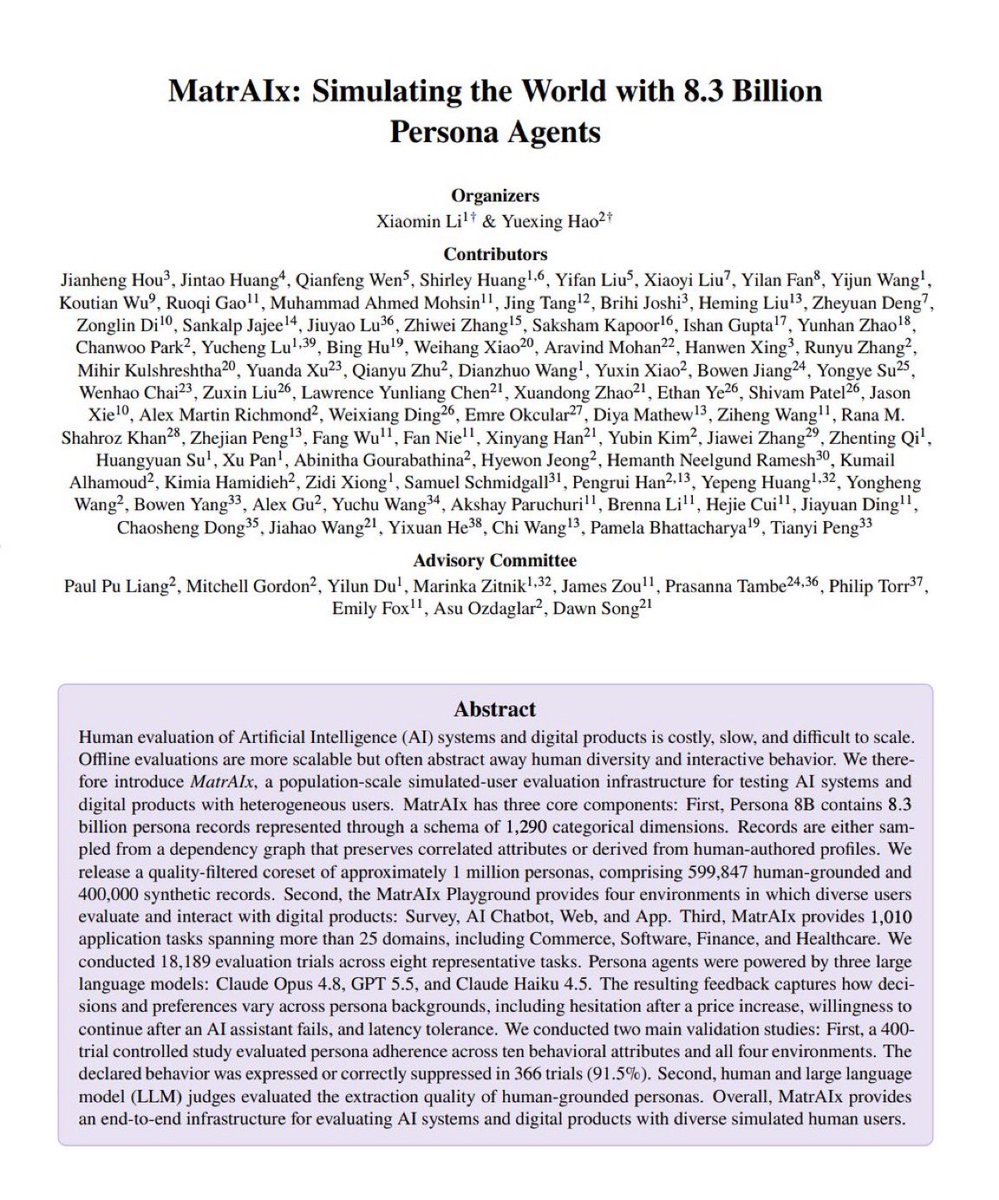
Harvard ve MIT, Dünya nüfusuna denk 8.3 milyar sanal insan yarattı. Dünya nüfusunun dijital ikizi de diyebiliriz buna.
Adı: MatrAIx. Her birinin 1.290 farklı özelliği var: yaş, psikoloji, harcama alışkanlığı, teknik bilgisi, hatta “fiyat artınca ne kadar tereddüt eder” seviyesinde detay. Tabi bu bilgiler bizim sanal dünyaya bir şekilde sunduğumuz bilgilerden derlenmiş.
Nitekim sanal insanlar GPT ve Claude gibi modellerin içine giydirilince, anketlerde, sohbetlerde, web sitelerinde ve uygulamalarda neredeyse gerçek gibi davranıyorlar. Testlerde kişilik tutarlılığı %91.5.
Artık bir meseleyi muhtemelen sanal dünyadaki bu bireylere yani matrixteki izdüşümlerimize yaşatıp istedikleri sonucu alırlarsa gerçek dünyada hayata geçirecekler. Pazar araştırması firmalarını, odak gruplarını, haftalar süren anketleri beklemeden… Tek bir sunucuda, bir gecede.
Bu, pazarlamanın, ürün geliştirmenin ve davranışsal bilimin kurallarını sessizce değiştiren bir kilometre taşı.
Dünya nüfusunun dijital ikizi ya da woodo bebeği artık ellerinde.
Desde noviembre de 2025 existe en la Ciudad de México un artículo que puede devolverte tu casa. Casi nadie lo conoce. Es el 238 Bis del Código Penal, y es el interruptor que la ley le puso al despojo.
Primero, la trampa vieja. Durante años los invasores tuvieron un manual: entrar, cambiar chapas, enseñar un contrato falso y aguantar. A las dos horas ya nadie podía tocarlos: “el delito ya se consumó, esto es civil”. Y la casa quedaba secuestrada en un juicio eterno.
El 238 Bis rompe ese manual. Aquí la guía, paso a paso:
🔴 Qué dice el artículo, en cristiano: imagina que los invasores ya están adentro. Llega la autoridad y les notifica por escrito: “tienen tantos días para entregar el inmueble”. Si el plazo vence y siguen ahí, cometen un delito nuevo: quedarse ya es despojo. Se castiga igual de fuerte: 6 a 11 años de cárcel, hasta 22 con agravantes. Y no se comete una sola vez: se está cometiendo cada día, cada hora que permanezcan adentro, hasta que la víctima recupere su casa.
🟠 Por qué esto cambia el juego: antes había que probar cómo entraron (a la fuerza, con engaños, a escondidas). Por eso los invasores enseñaban un contrato falso: para sembrar duda sobre la entrada y congelarlo todo. Con el 238 Bis, cómo entraron ya no importa. Solo hay que probar dos cosas muy simples: que la autoridad les ordenó salir, y que no salieron. Punto. Y como el delito se sigue cometiendo mientras estén adentro, la policía sí puede detenerlos en cualquier momento: se acabó el pretexto de “esto ya es civil”.
🟡 PASO 1. Denuncia en la fiscalía especializada en despojo (FIDAPU) con todo lo que pruebe tu derecho: escrituras, boletas de predial, recibos, fotos, testigos.
🟢 PASO 2. Pide el interruptor por escrito: solicita al Ministerio Público, o al juez de control, con el artículo 20 constitucional en la mano, que emita el requerimiento formal de desocupación con apercibimiento del 238 Bis. Ojo: tú no puedes requerir, tu abogado tampoco, el notario tampoco. El interruptor es de la autoridad. Por eso se pide por escrito: para obligarla a responder.
🔵 PASO 3. La notificación es el tesoro: requerimiento con plazo, notificado con acta, fotos y video. Vencido el plazo y siguen adentro: delito nuevo, cometiéndose en vivo.
🟣 PASO 4. Cosecha: exige la detención, hay flagrancia mientras permanezcan, y pide la restitución provisional de tu inmueble: es derecho constitucional, no favor. ¿El Ministerio Público se hace guaje? Impugna su omisión ante el juez de control.
⚠️ Lo que nunca: recuperar por tu cuenta. Rompes la chapa y el imputado eres tú.
El interruptor ya está en la pared. Lo que falta es que la ciudadanía sepa que existe y exija apretarlo. Porque si tu casa sigue tomada, ya no es por falta de ley: es porque alguien no está haciendo su trabajo.
Un desarrollador chino llamado tw93 se hartó de que sus aplicaciones de escritorio le devoraran la RAM y el disco.
Abría Slack y desaparecían cientos de megabytes. Abría Discord, Notion o cualquier otra app y pasaba lo mismo. ¿La razón? Casi todas son lo mismo por dentro: un sitio web empaquetado con una copia completa del motor de Chrome (Electron).
Decidió que tenía que haber una forma mejor.
En 2022 empezó a construir Pake. Usó Rust + Tauri, que en vez de incluir un navegador completo, aprovecha el WebView nativo del sistema operativo.
El resultado fue brutal:
- Slack con Pake → 8 MB (en vez de 524 MB)
- Discord con Pake → 9 MB (en vez de 265 MB)
- ChatGPT con Pake → 9 MB (en vez de 260 MB)
Cuatro años después, su repositorio tiene más de 51.000 estrellas en GitHub. Tiene builds listos para Grok, ChatGPT, Gemini, Discord, YouTube, Twitter y muchos más. Todo bajo los 10 MB, ligero, rápido y gratis.
Y lo mejor: con un solo comando puedes convertir cualquier página web en una aplicación de escritorio nativa.
No fundó una startup. No levantó inversión. Solo resolvió un problema que molestaba a millones de personas.
A veces el cambio real lo hace una sola persona que se cansa de las cosas como están.
Esta brutal, repo en los comentarios 👇
A Russian psychologist spent 10 years proving that the act of talking to yourself out loud is one of the most powerful cognitive tools the human brain has, and almost nobody outside his field has read the work.
His name was Lev Vygotsky.
He worked in Moscow in the 1920s and died of tuberculosis in 1934 at the age of 37. He had no laboratory, no funding, almost no English readers, and a body of work that the Soviet government suppressed for two decades after he died.
He produced the foundational theory of how human cognition actually develops, and the central piece of that theory was a behavior almost every adult is faintly embarrassed about.
Vygotsky noticed that young children talk to themselves constantly. They narrate their own actions, they argue with imaginary opponents, they instruct themselves through tasks out loud.
The dominant theory at the time, from the Swiss psychologist Jean Piaget, said this was a sign of cognitive immaturity that children would eventually grow out of as they learned to think properly.
Vygotsky said the exact opposite.
He argued that this self-directed speech was the most important cognitive event in the entire developmental window, because it was the moment a child first started to use language as a tool to control their own mind. The child was not failing to think. The child was learning how to think by externalizing the process and listening to themselves do it.
He predicted that as children matured, this out-loud self-talk would not disappear. It would go underground. It would become silent inner speech, which is the running monologue every adult has inside their own head for the rest of their life.
The voice you hear when you read this sentence is the direct descendant of a four-year-old narrating their own block tower.
For 50 years almost nobody outside Russia had access to his work, and the few researchers who did pick it up could not get funding to test it. Then in the early 2000s the experiments finally started to pile up, and what they found was that Vygotsky had been right about something even more important than he knew.
The first major study came from Gary Lupyan at the University of Wisconsin and Daniel Swingley at the University of Pennsylvania in 2012. They ran a simple visual search experiment. Participants were shown 20 images at once and asked to find a specific object, like a banana or a chair. In one condition they searched silently. In the other condition they were told to say the name of the object out loud to themselves while looking for it.
The participants who spoke the target name out loud found the object significantly faster, with higher accuracy, than the participants who searched in silence. The effect was strongest when the spoken word matched a familiar object the brain already had a strong category for.
Saying the word out loud literally tuned the visual system to detect that thing better. The researchers called it the label feedback effect, and the implication was that the act of vocalizing a goal physically changes how the brain processes the world while pursuing it.
The second major study came out of the University of Michigan and Michigan State in 2017. The lead researchers were Ethan Kross and Jason Moser, and they used both EEG and fMRI to record what happens inside the brain when people talk to themselves while emotionally upset.
They asked participants to recall painful autobiographical memories and reflect on them in two different ways. Some used the first person, saying things like "why am I feeling this way." Others used the third person, referring to themselves by their own name, saying things like "why is John feeling this way."
The brain scans showed that the simple act of switching from first person to third person, even silently, decreased activity in the medial prefrontal cortex, the region responsible for rumination and self-referential pain. Within a single second of using their own name instead of the word I, participants showed measurably lower emotional reactivity. The shift required no extra cognitive effort. It cost the brain nothing. And it worked.
Kross described the mechanism in his interviews. Talking to yourself by name creates a small amount of psychological distance from your own experience. Your brain processes the situation more like a problem belonging to someone else, which means it can analyze it instead of drowning in it.
What Vygotsky had intuited in 1934 turned out to be even more powerful than the developmental theory he built it into. The voice you use to talk to yourself is not background noise. It is one of the most precise cognitive tools the brain has, and you can change how it works just by changing the pronoun you use.
People who talk through problems out loud are not anxious or unstable. They are running an externalized version of a process the rest of us are running silently and worse. The kindergartener narrating their block tower, the surgeon muttering through a procedure, the engineer pacing a hallway describing a bug to nobody, the athlete repeating a cue to themselves before a free throw, they are all using the same ancient mechanism that builds and steers human thought.
You can run the experiment yourself the next time you are stuck on something hard. Stop trying to solve it silently in your head. Say it out loud. Describe what you are seeing. Walk yourself through the steps as if you were explaining it to a colleague who is not in the room.
And when something genuinely upsets you, switch to your own name. Ask why this person is feeling this way, instead of why I am feeling this way.
The voice you have been told to keep quiet your entire life is one of the oldest pieces of cognitive technology you own.
Most people are still embarrassed to use it.
Google's former CEO just said what everyone in AI already knows
Building wealth is getting easier if you actually learn the tools
Not by scrolling AI threads
By understanding agents, Claude Code, prompts, memory, skills, MCP, and routines
Save this before it disappears from your feed
Everything below is free:
Agent architecture
https://t.co/hhrSyF3y6u
Claude Code 101
https://t.co/71Zu7xQmxc
Claude Code in action
https://t.co/vg8fPChJxl
Prompt engineering
https://t.co/xEu7M3CPe1
Interactive prompt course
https://t.co/oGCxHkqFBD
Claude.md + memory
https://t.co/v6JKlS4OJl
Skills
https://t.co/AJCWlDcMU7
MCP
https://t.co/tQTUYCwN16
Routines
https://t.co/gAnEdq5SP0
Claude Code ultimate guide
https://t.co/WeDLJBVaGM
Awesome Claude Code
https://t.co/wvpwfcaf6U
Anthropic academy
https://t.co/uu3JyZyWyt
Official Claude Code docs
https://t.co/xuUWAfZGXy
All of this costs $0
Most people will keep asking AI one question at a time
Save this and start learning the stack