I got hacked at 3:59 AM without clicking anything. My voicemail handed the attacker my Telegram login code.
Here is exactly how it worked, so it doesn't happen to you.
3:54 AM. My phone rings about ten times in a row, No Caller ID. That was not harassment. It was the attack: keep my line busy.
Meanwhile, the attacker asks Telegram to log in with my number and picks "send the code by phone call". My line is busy, so Telegram's robot call lands on my voicemail and reads the code out loud to it.
Carrier voicemail can often be reached remotely, with a default PIN or a spoofed caller ID. He listens to the message. At 3:59 he is in.
Fortunately, the attack was noisy. The calls woke me up. At 4 AM I only wanted to go back to sleep, but I had the presence of mind to check my notifications. Telegram was showing a new login from a device I didn't know. That check is what saved me: I ended his session within minutes. If I had rolled over, the next day would have been a mess.
In those few minutes he had already typed /balance, then /start on every old wallet bot he could find in my chats. He was hunting for funds tied to my Telegram. The bots were long dead and nothing was lost. He still had time to set his own 2FA password on my account.
What would have stopped it:
Telegram two-step verification, with a recovery email. With a password on the account, the code alone is useless.
Your voicemail. Change the PIN, block remote access, or turn it off (##002# cancels call forwarding on most carriers).
Same for WhatsApp and any service that can send a code by voice call.
No seeds, keys or passwords in Saved Messages. Ever.
A burst of masked calls at night is a signal, not a nuisance. Check your notifications and your active sessions.
I have been building in crypto for more than ten years and I had never thought about my voicemail. Check yours today.
No, but I also wouldn’t use my own practices as the standard here. Given the industry I work in, I probably have considerably more OPSEC awareness around personas and alt accounts than the average person.
Most people aren’t thinking about compartmentalisation, identifier reuse or whether an email can link one persona back to another. They use whatever email is convenient, reuse usernames and generally leave connections everywhere.
So him using his real email on an alt account doesn’t strike me as particularly strange. It strikes me as fairly ordinary sloppy OpSec
@C2IRIS Ear recognition. The shape of the human ear changes very little throughout life and is often easier to capture than a face when people are standing in a queue or viewed from the side.
Then there’s gait recognition, the way a person walks. https://t.co/HAr5jLg8em
@iamTiresias@BenDoBrown Collect enough data you can identify people based on sensitive locations
Then you pull up all their activities and more often than not you then identify their home address
Home/Work are two of the main places people do activities to and from
Example
https://t.co/Zr5VZBEdPy
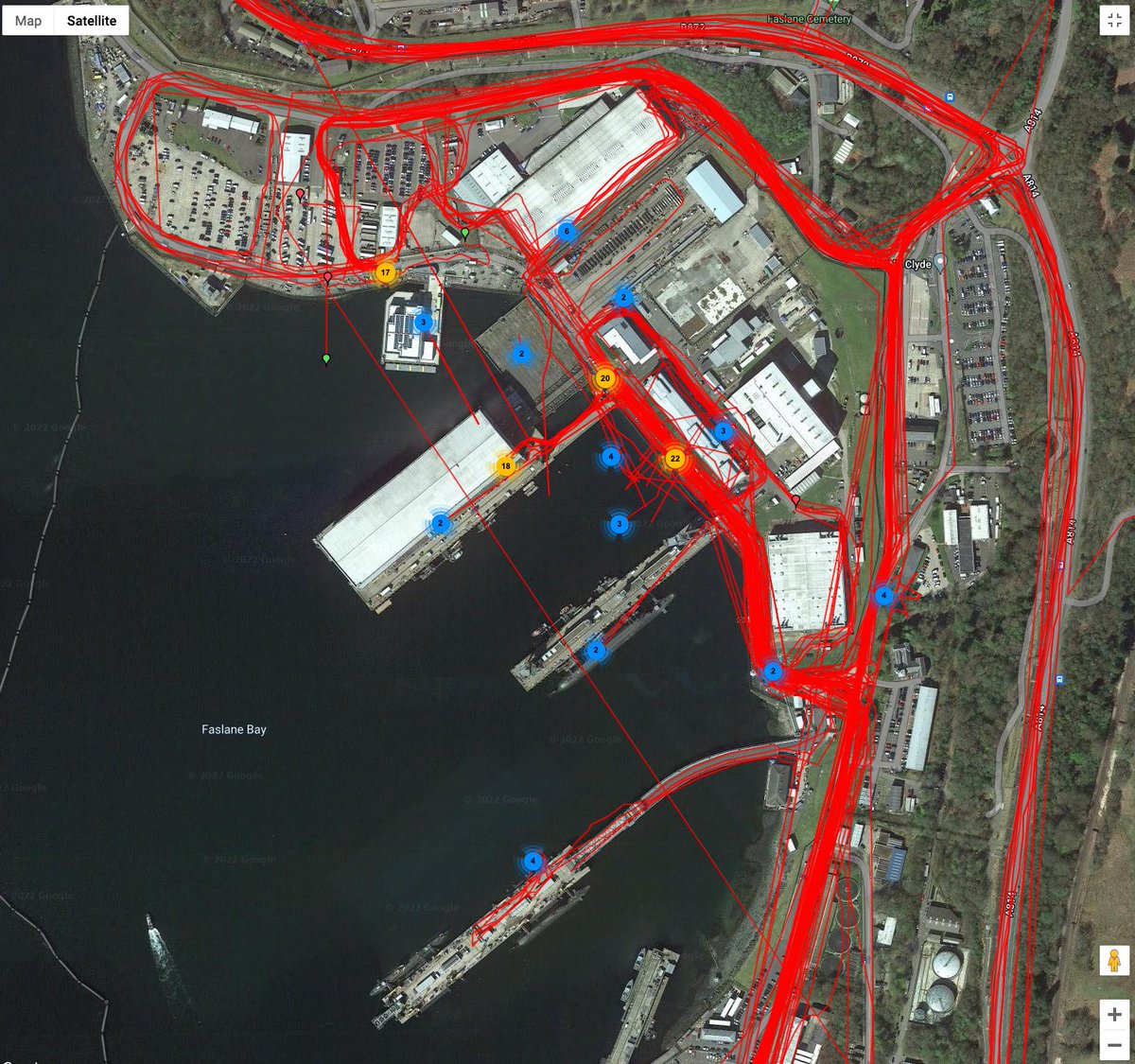
[#OSINT|#SOCMINT|#OPSEC] If you collect enough location/fitness data and create some simple tooling around it, you are able to create a very powerful reverse lookup tool.
Restricted locations are more vulnerable to this technique.
1/5
@GBPolitcs A few years ago I scraped all the activity data from Strava, then built custom tooling to search all activities against any location in the world.
Here is the Nuclear Naval Base in Scotland, Faslane. I could then identify many of their home addresses.
https://t.co/gsFFW4q3Kq
@Richard_AHolmes A few years ago I scraped all the activity data from Strava, then built custom tooling to search all activities against any location in the world.
Here is the Nuclear Naval Base in Scotland, Faslane. I could then identify many of their home addresses.
https://t.co/gsFFW4q3Kq
@EthicalHoopz@PolitlcsGlobal@lemondefr All you have to do is scrape the activities on a regular basis and you can do this all day long, despite even the pentagon telling it staff to stop using strava they still do, along with lot of other sensitive locations.
Ive posted a few times about it
https://t.co/Zr5VZBEdPy
[#OSINT|#SOCMINT|#OPSEC] If you collect enough location/fitness data and create some simple tooling around it, you are able to create a very powerful reverse lookup tool.
Restricted locations are more vulnerable to this technique.
1/5
@LifeInGen6@TechloreInc What’s more wild is how this method is very very rarely protected with rate limiting. Facebook, WhatsApp, Apple, Strava, all of them have fallen fowl of this.
@nbacyberguy@CraigHRowland Exactly. However that would take a level of integrity he clearly lacks. Instead of admitting he’s wrong, he doubles down. Even his Tor comment is nonsense.
@CraigHRowland Ask any survivor how they feel about their abuse being called “porn.” They don’t. That’s why professionals use CSAM, it’s about respect and accuracy.
You work in security, you know precision matters. Calling CSAM “porn” is like calling a malware payload “software.”
@CraigHRowland The acronym isn’t about “hiding it” , it’s about accuracy. “Kiddie porn” implies consent or legality. CSAM makes it clear it’s child sexual abuse, not “pornography.” The wording matters because the harm is real.
@CraigHRowland People love to claim Tor is full of CSAM, but the reality is far darker, most abuse material surfaces on the clear web, social platforms, and messaging apps. Tor isn’t the source of the problem; the open internet is. 2/2
@CraigHRowland The term “kiddie porn” trivializes real child abuse. The correct term is CSAM (Child Sexual Abuse Material) it’s evidence of a crime, not “pornography.” Words matter. 1/2