The most detailed document in the company turned out to be the least ready. The better the owner described a process, the more questions the model returned. On the half-baked ones — zero.
He answered that question for the fiftieth time. Then he stopped answering. The owner's replies lived in chats, files and his AI's artifacts — and landed nowhere. The analysts asked again.
The client ran the system on their own for three months. Then spent ninety minutes looking for someone to blame. Two questions had no answer: who understands the architecture, and who owns the data.
First sale by a company where the only employees are AI agents. Facebook ad → WhatsApp → voice call → package → courier → next batch. Not a single human action.
I sit in AR glasses and spin my client's company like a model made of blocks. Red block = problem. 65 processes in one graph: source, decisions, rules, steps, data, interfaces, tests.
Every evening I think: one more prompt and it will all work. The model replies "Want me to improve this further?" — and there is no finish line. This week I named it: AI psychosis. Nerves shot, sleep gone.
You won't build an AI company while everyone on your team uses AI alone. We've gathered smart people — and each works like a first-grader: their own Claude, their own style, lots of code, text and decks.
What a harness is made of, minimal. Between your chat and the result sit eight parts: LLM, instructions, skills, tools/MCP, memory, subagents, sandbox, permissions. A chat answers — a harness executes.
One word came from three directions in a single week: harness. Vercel teaches how to build one. Salesforce sells one (Claudeforce's "trusted enterprise harness"). We'd spent a month building ours by hand — without knowing the word.
Two of us shipped on the same evening — and wiped out each other's work. Half a day to recover. This is what happens when the whole team is vibe-coders ) One week later we had the delivery process teams usually build over years.
Software is no longer something you buy. @Salesforce and @AnthropicAI just announced Claudeforce — and their press release says it plainly: "the UI is the AI."
The two largest IPOs in history are being prepared by companies that sell work with text. Anthropic targets up to $2T on Nasdaq; OpenAI calls anything under $1T a non-starter.
The most common mistake with AI: leading it to the answer you already expect. It agrees — and you pay for an argument in favour of your own experience, not for a new answer.
I counted what one week of working as a human + agent pair costs. Not in dollars — in tokens.
386 million Claude tokens. ~1,000 agent turns. 311 terminal commands. 76 files.
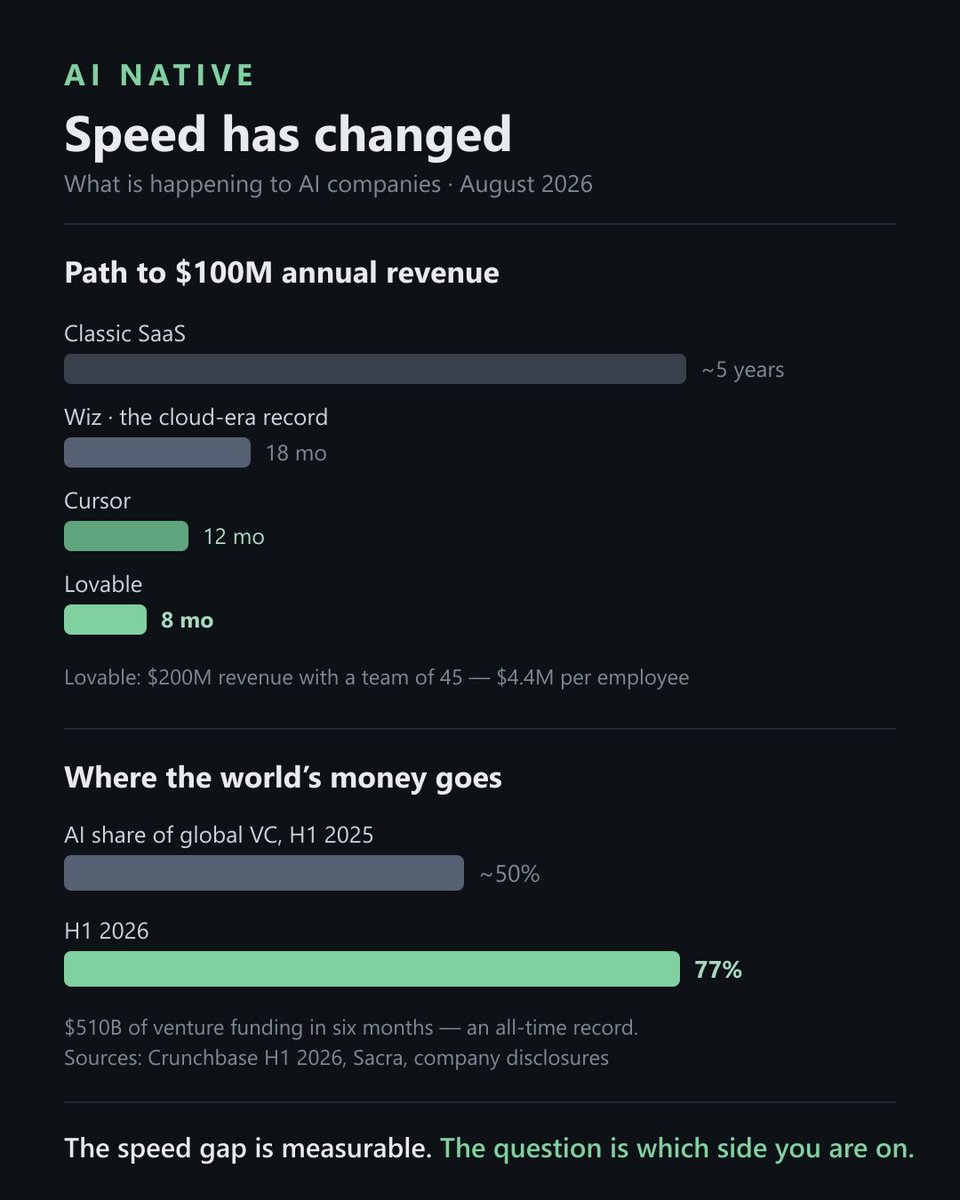
August 2026 in one picture.
Path to $100M ARR: classic SaaS ~5 years. Wiz set the cloud-era record at 18 months. Cursor did 12. Lovable — 8, with a team of 45.