A. R. Rahman and Hans Zimmer’s wall-to-wall score in Nitesh Tiwari’s Ramayana (2026) is a seamless combination of the composers’ individual styles. More a brassy, bombastic score than one brimming with bhakti rasa (something the film isn’t going for either), though. The background score works incredibly well within the film and would be thoroughly entertaining as an extra-filmic listening experience once the original soundtrack album is released. There are at least 40 different musical cues in the score. Those who are familiar with the composers’ works can easily hear who composed what in the score. There are several cues that are entirely A. R. Rahman, some entirely Hans Zimmer, and some other cues where Zimmer and Rahman’s layers are in perfect harmony—for example, the Indian electric violin parts that find their space in between and over the phrases composed by Zimmer for Ram (can be heard in the track “Rama Theme”).
All the electric violin parts heard throughout the film (used for Dashanan’s Tapasya, Indra’s dive into the deep ocean, Bharat Milap sequence) are by A. R. Rahman. This is a brilliant choice; the instrument’s timbre is modest and muted compared to the traditional violin or sarangi (typically used in emotional sequences in such films) that even in high registers it doesn’t squeal, which might sound sappy and excessive to a Western audience (and a cello might sound too low and Western), and so it offers a perfect sonic solution for what the film is attempting here—to appeal to both Indian and international audiences. The distinct tone of this instrument is most pronounced in the Vanvas theme that is heard in the film when Ram, Sita, and Lakshman bid adieu to Dasarath and Kaikeyi in the throne room.
A. R. Rahman's rousing cry for Ram makes a moment in the leaving-for-exile episode pivotal (the film should have cut to intermission immediately after this episode). The film by itself does not earn the emotion an audience member might feel at this moment; the audiences’ past encounters with the story could do it instead, and A. R. Rahman’s high cosmic wail matches the register of this emotion. The visual in this sequence looks stunning on the big screen—the carriage lit in golden yellow passing through a sea of darkness, almost a painting.
Equally visually stunning is the moment when Ram meets Sita for the first time, a moment made all the more glorious by Rahman’s music. The ascending strings as Sita approaches the temple, the musicality of the Sanskrit verses themselves, the meditative melody the verses are set to, the musical conversation between male and female voices as Ram and Sita exchange glances, the rousing orchestral coda as Sita leaves—the spatio-temporal congruence and the emotional congruence between the music and the moving image in this sequence are magical.
There are several other cues that are entirely A. R. Rahman: a sweet female solo for Surpanakha who is now smitten by Ram; the music that plays in the Swayamvar sequence (music heard after Ram picks the bow is more Zimmer, a variation of the Rama theme)—the warm, whimsical, bouncy strings we hear as men fail to lift the bow (reminded me of the track “Shark” from Couples Retreat and the strings heard throughout the The Hundred-Foot Journey score); the orchestral version of the song "Jai Jai Ram" is played a few times in the film—when Dasarath makes Ram wear his crown and when a forest blooms and comes to life after Ram kills the giants whose spell the forest was under. While the melody of “Dharti hai ambar” is A. R. Rahman, the accompanying deafeningly gargantuan chorus and orchestral layers are typical Zimmer. In other moments, where there is chorus singing Sanskrit verses, for example, in the sequences where Ram fights the giants in the forest, the music is largely Rahman, even if entirely orchestral.
Ram and Ravan get distinct leitmotifs, the orchestral variations of which are heard throughout the film. The four-note Ravan motif is Zimmer, but there is a secondary theme, a low, grunting, rumbling male choir (singing some non-linguistic syllables) which is clearly Rahman and sounds derived from the track “Ravana Thandav.” And the thandav track is thunderous and effective within the film. The version played in the film’s prologue is much longer, with Zimmer’s Ravan theme dubbed over Rahman’s densely layered percussive Indian parts. This opening prologue is made all the more breathtaking by the accompanying score to which both Rahman and Zimmer seem to have contributed equally. There are several more interesting musical cues in the score. I can’t wait to listen to the original soundtrack album. Might watch the film again just to hear the score. For now, I’ll leave you with the beautiful Vanvas theme.
Facts based on hard data.
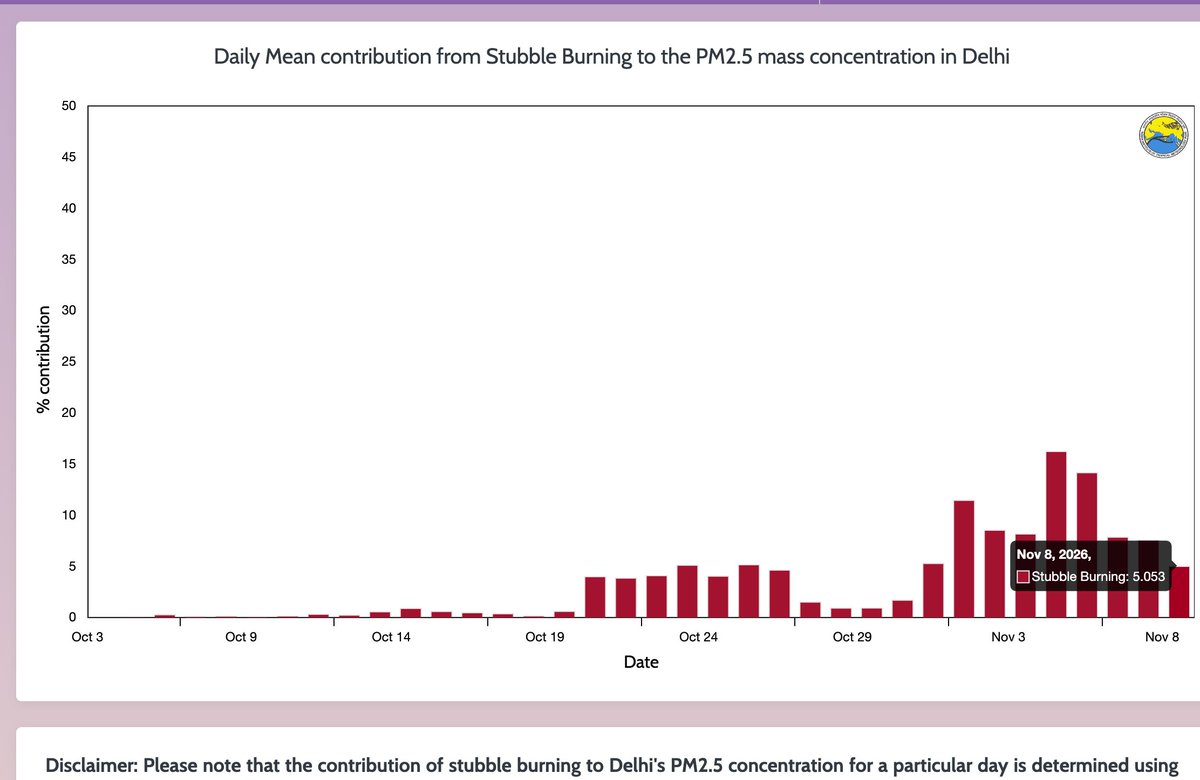
1. Stubble burning in Punjab has gone down by 95%
2. Hence AQI across cities of Punjab even on Diwali Day is between 164-366 (We need to improve it further)
3. Graph below is from SAFAR (Centre Gov) which shows that contribution of stubble burning was only 5% on Diwali. This graph includes stubble both from Punjab & Haryana.
#AirQuality
The type of words, the dragging of certain syllables have a rhythm in each language. A composer who is well aware of these nuances will be better equipped to make better tunes for that language songs.
If you notice the kannada songs in the last 25 years, this rhythm is missing!
@pnamblat Check these two kannada songs have very similar pattern.
A kannada song from 2014
https://t.co/KBuj94m2sx
Another kannada song by S Janaki from the 1960s
https://t.co/BP0nwizoSx
I used to always wonder why ARR hasn't used Saindhavi's voice much despite being so closely related to her. When he got a big project, he put all his favourite people and other composers like Ravi Basrur.
@internetfreedom@apar1984 It's very clear Delhhi ppolice sent the notice, but now they are distancing themselves.
It just needs a verification of a few more emails sent to other people including social media platforms. If that email ID is invalid, then all the past notices become invalid!
X has told the Delhi High Court that the takedown reports filed in the Delhi Police’s name appear to be fake, and that it has complained to the police and will not act on them.
https://t.co/2ut9Su3KZ1
#BREAKING X informs Delhi High Court that takedown notices sent to Internet Freedom Foundation and SFLC were by some impostor and not by Delhi Police.
X says complaint has been filed to find the impostor and no action is taken against IFF and SFLC.
@Slfc05@internetfreedom