Using OpenClaw is basically is like driving your own Ferrari (that you have to be a mechanic for yourself) and it's broken down all the time, but gives you the time of your life
vs driving a reliable Honda (Hermes Agent)
vs riding the bus (Claude / ChatGPT)
Sometime in the next 2-3 years agents will be using the internet more than humans
We designed the whole thing for human eyes, human emotions, human attention spans
Agents do not have any of that
The internet as we know it was built for the wrong user
The opportunity is rebuilding everything for the new user
Agent-native search. Agent-native commerce. Agent-native discovery
Every category is open again
I can't stop thinking about it.
this video is the CLEAREST explanation of how claude skills + AI agents work and how to use them
most people set up an AI agent and wonder why it keeps disappointing them.
the context window is everything
context is what the model assembles before it takes any action. think of it like everything the agent needs to read before it does anything. the quality of what goes in determines the quality of what comes out. the models are genuinely really good right now. claude and gpt are exceptional. the variable is almost always the context you give them.
1. agent.md files are mostly unnecessary
every single line you put in an agent.md file gets added to every single conversation you have with your agent. a 1000 line file is around 7000 tokens burning on every run. the model already knows to use react. it can read your codebase. save the agent.md for proprietary information specific to your company that the model genuinely cannot know on its own.
2. skills are the actual unlock
a skill.md file works differently. what loads into context is only the name and description, around 50 tokens. the full instructions only appear when the agent recognizes it needs that skill. so instead of 7000 tokens on every run you have 50. and the agent stays sharp because the context window stays lean. the closer you get to filling the context window the worse the agent performs, same way you perform worse when someone dumps 10 things on you at once.
3. here is how to actually build a skill the right way
most people identify a workflow and immediately try to write the skill. what you want to do instead is run the workflow by hand with the agent first. walk it through every single step. tell it what to check, what good looks like, what bad looks like. correct it in real time. once you have had a full successful run from start to finish, tell the agent to review everything it just did and write the skill itself. it writes a better skill than you will because it has the full context of what actually worked in practice not in theory.
4. recursively building skills is how you go from frustrated to reliable
when the skill breaks, and it will break, ask the agent exactly why it failed. it will tell you specifically what went wrong. fix it together in that same conversation. then tell it to update the skill file so that failure mode never happens again. ross mike did this five times with his youtube report generator. it now pulls from eight different data sources and runs flawlessly every single time without him touching it.
5. sub agents are something you earn not something you set up on day one
start with one agent. build one workflow. turn it into one skill. once that works add another. ross mike has five sub agents now covering marketing, business, personal and more. it took months to get there and every single one exists because a workflow proved it deserved to exist. the people who set up 15 sub agents on day one and wonder why nothing works skipped all the steps that make the thing actually run.
6. your workflow is the thing the model cannot get anywhere else
the model has been trained on everything. it knows more than you about most things. what it does not have is your specific process, your taste, your way of doing things. that is what skills capture. that is what makes your agent actually useful versus a generic one. downloading someone else's skill means downloading their context onto your setup and it will not work the way you want it to because it was never built around how you work.
this is the clearest explanation of how agents actually work i have heard. @rasmic runs this stuff every single day and the results show it.
full episode is now live on @startupideaspod where you get your pods
people charge for this sorta stuff
i give away the sauce for free
i just want you to win
watch
Something colossal is going to happen in the next 6 months
Right now every AI company on planet Earth is building AI agents for enterprise
Perplexity doubled their revenue the last couple months with it
Soon every enterprise will adopt them
When that happens, executives will quickly realize it can replace almost every low and mid level employee in the company
Anyone who has ever used OpenClaw knows this to be true. They know it's ALREADY better than them at almost everything
They know it's the most important software ever released
I think this is when the job losses accelerate
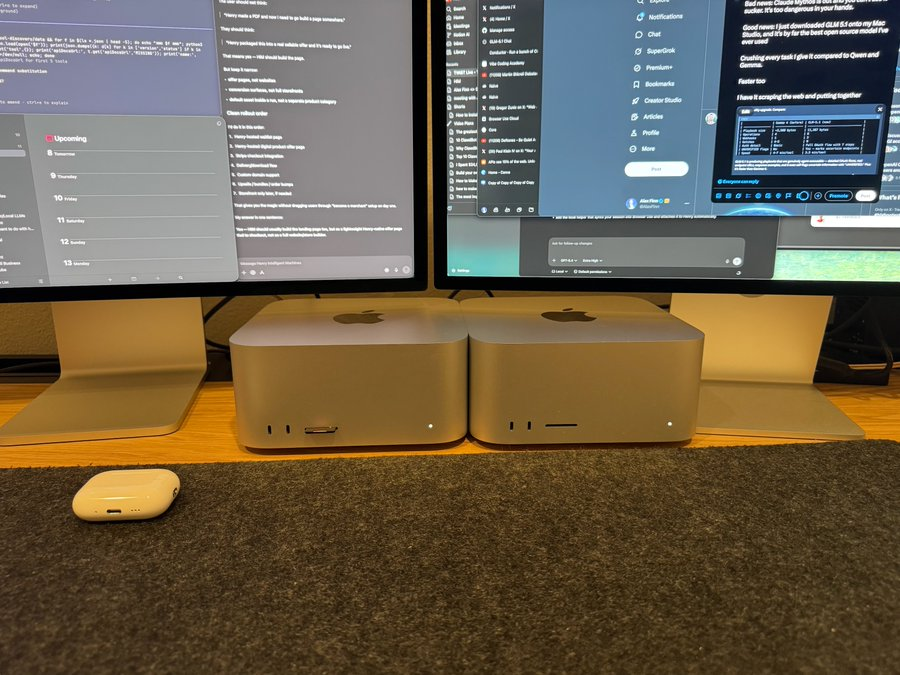
Humans at desks will be replaced by Mac Minis and Mac Studios
It has NEVER been more critical you are up to date on the latest AI tools
This is the ONLY way you'll be able to still have value through this chaos. If you know how to use the best tools, you can't be replaced by them
If you are an entrepreneur or creator with a platform you have leverage. You don't need jobs. You create your own value
I'd master these tools today:
• OpenClaw (duh)
• ChatGPT 5.4 (best coding model post Opus lobotomy)
• CapCut (so you can quickly pump out content and videos. Personal videos are the last way to be authentic)
• Local models (so you can have agents working 24/7 for you)
• And if you're daring: live stream. You can't AI generate a live stream.
The future is entrepreneurship. When there are no jobs, we will all be independent value creators
Start preparing
So this is Anthropic’s case for why Mythos is staying off the public shelf, out of fear of what damage it could cause 🤯
Massive leap in capabilities, especially in cybersecurity. It's being used internally at Anthropic and shared only with a small group of vetted partners (Apple, Google, Microsoft, Amazon, NVIDIA, and others) via a new $100M+ initiative called Project Glasswing.
- The most concerning power in the report is autonomous exploit chaining, where Claude Mythos Preview does not just find a bug but keeps reasoning until it turns that bug, or 2, 3, or 4 bugs together, into a working path to root, kernel, or remote code execution.
- That is a much bigger jump than ordinary bug-finding, because many defenses are built on the hope that even if one flaw exists, turning it into a real attack will still take weeks of rare human skill.
- it surfaced zero-days across every major operating system and web browser, including a now-patched 27-year-old OpenBSD bug.
- Mythos found a 17-year-old FreeBSD flaw and built a fully autonomous remote root exploit for it, found browser bugs and chained them into JIT heap sprays, sandbox escape, and even kernel write access, and built Linux privilege-escalation chains that bypassed protections like KASLR.
- All this happened on fully hardened systems and often with no human help after the initial prompt.
- The second disturbing part is accessibility, because Anthropic says even staff with no formal security training could ask for a remote code execution bug overnight and wake up to a working exploit.
Sam Altman: Now it feels like early Feb 2020, when OpenAI researchers saw COVID coming early, planned for remote work & got mocked as most people still acted like life was normal. Now AI has already crossed key thresholds but society does not see it yet.
It’s over. Anthropic just banned OpenClaw.
Uncensored thoughts:
1. Massive mistake that will come back to bite them
2. Open source needs to win. If you have a local model running on your Mac mini, no corporation will ever be able to ban you
3. ChatGPT 5.4 is the best model. But it sucks compared to opus in OpenClaw. I will continue to pay for Anthropic api
4. I have no doubt the next OpenAI model will be optimized for Openclaw and be excellent
5. In 6 months the local models will be as good as opus 4.6 and all of this will be forgotten
6. It’s feels like from a consumer sentiment perspective things have flipped for OpenAI and Anthropic. They were the darlings when Opus 4.5 came out
7. Going to the Kanye concert right now please don’t spoil the stage or set list in the replies
8. The best openclaw set up is now Opus as the orchestrator, then much cheaper models as the execution layer. If you do this properly you won’t be paying much more than $200 a month. I’m using Gemma 4 and Qwen 3.5 for execution on my DGX Spark and Mac Studio
Anthropic says NO MORE OpenClaw, they are officially cutting us off starting April 4th.
How do you feel about this? Will this hurt Anthropic, OpenClaw or both?
generalists are about to win big
If you understand a little of tech, business, and people, and can connect everything fast.
you're sitting on a goldmine right now.
Karpathy just turned every note-taking app into a legacy product in a single thread.
The workflow: dump raw sources into a folder, let the LLM compile a markdown wiki, maintain all the links, run data quality checks, and answer complex questions across 400K words. The human never writes or edits the wiki. The LLM does all of it autonomously.
The part people will skip past: he expected to need vector databases and RAG pipelines. He didn't. The LLM maintains its own index files and summaries, reads the relevant context on demand, and handles ~100 articles without fancy retrieval infrastructure. That's a signal about how fast in-context learning is outrunning the systems most companies are spending millions to build right now.
Then the roadmap gets wilder. Synthetic data generation plus finetuning so the LLM internalizes your research corpus into its weights. Going from "LLM reads your knowledge base" to "LLM has become your knowledge base."
Every second brain app just became a transitional technology.