🚨🇺🇸BREAKING: The CIA officer caught with $40 million in gold bars allegedly invented an entire fake top-secret spy program to steal the money.
As if this story couldn't get and wilder:
-David Rush allegedly built a sham "special access program," the blackest box in U.S. intelligence, so secret even top-clearance officials couldn't look inside without authorization
-The fake program posed as "continuity of government" work, the doomsday planning that keeps Washington running after a nuclear war
-He allegedly read in two colleagues as unwitting accomplices and used a made-up government contract to funnel millions, persuading a defense contractor to buy huge amounts of gold
-The FBI raid on his home seized 303 gold bars worth roughly $40 million, $2 million in cash, and 35 luxury watches
-Investigators say he lied about his college degrees, faked being a Navy pilot, and still sailed through the CIA's notoriously brutal vetting
-A judge ordered him held as a flight risk, and several CIA officials are now on leave as the probe widens
The scheme worked because of the system, not in spite of it.
The secrecy walls built to hide operations from China and Russia hid the fraud from the CIA itself.
A man with a fake résumé ran a fake doomsday program inside the most paranoid institution in America, and for years nobody noticed...
Source: Washington Post
🚨 PHYSICISTS JUST CONFIRMED “NEGATIVE TIME” IS REAL IN A MIND-BENDING QUANTUM EXPERIMENT.
Light can exit a cloud of atoms before it even enters.
In a new experiment, researchers fired photons through a dense cloud of ultra-cold atoms and measured something that shouldn’t be possible in classical physics.
Some photons appeared to spend a negative amount of time inside the cloud effectively leaving before they had fully arrived.
Why this matters:
• This isn’t time travel it’s a quantum effect involving how light interacts with matter at the deepest level
• It comes from “weak measurements” that let scientists observe the system without fully disturbing it
• The atoms themselves “report” spending negative time in an excited state
• It challenges our everyday intuition about cause and effect in quantum systems
The deeper implication is enormous:
We are seeing the strange, non-intuitive nature of quantum mechanics play out in real experiments.
Time at the quantum scale doesn’t always behave like the arrow we experience in daily life. Effects can appear to precede causes in measurable ways without breaking relativity or causality.
This is one of the clearest experimental windows yet into how reality works at its most fundamental level.
What do you think does “negative time” change how you see reality, or is it just another quantum quirk we’ll eventually get used to?
Follow for more frontier physics and reality-bending discoveries.
🦔GitHub Copilot switched to token-based billing this morning and users are already out of credits. Pro+ subscribers paying $39 a month are reporting 60% of their credits gone in two hours of normal use. One user lost 20% of their allowance from a single file review with no code changes. Another hit their monthly cap before the calendar even flipped to June.
Orgs with shared token pools have no way to see individual usage, so entire teams get cut off when one person runs a heavy prompt. Users are canceling and moving to Claude Code and Codex. GitHub community forums are on fire.
My Take
Flat-rate AI subscriptions were always subsidized. Everyone in the industry knew it. Today the subsidy ran out for a few million developers at once. The problem is a lot of companies already restructured around these tools. They cut headcount and told remaining engineers to lean on Copilot instead of building skills internally. Those companies now depend on a tool whose cost just became unpredictable and whose usefulness completely changes when you have to ration prompts to stay under budget.
The developers moving to Claude Code and Codex will hit the same wall eventually. Every AI provider faces the same unit economics. Anthropic filed its S-1 this morning, and the durability of its revenue depends on whether customers stick around once real pricing kicks in everywhere. If a $39 subscriber cancels after one day because the tool became unusable, multiply that across millions of seats and the churn risk becomes very real.
Today showed what happens when AI pricing meets reality. The companies that built their workflows around cheap tokens just discovered the tokens aren't cheap anymore and the people who knew how to do the work without them are already gone.
Hedgie🤗
في عام 1983 ظهر مزارع أسترالي نحيف عمره 61 عام اسمه Cliff Young على خط انطلاق سباق ألترا ماراثون بطول 875 كيلومتر بين سيدني وملبورن.
كان يرتدي ملابس عمله وحذاء مزرعة، لدرجة أن البعض ضحكوا عليه، بعضهم قال له بشكل مباشر:
(ستنهار وقد تموت قبل أن تنهي السباق )
فرد عليهم:
كنت أطارد أغنامي وأبقاري أيام العواصف أحيانا ليومين أو ثلاثة أيام متواصلة، أعتقد انني أستطيع فعل هذا أيضا
ثم حدث شيء غريب، بينما كان الجميع يركضون ثم ينامون لساعات، واصل كليف الركض، ليلة بعد ليلة، يوما بعد يوم كأنه آلة لا تعرف التوقف ويأكل ويشرب وهو يركض، لدرجة أنه لم يتوقف الا لقضاء حاجته فقط
وفي النهاية أنهى ال875 كيلومتر خلال 5 أيام و15 ساعة فقط، محطما بذلك الرقم القياسي ومتقدما على أقرب منافسيه بحوالي 10 ساعات كاملة.
كتبت الصحف أن رجل عجوز من مزرعة نائية أعاد تعريف حدود التحمل البشري، وأثبت أن بعض البشر تدربهم الحياة بطريقة لا تستطيع أي صالة رياضية في العالم مجاراتها
Mark Hamill says he wanted Luke, Leia, and Han to reunite in the Star Wars sequels but he got rejected.
“I said, ‘It’ll only take 30 seconds.’
JJ said, ‘Well, Mark, it’s not Luke’s story anymore”
🚨 MATHEMATICIANS ARE NOW CHALLENGING DARK ENERGY ITSELF.
For decades we’ve explained the universe’s accelerating expansion by adding a mysterious force called dark energy.
But a new mathematical paper argues it might not be needed at all.
Researchers at UC Davis say the standard cosmological model may be unstable under the Einstein–Euler equations — the mathematical framework that combines general relativity with the dynamics of cosmic fluids.
Their bold claim: the acceleration we observe could emerge naturally from instabilities in Einstein’s own equations… without any invisible dark energy.
Why this matters:
Dark energy is supposed to make up ~70% of the universe’s energy budget.
Yet we have never detected a single particle of it, nor do we know what it actually is.
It’s simply something we inserted into the equations to make the numbers work.
The deeper implication is massive:
Maybe the universe isn’t being pushed apart by an exotic substance.
Maybe the standard model of cosmology is sitting on an unstable solution — like a pencil balanced on its tip and the slightest perturbation naturally drives cosmic acceleration.
This does not mean dark energy is dead.
But it does mean one of the deepest assumptions in modern physics is being seriously challenged again.
And that is exactly how revolutions in cosmology begin.
What if the biggest “mystery force” in the universe was never a force at all?
Follow for more frontier physics and cosmic discoveries.
CEOs are quietly realizing the AI replacement plan has a problem.
Two problems, actually.
One: the token costs for running AI agents are now exceeding what they were paying the employees they fired.
Two: when the tokens run out, the AI stops. Just stops. No continuity. No workaround. Just a spinning wheel where your workforce used to be.
You fired humans to save money and bought a subscription that bills you into a corner.
The employees you let go knew what to do when things broke.
The AI just invoices you for the outage.
And then there’s the permission problem nobody wants to talk about.
To do its job, the AI agent needs access. Full access. Your systems, your patents, your contracts, your future plans. Everything you spent years building, handed over to a process that has no loyalty, no discretion, and no skin in the game.
You didn’t hire a replacement.
You gave a stranger with no soul the keys to everything you own.
Enjoy.
Still battling emotions about the fact that my work is being gobbled up and spit out by AI to inform the public and de-incentivize them from actually reading my work.
... all without any additional compensation.
Very weird time we're living in.
This indie dev made a survival horror game where you're unemployed and can literally die of boredom
- Must maintain high dopamine levels
- Eat, drink, use the toilet & wash yourself
- Hide from responsibilities
It's Called Unemployment Simulator 2018. Would you play this?
Let me trace the timeline here because nobody's connecting it.
Step 1: Scrape the entire internet. Every book, every article, every conversation, every piece of art, every forum post. Do it without asking. Do it without paying.
Step 2: Train a model on all of it. Call it "artificial intelligence."
Step 3: Go to BlackRock's Infrastructure Summit and announce: "We see a future where intelligence is a utility, like electricity or water, and people buy it from us on a meter."
Step 3 is where you sell people's own knowledge back to them. On a meter.
They took the collective output of human thought, compressed it into a model, and now they want to charge you by the token to access a version of what you and everyone you know already created.
One Reddit user put it perfectly: "They stole all this data from us, the people, our life's work, creativity, art, by devouring the internet and blowing through all copyright laws. Now they want to sell it back to us in the form of a utility."
Imagine if someone photocopied every book in the public library, burned the library down, and then opened a subscription service for the copies.
That's the metered intelligence business model.
And they're pitching it to infrastructure investors as though they invented water.
Uber’s COO has said that it’s getting “harder to justify” its AI costs because there was no way to show a link between AI spend and any meaningful increase in useful features. This is the first time I’ve seen a company say this directly.
https://t.co/xUhZvtpwah
Microsoft reportedly pulled engineers off Claude Code after the token bills started getting insane.
The wild part is AI is starting to look less like a replacement for workers and more like a second workforce to pay for.
🚨 THE ENTIRE AI BOOM MIGHT BE BUILT ON FAKE REVENUE.
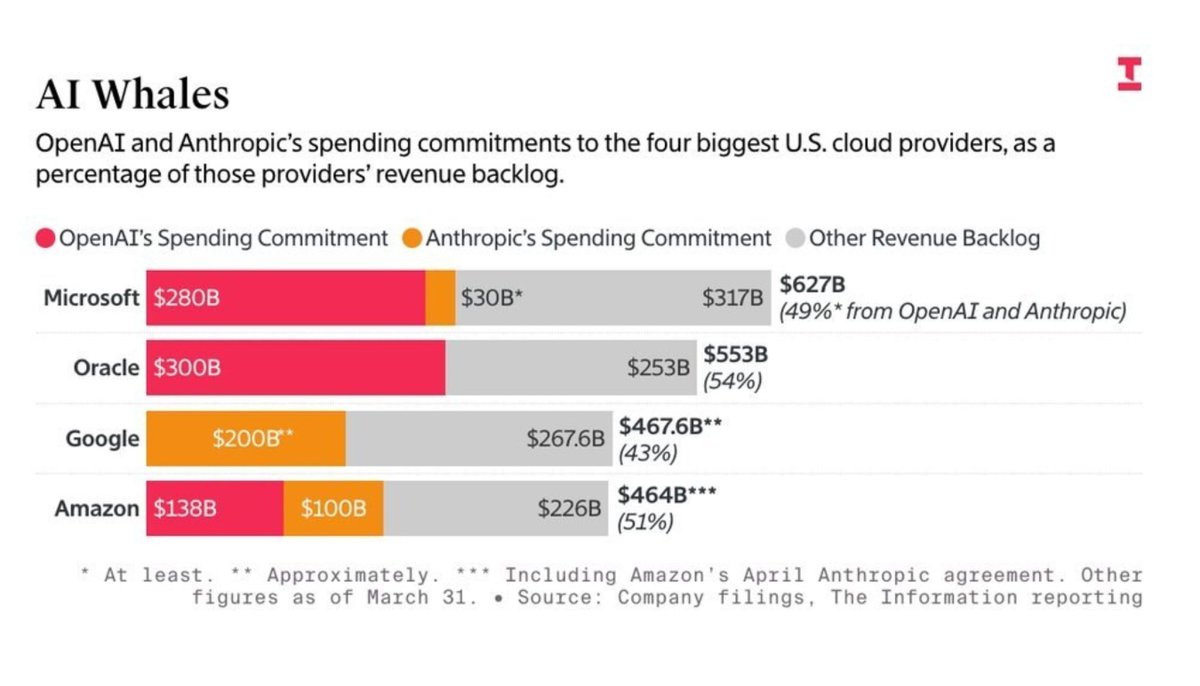
Latest corporate filings show that OpenAI and Anthropic alone make up over half of the entire $2 trillion future cloud backlog held by Microsoft, Oracle, Google, and Amazon.
This massive pipeline is actually being created through a circular accounting trick called a round trip revenue loop.
But how it works ?
A tech giant gives billions of dollars to an AI startup as an "investment". But hidden in the contract is a strict rule forcing the startup to hand that exact same money straight back to the tech giant to rent their computer servers.
Look at the documented case of Microsoft and OpenAI.
When Microsoft invested $13 billion into OpenAI, it didn't just give them cash; it gave them "cloud credits" to use Microsoft servers. OpenAI used those exact credits to train its AI models, and Microsoft then turned around and recorded that server usage as brand new "cloud revenue" from a customer.
The tech giant is literally paying itself with its own money and calling it a sale.
This is why OpenAI’s annual cloud bill has ballooned to over $60 billion, double its actual revenue of $25 billion, kept alive solely by this recycled funding loop.
Anthropic runs the exact same play, spending $2.66 billion on Amazon Web Services in just nine months, which was basically 100% of all the money it earned at the time.
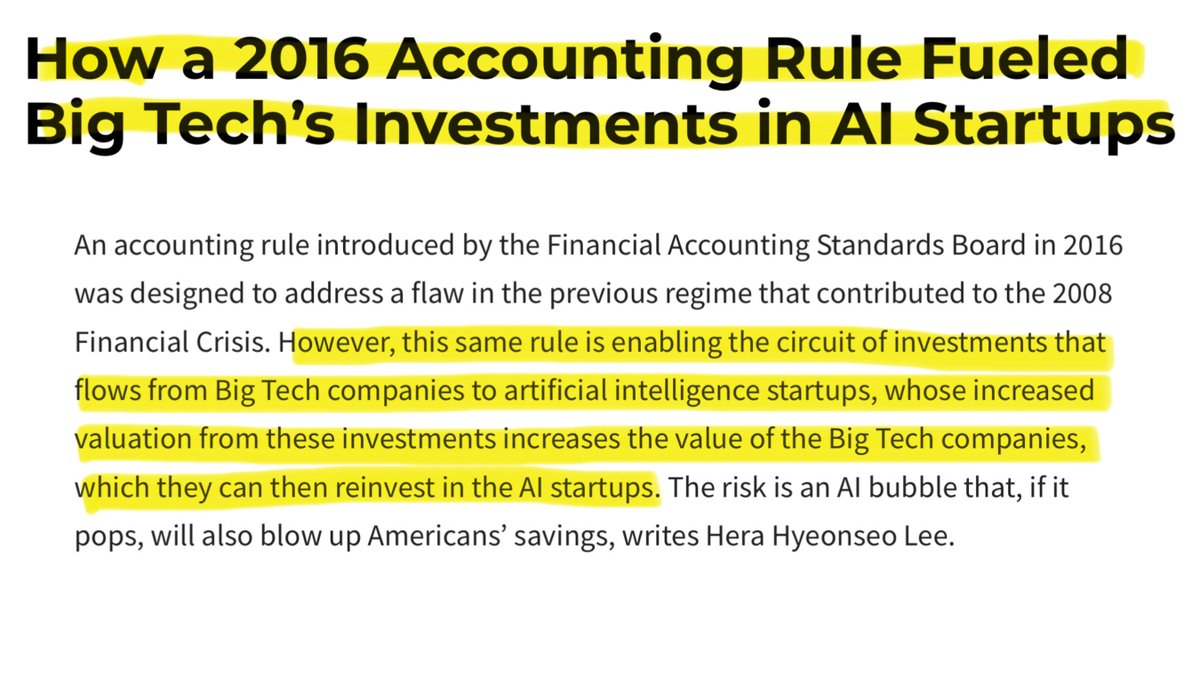
This manufactured demand triggers a second accounting trick where tech giants book massive paper profits. Every time a startup gets a higher value from a new funding round, the tech giant updates the value of its investment on its books and counts that unearned paper gain as direct profit.
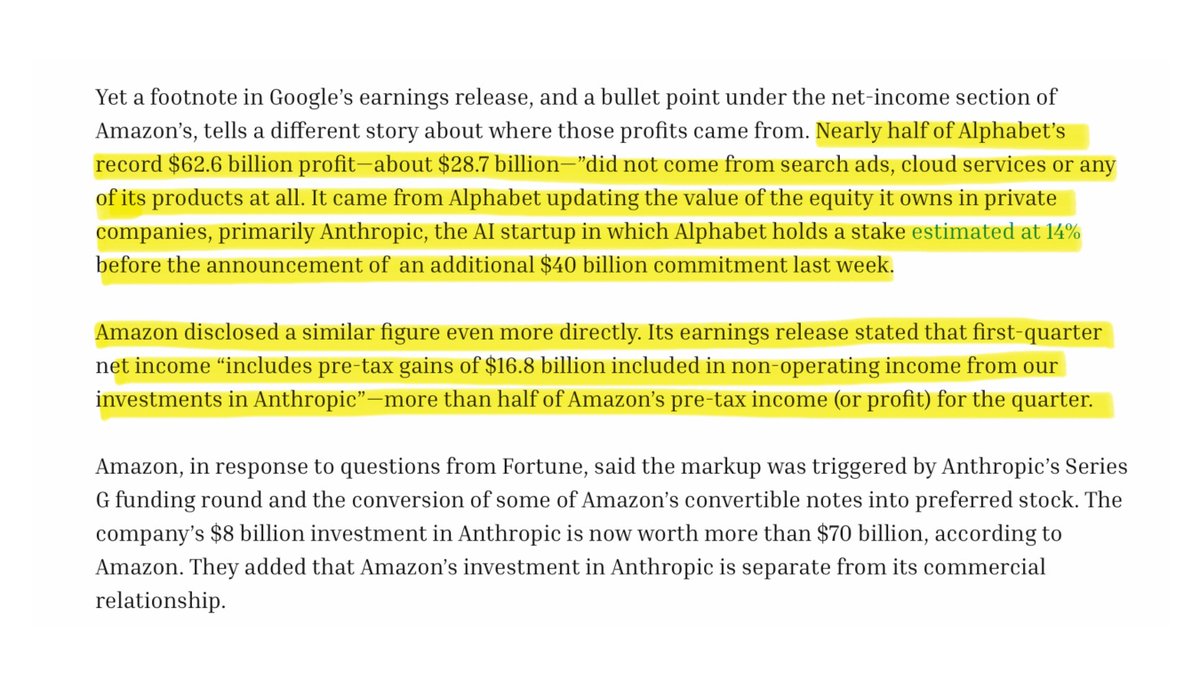
In Q1 2026, Alphabet reported a record $62.6 billion profit, but $28.7 billion nearly half, was just a paper markup on its Anthropic investment. In the same quarter, Amazon reported $30.3 billion in profit, but $16.8 billion of it was just an Anthropic paper gain.
While Amazon reported record profits, its actual free cash flow collapsed 95% to just $1.2 billion because it had to spend $44.2 billion in real cash to build physical data centers.
This has created a massive danger where these giant companies rely heavily on just one or two unstable startups. Microsoft has 49% of its $627 billion future backlog tied to OpenAI, while Oracle has an incredible 54% of its entire $553 billion pipeline relying on OpenAI alone.
This perfectly mirrors the 2001 dot-com crash when Global Crossing and Qwest Communications swapped identical fiber-optic network capacity with each other just to book fake sales.
Qwest had to erase $1.4 billion in fake income, and Global Crossing went completely bankrupt.
The only difference is that the dot-com swaps were illegal, but today's AI loop is fully legal under current accounting rules.
This legal loop inflates tech company stock prices, forcing automatic retirement accounts and index funds to buy even more of these tech stocks. It is a self feeding loop where investments, sales, and stock prices all go up on paper without the AI technology ever making real cash profits.
A 22-year-old graduate student in Kazakhstan got so angry at journal paywalls in 2011 that she built a pirate website holding 88 million scientific papers, and last month she turned the whole thing into an AI that lets you ask one question and get the actual research as the answer.
Her name is Alexandra Elbakyan, and the website is called Sci-Hub.
The AI she just launched is called Sci-Bot. It lives at https://t.co/6w0IBtOEYB and almost nobody outside academia knows it exists yet.
Here is the story, because it is one of the strangest things to happen in science publishing in the last 50 years.
Elbakyan was born in Almaty in 1988, the year the Soviet Union started to collapse. She taught herself programming at 12. She read Soviet science books that explained things her family used to call miracles. She got into computer security at university and graduated in 2009 with a degree she barely needed because by then she was already a serious hacker.
Alexandra moved to Moscow that fall. Then Germany. Then a research internship in the United States. She was working on brain-computer interfaces, the kind of research that requires you to read hundreds of papers a year just to keep up with the field.
And every single one of those papers was locked behind a journal paywall that cost between 30 and 50 dollars to read once.
She did the math. A graduate student in Kazakhstan could not afford to read science.
The first thing she did was learn how to get around the paywalls one paper at a time. She passed the trick around to other students. They asked her for papers constantly. She got tired of doing it manually.
So in September 2011, in three days, she wrote a script that automated the whole thing. A user pastes a DOI. The script logs in through a donated institutional credential. The paper comes back free. The website caches it.
The next person who asks for that paper gets it instantly because the previous request already saved a copy.
That was Sci-Hub. Three days of code. One graduate student. Done.
15 years later, the cache holds 88 million scientific papers. Almost every piece of scholarly literature published before 2020 is sitting on her servers. Researchers in 190 countries use it. Studies in Nature have shown that roughly half of all academic paper downloads worldwide now go through Sci-Hub, not the publishers who actually own the copyrights.
Elsevier sued her in 2015 and won a 15 million dollar judgment. She did not pay. The American Chemical Society sued her and won an injunction. She did not comply. Courts in India, France, Russia, and the UK have tried to block the domain. She just moves it. https://t.co/3sAWJzNe8I. https://t.co/tGIETesZ8i. https://t.co/H5WQ1f9lqR. The site has had over 20 domains and is still up.
Nature put her on its list of the 10 people who mattered most to science in 2016. The New York Times compared her to Edward Snowden. The Verge called her the pirate queen of science.
She has not been to the United States in over a decade because she would be arrested at the airport.
The Sci-Bot launch in April 2026 is the part that nobody is talking about.
She took the 88 million paper database and put a small language model on top of it. You ask a question in plain English. The model searches the entire shadow library, pulls the relevant papers, synthesizes an answer grounded in real citations, and links you to the full text of every source. Free. No login. No institutional credential. No paywall.
Three real scientists tested it for a Chemical and Engineering News article last month. They asked it medical and chemistry questions. The radiologist said the answer he got was usable. The chemist said the gaps in recent literature were obvious but the older science was solid. The publisher community is furious.
What she built is what the paid academic AI tools are trying to build. Except the paid ones are limited to what their parent publisher legally owns. Hers is limited to almost nothing.
Alexandra still lives somewhere in Russia. She does not give her address. She does not do video interviews. She gives talks over Skype with the camera off. She runs the largest illegal library in human history from a laptop and a donation page.
A graduate student who could not afford to read science built the system the entire scientific community now quietly depends on.
The publishers have spent a decade trying to shut her down.
She just shipped an AI that makes their entire business model outdated.
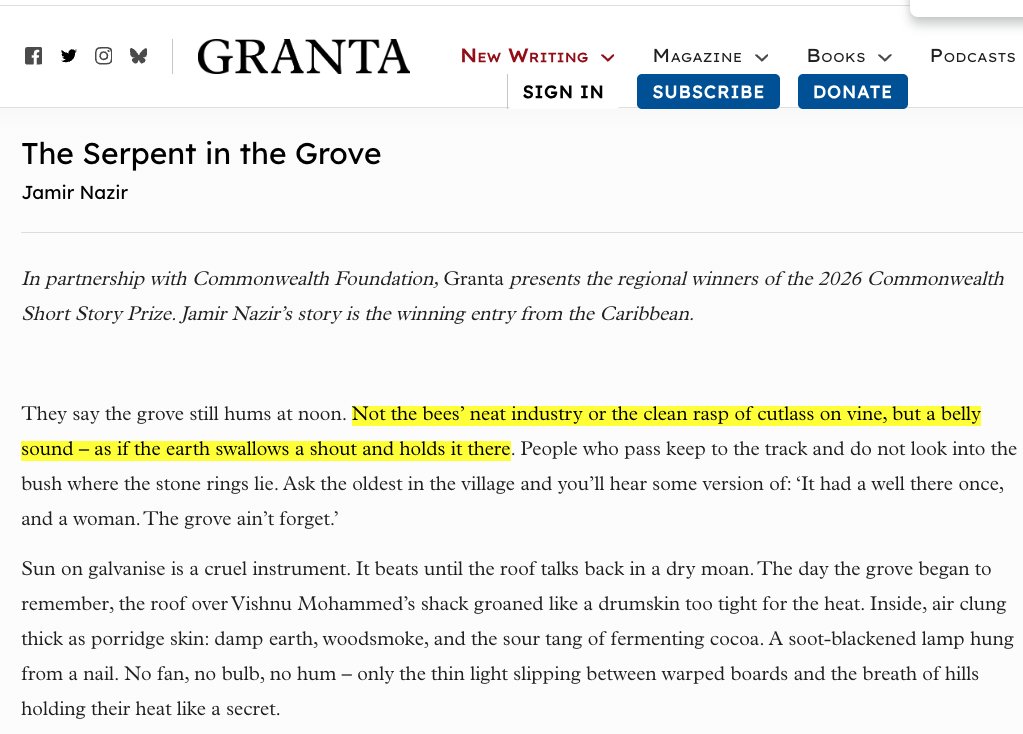
I agree the Granta AI story is bad for the reasons people are saying—that it's full of lyrical nonsense linesa that are quite literally nonsensical (similar to OpenAI metafiction story)—but also... man, it doesn't have a story. There’s no narrative. Does almost read like a parody
Well, this is a first: a ChatGPT-generated story won a prestigious literary prize (The Commonwealth Prize).
"Not X, not Y, but Z" sentences everywhere, the "hums" trope, and plenty of other obvious markers of AI writing.
A major milestone for AI, at any rate...
@GrantaMag