Les films comme « La Bataille de Gaulle » sont de ceux qui vous rendent fier d’être Français, que vous soyez de gauche ou de droite. Ce sont des films capables de rassembler une nation autour de son histoire.
So we ll never see you in Morocco 🇲🇦 you became so bitter but we still respect your work on Black Swan and Anti Fragile. If you change your mind you are Welcome !!
I'm obsessed with mental models.
A "mental model" is a thinking tool that lets you see the hidden machinery behind everything.
These are the 11 most powerful mental models I've found: 👇
1. The Map Is Not the Territory
دوزت نهار كامل كنقلب ب OSINT على قضية سبتة، وتبعت القصة نقطة بنقطة من 8 يوليوز حتى 31 يوليوز.
بدات ب جملة ف صفحة جريدة محلية إسبانية، الساعة 13:01:52
من بعد 6 سوايع، ترجمات للعربية ف تيلكيل. الترجمة كانت صحيحة
من بعد 7 سوايع ونص، طلع أول تعليق: "دابا واش لي شدوه غوارديا يدخلوه؟"
من بعد 10 سوايع، أول "vamos a espania".
من بعد 11 ساعة ونص، ولّات صورة زرقا بمعلومات غالطة كتدور ف صفحات الحريك.
من بعد 22 ساعة، ولّات فيديو ديال واحد كيشجع على الحريك و 424 ألف مشاهدة.
من بعد 23 ساعة، محامي إسباني شرح الحكم ف تيك توك و استعمل عبارة "alta mar" وترجموه من بعد للعربية
من بعد يومين، تزادو أفكار أخرى للقصة بحال ما غديش يرجعك إذا دخلتي للمياه الدولية، وحوايج أخرى ما كيناش في الحكم.
من بعد 4 أيام، فيديو بالدارجة كيشرح "القانون الجديد" وصل 1.3 مليون مشاهدة.
من بعد 10 أيام، بدات كتنتشر في فيسبوك "لي بغا يحرگ لسبتة دوز الخاص"
من بعد 11 يوم، طلعات لائحة ديال المعدات لي خاصة باش تحرك كتدور في فيسبوك.
من بعد 18 يوم، تعليقات كتسول على شكون يمشي نهار الخميس لسبتة
من بعد 20 يوم، تدار گروب واتساب فيه 120 واحد، كيهدرو على كيفاش ممكن يديرو حريك منظم و المؤسسين ديالهم عندهم أرقام +213
من بعد 21 يوم، القنوات الإسبانية الكبيرة دخلات على الخط، وبينات نجاح الحريك ديال بنات ودراري وكل فيديو تشاف 5 مليون مرة
من بعد 22 يوم، عشرات الآلاف ف الحدود.
تبعت كل نقطة نهار بنهار، ولقيت شنو تكتب، شكون كبر هادشي آشمن مؤثرين بارطاجوها، شحال جمعات د المشاهدات...
كنفكر ندير فيديو معمّق على كيفاش كتنتشر ال misinformation إلا لقيت الوقت، وإلا غادي نكتبها هنا مقال كامل.
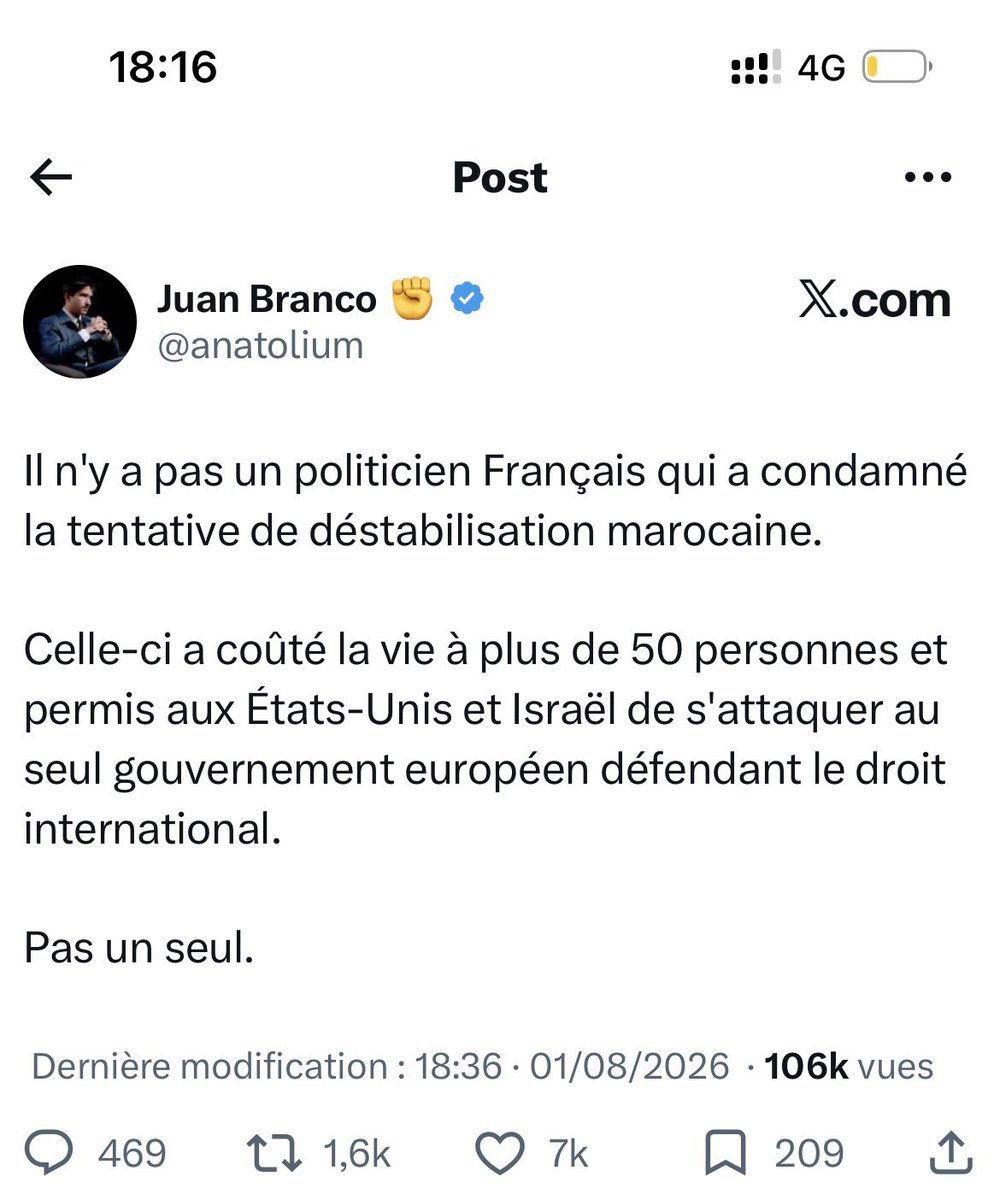
Ça bouge pas. Juan Branco toujours premier pour faire un combo des différentes théories complotistes sur Ceuta : Maroc - US - Israël.
Manque plus que Soros et les illuminatis 👽
Branco c’est le Alain Soral du 6e arrondissement de Paris 🎃
Ceuta, Morocco, Understanding the Situation
For a long time, Islamist rhetoric in Morocco has painted Europe as a kind of promised land, a place where welfare never runs out, chances are everywhere, and prosperity comes easily, with barely any effort required. The objective has always been to weaken trust in Morocco's own institutions and steer young people toward leaving.
But those very currents held power after the 2011 constitutional reforms tied to the Arab Spring. Their time in government produced a sluggish economy, unfulfilled promises, and a public that steadily lost faith. Since then, the pitch has barely changed. The same refrains keep coming back, while Morocco is framed as a failed state, not worth anyone’s loyalty, not worth building, not worth investing in.
In that narrative, Morocco is often branded a kafir state and the King is attacked as not Islamic enough. Young Moroccans are urged toward jihad and a permanent stance of confrontation with the West. Amazigh (Berber) identity, too, is mocked or dismissed as backward, even primitive. Year after year, the effort has been to drain the spirit out of an entire generation, to sell them on one bleak claim above all: their country has no future.
The same ideological current also pushes a claim that Morocco is trying to “reclaim Muslim land” via Ceuta and Melilla. In reality, no Moroccan government has expressed such a demand to the United Nations or any similar international body. Official diplomacy has kept those enclaves separate from Western Sahara, where Rabat has made a formal, explicit sovereignty claim for decades. That difference says a lot about the distance between Morocco’s actual foreign policy and the Islamist storyline built for ideological mobilization.
It’s also worth noting where the loudest demand has come from. A Moroccan Islamist leader has publicly argued that the country “must eventually regain control of Ceuta and Melilla.” By projecting that position onto the state while brushing aside official statements and practice, Islamist activists manufacture a thin appearance of legitimacy for a campaign that aims to weaken state authority, and amplify the message online for global support. Morocco’s ties with Israel and the United States then get turned into a weapon as well, presented as proof that the government itself lacks legitimacy.
Morocco remains a developing country. Real social and economic difficulties persist, and legitimate frustrations deserve to be taken seriously. Still, describing the country as hopeless helps no one, not Moroccans and not anyone interested in meaningful reform. In practice, that narrative mainly benefits two groups: people looking to justify illegal migration, and those trying to strip the Moroccan state of legitimacy.
The timing is also interesting: general elections are set for 23 September, and Islamist operators understand that border chaos, magnified on social media, can destabilize the incumbent narrative before the vote.
Since October 7, this has sharpened, in part because Islamists now face a possible political rival in Fouzi Lekjaa, the highly capable president of the Royal Moroccan Football Federation. Lekjaa is widely credited with driving Morocco’s historic run to the semi-finals in the 2022 World Cup and with turning the national team into a global force. Now he is using his key role in winning and preparing for the 2030 World Cup, co-hosted with Spain and Portugal, to bolster his profile as a potential prime minister, and to deepen his standing as one of the country’s most influential public figures.
Contrary to the conspiracy talk that spreads online, Morocco gains nothing from uncontrolled crossings. Some critics point to Algeria’s relationships with European governments, but every major European state keeps channels open with Algiers, Giorgia Meloni’s Italy has a notably strong relationship, while Morocco’s day-to-day cooperation has stayed consistently solid across the board. That includes strong migration frameworks with France and Germany, including a bilateral partnership signed with Berlin in 2024 that has driven higher returns, deportation arrangements with Hungary and Poland, and, most recently, close operational coordination with the United States.
The truth is that Morocco is itself under heavy migration pressure coming from the Sahel. In 2025 alone, authorities intercepted 73,640 attempted irregular crossings, and sub-Saharan nationals now account for nearly 60% of foreign residents.
Last year, several thousand Sudanese and other Sahel-origin migrants also crossed the eastern border, adding to the strain already felt in Moroccan cities, it’s a pressure ordinary Moroccans regularly complain about. The chaos of the past two days only worsens Morocco’s position rather than helping it: once the impression of an open or uncontrolled border spreads, it draws in even more refugees and irregular migrants, piling additional weight onto a burden that is already substantial.
https://t.co/sR2fyqMzrY
🇲🇦🇪🇸
Maroc: Des Marocains rentrent au Maroc après être rentrer dans les enclaves espagnols face aux pénuries alimentaires et aux conditions de vie déplorable après l'afflux d'hier et de cette nuit.
Spain’s entire budget will be destroyed by illegal migrants.
It’s basic math: if Spain offers free stuff to migrants that is above 90% of the living standard of Earth, they create a forcing function for 90% of Earth to move to Spain, which is around 7 billion people!
Ils pensent tous arriver en Espagne ou en Europe, avoir des aides de l’état, se marier avec une espagnole et se la couler douce alors que l’Espagne elle même souffre du chômage et d’une crise du logement.
Je ne sais même pas ce qui vous choque que des jeunes d’un pays musulman,