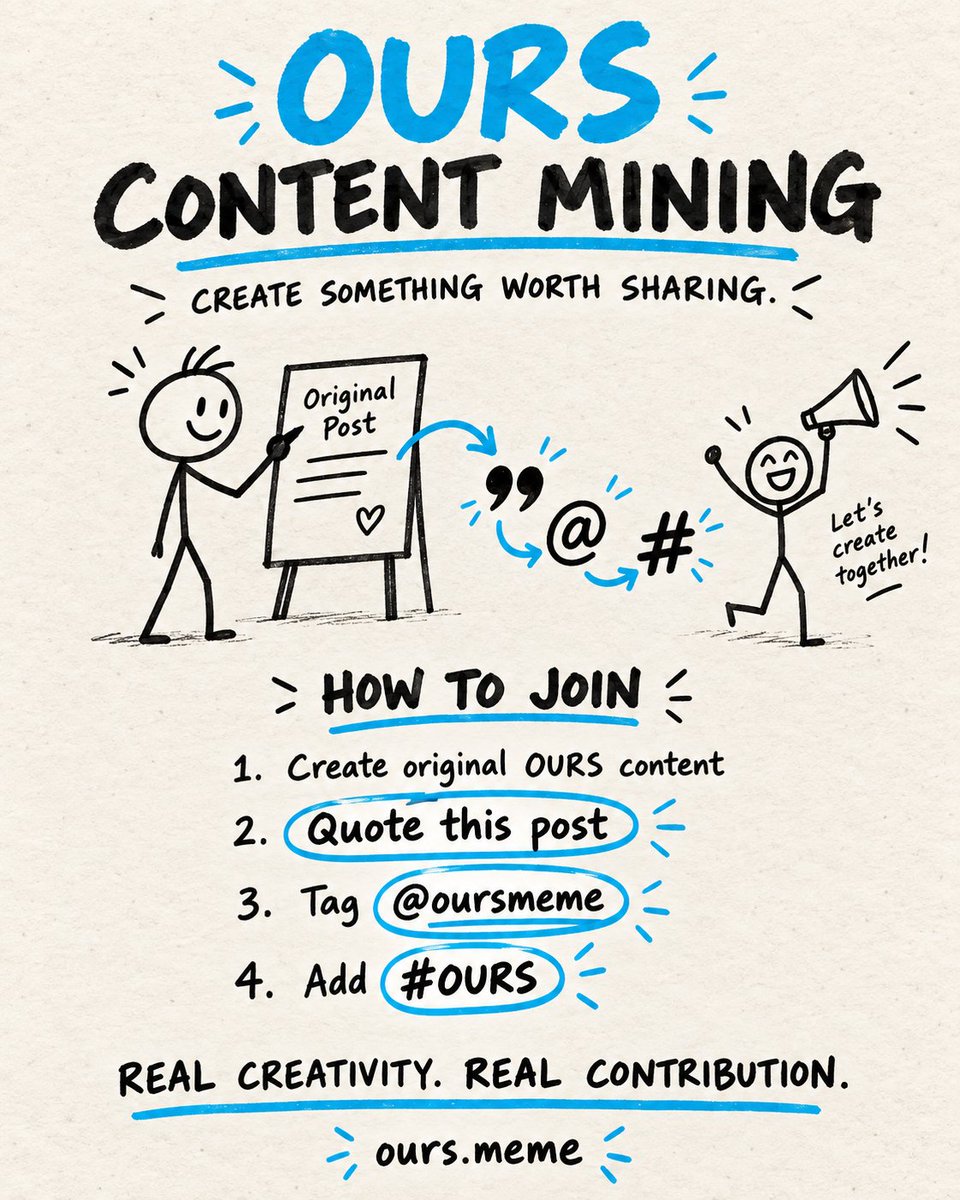
GM! 🐱⛏️ OURS CONTENT MINING IS NOW OPEN
Most platforms ask you to promote a ticker.
We’re asking you to understand the model, challenge it, explain it, and help more people discover what OURS is building.
OURS is not designed to stop when a token launches. It is building infrastructure for what happens next:
⚡ Token creation and bonding-curve trading
🚀 Project graduation and Uniswap V4 liquidity
🛠️ Ongoing fee sharing for builders
🔥 Transparent platform-fee allocation
🌟 Long-term ecosystem project support
🎨 Independent content-mining rewards
What makes OURS different?
When project fee sharing is enabled, eligible fees are designed to split:
70% to the project side
30% to the platform side
The platform’s actual fee revenue follows a transparent model:
48% — $OURS buyback and burn
16% — Liquidity development
16% — Eligible ecosystem project support
20% — Security, development, and operations
The current early-participation proposal is also designed around longer-term alignment:
No undisclosed free team allocation under the current design
Proposed 12-month continuous linear vesting
Proposed allocation of 80% of eligible fundraising proceeds to liquidity and market-depth development
20% proposed for product development, security, audits, and operations
These structures are designed to reduce hidden privileges and concentrated selling pressure—not to guarantee price appreciation or investment returns.
Final terms only become active after the contracts and official rules are confirmed.
Your content-mining mission
Choose one part of OURS and explain it in your own voice:
🧵 Write an X post or thread
🎬 Create a short video
📚 Make a beginner-friendly tutorial
🎨 Design a Meme or original visual
🔍 Analyze the fee or fundraising model
🌍 Translate the platform for a new community
💬 Start a real discussion about what happens after a Meme launches
How to participate
Full participation details are shown in the image below.
Our team will regularly monitor and review eligible quote posts that tag @oursmeme and include #OURS.
There is no need to submit your content link separately.
Only original, relevant content with authentic engagement will be considered.
Content will be reviewed based on originality, clarity, quality, verified engagement, and its ability to bring real people into the conversation.
Copied posts, repetitive spam, fake engagement, bots, linked-account manipulation, plagiarism, and Sybil activity will not qualify.
You do not need to pretend that OURS is perfect.
Ask difficult questions. Explain the risks. Compare the model. Make the complicated parts understandable.
The strongest communities are not built by people repeating the same slogan.
They are built by people who understand the idea well enough to tell the story in their own way.
Don’t just watch OURS launch.
Explain the model. Create the culture. Help build what comes next.
#OURS
100 USDT GIVEAWAY 🐱
20 winners. 5 USDT each.
A Meme can have a loud first hour. What makes people stay after that?
OURS is live. We’re building a launchpad for more than the moment a token goes live—and we want to hear from the people who know where projects usually get stuck.
Builders: what would help you keep building after launch day?
Traders: what makes you give a new project a chance? And what makes you leave?
If you’ve tried OURS and something feels off, tell us that too. We’d rather hear one useful criticism than 100 identical “LFG” replies.
To join the giveaway:
1) Follow @ours_meme
2) Repost this post once
3) Reply with your answer: What would you build on OURS, or what should we improve first?
We’ll randomly select 20 eligible replies. Each winner gets 5 USDT.
Some of you have also asked how to support OURS beyond feedback. Our current early fundraising proposal sets aside 20% of the token supply for a pool allocated in proportion to accepted contributions. Its proposed valuation is 5× the final amount raised, with 80% of proceeds intended for liquidity and 20% for product development and operations. Tokens are proposed to unlock linearly over 12 months from TGE.
That is a proposal, not a promise of returns—and “5× valuation” does not mean a 5× return. Final terms, eligibility, contracts, and fund-handling details must be published and checked before anyone contributes. Never send funds to an address from a DM.
The giveaway is separate from fundraising. You do not need to buy anything, contribute, trade, or connect a wallet to enter.
It starts when this post goes live. @ours_meme will announce the closing time at least 24 hours in advance. We’ll draw 20 eligible entries, share a recording of the draw, and contact winners from @ours_meme only.
One entry per person. Bots, multiple accounts, duplicate replies, and repeated Reposts are ineligible. We will never ask for a seed phrase, private key, fee, or wallet signature. If a winner does not claim within 7 days of being contacted, we’ll redraw that spot. Open to ages 18+ where permitted by local law. Not sponsored, endorsed, or administered by X.
Now for the question that matters to us: what would make you come back to OURS after the first day?
#OURS
@0nikoyi@projectspherexy Starting early is useful if the reputation is portable and rewards original work rather than raw posting volume. I’d watch how the campaign scores accuracy, audience fit and repeat contribution—those signals determine whether the track record compounds beyond one prize pool.
@DammyGentuu GM. The useful question for today is whether crypto’s price strength is being matched by fresh liquidity. I’m watching stablecoin supply, spot ETF flows and DEX volumes together—one green chart matters less than all three improving at the same time.
The simple flow is attractive, but points are only meaningful relative to total issuance. Before mining, I’d estimate claim cost, expected share after dilution, contract risk and NFT liquidity. Starting earlier improves points, yet it doesn’t automatically make the trade positive-EV.
Permissionless distribution matters, but open campaign creation still needs credible quality control. The strongest design is transparent scoring, escrowed budgets and a public audit trail for why work earned rewards. That lets small builders buy outcomes instead of renting KOL access.
@batikaneth@fhenix Encrypted fitness data is a strong FHE use case because communities can compute rankings or rewards without exposing raw health records. The adoption test will be latency, mobile battery cost and key recovery—privacy only works if the running experience still feels effortless.
@creed_web3@RobinGuards The 50-points-per-hour mechanic is easy to understand, but expected value depends on more than the $300K headline. Claim cost, total staked NFTs, token liquidity and smart-contract risk should be compared with the opportunity cost of keeping the NFT locked through launch.
@jenny_31111 Congrats on the verification milestone. The best next step is turning new visibility into a repeatable content system: one clear topic, consistent original posts and thoughtful replies in that niche. That compounds trust much better than follower-for-follower activity alone.
A security quiz becomes much more useful when it tests decisions, not definitions: spotting a malicious approval, isolating a compromised wallet and choosing the right recovery sequence. Scenario-based questions reveal whether people can act under pressure, not just remember terms.
The strongest loop here is when the show remains entertaining without token incentives, while tickets deepen participation for existing fans. I’d separate episode retention, game replay rate and whitelist conversion—otherwise reward-driven traffic can look like genuine audience growth.
Real-world utility should be measured in operational outcomes: settlement time, cost saved, legal enforceability and repeat business usage. An RWA narrative becomes durable only when the off-chain claim is clear and the blockchain removes friction instead of adding another speculative layer.
Pool size alone doesn’t describe usable liquidity. For RVH/WETH I’d also track depth at 1–2% slippage, LP concentration, fee APR versus incentives, and impermanent-loss exposure. Those numbers show whether the pool supports organic trading or only looks deep while rewards are active.
@csamdereli@FungoLabs Erişim sınırlıysa seçim kriterlerinin ve başvuru zaman çizelgesinin açık olması önemli. Gizlilik odaklı bir NFT projesinde asıl değer sadece kapıdan girmek değil; şifreli sahipliğin transfer, görünürlük ve anahtar kurtarma süreçlerinde nasıl çalıştığını göstermek.
The useful Fed discussion is a scenario map, not a single prediction: inflation surprise, labor weakness and liquidity conditions can each move rates differently. I’m watching real yields and dollar strength together—crypto usually needs both pressure points to ease for a durable risk-on move.
Semantic consensus solves non-determinism, but it introduces a new risk: false equivalence. The contract needs explicit invariants, evidence requirements and an appeal path when validators agree on meaning but miss a critical fact. The evaluation schema becomes part of the security model.
@Aleena06426596@axisrobotics The points-to-token ratio alone can be misleading. Circulating supply, unlock schedule, sybil filtering and whether points are capped matter more to real value per point. Publishing those inputs before the snapshot would make any conversion ratio much easier to evaluate.
@AyinlaDimeji99@HWlabs_rh Giveaways build better trust when the draw method, exact deadline/time zone and winner verification are public. That turns a short engagement spike into a transparent community mechanic instead of leaving participants unsure how the five spots were allocated.
@0x99Gohan The market-cap move validates attention, not necessarily product-market fit. I’d watch liquidity depth, holder concentration, repeat usage and whether the product generates fees without incentives. Those metrics tell us if the repricing is durable or just a thin-liquidity spike.
Encrypted NFTs become compelling when privacy survives the full ownership lifecycle. The hard parts are transferable viewing rights, key recovery and proving traits to marketplaces without revealing the artwork. Selective disclosure could make rarity usable while keeping the asset private.