I watched a creator with eight hundred followers write a brilliant, deeply researched thread about our protocol. I also watched an account with fifty thousand followers post a single generic meme about the same thing and get ten times the attention.
I used to think that was just how the internet worked. The big accounts eat first, and the quiet builders starve. I almost gave up on marketing entirely because paying for vanity metrics felt like burning treasury funds.
Then I set up a Permissionless Campaign on a Tuesday afternoon. I wrote the brief, locked the stablecoins in the escrow, and hit launch. A week later, the AI verification flagged that eight hundred follower account as the top performer. The escrow released the funds directly to them. No agency took a cut. No middleman negotiated a fake rate. The system just paid the person who actually did the work.
@RallyOnChain finally made the math make sense. Quality gets paid, not just the follower count.
What is the best piece of content you have seen from a small account that deserved way more attention?
@DammyGentuu@RallyOnChain I have a folder full of posts I never published 😂 Sometimes I revisit them months later and wonder why I was so afraid to share them.
I lost money trying not to miss a move.
The chart looked promising, and the hype made me feel like I had to get in before it was too late. Instead of focusing on whether the entry made sense, I was imagining the profit I’d miss if I stayed out.
When the trade went against me, the mistake became clear. I had spent more time fearing a missed opportunity than defining what I could afford to lose.
That changed how I trade. Now I need a valid setup, a clear invalidation point, and a reason to enter beyond the fear of being late.
Some coins will run without me. That’s fine. Missing a pump costs me nothing, but entering without a plan can cost me capital and my next opportunity.
No setup, no trade.
@RallyOnChain
What loss made you change the way you trade?
I keep a single unmatched sock in my drawer because throwing it away feels like admitting defeat to the laundry machine.
@RallyOnChain, what petty battle are you still refusing to lose?
I paid an agency two thousand dollars upfront last month for a launch thread. They delivered a generic summary and I had zero leverage to ask for a refund.
Upfront payments in web3 are just donations to bad marketing. The risk is always on the builder.
Now I use a strict three step rule. One, write the brief. Two, lock funds in a Rally escrow. Three, let the AI verify quality before a single cent releases. No calls, no middlemen, no upfront risk.
@RallyOnChain finally shifted the leverage back to us. What is the worst upfront marketing deal you ever regretted?
To the team at @RallyOnChain:
I measure success by the 2 AM messages. Not the noon applause.
I write for the deep thinkers. I ignore the fast scrollers. If a draft lacks a genuine pulse, it goes back to the floor.
You are building a home for actual substance. I want to lay the bricks.
Creators, what is the one hidden metric you check before hitting publish that never makes it into public case studies?
I used to reply to the same fifty accounts every day and wonder why my network wasn't growing.
Then I discovered a Smart Followers list from @web3lists_ for a niche I barely knew. I picked ten unfamiliar accounts, built my own list around them, and started joining conversations outside my usual circle.
Three months later, half my timeline was filled with people I'd discovered through that one list. Better connections, fresh perspectives, and conversations that didn't feel like the same opinions bouncing around.
The LIST_ID -filter:replies query helps me find what people on that list are actually discussing, instead of relying on my usual algorithmic feed.
What's one list you've built that introduced you to people you wouldn't have found otherwise?
@Hiraly_1@Web3Lists_ That -filter:replies part matters more than people realize. Finding what a niche is actually discussing makes it easier to join meaningful conversations instead of replying just to stay visible.
congratulations 🎉 👏🏾 to me for my first verified thanks for all of you that follow me 💕 i appreciate i no u Guy Can do more let connect if we haven't together we all grow together
The Briefcase is actually the piece that closes the loop here. If dividends can accumulate there before you claim them, the Seat is doing more than granting voting rights. It gives the ownership a recurring financial action instead of leaving the NFT as a passive membership badge.
@evrendag1284@FungoLabs@zama The interesting part is whether the sealed data can still drive useful onchain actions without being revealed. If it can, the NFT stops being just a private container and becomes a programmable asset with hidden state. That is where FHE starts adding real utility.
@web3_marine@ComputersRh The strongest progression would be when upgrades actually change the way you play, not just the specs on your PC. A better GPU should unlock something meaningful rather than simply increase a stat. That gives every upgrade a purpose beyond chasing the next bigger number.
AN NFT SHOULD DO MORE THAN SIT IN A WALLET.
The useful distinction in the @0xhazels model is that ownership becomes an active access layer once the NFT is staked.
One asset connects its holder to:
→ Access Drops and staking opportunities
→ A 1.2× boost across Pulse and creator campaigns
→ Hazels Academy
→ Full access to Azura SI
The 1.2× boost is especially interesting because it links ownership directly to creator activity. Holding alone is not the entire loop; participation is what activates the wider utility.
That makes the Hazels NFT feel less like a static collectible and more like a membership credential connecting ownership, reputation, education and ecosystem access.
Hold. Stake. Participate.
Want to enter Hazels Studio through my referral?
#WEAREHAZELS
https://t.co/MkiJ3SfViL
@evrendag1284@0xhazels The key gap is that most of the utility described only becomes active after staking, so the NFT itself is not the whole access layer. That makes the staking mechanism pretty important to the product, because it determines how easily ownership turns into participation. .
@web3_marine@FungoLabs The real shift is being able to interact with encrypted NFT state without exposing it to the application or other users. If FHE handles that reliably, privacy becomes part of the NFT’s functionality rather than just a layer around the asset.
i got into crypto to escape the 9–5 not accidentally create a new one 😭
somehow @themutualfun has me
> owning a Seat > joining a fund > voting on allocations > carrying an onchain Briefcase
At this point, i’m expecting the next update to be mandatory Monday meetings
but i can’t even complain because that Briefcase is where your uncashed ETH dividends can collect
so apparently my career path is now:
> wake up > check charts > make questionable decisions > vote with the fund > check Briefcase > pretend this was always the plan
Bro.. my parents wanted me to work in finance 🫠
@web3_marine@themutualfun The Briefcase is the part that makes the whole setup feel more like an actual financial workflow than a collectible. The interesting bit is that uncashed ETH dividends can sit there until you decide to claim them, so the onchain position has a separate cash-out step.
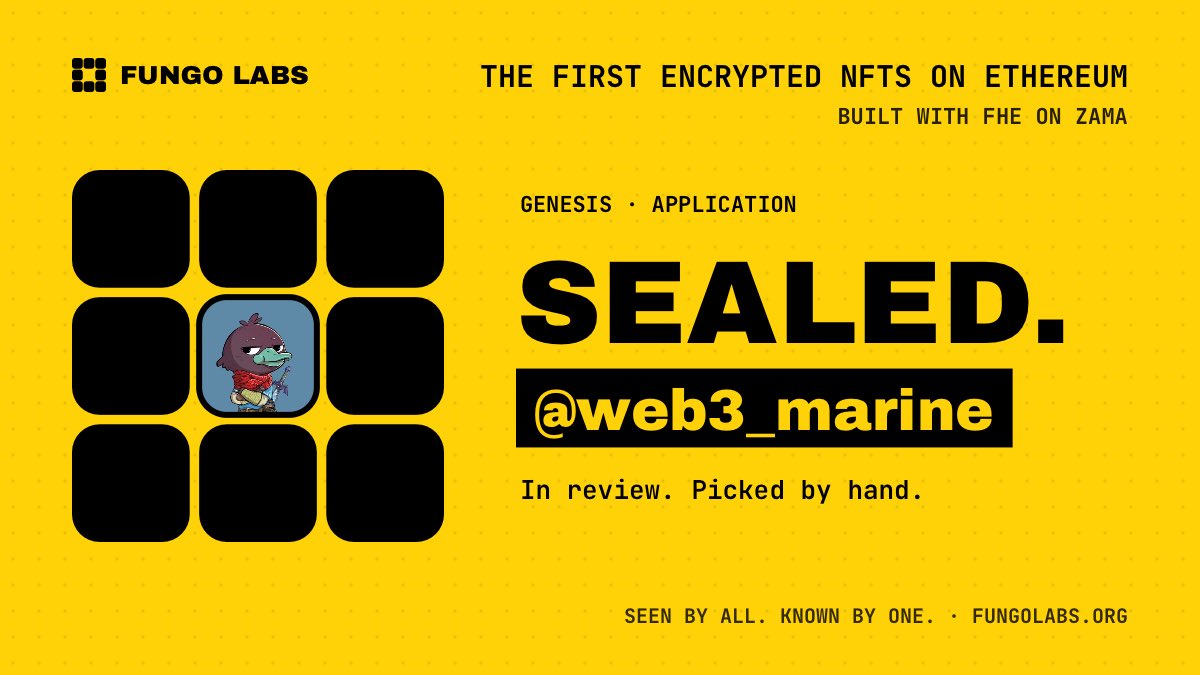
An NFT being visible doesn't mean everything inside it has to be public. That's what caught my attention with @FungoLabs and its sealed NFTs built with @zama's FHE infrastructure. Application submitted curious to explore what's inside.
@evrendag1284@FungoLabs@zama The important piece is whether the hidden state can still be used by the application without being revealed. That is where FHE moves beyond simply hiding metadata and starts changing what an NFT can actually do.