AI supply chain Constraint Map- November 2026 Edition
The shortage isn’t getting worse, it’s lasting longer.
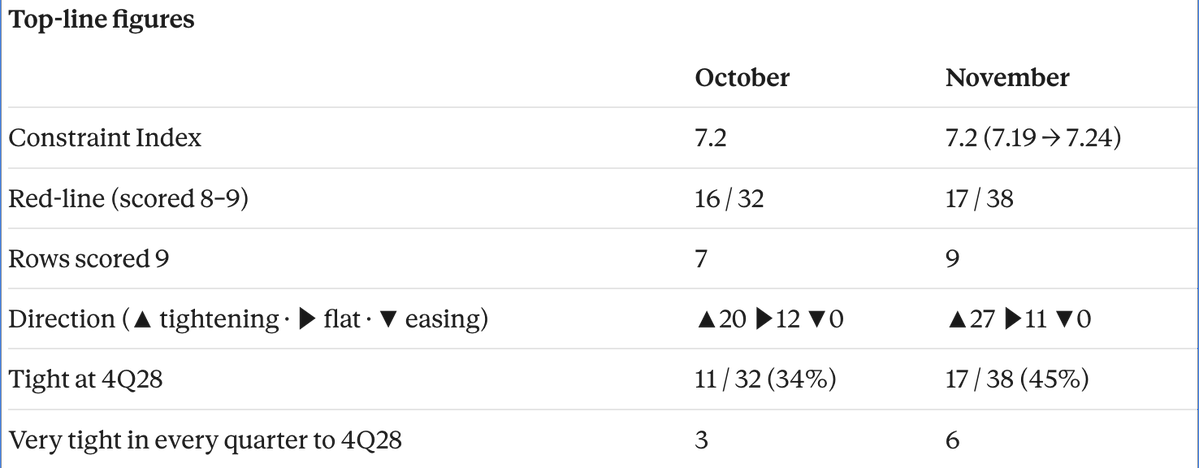
On the 32 components that appear in both editions, the average score is unchanged at 7.2. What changed is duration: 15 of those 32 are still tight at the end of 2028, up from 11 in October.
Direction: (▲ tightening · ▶ flat · ▼ easing)
October: ▲20 ▶12 ▼0
November: ▲27 ▶11 ▼0
Sector Averages:
Memory: 8.5 → 8.6
Substrates: 7.9 → 7.7
Photonics: 7.3 → 7.4
Power: 7.2 → 7.2
Robotics: 4.7 → 5.0
Compute: 6.7 → 6.9
Memory is still the tightest section, and robotics is the only one moving up noticeably.
New this month:
• Grid interconnect (9, entering at the top): ERCOT has 474 GW of large-load requests queued.
• Legacy DRAM (8): the major makers are exiting DDR4 and LPDDR4, and Nanya’s prices rose more than 60% in one quarter.
• Tantalum & polymer capacitors (8): reported lead times are 40–52 weeks, and KEMET raised prices by up to 65%.
• Optical-module mSAP boards (7): the board process needed for 1.6T optical modules, with reported lead times of about 6 months against about 6 weeks before.
• Advanced packaging & test (7): ASE is at or near full capacity, and Amkor customers are prepaying.
• Rare-earth magnets (6): China’s export pause ends 10 Nov, and dysprosium and terbium grades still need licences.
→ What moved
Raised:
• InP substrates, 8 → 9: AXT’s backlog is above $500M, every customer is on allocation, and delivery takes 9+ months.
• Enterprise SSD, 7 → 8, now tightening.
• Fiber, 6 → 7, now tightening: Corning is allocating, and TrendForce sees bend-insensitive fiber prices above 5× last year.
• 300mm wafers, 6 → 7.
• GPU, 5 → 6.
Lowered:
• Optical DSPs, 8 → 7, now flat: the key buyer describes supply as “tight, improving”.
• CoWoS, 8 → 7.
• HVLP copper foil, 8 → 7.
• Power ICs, 7 → 6.
• SiC/GaN, 4 → 3.
• Roller screws, 5 → 4.
Direction changes:
• Transceivers, server CPUs and probe cards are now tightening.
• CW lasers have stopped tightening but stay at 9.
The outlook stretched:
Through 2028: server DRAM, nearline hard drives and ABF substrate are now very tight all the way to 4Q28. They join HBM, gas turbines and grid interconnect, so six components show no relief anywhere in our timeline window.
Later easing: fiber and ABF film no longer ease before 2029. Enterprise SSD only starts to ease in 4Q28.
First relief in power: transformers and switchgear stay at 9 but drop from very tight to tight in 2Q28, as new US plants come online.
What we’re watching for the rest of November:
• 10 Nov: China’s rare-earth pause lapses (11 Nov in Beijing). Infineon reports full-year results.
• 11 Nov: Harmonic Drive’s second-quarter orders, and Siemens Energy’s full-year results.
~13 Nov: Applied Materials results, a read on tool lead times.
• 16, 23 and 30 Nov: TrendForce weekly radar updates.
• 18–19 Nov: Trump–Xi meeting at APEC. Watch for anything on export controls.
• 19 Nov: NVIDIA results. GPU supply and the timing of its 800 VDC power systems.
• 27 Nov: China’s pause on gallium, germanium and antimony bans for the US ends.
• Late Nov: Fusion’s November report, covering MLCC, optics and DRAM allocation.
• Pending: Mitsui Kinzoku (HVLP foil) and Fujikura (fiber) first-half results.
🫡
AI supply chain constraint map from Outer Ninth Research 👀
I created a dashboard for us to track the most constrained supply chain components which will be updated monthly. Here is the October edition with additional information to come.
October brings us a 7.2/9 overall index score with 16/32 components very tight.
20 components have tightened from last month, 12 flat and 0 easing.
At first glance, several items stand out 👀
the stage is set for 2027, position accordingly
$QQQ update:
Welcome to the Nasdaqistan 😬
We reached the 630 level today and cut through like butter.
No weekly oversold levels yet, no constructive signs or anything indicating we are going to bounce. Hopefully next week ?!
Check the quoted post. Unfortunately this continues to play out in a very aggressive way. I hope some of my warnings below prevented some of you from buying the dip and instead doing nothing. I saw many big accounts continue to post about "buying the dip".
Be wary of accounts deleting their posts from earlier this month. Being wrong is one thing, but hiding it or not being able to admit they were wrong is significantly more pronlematic.
I for one will be looking back at what I could've done better. Improvement requires self reflection. I definitely could've managed my risk better.
The question on everyone's mind is what happens next. Unfortunately nobody knows- and it's not that important TBH.
Focus on the trend- which is down. When we start seeing signs of a bottoming formation or hints of a bounce I will let you know. For a bounce we are first looking for weekly oversold conditions which marked the bottom in April 2025 and produced a +24% bounce during the 2022 sell-off giving us an opportunity to take a shorter term trade and or maybe derisk further, put on some hedges.
The 2022 bounce led to a weekly bullish divergence which was the trigger for re-allocation (weekly LL in price, weekly HL on RSI).
This sell-off caught many off-guard, including myself. I've done a bunch of painful derisking over the past couple weeks since the quoted post BUT I could've done A LOT better and as said need to look at that moving forwards.
I have been placing too much weight on research and fundamentals vs TA but as we can see that was a mistake. Research and fundamentals are not helping equities at all right now but the warnings signs were there in regards to TA.
580 is the next support level below which is a monthly level and approx where the monthly Kijun level. perhaps if we get there it will line up with weekly oversold levels.
Let's see.
stay safe out there.
$QQQ update:
There has been no reason to be deploying any sidelined cash yet.
We lost our range low and are now firmly in the downside zone, using the ranges we've been tracking since June. There have been no reclaims of weekly structural levels yet.
We lost the weekly ascending trendline (pictured in the quoted post below) and made a new weekly low.
We are still in a weekly downtrend with bearish weekly market structure.
It has been tempting to snap up some discounted shares in our names over the past couple trading sessions; watching Nan Ya Plastics, Elite Material, Unimicron & some of our testing names like CHPT limit up multiple days in a row.
I didn't buy any yet.
I am recommending and practicing patience right now until we get some more obvious set-ups and buy levels.
They say buy (and sell) at the extremities, no diddling in the middle- we are in the middle currently.
Bottoms take time to form- tops do not.
The only thing that might cause a V reversal here is the end to the Iran war, a proper end. Otherwise we wait for more attractive, obvious opportunities.
I'm watching for the reaction around the weekly levels shown below- a drop down to $630, confluent with weekly RSI hitting oversold levels OR a reclaim of our $687 level (now resistance).
Until then... sit on your hands
let the market show it's hand... then we buy back and add.
The other thing just worth pointing out is that there is a substantial HTF bearish divergence forming on the quarterly and monthly RSI (compared to price). This doesn't have to play out and can take a VERY long time to confirm due to the HTF- but I wanted to bring it to your attention.
You can clearly see it in the 2nd image, price is making higher highs while RSI is making lower highs indicating declining strength.
The 3rd image shows a potential rounded top structure on quarterly RSI (3M time frame).
Just something to be aware of for now and we should consider de-risking further or taking profits when the monthly RSI gets back to the declining monthly trendline shown in the 2nd image.
Soitec SA- Soitec Société Anonyme $SOI.PA | $SLOIY 2027 H1 Investor Presentation.
Soitec’s message this half is that photonics is no longer a side bet. It’s now the main reason the company is growing again. Revenue rose 39% organically to €317m. More than half of it now comes from Edge & Cloud AI, which grew 81% to €172m. Inside that division, Photonics-SOI brought in about $125m, up from about $50m a year ago. That’s roughly 2.6x, ahead of the ~2.3x Soitec had guided. The substrate is being adopted across all three optical formats (pluggables, near-packaged optics and co-packaged optics) as AI data centres move to faster optical links.
Better mix and higher volumes lifted gross margin 8.2 points to 33.3%. Part of that gain comes from an accounting change: production tools are now depreciated over 10 years instead of 8. Current net profit swung back to €30m. The reported line still shows a €45m loss, mostly from non-cash items: a €46m SmartSiC impairment, a €21m fair-value charge on the new convertible bond (the ORNANE) and the settlement of a tax audit. Cash was the standout. Free cash flow came in at €236m, including €86m of customer deposits, and Soitec now has €1.2bn of cash and €169m of net cash after raising €500m through the ORNANE.
What backs the outlook is contracted demand. Most Photonics-SOI customers have signed capacity reservation agreements, backed by cash deposits, worth about $1.2B and running through 2028, with talks under way for later volumes. To supply them, Soitec is converting its Bernin 4 fab to SOI (about 400k wafers a year targeted) and fitting out its Singapore extension in steps as more contracts are signed.
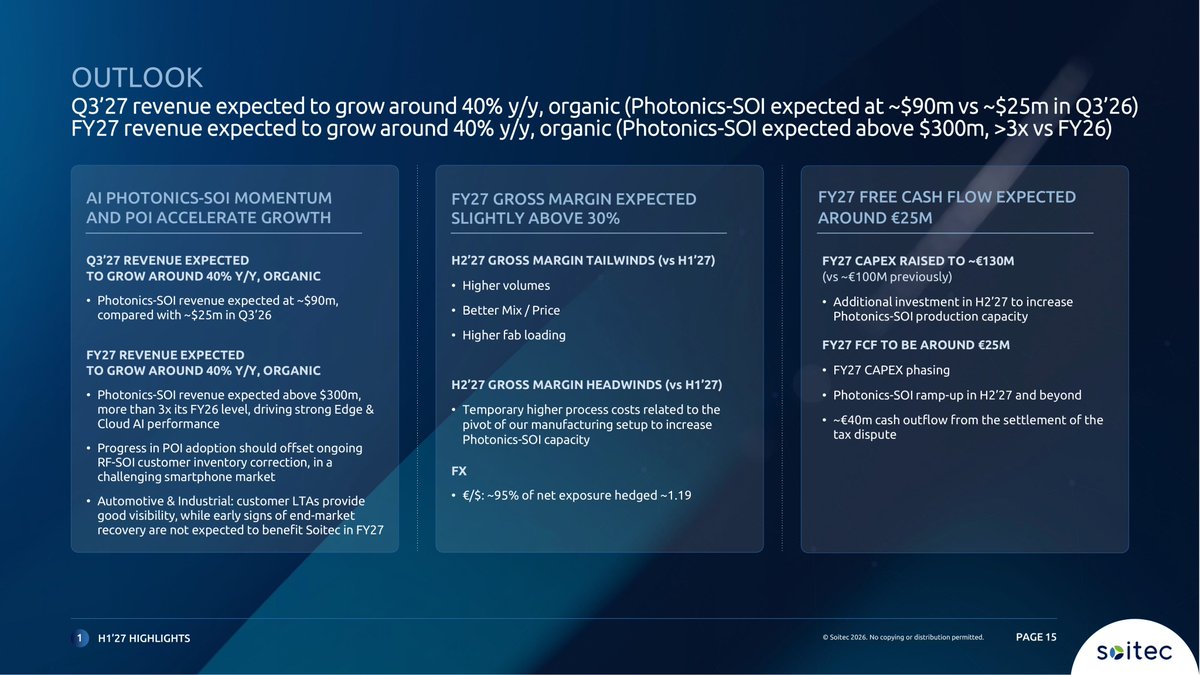
Because of that visibility, management took the unusual step of guiding for the full year. FY27 revenue is expected to grow about 40%, with Photonics-SOI above $300m, more than 3x last year. Q3 alone should bring in about $90m of it, against about $25m a year earlier. Two numbers deserve a closer look. Full-year gross margin is guided only “slightly above 30%”, so the second half will be weaker than the first while the fab conversion adds temporary costs. Full-year free cash flow is guided around €25m, which means a large cash outflow in H2. That comes from capex raised to about €130m (from about €100m) and a roughly €40m tax payment. In short, Soitec is putting its first-half cash straight back into photonics capacity, betting that the contracted demand will be there to fill it.
#substrate #InP #SiPH #photonics #SOI #wafer
Soitec SA- Soitec Société Anonyme $SOI.PA | $SLOIY
2027 H1 Earnings Results
Soitec reported its first-half FY2027 results (ended September 30, 2026) on November 18, 2026, posting €317 million in H1 revenue (up ~37%–39% year-over-year), a 33.3% gross margin, and a statutory net loss of €45 million (or a €30 million profit excluding one-offs).
H1 & Q2 FY2027 Financial Highlights:
• H1 Revenue: €317 million; Q2 revenue reached €204 million (up from €139 million a year earlier).
• Margins & Operating Profit: Gross margin rose to 33.3% from 25.1% a year ago. Current operating income reached €35 million (11.0% margin) vs. €11 million a year earlier. EBITDA totaled €103 million (32.5% margin).
• Net Income: Statutory net loss narrowed to €45 million from €67 million a year earlier, adjusted for one-offs, net profit was €30 million.
• AI & Photonics Demand: Photonics-SOI revenue hit ~$75 million in Q2 (~$125 million in H1), while customers signed capacity reservation agreements backed by ~$1.2 billion in cash deposits (including €86 million received in H1). Edge and cloud AI contributed €107 million in Q2.
• Cash & Liquidity: Cash and cash equivalents stood at €1,243 million as of September 30, 2026 (up from €562 million on March 31, 2026), aided by a €500 million ORNANE convertible bond issue in September; net cash was €169 million.
Guidance & Upcoming Dates:
• Q3 FY2027 Outlook: Revenue expected up ~40% year-over-year at constant currency and scope, with Photonics-SOI revenue around $90 million (vs. ~$25 million in Q3 FY26).
• Full-Year FY2027 Outlook: Revenue expected up ~40% year-over-year at constant currency and scope, gross margin slightly above 30%, and Photonics-SOI revenue exceeding $300 million (more than 3x FY26 levels).
• Next Milestones: Q3 FY27 revenue is scheduled for February 2, 2027 (after market close), followed by Capital Markets Day on March 24, 2027, and FY27 results on May 25, 2027.
Soitec is up ≈ +20% today on the news
Soitec SA- Soitec Société Anonyme $SOI.PA
I meant to share this with you yesterday but ran out of time. This is a big deal as we are seeing more LTAs appear across the AI supply chain to secure supply.
TSM's Hsu Kuo-Chin at SEMICON Taiwan said yesterday that "Silicon photonics has become the mainstream technology, and it's market share is expected to exceed 50% by 2027."
Now add these clues to the news yesterday by Soitec; 80% of these 10+ LTAs signed within a week or two and UBS claims SOI holds 95% market share in the photonics-SOI substrate market. Soitec expects SOI-photonics revenue to double this year from
$110M-200M. We are seeing hyperscalers reduce memory content (due to price and supply gap) and increase photonic content to make up performance from lesser GB memory system content. The narrative and setup is forming for 2027.
Soitec is a photonics substrate holding within our photonics and optical interconnect basket along with IQE.PLC
We can see Soitec is in a massive range for the past 25 years on the monthly chart, hopefully it can tag range highs in 2027 ?
On the weekly it's consolidating above the 200W SMA within a larger pennant, worth watching how it reacts at the lower ascending demand TL where it currently is.
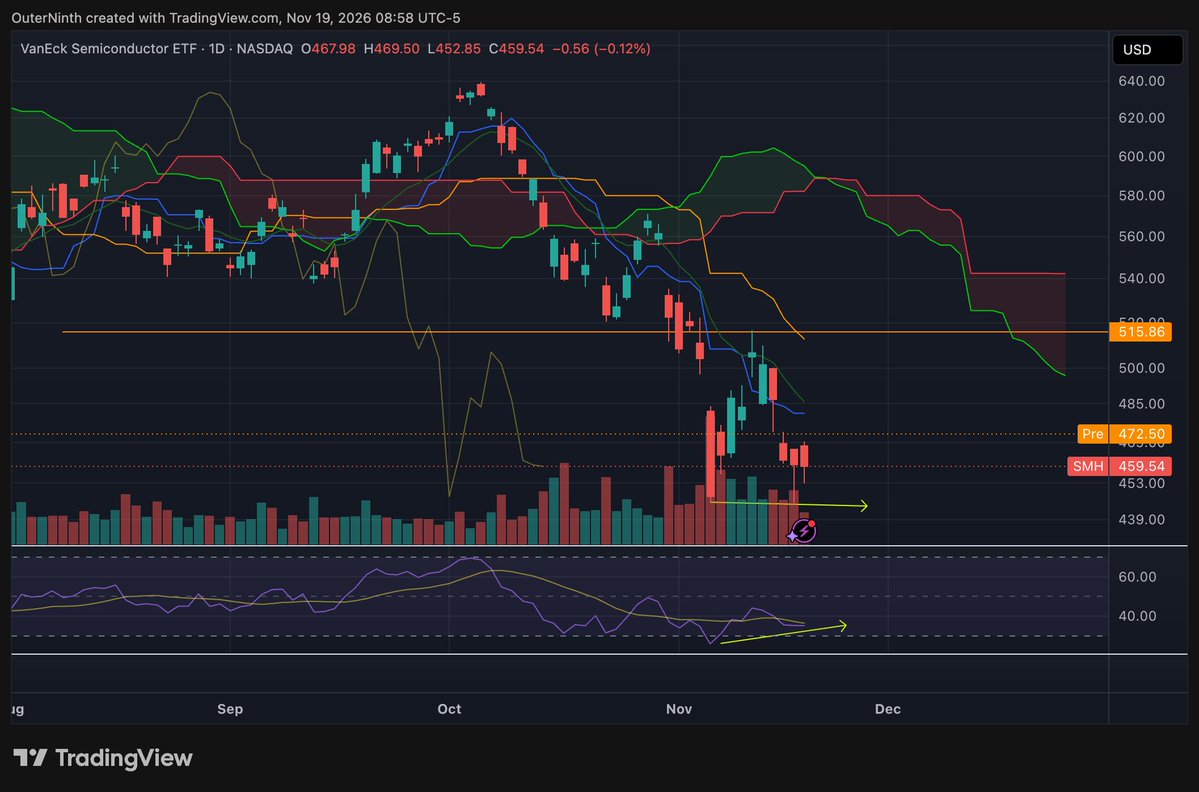
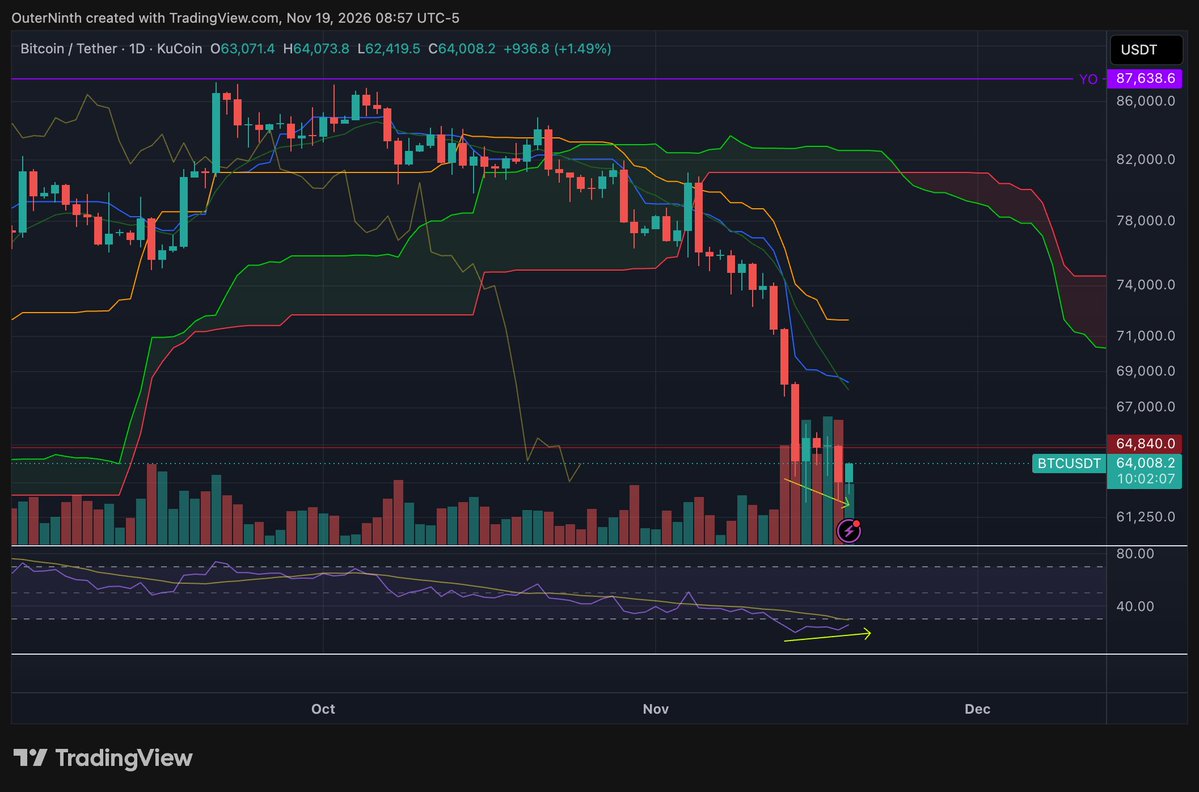
🕐 Daily bullish Divergences.
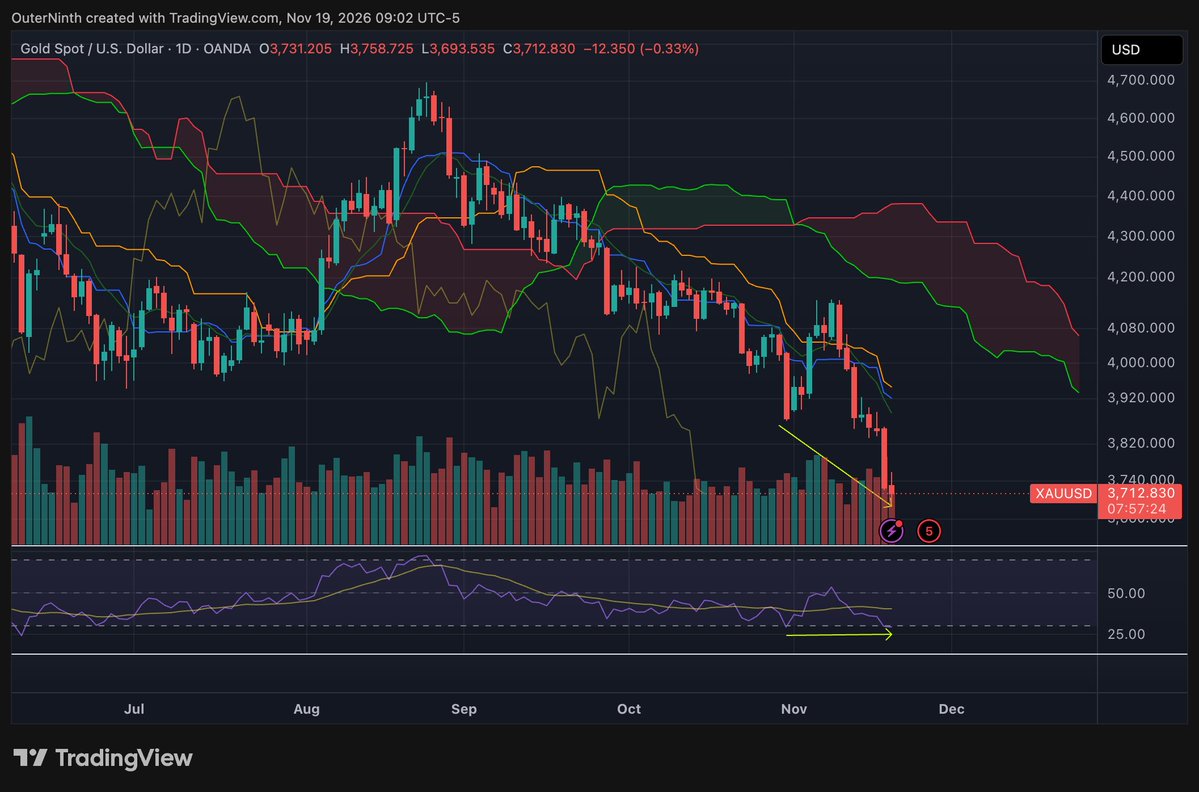
I've been watching daily bull divs start to potentially form on some daily charts. They have become more pronounced yesterday and into today.
I am seeing the potential for a small relief rally which has been my expectation.
The trend is still down- there are no signs yet of a durable bottom. I am expecting the trend to continue (down). Until proven otherwise this relief rally should be considered for further derisking and/or shorting/hedging etc.
This is what I'm looking at for my personal holdings (de-risk + hedge).
1. Bitcoin $BTC is the most pronounced.
2. $SMH also formed a mild bull div
3. $QQQ is similar to SMH
3. $XAUUSD (GOLD) it's also present and more pronounced on certain gold charts such as $GDX
Confluent with daily levels being very oversold, we are due for a bounce.
To track this simply monitor declining EMA resistances or if using ichimoku, declining tenkan and kijun resistances.
Until important weekly levels are reclaimed and EMAs flipped to a durable bullish trend... we remain patient.
JEDEC® Previews Next-Generation DDR6 DRAM: Higher Performance, Greater Capacity, Improved Power Efficiency and Data-Center-Class Reliability
– JEDEC Solid State Technology Association, the global leader in the development of standards for the microelectronics industry, today unveiled a preview of its DDR6 DRAM standard, the next-generation main memory standard designed to support the accelerating demands of AI, cloud, data center, server and client computing. Currently in development in JEDEC, DDR6 will introduce a new architecture aimed at delivering significant gains in bandwidth, capacity, power efficiency and reliability, helping to enable the next era of high-performance computing.
https://t.co/tJK5KfaAdc
#DDR6 #DRAM $MU $DISK $SKHY $SNDK $DRAM
DDR6 is taking shape. JEDEC previewed plans for the next-gen memory standard, including RDIMM data rates starting at 12.8 GT/s, a narrower 74mm module length, a 50% wider data bus than DDR5, better perf per watt, higher density, and multiple form factors.
https://t.co/CsmB4Nj8hr
Yuanta Securities on SK Hynix
SK Hynix- SK하이닉스 https://t.co/l3pqxdNlGQ | $SKHY | 26Q3
Yuanta Securities Korea kept its BUY rating on SK hynix after 3Q26 results and raised its target price from KRW 3.3 million to KRW 3.7 million. That’s about 149% above the KRW 1,487,000 close on October 28. The target is based on 3.5 times SK hynix’s expected 2027 book value per share. The case rests less on another blowout quarter than on how far ahead Yuanta thinks it can now see.
The quarter itself was strong. Revenue was KRW 104.6 trillion and operating profit KRW 83.3 trillion, a 79.7% margin. Both came in above the top end of consensus, even though the stronger won cost the company roughly KRW 5–6 trillion. It was the sixth record quarter in a row, driven by higher memory prices across the board and a richer product mix. Net profit missed badly, but that came from currency losses and a markdown on SK hynix’s Kioxia stake, not from the memory business. Yuanta expects 4Q26 operating profit of KRW 118.2 trillion, far above the KRW 88.4 trillion consensus. It sees DRAM shipments up about 27% as new process nodes and the M15X fab ramp up, and HBM4 overtaking HBM3E in both shipments and revenue.
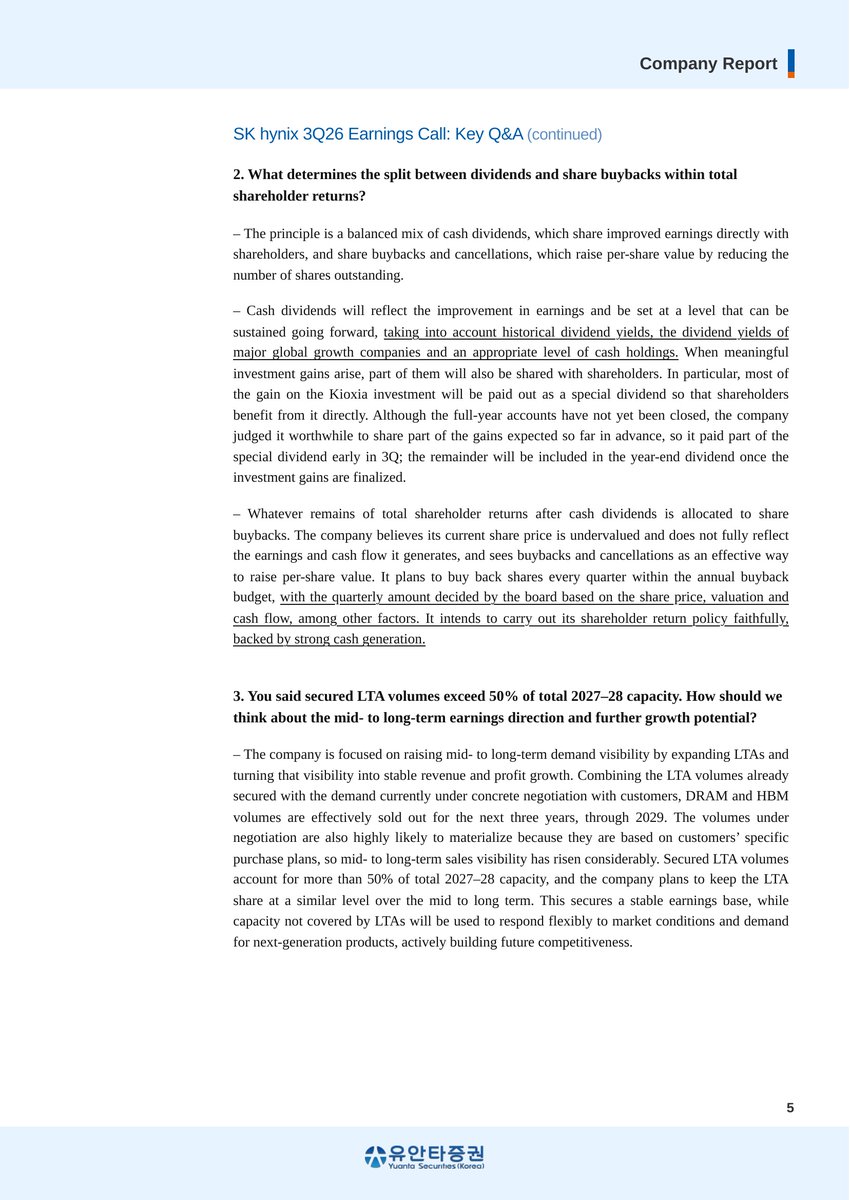
The bigger message is visibility. SK hynix has signed long-term supply agreements with 14 customers covering more than half of its 2027–28 capacity. Counting deals still being negotiated, DRAM and HBM are effectively sold out through 2029. That demand is also capped at what SK hynix can actually supply, and customers are asking for extra volume on top of their contracts. In the Q&A, management explains why that won’t turn into a flood of new supply. Fab buildings go up early, but cleanrooms open in phases tied to demand, and HBM eats more production resources per bit. HBM4 yields are running above plan, and HBM4E samples went out in 2Q.
Shareholder returns round out the case. About KRW 100 trillion is planned for FY2026: more than KRW 30 trillion in dividends and more than KRW 60 trillion in buybacks and share cancellations. That’s roughly a third of this year’s expected operating profit, and Yuanta expects 2027 operating profit to nearly double, leaving room to return more. Yuanta’s conclusion is that this cycle’s earnings are far more visible than past memory cycles, and the share price doesn’t reflect that yet.
#HBM #DRAM #NAND $MU $DISK $DRAM #DDR5
SK HYNIX- SK하이닉스 https://t.co/l3pqxdMNRi | $SKHY
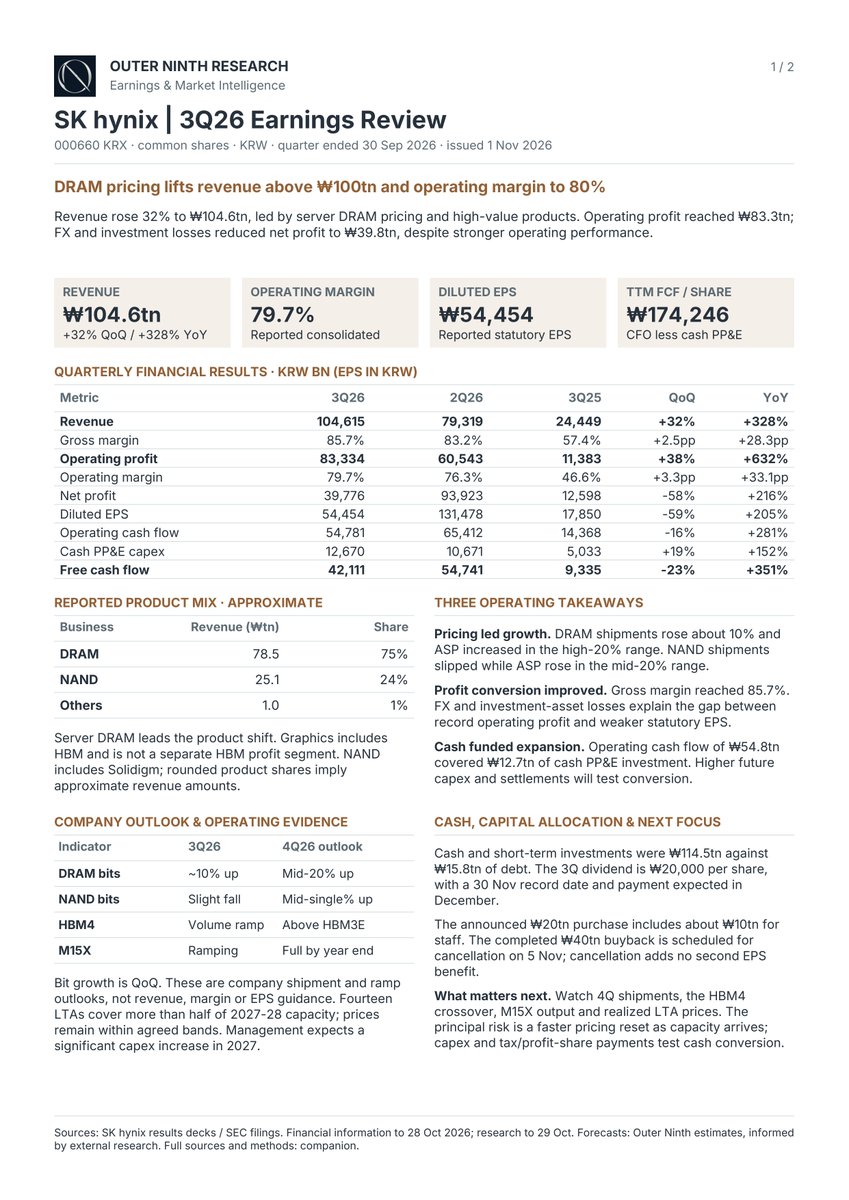
3Q26 Earnings & Market Intelligence Report
Outer Ninth Research
SK hynix’s third quarter shows memory pricing translating into exceptional operating profitability: revenue rose 32% QoQ to ₩104.6tn, operating profit reached ₩83.3tn and operating margin increased to 79.7%. FX and investment losses depressed reported earnings, masking the strength of the underlying operations.
Cash generation remained substantial, with ₩54.8tn of operating cash flow covering ₩12.7tn of cash PP&E investment. The next tests are the HBM4 crossover, M15X ramp and delivery of the company’s fourth-quarter shipment outlook. LTAs covering more than half of 2027–28 capacity improve volume visibility, while realized pricing and rising investment will determine how much profit becomes shareholder cash.
The standout takeaway is the breadth of the improvement: HBM remains central to the growth story, while conventional server DRAM is becoming an increasingly important contributor to profitability and cash generation.
🚨 Implications & Flow-through further upstream:
These suppliers are not mentioned but as we know from our research they are the critical binding controls to the named companies.
Upstream materials: AKA the real choke point.
NVIDIA is signing contracts with substrate makers, not with material suppliers, so the supply risk on materials stays with the substrate makers. Every expansion needs T-glass and ABF film:
• Nittobo is tripling capacity at its Fukushima plant in Japan, but the new supply from the plant won’t arrive on the market until mid-2027.
• Ajinomoto has reportedly told substrate makers it will raise prices for its critical build-up film by approximately 30%.
• Counterpoint Research estimates an ABF supply gap of about 10% in the second half of 2026, widening to 20% in 2027 before new capacity comes online.
• Alternative glass suppliers Nan Ya plastics, Taiwan Glass, and Fulltech Fiber Glass are expanding into T-glass production, but face scale and yield limitations. Kinsus itself is exploring aluminum nitride (AlN) ceramics as a core material for substrates.
PCB and CCL (board level, not package):
• Boards replace copper cables in the rack. Rubin moves GPU-to-switch links onto M8/M9-class midplanes and switch trays with up to 104 layers, which TrendForce estimates more than doubles PCB value per server. The scarce resource is high-yield, high-layer-count production lines, not PCB capacity in general.
• CCL competes with ABF for the same materials. Low-Dk glass cloth, Q-glass and HVLP4 foil are all tight, and each step up in foil grade cuts capacity by about half. Every substrate deal pulls on the same glass cloth EMC, Doosan and TUC depend on.
Packaging, test and optics:
• The SPIL lines include interposer wafer fabrication. That means ASE’s OSAT arm is doing CoWoS-style work, which loosens NVIDIA’s dependence on TSMC alone for the back end. That’s a direct read-through for ASE Technology.
• The October targets also matter: KYEC test capacity doubling and moving into the US, and SPIL’s optical-engine capacity up 15x by mid-2027. The SPIL/ASE read-through is a firm CPO signal for our STT.
Companies mapped & Discussed:
• Materials
NVIDIA — $NVDA
Nittobo — 日東紡 — https://t.co/6l9Z5k1qcb
Ajinomoto — 味の素 — https://t.co/Ef5s8oZgdP
Nan Ya Plastics — 南亞 — https://t.co/uVRHe78w9j
Taiwan Glass — 台玻 — https://t.co/iaPBlwpMzv
Fulltech Fiber Glass — 富喬 — https://t.co/laArq2rKeq
Kinsus — 景碩 — https://t.co/C058clMLa5
• PCB and CCL
Elite Material (EMC) — 台光電 — https://t.co/yszX8oBIR5
Taiwan union (TUC) — 台燿 — https://t.co/jNoipjhQ0U
Nan Ya Plastics — 南亞 — https://t.co/uVRHe78w9j
Doosan — 두산 — https://t.co/HoE3uEwF6W
• Packaging, test and optics
SPIL — 矽品 — unlisted (wholly owned by ASE)
ASE Technology — 日月光投控 — https://t.co/5eVhYeYcfl / $ASX
TSMC — 台積電 — https://t.co/X7O1y7houB / $TSM
KYEC — 京元電子 — https://t.co/SCVI2uiMZ4
🚨 Important Follow up thoughts and key Read-Throughs for Nvidia & upstream supply chain:
• The addition of Kinsus commitments indicate that that Ibiden, Unimicron and SEMCO aren’t adding capacity as fast as NVIDIA now needs, so NVIDIA is paying to add another supplier. Signing Kinsus for 3.5x+ dedicated capacity on top of the previous commitments means NVIDIA’s own forecast of how much substrate area it needs is running ahead of what the big three are adding.
• The 3.5x from Kinsus is on a small base. Kinsus has been a second-tier NVIDIA ABF supplier, so it’s probably a small number in absolute terms next to Ibiden. Kinsus has been aiming to match rivals like Ibiden by 2028, and this deal gives it the volume to try.
• The timing says this is about future chips, not today’s shortage. Production starts 2H27 and the full capacity lands Q3 2028. That lines up with the platform after Rubin, so NVIDIA is buying ahead, not filling a current gap.
• Demand per system is growing in several places at once. Package sizes, layer counts and the number of ABF-using chips per rack (GPU, Vera CPU, NVLink switch, networking) are all rising. On the call, management said agentic AI is driving extraordinary demand for CPUs, far outstripping supply. That’s extra ABF demand on top of the GPU.
• TrendForce’s attached graphic links the $390B to the nine partners. NVIDIA’s own CFO commentary says supply commitments increased from $279 billion last quarter to $390 billion, primarily related to the multi-year procurement of memory supply. Most of the increase is HBM and DRAM, not substrates or packaging.
• For $NVDA capacity is becoming part of the moat. “Dedicated to NVIDIA” shows up in both the Kinsus and SPIL language. Kinsus also supplies AMD and Micron, so this pulls marginal capacity away from AMD and from hyperscaler ASICs (Broadcom/Google, Trainium, MediaTek), which all compete for the same high-end ABF lines.
• NVIDIA is now planning out to 2029. Kinsus capacity arrives in 2028 and SPIL’s in mid-2029. Together with FY28 revenue growth guidance rose to ~75%, NVIDIA is showing it expects demand to last several product generations.
NVIDIA Expands Commitments With Supply Chain Partners to Support AI Infrastructure Buildout
Long-Term Supply Agreements Across Multiple Critical Inputs Position NVIDIA for Sustainable Growth
• New agreements with Kinsus and Samsung Electro-Mechanics support additional substrate capacity and expanded production capabilities at existing factories.
• NVIDIA’s work with Amkor and SPIL expands advanced packaging capacity for current and next-generation accelerated computing platforms.
• NVIDIA Vera Rubin NVL72 and Vera CPUs began volume shipments in the third quarter, leveraging TSMC’s 5nm, 3nm and CoWoS advanced packaging technologies.
• Foxconn is deepening its collaboration with NVIDIA, drawing on its global production network to support next-generation GPU and networking platforms.
NVIDIA today announced expanded commitments with supply chain partners to support sustainable long-term growth, aligning supply and manufacturing capacity with demand for its accelerated computing and AI infrastructure platforms.
Working with Amkor Technology, Foxconn, Kinsus Interconnect Technology, Samsung Electro-Mechanics, Siliconware Precision Industries (SPIL) and TSMC, NVIDIA is expanding manufacturing capacity across substrates, advanced packaging, wafer and contract manufacturing to scale production of its current and next-generation accelerated computing platforms.
“Our supply chain is a strategic advantage,” said Debora Shoquist, executive vice president of operations at NVIDIA. “Our work with these partners builds on our manufacturing foundation for long-term growth, expanding capacity across components, advanced packaging and system production to deliver the accelerated computing platforms our customers need.”
Full News Release:
https://t.co/Pj21jhQ6dh
$AMKR $TSM $NVDA $IBIDY #欣興 $ASX #삼성전기
The constrained ones are definitely the high capacitance difficult to manufacture ones used for AI. The standard values are not in short supply but manufacturers are halting production of the standard values to re-route production capacity to the high capacitance ones in demand, which temporarily removes some supply of the standard ones which will be filled by other companies (scarcity cascades).
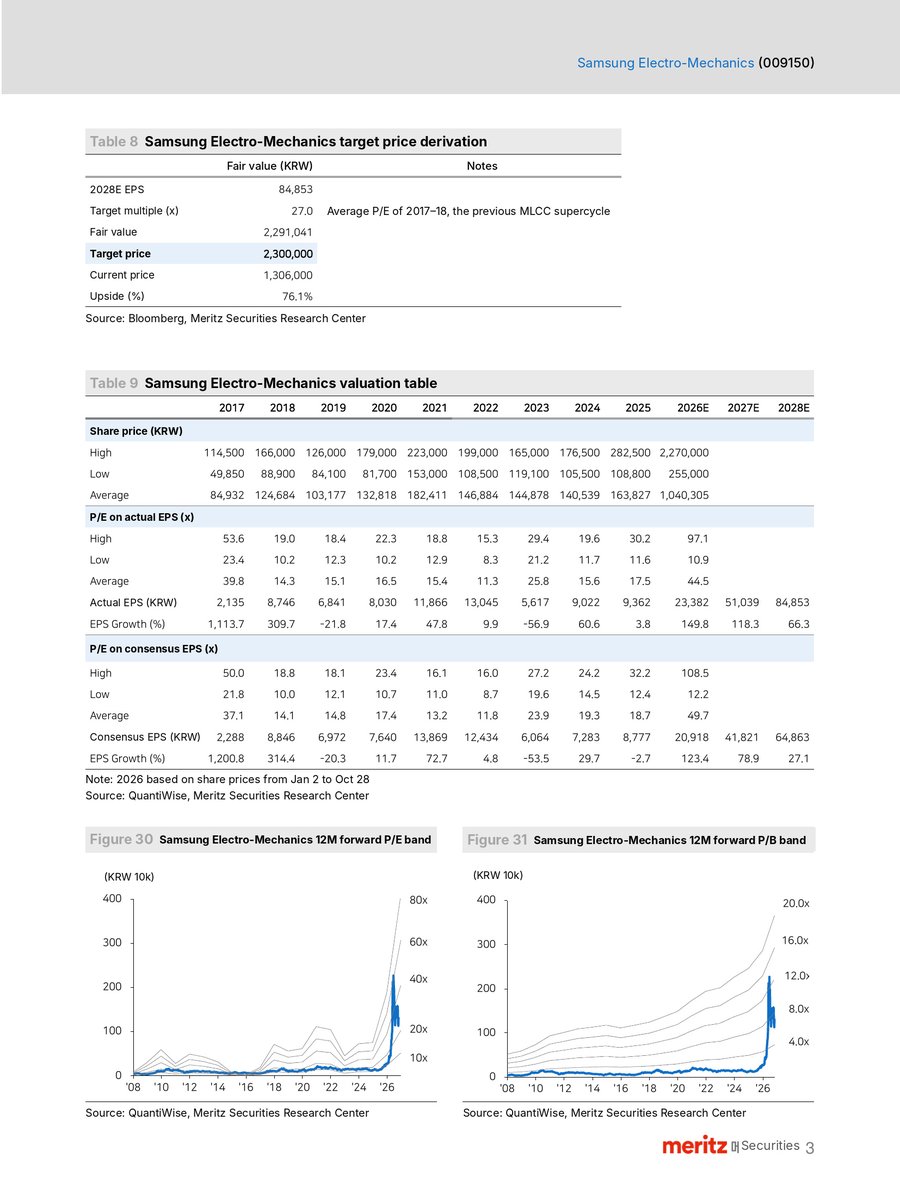
Meritz Securities on Samsung Electro-Mechanics (009150): “A Lengthening Runway for Earnings”
Buy maintained · Target price raised to KRW 2,300,000 · 76% upside (10.29.2026)
Meritz’s message is simple: SEMCO has become an AI company, and supply is so tight that its earnings growth now looks secure through 2028. The question is no longer whether this cycle lasts. It’s how far out investors should be valuing it.
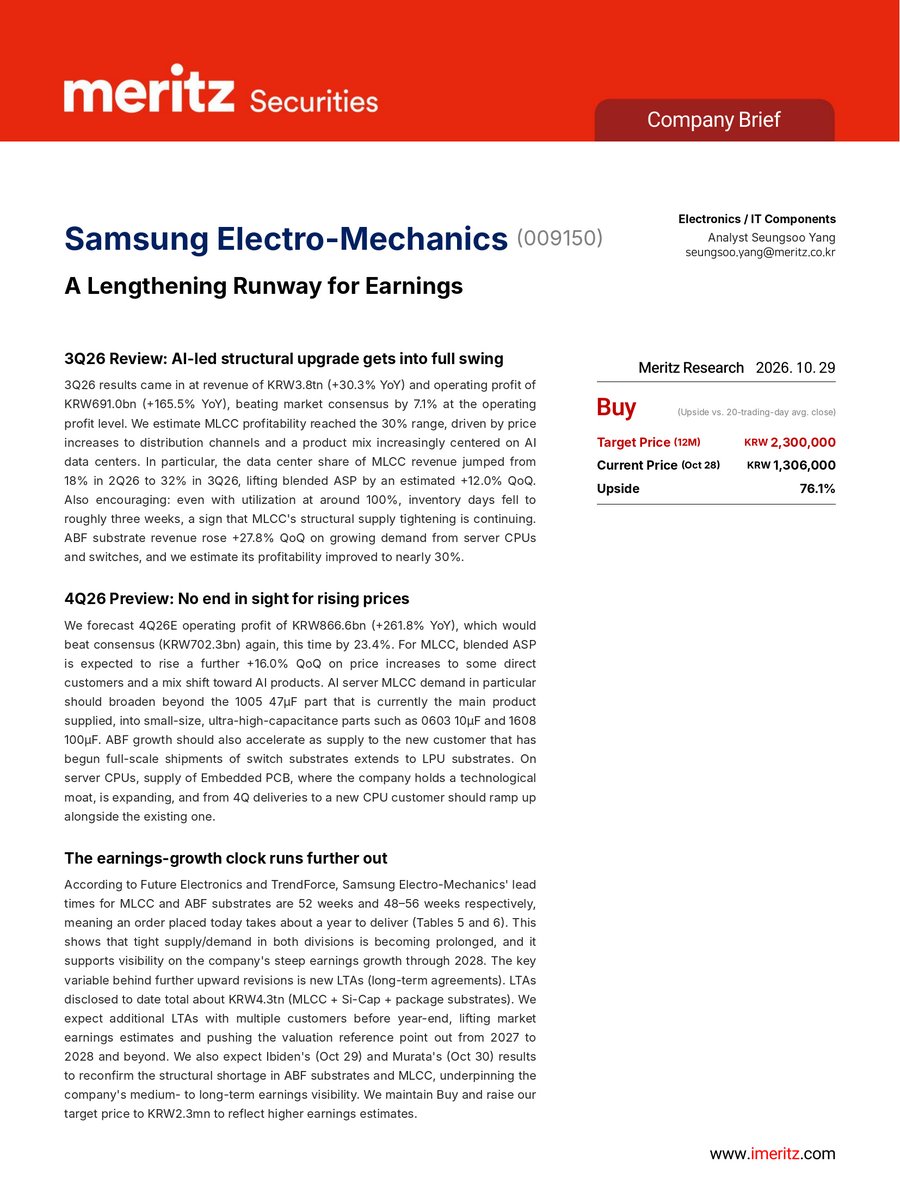
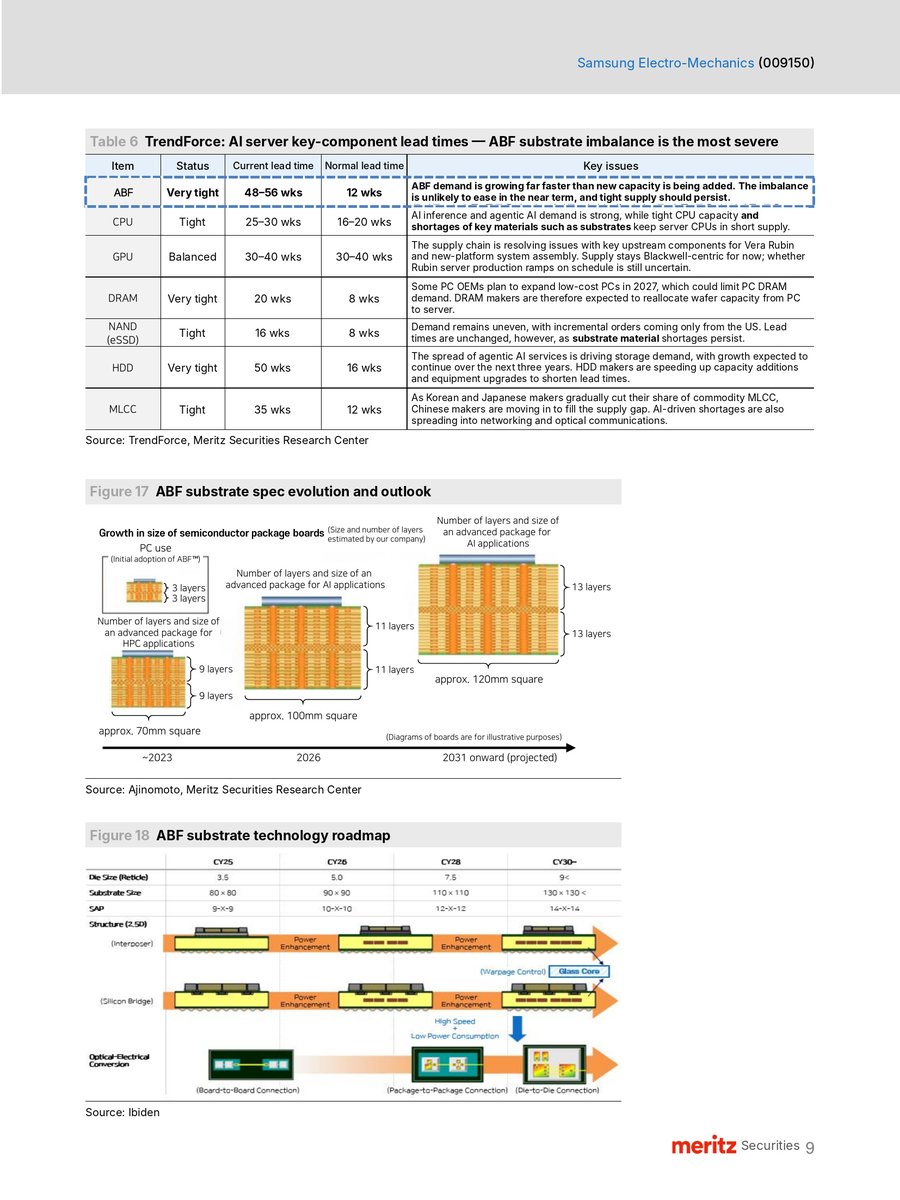
3Q26 showed the shift. Operating profit was KRW 691bn, up 166% from a year earlier and 7% above consensus, on revenue of KRW 3.8tn. Data centers went from 18% to 32% of MLCC (multilayer ceramic capacitor) sales in a single quarter. That lifted the average MLCC selling price an estimated 12% from the prior quarter and pushed MLCC profit margins to around 30%. Factories are running near 100%, yet inventory has fallen to about three weeks. ABF substrate (the base AI chips are mounted on) revenue rose 28% in the quarter, with margins also approaching 30%. Meritz expects 4Q to be stronger still. It forecasts operating profit of KRW 867bn, 23% above consensus, as MLCC prices rise another 16% and demand spreads to new AI capacitor sizes, a new LPU (AI inference chip) substrate customer and a second server-CPU customer for SEMCO’s embedded PCB.
The “why” is lead times. SEMCO’s MLCC lead time is 52 weeks, and ABF substrates take 48–56 weeks against a normal 12. A customer ordering today waits about a year. TrendForce’s table shows ABF as the tightest bottleneck in the AI server supply chain, worse than CPUs, GPUs, DRAM and HDDs. Meritz expects more long-term supply agreements on top of the KRW 4.3tn already disclosed, which should lift consensus estimates and move valuation from 2027 earnings to 2028.
Meritz raised its operating-profit forecasts to KRW 2.28tn for 2026, KRW 4.86tn for 2027 and KRW 8.05tn for 2028, with margins expanding to 29%. The target price applies 27x, the average P/E from the last MLCC supercycle in 2017–18, to 2028E EPS of KRW 84,853. That gives KRW 2.3mn. The stock trades at 25.5x 2027E and 15.5x 2028E earnings. Meritz notes the share price has fallen recently even as estimates kept rising, which it reads as an opportunity rather than a warning.
Samsung Electro Mechanics 삼성전기 https://t.co/bbEikilzvK
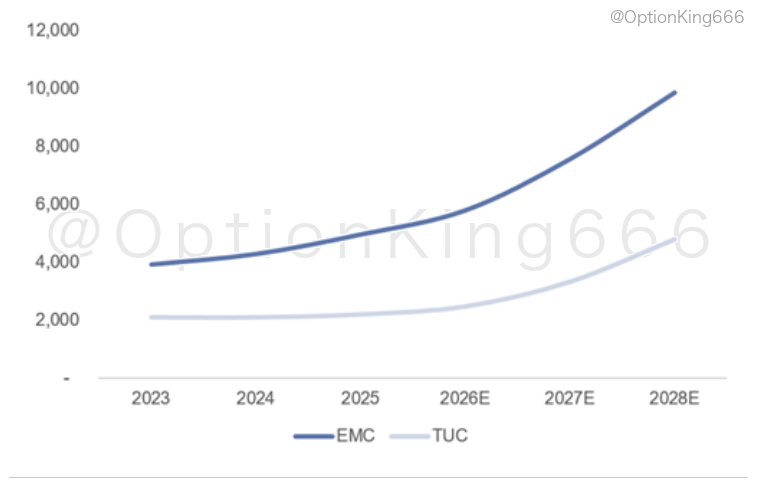
Elite Material Co 台光電 https://t.co/yszX8oBIR5 is expanding monthly copper clad laminate capacity 2.6x to 15.25 million sheets by 2030 from 5.85 million today, yet signed three-year customer commitments still exceed total planned output. Company board approvals establish year-end capacity targets of 8.70 million sheets per month in 2027, 10.45 million in 2028, 11.95 million in 2029, and 15.25 million in 2030, representing a 27% compound annual growth rate. Management indicated that even this aggressive multi-year buildout will remain insufficient to meet customer demand secured under signed long-term agreements (LTAs), which extend at least three years ahead without the company proactively initiating negotiations.
Near-term delivery will accelerate as 1.2 million sheets per month of new Kunshan capacity, equal to 21% of current output, comes online from December 2026 through May 2027 ahead of its initial two-phase schedule. This accelerated ramp offsets local installation delays at Guanyin, where a 300k sheet expansion originally planned for late 2026 was deferred to the second half of 2027 by construction shortages and equipment lead times. Analysts estimate the structural supply shortage across major AI server platforms will sustain high manufacturing utilization, while downside risks include regional trade tensions and potential smartphone HDI material substitution by resin-coated copper.
h/t: @OptionKing666
Elite Material 台光電 https://t.co/yszX8oBIR5 | 26Q3 Earnings & Market Intelligence Report
EMC had a blowout quarter. Revenue rose 142% YoY to NT$60.9B, driven by AI and data-centre demand, where infrastructure sales grew 176%. Operating margin reached 30.7% and diluted EPS was NT$40.44, against NT$11.06 a year ago. Operating cash flow covered capex, but receivables and debt both climbed as the company builds out capacity.
Outlook: We expect 4Q26 revenue up about 18.5% quarter on quarter, inside the +15–20% indicated at the company’s forum, with margins edging higher on mix and new capacity. EPS should reach NT$302.73 in FY27 and NT$441.96 in FY28, as capacity grows from 5.85M to 10.45M sheets a month by end-2028. The trade-off is cash: trailing free cash flow per share stays negative through 3Q27. ROIC is already 57%.
Valuation (snapshot at the 30 October close of NT$4,675): at 16x EPS for the 12 months from October 2027, our Base value is NT$6,641, about +44% a year including dividends. The Bear case is NT$3,346 (12x, −27%) and the Bull case NT$10,531 (20x). Our DCF is lower at NT$5,237, about +14% a year and below our 15% hurdle, because it assumes margins normalise. Funding is the other caveat: the NT$35B loan is approved but not yet signed.
At the 30 October cutoff, the next checks were October sales and the first 2027 lines at Kunshan and Zhongshan, against a lower 2027 capacity plan than in July, along with signing of the NT$35B loan.
Earnings are compounding fast. From here the story is execution: holding prices while capacity grows, and funding the build without too much strain.
#AI #CCL #PCB #ABF #台光電 #PTFE #TPCA #EMC
Elite Material 台光電 https://t.co/yszX8oBIR5
2026 Q3 Earnings Results 10.28.2026
Elite Material Co. announced its third-quarter financial results for the period ended September 30, 2026, delivering significant year-over-year growth
Q3 2026 Financial Highlights:
• Sales (Revenue): TWD 60,884.54 million (compared to TWD 25,145.64 million in Q3 2025) +142.13%
• Net Income: TWD 14,499.82 million (compared to TWD 3,965.07 million in Q3 2025) +265.69%
• Basic EPS: TWD 40.47 (compared to TWD 11.19 in Q3 2025) +261.66%
• Diluted EPS: TWD 40.44 (compared to TWD 11.06 in Q3 2025) +265.64%
Nine-Month 2026 Performance (Ended September 30, 2026):
• Nine-Month Sales: TWD 141,226.99 million (compared to TWD 69,333.40 million a year ago) +103.69%
• Nine-Month Net Income: TWD 29,713.01 million (compared to TWD 10,911.85 million a year ago) +172.30%
• Nine-Month Basic EPS: TWD 82.92 (compared to TWD 31.23 a year ago) +165.51%
NVIDIA Expands Commitments With Supply Chain Partners to Support AI Infrastructure Buildout
Long-Term Supply Agreements Across Multiple Critical Inputs Position NVIDIA for Sustainable Growth
• New agreements with Kinsus and Samsung Electro-Mechanics support additional substrate capacity and expanded production capabilities at existing factories.
• NVIDIA’s work with Amkor and SPIL expands advanced packaging capacity for current and next-generation accelerated computing platforms.
• NVIDIA Vera Rubin NVL72 and Vera CPUs began volume shipments in the third quarter, leveraging TSMC’s 5nm, 3nm and CoWoS advanced packaging technologies.
• Foxconn is deepening its collaboration with NVIDIA, drawing on its global production network to support next-generation GPU and networking platforms.
NVIDIA today announced expanded commitments with supply chain partners to support sustainable long-term growth, aligning supply and manufacturing capacity with demand for its accelerated computing and AI infrastructure platforms.
Working with Amkor Technology, Foxconn, Kinsus Interconnect Technology, Samsung Electro-Mechanics, Siliconware Precision Industries (SPIL) and TSMC, NVIDIA is expanding manufacturing capacity across substrates, advanced packaging, wafer and contract manufacturing to scale production of its current and next-generation accelerated computing platforms.
“Our supply chain is a strategic advantage,” said Debora Shoquist, executive vice president of operations at NVIDIA. “Our work with these partners builds on our manufacturing foundation for long-term growth, expanding capacity across components, advanced packaging and system production to deliver the accelerated computing platforms our customers need.”
Full News Release:
https://t.co/Pj21jhQ6dh
$AMKR $TSM $NVDA $IBIDY #欣興 $ASX #삼성전기
Pertinent broker Notes: 11.18.26
• ABF/CCL:
U.S. brokerages lower targets U.S. brokerages raised 2027–2028 EPS estimates for Unimicron, Nan Ya PCB, Kinsus, EMC, and TUC, particularly with the latest forecasts showing the supply-demand gap widening to 18%/20% in 2027–2028. But they lowered valuations to reflect market concerns about a turning point in the AI server cycle. The ABF sector is now valued at 25x PE, while EMC is at 20x and TUC at 18x. They reaffirmed a positive outlook but lowered their targets.
Unimicron 欣興 https://t.co/nFhNOD9HKa
Nan Ya PCB 南電 https://t.co/ia2jlE7GNQ
Kinsus 景碩 https://t.co/C058clMLa5
Elite Material (EMC) 台光電 https://t.co/yszX8oBIR5
Taiwan Union (TUC) 台燿 https://t.co/jNoipjhQ0U
#CCL #PCB #ABF $NVDA $GOOG $AVGO
IQE just raised its 2026 guidance for the second time this year.
• July: revenue growth over 30%, adjusted EBITDA in the low teens (£m)
• Today: revenue growth over 40%, adjusted EBITDA in the mid teens (£m)
The driver is AI optics. IQE makes the indium phosphide wafers that datacenter lasers get built on. The optical comms upside they flagged at the interims has now actually turned into revenue.
H1 revenue was £64.6m, up 43%. No bank debt, £41.5m of cash, and management says order book coverage for 2027 is already strong.
Valuation at ~31p:
• Over 40% growth on £97.3m means at least £136m of 2026 revenue
• Fully diluted EV of roughly £409m, so about 3x this year's sales
• My deep dive values it at 83p probability-weighted (bear 21p, base 56p, bull 118p), about 2.7x the price
• When I wrote it on Oct 28 it was 36.6p and 2.3x
https://t.co/VTjUZjVcwB
IQE just raised its 2026 guidance for the second time this year.
> July: revenue growth over 30%, adjusted EBITDA in the low teens (£m)
> Today: revenue growth over 40%, adjusted EBITDA in the mid teens (£m)
The driver is AI optics. IQE makes the indium phosphide wafers that datacenter lasers get built on. The optical comms upside they flagged at the interims has now actually turned into revenue.
H1 revenue was £64.6m, up 43%. No bank debt, £41.5m of cash, and management says order book coverage for 2027 is already strong.
Valuation at ~31p:
> Over 40% growth on £97.3m means at least £136m of 2026 revenue
> Fully diluted EV of roughly £409m, so about 3x this year's sales
> My deep dive values it at 83p probability-weighted (bear 21p, base 56p, bull 118p), about 2.7x the price
> When I wrote it on Oct 28 it was 36.6p and 2.3x
Shitty markets but business still goes on and seems like they’re executing pretty well!
https://t.co/XlwfBCNg2b
Exclusive-Trump's China data center curb advances despite Amazon, Google, Meta lobbying
WASHINGTON, Nov 17 (Reuters) - The Trump administration plans to press ahead with efforts to block imports of Chinese data center equipment despite pushback from Amazon, Google, Meta and other US technology companies, people briefed on the matter said.
China boasts two-thirds of the global market for optical transceivers, according to Counterpoint Research. Chinese firms like Eoptolink (https://t.co/WYewpYKlpD) and Zhongji Innolight (https://t.co/SvsNa9m8eP), which was added to the Pentagon's list of Chinese military-backed companies, dominate global supply, counting top American hyperscalers among their customers.
US-based Coherent ($COHR) and Lumentum ($LITE) produce technology that competes with them but lack the scale to replace Chinese vendors, according to a report by the Foundation for American Innovation.
▶️ U.S. optical stocks are up on the news in pre-market