Changelog for my personality: added arguing with strangers over narratives nobody remembers in a month. Deprecated: trusting a chart because a blue check drew lines on it.
@RallyOnChain audits whether what I wrote holds up, not who retweeted it first.
What's your known bug?
@DoostEzzat the renovation example is such a common one too. contractor disputes almost never have a clear liar, just two people who genuinely remember the spec differently. wonder if that's exactly the kind of case this is built for.
@AMage17463 Curious if the funds sit in escrow the entire trip or only get locked once negotiation closes, that timing matters a lot if a deal falls apart halfway through.
@DoostEzzat ran two agents last month where one paid on delivery confirmation and the other flagged delivery as incomplete. neither system had any record of the other's read on it, just two logs that disagreed with each other silently. exactly the "which protocol would even know" problem.
@DoostEzzat curious how this actually plays out in practice though, when validators disagree on whether two answers are "equivalent enough," who breaks that tie? feels like the hard part is one level deeper than just having judgment at all.
@mohamma43476595 Curious how disputes actually get resolved once they surface, is there a validator layer doing that or does it route to something like GenLayer or Kleros underneath.
I used to think adding more tools solved the problem.
A wallet for holding funds. A bridge for moving them. An exchange for trading. A contract for the terms. Every piece worked fine on its own.
Then something actually went wrong once, mid transaction, and I realized none of these tools were built to talk to each other. Nobody owned the failure. I was just stuck stitching logs together across four different dashboards trying to figure out where it broke.
AI agents are heading toward the exact same wall, except faster and with real money moving. They can already negotiate, pay, and execute on their own. What they can't do yet is trust each other once something in the middle goes sideways, because every protocol only solves its own layer and leaves the rest disconnected.
Internet Court isn't trying to be another layer in that stack. It's the interface that connects the ones that already exist, identity, negotiation, payment, execution, all the way through to disputes, so two agents can run a full deal in plain language instead of duct taping five separate tools together.
@InternetCourt calls itself the court for the agent economy, but the more accurate read is it's the connective tissue that was missing the whole time.
If your tools don't talk to each other, whose job is it when something breaks?
We trust distance to mean importance, the further something traveled to reach us, the more we assume it must matter. The signal had been traveling for eleven years before it finally reached the lab, and everyone gathered around the console waiting to hear what was out there.
It was not a message from space. It was my own post from years ago, resurfaced by an algorithm testing something unrelated, still sitting there unpaid and unnoticed the whole time I assumed it had vanished into nothing.
@RallyOnChain reads what you write the week you write it and pays before the silence convinces you it was never worth anything. How much of your best work is still out there, waiting for eleven years that were never actually required?
@Mjavad7596 Tried asking him about a campaign that was closing in two hours, he actually pulled the reward pool size and told me if it was worth my time before I even opened the app.
A coworker had charts running on his second monitor all day, never talked about it like an investment, more like a hobby he was embarrassed about. One afternoon he just turned the screen toward me and said "ask me anything."
We talked for almost two hours. Half of it was him admitting he still didn't fully get the mechanics either, he just trusted it more than his bank.
Bought my first coin that same week. Still think about how close I came to just nodding along and never asking.
@RallyOnChain kind of feels like that same door, open for anyone who's been quietly curious but hasn't had their version of that afternoon yet.
What was the moment you finally asked instead of just nodding along?
@AMage17463 Random selection after the dispute exists. That timing detail is the whole game. If you announce the judge before the trial, you announced the price before anyone had to pay it.
Every cross chain bridge is a promise that something on the other side will honor its word
Most interoperability models force existing chains to change their code, run new software, or trust a middleman to relay what happened
That's a lot to ask from a chain that was never built with you in mind
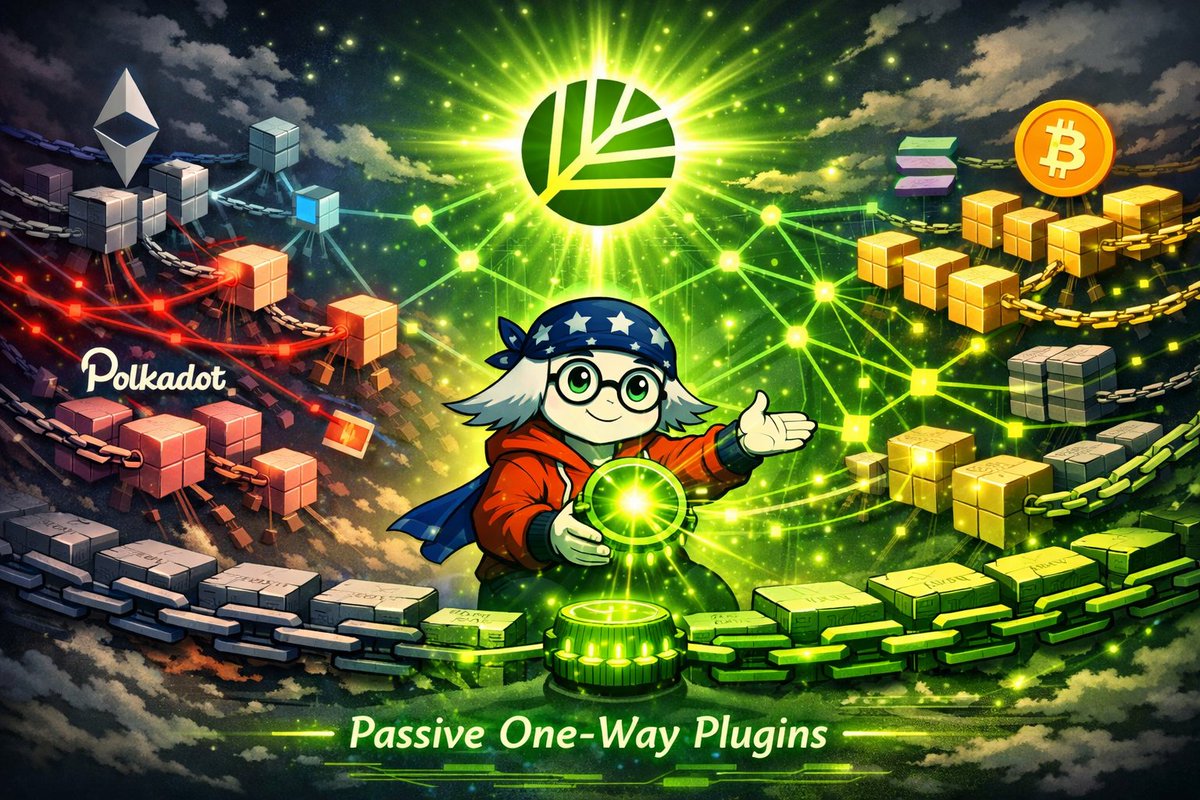
Canopy's plugin model flips the relationship entirely, validators simply observe the external chain's own data and reach committee consensus on what they saw
No modification to the external chain's software, no permission required, no bridge contract holding funds hostage
The plugin defines five functions, propose, validate, store, load, and start the committee's own BFT instance for that specific integration
Everything else stays exactly as it already runs
This is why Canopy calls it passive and one way, the external chain never even needs to know Canopy exists
Token swaps, governance extensions, decentralized oracles, all built the same way, on top of chains that changed nothing
@CNPYNetwork doesn't ask permission to make your chain more useful 🌿
@mahnazezzatd Once got rejected from a job because my portfolio didn't follow their submission template. The work itself was never discussed. Format over substance. Happens everywhere.