VAG (Virtual Air Gap) / SAHAB (Sanal Hava Boşluğu) ürünümüzün v1 ve v2’den sonra, son sürümü de (VAG v3.0.3) EAL4+ sertifikası aldı.
Bize güvenen tüm paydaşlarımıza ve bu istikrarlı başarıda emeği geçen tüm çalışma arkadaşlarımıza teşekkür ederiz.
#invicta#vag#sahab
Today is David Gilmour's 80th birthday! 🎉
It’s also the 20th anniversary of his On an Island album, released on this day in 2006.
To celebrate, we’ll be sharing tracks from the 2006 AOL Session in New York over the next few days – starting today with the album's title track.
Watch the full performances on David’s YouTube channel (link in bio).
I just watched an absolutely brilliant documentary “ Queen of Chess” on @netflix about the greatest female athlete ever @GMJuditPolgar . It’s a story of an impossible dream of parents Laszlo and Klara and their brilliant children in a time when misogyny and government control was predominant.
Part of a movie is much about that game against Kasparov in Linares 1994. I feel that it did change the trajectory for Judit because when your idol does something bad and then does not apologize and even stops talking to you it becomes a trauma that follows you around for a long time.
I am in awe of Judit because the way she managed to face all the pressure and unfairness but remain beautiful , kind and resilient is incredible.
Judit, you did not become a world champion, but you are one of the greatest women who ever lived!
Bu gece yeni bir şeye adım atmıyoruz.
Sadece devam ediyoruz.
Aynı nefes akıyor,
aynı Dünya dönüyor,
aynı kalpler tamamlanmamış umutlarını taşıyor.
Gece yarısı bizi sıfırlamaz.
Bizi birbirimize bağlar
dünün derslerine,
bugünün farkındalığına,
yarının açılışına.
Aslında hiçbir şey yeni değil.
Ve güzelliği de burada.
Çünkü büyüme ani bir başlangıç değil,
sessiz bir devamlılıktır
alışkanlık hâline gelen nezaketin,
hatırlanan hakikatin,
olgunlaşan sevginin.
Biz “yeni”yi değil,
süreni kutluyoruz.
Devam edebilme cesaretini,
taşıyabilme bilincini.
Bu yıl,
daha fazla açıklıkla,
daha fazla şefkatle,
daha derin bir farkındalıkla
devam etsin.
Mutlu Devamlar ✨
No disrespect to Linus Torvalds, but this guy is the greatest geek alive 🫡
Created UNIX in 1971 when he was 28 years old.
Created Go in 2009 when he was 66 years old.
He also developed the B programming language (which led to C), created UTF-8 encoding (making international text possible online), and designed essential tools like grep that developers still rely on daily.
He also helped with the development of Multics (that led to UNIX), Plan 9 from Bell Labs and Inferno operating systems.
That's 4 operating systems in total... Most people don't even use these many OS.
Pretty impressive resume, right?
And it's a shame that many people, even the ones in the IT and tech industry, don't know him.
Ken Thompson.... Remember the name 🙏
Bacaklarınız ve üst gövdeniz ince olduğu halde göbeğiniz olabilir. Masum gibi görünen bu durum sağlığınız açısından oldukça problemlidir.
Bu göbeğin sebebi; karın boşluğunu dolduran ve iç organları saran viseral yağ, yani karın yağıdır. Birçok ciddi hastalığa neden olur.
📌Pazardan ,marketten aldığımız gıdalarla tarım zehiri tüketmek istemiyoruz
📌Denetim raporlarınızın düzenli olarak bizimle paylaşılmasını talep ediyoruz
📌Reçetesiz tarım zehirinin durdurulmasını istiyoruz
@TCTarim
Benimle aynı kaygı ve talepteyseniz lütfen sesimi çoğaltın🙋♀️
#zehirsiztarımistiyoruz
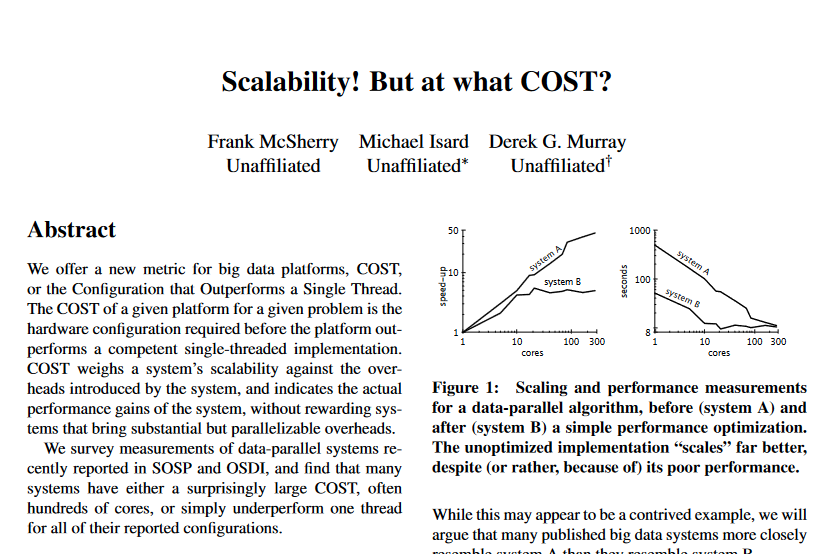
Scalability! But at what cost?
This paper is an absolute classic because it explores the underappreciated tradeoffs of distributing systems.
It asks about the COST of distributed systems--the Configuration that Outscales a Single Thread. The question is, how many cores does a big distributed system need to outperform some moderately-optimized single-threaded code running on your laptop?
As it turns out, scalability often comes with an extremely high COST. The authors examine several graph processing systems--including some big names like Spark--and find that they need dozens to hundreds of cores to outperform a single-threaded program.
Why is this the case? It's not because these distributed systems are badly designed, but because distributing computation is inherently inefficient for many problems.
Fundamentally, a distributed system cannot rely on all processors sharing state, at least not efficiently. This is a big issue! In graph algorithms, it means servers need to expensively exchange data and eliminates a wide swathe of algorithms and optimizations that rely on shared state. In distributed databases, it means expensive coordination is required to distribute transactions to ensure participating servers have consistent views of data.
Does this mean we shouldn't build scalable systems? Of course not! Many problems are well beyond the capability of a single server, no matter how optimized. But it does mean we should be mindful of the efficiency costs of scaling.
As an aside, I think this kind of thinking is why Postgres is so popular, despite not being distributed. A large Postgres server can handle a vast amount of traffic (especially with read replicas, which can be cheaply maintained). You need a huge company or incredibly heavy workload to outscale that single server, and when you do, the alternatives come with huge tradeoffs!