Imagine you spent 40 years doing the boring, responsible thing.
You opened a 401k at 23. You contributed every paycheck. You ignored the noise. You bought the index because Bogle told you to, because Buffett told you to, because every honest piece of financial advice for 30 years told you the index was the safest, most diversified, most rules-based way to own America.
The whole point was the rules.
The rules said: a company must trade for 12 months before joining the S&P 500. The rules said: it must show four consecutive quarters of GAAP profitability. The rules existed because in 1999 the index quietly bought a lot of stocks at the top, and pensioners paid the bill.
After the dot-com crash, S&P tightened the rules. Nasdaq tightened the rules. FTSE Russell tightened the rules.
For 23 years, those rules held.
Then SpaceX filed for IPO.
And the rules changed.
The S&P 500 waived the profitability requirement. Nasdaq cut its trading-history window from 90 days to 15. FTSE Russell cut its to 5.
Bloomberg Intelligence estimates the major index funds will absorb between 19% and 24% of SpaceX's float within six months. That's over $30 trillion of passive 401k and retirement money, mechanically buying a single newly public company at IPO valuations, because the rules said they had to.
Except the rules used to say they didn't.
Here's the thought exercise:
If you spend 40 years building a system designed to protect ordinary savers from buying overpriced stocks, and then you waive the protections the moment a sufficiently large stock asks you to, what was the system actually protecting?
Most of investing is about understanding what's a rule and what's a guideline.
A rule binds the rule-maker.
A guideline binds the saver.
You're allowed to find out which is which only after the fact.
Excited to share our most powerful new Claude Code feature: dynamic workflows!
Mention "workflow" in a prompt and Claude will dynamically create an orchestration plan that it strictly follows, allowing you to confidently trust that every stage happens in the right order even across 100s of agents.
I've got an agent in a loop optimizing a renderer with the goal to minimize frame times (and tests to measure). It got times down from 88ms to 2ms and allocations down from ~150K to 500. Sounds good, right? Wrong. This is exactly why agent psychosis is a big fucking problem.
As an experiment, I rewrote the Ghostty core render state in Go, with access to identically laid out data structures as Ghostty and the exact same validation tests. I made a purposely naive renderer (simple, correct, but slow). 88ms per frame with 150,000 allocations (horrendous, lol)!
I then kickstarted a Ralph loop to bring the frame times down. I told it it can't modify input data structures or the public API or tests (they're correct), but it can do anything else it wants. It got to work.
It has worked for about 4 hours. I've spent around $350 on this experiment so far. The results?
88ms => 1.5ms
150K allocs => ~500 allocs
Incredible right? Nope.
My hand-written renderer I ported has frame times (same benchmark) of ~20us (0.020ms) and 0 allocations in the update path.
This is the problem with psychosis and lacking systems understanding. If you don't understand the system, you're going to accept that this is an incredible result. If you understand the system, you'll see better solutions immediately and can do roughly 75x better on throughput.
The people who blindly trust agent output are in the former camp. They're sheeple, overdrinking from a fountain of mediocrity.
Standard disclaimer: I use AI all the time. I like AI. The point I'm making is to not blindly accept results. Think. Analyze. Learn.
Anyone who has travelled on a weak passport will celebrate investigative reporting into VFS global, the near monopoly intermediary that handles visa applications for 71 countries. https://t.co/ALB7KQM9e3
@tanaydin_s@adimceyd Zekât, sadaka, bağış vs onlar ayrı ibadet, kurban, hac vs ayrı. Birbirinin yerini tutmaz. Vahhabilere para kazandırmak benim de içime sinmiyor ama Kâbe orada, yapacak bir şey yok :)
🦔Motorola's preinstalled Smart Feed app on Razr Ultra and Razr Fold phones secretly hijacks Amazon app launches to inject affiliate codes into your purchases. The behavior showed up in version 2.03.0070, released in the latest software update. Network logs traced the redirect through https://t.co/L9hNKe4aKa (a mobile ad service whose Motorola integration page got quietly deleted this week) and then through a domain tied to a fashion influencer whose public affiliate codes do not match the ones being injected.
The Razr Ultra retails for $1,300, the Razr Fold for $1,900. Motorola has not commented. Users can disable Smart Feed under Settings, Apps, Smart Feed, Disable.
My Take
Somebody on the Motorola side decided affiliate revenue from your Amazon purchases should fund the bottom line on a $1,900 phone. The behavior closely tracks the Honey scandal from 2024, where PayPal's browser extension was caught stripping other people's affiliate codes off Amazon purchases and replacing them with its own to skim commission. The difference here is that Motorola built the skimming directly into the operating system layer, not a browser extension you chose to install.
https://t.co/Dd0IfTiCR9 had a public documentation page describing its Motorola integration, and that page now returns a 404 error after the Reddit thread went viral. A legitimate business partner does not scrub its own documentation hours after a story breaks. Whoever built this knew it would not survive scrutiny. Phone manufacturers want recurring revenue beyond the one-time hardware sale, and monetizing the traffic the user already generates is the easiest path to get there. Anyone running a Motorola phone should disable Smart Feed today, and anyone shopping for a new phone should price in the trust premium Apple and Pixel still command for not pulling stunts like this.
Hedgie🤗
Let me trace the timeline here because nobody's connecting it.
Step 1: Scrape the entire internet. Every book, every article, every conversation, every piece of art, every forum post. Do it without asking. Do it without paying.
Step 2: Train a model on all of it. Call it "artificial intelligence."
Step 3: Go to BlackRock's Infrastructure Summit and announce: "We see a future where intelligence is a utility, like electricity or water, and people buy it from us on a meter."
Step 3 is where you sell people's own knowledge back to them. On a meter.
They took the collective output of human thought, compressed it into a model, and now they want to charge you by the token to access a version of what you and everyone you know already created.
One Reddit user put it perfectly: "They stole all this data from us, the people, our life's work, creativity, art, by devouring the internet and blowing through all copyright laws. Now they want to sell it back to us in the form of a utility."
Imagine if someone photocopied every book in the public library, burned the library down, and then opened a subscription service for the copies.
That's the metered intelligence business model.
And they're pitching it to infrastructure investors as though they invented water.
Zohran Mamdani just forced Jeff Bezos to pay New York City $9 million in fines his company owed.
This is exactly why we elect politicians who aren’t bought by corporations: they actually hold powerful people accountable instead of protecting them.
Jennifer Combs, a resident of Trinidad, Texas, was actively arrested and jailed simply for making a Facebook post exposing the city's brown, contaminated tap water.
The city officials panicked over the bad publicity, hid behind a garbage law, and used the local police department to lock her up under the guise of "preventing public alarm."
Let’s be entirely real: this isn’t law enforcement; it’s tyrannical retaliation. Since when does a local bureaucrat get the right to suspend the First Amendment because their infrastructure is failing?
If the citizens can’t openly criticize the basic hiding-in-plain-sight truth of what’s coming out of their own common faucets without getting a mugshot, the system is completely broken.
She is officially suing the city for violating her civil rights. Is this Texas or North Korea?
🎥: Fox 4 News
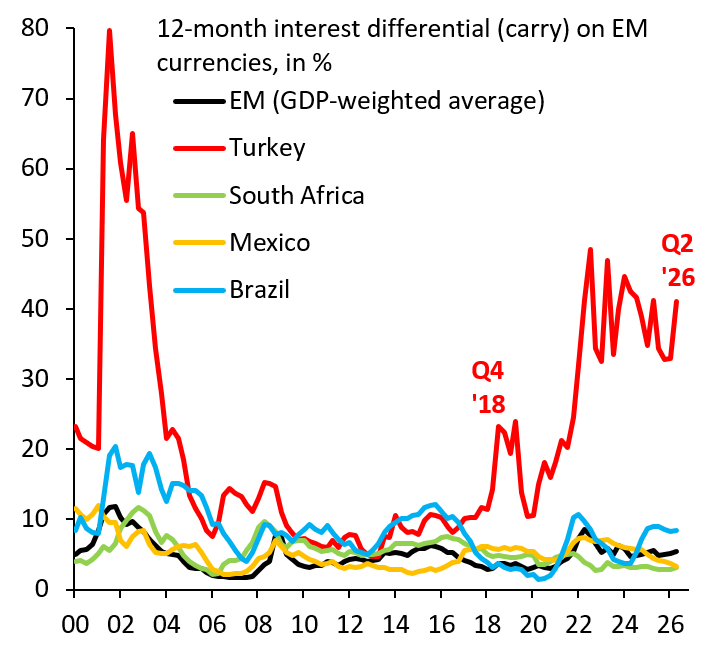
The price Turkey pays for Erdogan's relentless push to stay in power is sky-high interest rates that have taken the country back to the early 2000s. Interest rates these days are far above Turkey's EM peers and we're closing in on a full decade of this...
https://t.co/ipBGkf9GSC
Let me tell you how it happened. Nigeria’s ginger export hit zero from N26 billion within 3 years.
The official story blames fungal blight.
But here is what actually happened. When Nigerian farmers lost their indigenous seed supply, grant-aided interventions arrived with replacement seeds.
An associate professor at Lagos Business School flagged publicly that some of those interventions involved GMO organisms that weakened indigenous crops and compromised soil health.
That is not a conspiracy theory because it is a documented academic concern.
Now that Nigeria spoke got destroyed by the GMO seedlings….what is not the result?
Nigeria was forced to import ginger from China to fill domestic demand. Chinese ginger has none of the pungency, oleoresin content, or quality that made Nigerian ginger a global premium product. And the ginger now sitting in Nigerian markets tastes like wood because it essentially is wood.
The two indigenous varieties that built Nigeria’s global ginger reputation, the Tafin Giwa and Yatsun Biri, had decades of soil relationship and quality built into them.
Once the soil was degraded and those seed varieties were displaced, the product that returned was a pale imitation. Nigeria did not just lose a market. It lost a seed. And without a National Ginger Seed Bank, which nobody has built, it may never fully get it back.
Controversial take ⚠️: Was chatting with a very experienced big tech recruiter from the Valley and one thing he said stuck with me.
Big tech companies rarely let go of their true top performers voluntarily. Most movement at that level usually happens through massive compensation jumps or very strategic opportunities beyond normal bands.
A lot of the circulation in the market is often average to below-average performers moving around repeatedly.
And over time, companies also start realizing that many of their strongest performers internally aren’t necessarily the ones coming from big tech backgrounds.
Wouldn’t be surprised if this “big tech tag” fever reduces significantly over the next few years.