Gamification, Serious Games, Augmented Reality, Virtual Reality, Mixed Reality, Immersive Technology, Digital Health, AI, Innovation the Age of Implementation™
@RKOZBOY @burrosavic @dystopian_DU I have a mini-stroke after the first AZ covid injection. The side effects have resulted in high platelets level over 1K and essential thrombocytosis. The private haematologist I see, his saying its is common with an increase in cancers
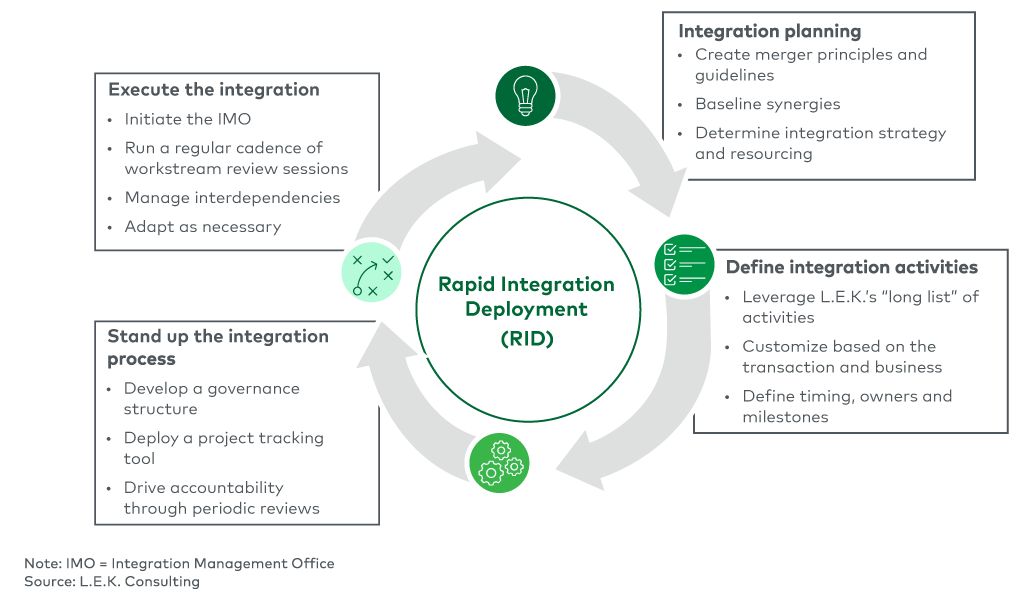
Your acquisition integration plan can fail while every milestone still appears on time.
L.E.K.'s midmarket framework separates planning, defining activities, establishing the process and execution.
The resource conflict deserves the same attention as the timetable. An account manager may be expected to retain customers, migrate accounts and deliver cross-selling while still carrying the original workload.
Decide which work gets cover, which is sequenced and which needs dedicated responsibility. The integration plan should show how the existing customer base will continue to be served.
Source: L.E.K. Consulting, “Rapid Integration Deployment: Realizing M&A Potential”
@RLDI_Lamy@sulefati7@ILoveBooks786@Corix_JC@FrRonconii@Nicochan33@faryus88@ramonvidall@ozsilverfox@jameslhbartlett@dinisguarda@PatrickCFOD@Eli_Krumova@BCAgroup@ricardo_ik_ahau@timo_vi@violetainsights@DioOmega@66Iot
Would you pay an AI supplier for an answer sent, a case resolved, or a customer problem that stays solved?
Those are three different products.
Simon-Kucher's pricing framework distinguishes the role of human work from the value delivered. Consider an AI support service:
1. Access pricing pays for availability.
2. Usage pricing pays for activity.
3. Outcome pricing pays for a defined result.
The difficulty sits in that last definition. Who checks completion? What happens when a customer returns? Which exceptions still need people?
Outcome pricing can align incentives only when buyer and vendor can verify the same result.
Source: Simon-Kucher, “A how-to guide to monetizing GenAI and AI agents”
@RLDI_Lamy@sulefati7@ILoveBooks786@Corix_JC@FrRonconii@Nicochan33@faryus88@ramonvidall@ozsilverfox@jameslhbartlett@dinisguarda@PatrickCFOD@Eli_Krumova@BCAgroup@ricardo_ik_ahau@timo_vi@violetainsights@DioOmega@66Iot
An AI workflow can remain technically impressive after its business case has stopped working.
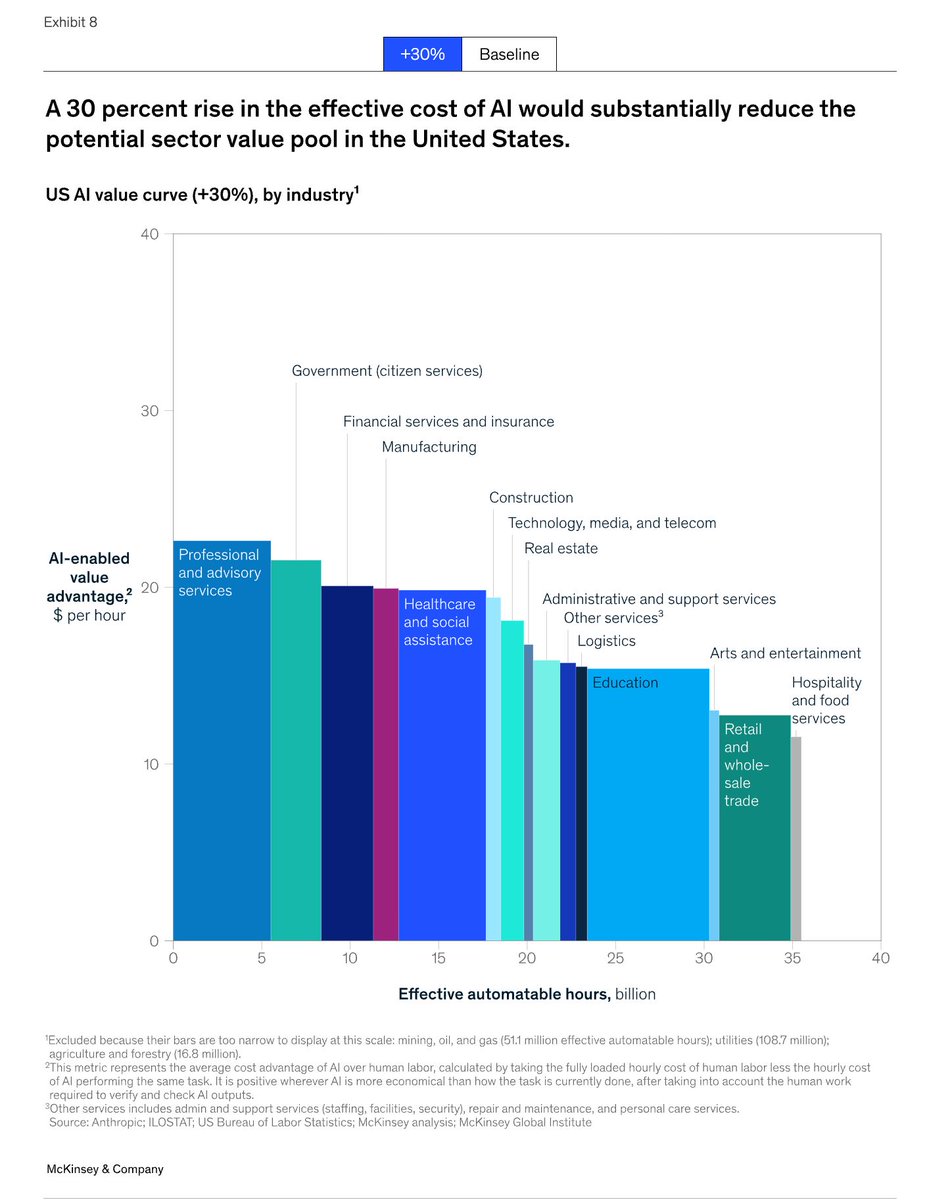
McKinsey's value-curve analysis tests a 30% rise in effective AI cost. In its US model, the estimated annual value pool falls from $960 billion to $640 billion.
That is a sensitivity scenario, not a forecast. The model's potential value also differs from returns a company will actually capture.
The commercial lesson is to test the margin between the current workflow and the AI-enabled alternative. A use case that only just pays under today's assumptions deserves a different commitment from one with room for higher costs.
A business case should show the conditions under which it stops paying, alongside the result under its preferred assumptions.
Source: McKinsey & Company, “The AI value curve: The economics of applying AI to existing work”
@RLDI_Lamy@sulefati7@ILoveBooks786@Corix_JC@FrRonconii@Nicochan33@faryus88@ramonvidall@ozsilverfox@jameslhbartlett@dinisguarda@PatrickCFOD@Eli_Krumova@BCAgroup@ricardo_ik_ahau@timo_vi@violetainsights@DioOmega@66Iot
A European public-sector buyer is interested in your AI product. A manufacturer is ready to pay for a pilot. You have one engineering team.
The larger buyer wants to know who can access its contracts and who can keep the service running if the model provider goes offline. EU hosting tells you where the contracts sit. You still need to trace who handles model requests and support logs.
Before moving the team off the paid pilot, ask what would block the public buyer’s approval and whether a second buyer would pay for the same setup. That’s how you tell whether a separate deployment could open a market.
#DigitalSovereignty #CloudComputing
Read “Who Controls Your AI in Europe?” on Medium:
https://t.co/G27LyVmPKw
@RLDI_Lamy@sulefati7@ILoveBooks786@Corix_JC@FrRonconii@Nicochan33@faryus88@ramonvidall@ozsilverfox@jameslhbartlett@dinisguarda@ricardo_ik_ahau@timo_vi@violetainsights@DioOmega@66Iot@PatrickCFOD@BCAgroup
A digital-first buying journey can work brilliantly for one B2B customer and frustrate another.
McKinsey's 2026 Global B2B Pulse identifies three segments:
1. Adapters (53%): more relationship-oriented.
2. Seekers (29%): comfortable across channels.
3. Innovators (18%): more technology-oriented.
The spending gap matters. In the survey, 61% of Seekers would spend $500,000 or more online, versus 18% of Adapters.
For commercial leaders, the opportunity is choice without chaos: self-service when buyers want it, expert support when they need it, and consistent terms across both.
A single digital journey is rarely a complete commercial strategy.
Source: McKinsey & Company, “The surprising economics of B2B growth: The new survival threshold—and what it takes to thrive”
@RLDI_Lamy@sulefati7@ILoveBooks786@Corix_JC@FrRonconii@Nicochan33@faryus88@ramonvidall@ozsilverfox@jameslhbartlett@dinisguarda@PatrickCFOD@Eli_Krumova@BCAgroup@ricardo_ik_ahau@timo_vi@violetainsights@DioOmega@66Iot
The shady dealings run rife and a clear pattern of allegations against Albanese is emerging -
• Farley offered a 200k staffer
• Payman offered extra staff for a Senate vote
• Ley offered more staff for backing the FOI bill.
Dirty politics which obfuscates the voice of the people.
If these claims are true he should resign before he is pushed out.
No wonder only one in five voters trust him.
A $6 trillion AI market scenario is a financing requirement, not evidence that customers will spend $6 trillion.
Bain estimates that annual AI infrastructure spending could reach $1.5 trillion by 2031. Assuming capital expenditure equals about 25% of industry revenue, sustaining that investment would require an annual AI market approaching $6 trillion.
The assumptions matter. This is a conditional economic requirement, not secured revenue.
For a B2B founder, the useful question sits much closer to the customer: which valuable activity becomes possible, who controls the budget and what would they stop buying to fund it?
Infrastructure investment creates capacity. A commercial strategy still has to establish why someone will pay to use it.
Source: Bain & Company, “New Innovation Is Required to Fund AI’s $6 Trillion Buildout”
@RLDI_Lamy@sulefati7@ILoveBooks786@Corix_JC@FrRonconii@Nicochan33@faryus88@ramonvidall@ozsilverfox@jameslhbartlett@dinisguarda@PatrickCFOD@Eli_Krumova@BCAgroup@ricardo_ik_ahau@timo_vi@violetainsights@DioOmega@66Iot
Open AI models are catching up. That makes switching costs part of the model-buying decision.
Bain's capability chart shows open models narrowing the benchmark gap with proprietary models. That expands the alternatives worth testing; it does not establish that the models are interchangeable in a specific workflow.
For a B2B service, compare candidates against the same customer tasks, quality threshold and cost of handling failures. Include the work required to change providers.
The purchasing decision then becomes more concrete: where does superior performance justify a premium, and where can a less expensive model meet the requirement?
Model choice should follow the workload.
Source: Bain & Company, “The AI-Native Enterprise: Absorption Is the New Advantage”
@RLDI_Lamy@sulefati7@ILoveBooks786@Corix_JC@FrRonconii@Nicochan33@faryus88@ramonvidall@ozsilverfox@jameslhbartlett@dinisguarda@PatrickCFOD@Eli_Krumova@BCAgroup@ricardo_ik_ahau@timo_vi@violetainsights@DioOmega@66Iot
‘While David Jones is only one company, it is another established business that has survived wars and plagues since 1838 but looks defeated by an increasingly stagnant economic landscape and shifting consumer behaviour.
Imagine surviving the Spanish flu only to get the kiss of death from economic illiterates Airbus Albo and Grim Jim.’
Me for @News24Aust
A larger sales pipeline will not fix a value proposition that customers struggle to distinguish from competitors.
Bain's 2026 survey of 1,125 B2B companies found that those with clear, consistently communicated value propositions reported 19% revenue growth, compared with 12% for companies with limited or inconsistent ones.
Yet only 4% considered their value proposition strong.
The commercial problem often begins before the sales conversation.
If product, marketing and sales disagree on who the ideal buyer is, why that buyer should choose them and what evidence supports the claim, increasing outreach simply spreads the inconsistency.
Before investing more in demand generation, leadership teams should test whether they can independently explain the same customer value proposition.
The findings show an association, not proof of causation. But they highlight a frequently overlooked growth priority: aligning commercial execution around a differentiated offer.
Source: Bain & Company, “Unclear Value Propositions Stall Growth”
@RLDI_Lamy@sulefati7@ILoveBooks786@Corix_JC@FrRonconii@Nicochan33@faryus88@ramonvidall@ozsilverfox@jameslhbartlett@dinisguarda@ricardo_ik_ahau@timo_vi@violetainsights@DioOmega@66Iot@PatrickCFOD@Eli_Krumova@BCAgroup
@RayeCharles Nice weather in Adelaide. Concern about the upcoming cardio ablation another one. The races should be on one channel not surfing to watched Sydney & Melbourne this week
@NicolleFlint
“Customers like the demo” leaves several launch questions unanswered.
Who funds the purchase? What are they paying for? What must change before they can use it?
Hg's Catalyst blueprint runs pricing, sales preparation and early-access customer confirmation alongside AI product development.
That is a useful sequence: test the purchase and adoption path while the product can still change. Early feedback should influence packaging, scope and launch readiness, rather than arrive after technical completion has become a fixed deadline.
This is Hg's operating blueprint, not independent evidence of launch success.
Source: Hg, “AI-first value creation”
@RLDI_Lamy@sulefati7@ILoveBooks786@Corix_JC@FrRonconii@Nicochan33@faryus88@ramonvidall@ozsilverfox@jameslhbartlett@dinisguarda@ricardo_ik_ahau@timo_vi@violetainsights@DioOmega@66Iot@PatrickCFOD@Eli_Krumova@BCAgroup
@robwade91225@HenryLawson55 I when to an ER and they could not do an ECG, public hospitals waiting time. That day I blackout and taken to the ER by ambulance 🚑 Told to go home rang the private cardiologist and she managed too do an ECG. The heart was in AF
That bloody green card that Bulter & Albo wave around as the only card you needs to see a doctor. $1008 this week with appointments. It's as useless as tits on a bull 🐂 with a chronic illness you need a regular doctor, not different one every time. @robwade91225@HenryLawson55