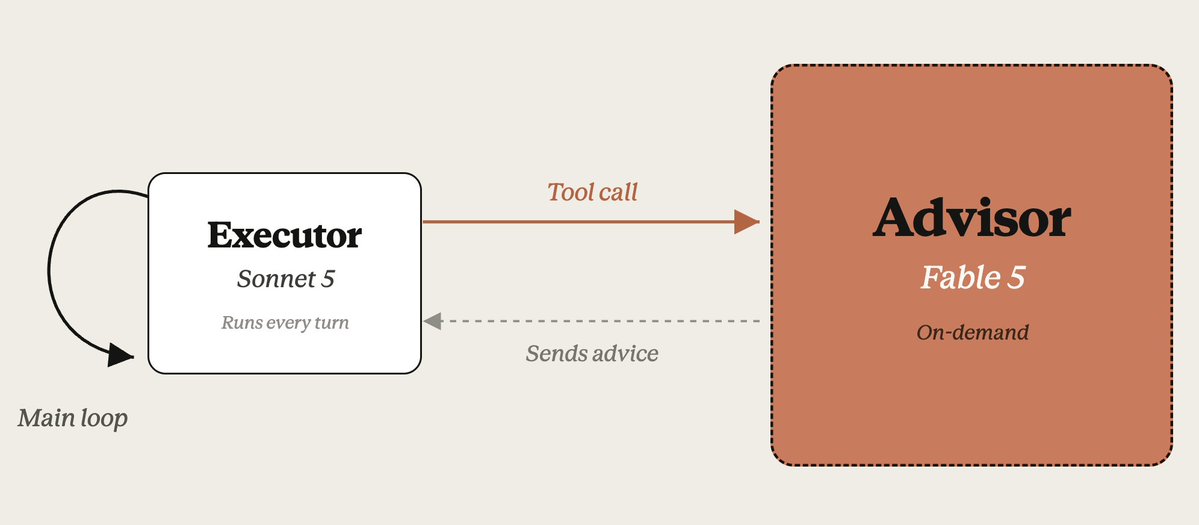
This feels like the future of AI agents.
Instead of throwing the biggest model at every task, use a fast executor and call a stronger reasoning model only when needed.
Better latency, lower cost, and often better architecture.
A few patterns we frequently use with Fable 5:
Use Fable 5 as an "advisor."
An executor (Sonnet 5) calls Fable 5 for guidance.
Most tokens are billed at the lower executor rate.
Curious what everyone is using as their Expo boilerplate in 2026.
Are you starting from:
Expo template
Ignite
Solito
A custom internal starter
Something else?
Looking for inspiration 👀
@CarlosBBuild I’m team “whatever gets the job done.” 😂
Codex, Claude, Cursor… they’re all open. If one gets stuck or refuses, I just switch to another.
First 1-minute experiment with Codex + serve-sim + Expo 🚀
Codex is inspecting and interacting with a live iOS Simulator stream running my Expo app.
No custom setup. No complicated tooling.
This feels surprisingly close to having an AI mobile tester for app development.
Curious how others are using this workflow today.
Huge shoutout to @Baconbrix@OpenAIDevs 👏
@OpenAIDevs Can we build a personal QA tester for mobile apps with Codex + serve-sim?
It already feels possible for React Native apps.
Curious about the best workflow and real cost/token usage.
More of the iOS app loop, now inside Codex.
The Build iOS Apps plugin lets Codex view and test your iOS app in the in-app browser, open SwiftUI previews, and hot reload edits without leaving Codex.
For teams starting a new React Native project in 2026:
• Expo UI
• React Native Reusables
• Tamagui
• NativeWind + custom components
• Something else
What are you betting on and why? 👀
#reactnative#expo
@expo We’re not just building with Expo anymore, we’re building businesses on top of it. Any chance the community will be able to invest in Expo one day? 🚀