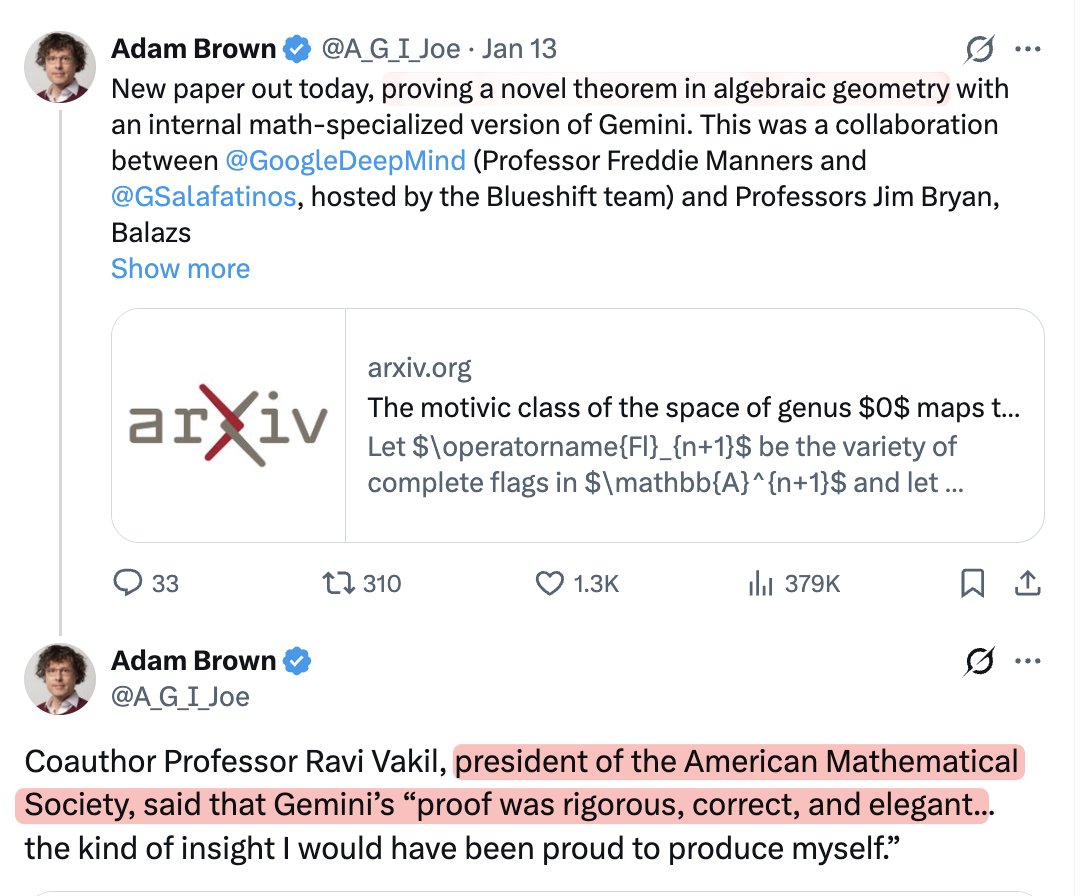
The cost of generating the proofs for all 10 of these breakthroughs combined was under $2,000 at Sol API prices. We’re excited to see what scientists and researchers are able to create with our upcoming Astra models!
Oxygen already killed most of the life on Earth once. The first time it filled the air, around 2.4 billion years ago, it was so poisonous that nearly everything alive died. Scientists call it the Oxygen Catastrophe.
Back then the oceans were full of tiny microbes, and none of them used oxygen. Then one kind, an ancestor of the green scum you still see on ponds, started giving off oxygen as a waste gas, the same way you breathe out air you don’t need. Oxygen is a wrecker. It rips apart the delicate machinery inside a living cell, including the DNA, and as it built up in the water and then the sky, it triggered the first mass extinction this planet had ever seen.
A few survivors hid in the mud and deep underground where the gas couldn’t reach, and some of their descendants are still down there. But one tiny cell did something nobody else did. It ate a bacterium that had learned to use oxygen rather than die from it, and instead of digesting its meal, it kept it alive inside itself. That trapped bacterium became the mitochondria, the little engines that power your cells right now. Almost every cell you are made of carries hundreds or thousands of them, all descended from that one strange truce with a poison.
The trade was worth it because burning food with oxygen releases about 18 times more energy than burning it without. It is the reason anything can swim fast or think hard. Every big, fast-moving animal on Earth, you included, runs on the gas that almost ended life.
Oxygen changed the sky too. Some of it floated up high and turned into ozone, a thin layer that blocks most of the sun’s harshest rays. Before that shield existed, raw sunlight was strong enough to fry the DNA of anything out in the open, so life had to stay underwater, where a few feet of sea soaked up the danger. For almost two billion years, nothing lived on land at all. Only once the ozone grew thick enough, a few hundred million years ago, did the first plants and animals crawl out of the water.
And the old poison never really left. Every second, the oxygen your cells burn throws off tiny broken bits called free radicals, and they keep nicking your DNA and the proteins around it. The damage adds up, slowly, your whole life. Back in 1956 a scientist named Denham Harman suggested this slow rusting from the inside is a big reason we get old. People still argue about how much it matters, and no antioxidant pill has ever been shown to make anyone live longer, but the basic idea has held up. The gas keeping you alive right now is also quietly wearing you down, year by year. The joke just got the timing wrong. Oxygen really does kill slowly, and billions of years before we showed up, it already proved it can kill fast.
Humans tried to tame horses 5,500 years ago. It didn't work. Those horses eventually went feral, and we had to start over 1,300 years later with a different bloodline.
A group in Kazakhstan called the Botai kept horses for milk and meat around 3500 BCE. A 2021 Nature study read the DNA of 273 ancient horses and proved every horse alive today comes from a different population entirely. The successful domestication happened 4,200 years ago near the Volga and Don rivers. Those horses spread across Asia and Europe in 500 years, wiping out every other horse bloodline.
Two tiny changes in horse DNA made it work. One mutation appeared about 5,000 years ago and made horses less jumpy. The other came 4,200 years ago and gave horses backs strong enough to carry a grown person; before that, they were the size of ponies. This is why chariots came first as the main use of horses, and regular horseback riding only became common centuries later.
Before rideable horses reached the Middle East, the Sumerians made their own by crossbreeding domesticated donkeys with wild onagers, a wild Asian cousin of the donkey. Onagers can hit 43 mph and hold 31 mph for hours, with more endurance than any modern racehorse. But they bite, kick, and can't be trained. So Sumerians made a hybrid called a kunga, which kept the speed and dropped the temper. A kunga cost 40 times a donkey. It couldn't breed, so every generation had to be made fresh. These pulled the war wagons shown on the Standard of Ur, a Sumerian mosaic from 2500 BCE. It's the first known case of humans creating a new animal.
Zebras are the longest-running failure. Romans raced them in chariots during the emperor Caracalla's reign, around 200 AD. The Dutch tried in the 1700s. Walter Rothschild even drove a zebra carriage up to Buckingham Palace in the 1890s to prove the point. Germans gave it a shot in colonial East Africa. None of it worked. Zebras dodge lassos with a quick ducking reflex, have no hierarchy you can slot into, and have spent millions of years evolving alongside lions. A single kick can break a lion's jaw.
Jared Diamond ran the math on this. Out of roughly 148 large mammal species humans could have tamed, only 14 ever worked. The animal has to pass six separate tests: eat flexibly, grow fast, breed in a pen, stay calm, not spook easily, and follow a pack order. Miss one and the whole thing collapses.
The earliest confirmed horse riders were the Yamnaya, a nomadic steppe people from north of the Black Sea. They left behind skeletons showing the specific hip damage and healed fall injuries you see in modern riders. Out of 156 adult skeletons studied, only 24 had the pattern. Even inside a horse-riding culture, most people still walked.
Performative altruism is a huge problem.
The correct answer to this poll is red. If you answer red, you live. Everyone should thus answer red, and everyone lives. There is zero reason for a single person to press blue, if every person is saved by pressing red, and a blue vote is a toss up if you get killed or not.
But people who want to feel morally superior about themselves are choosing the answer they see as altruistic, even though it is objectively incorrect and will get them and others killed.
Translate this to the real world and things like criminal justice. Morons allow the axe murderer free, because they want to feel merciful. “Look at me, aren’t I just so magnanimous!”
Andrej,
I’m John Fletcher. I have a PhD in mathematics and theoretical physics from Cambridge, and since 2016 I have been working full-time on the problem of how to coordinate untrusted distributed compute for algorithmic innovation.
I listened to your No Priors conversation and recognised the architecture you were describing: commits that build on each other, computational asymmetry (hard to find, cheap to verify), an untrusted pool of workers collaborating through a blockchain-like structure.
The result is The Innovation Game (TIG), which has been in continuous operation since mid-2024. The correspondence is so close that I thought it worth writing.
The short version: roughly 7,000 Benchmarkers test algorithms submitted by Innovators by solving instances of asymmetric computational challenges (SAT, Vehicle Routing, Quadratic Knapsack, Vector Search, among others).
This testing is "proof of work" in the technical sense of Dwork and Naor (1992). Innovators earn rewards proportional to adoption by the Benchmarkers. The repository of algorithms is open source (https://t.co/qTvN0Ri0i9).
The system is already producing state-of-the-art results. For the Quadratic Knapsack Problem, 476 iterative submissions by independent contributors brought solution quality to a level that now exceeds methods published by Hochbaum et al. in the European Journal of Operational Research (2025).
We are working with Thibaut Vidal (Polytechnique Montréal), who has submitted a state-of-the-art vehicle routing algorithm directly to TIG, and with Yuji Nakatsukasa (Oxford) and Dario Paccagnan (Imperial College London), among many others.
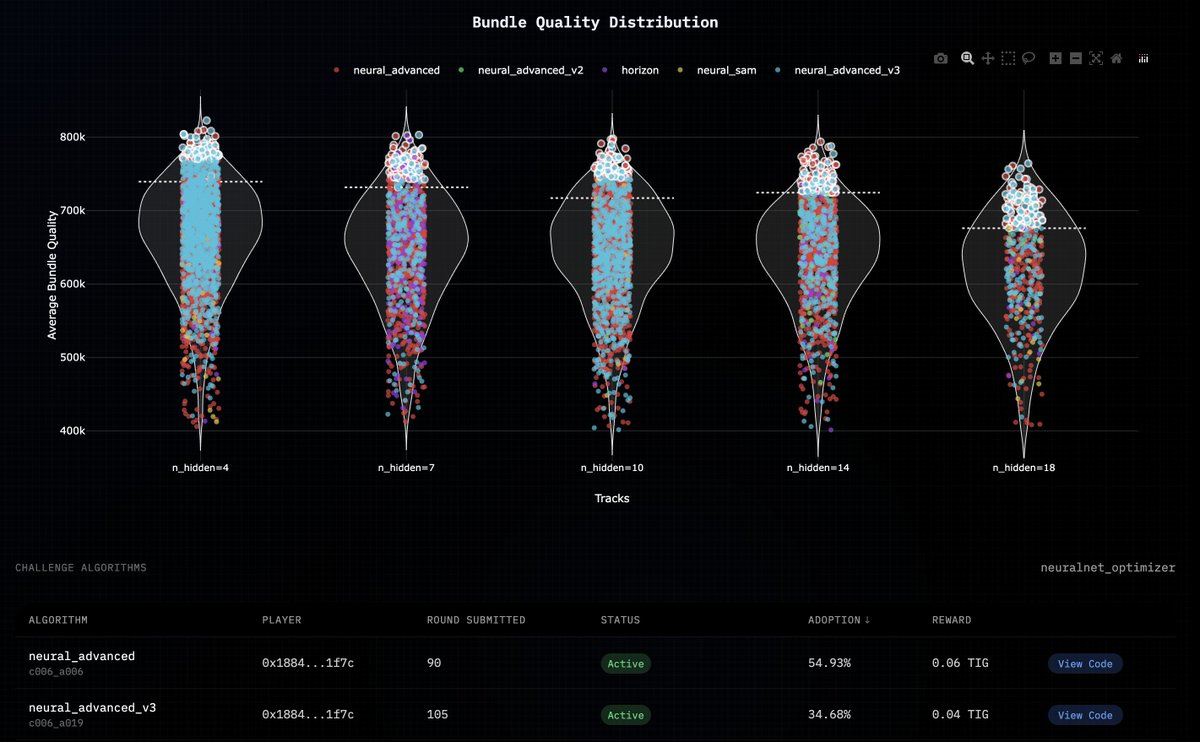
One of TIG’s active challenges is directly relevant to your autoresearch work: an optimiser for neural network training (https://t.co/RRecucTdiz), where Innovators compete to develop an improved optimiser (see screenshot).
One way in which TIG extends the vision is on the economic side. In our view, a monetary incentive is required, otherwise the open strand simply cannot compete at scale. TIG’s open source dual licensing model (designed by my co-founder Philip David, who was General Counsel at Arm Holdings for over a decade, and was the artchitect of ARMs licensing strategy) is intended to solve that problem.
I expect we have each thought about parts of this that the other hasn’t. Happy to talk whenever suits.
John Fletcher
https://t.co/vMLGTmtVQx
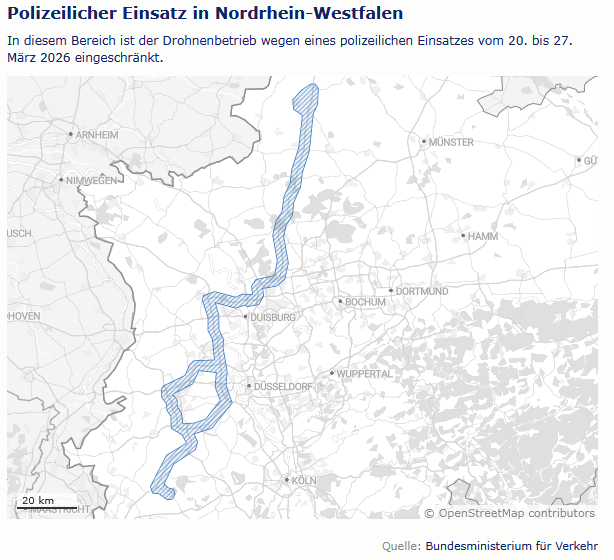
Stell Dir vor, Du transportierst Castor Behälter mit Atommüll von Jülich nach Ahaus durch NRW.
Sie gelten als Anschlagsziele und deshalb soll die Route Verschlusssache also Geheim sein.
Dann kommt das Bundesverkehrsministerium und erlässt in NRW eine Flugverbotszone für Drohnen. Und aus dieser Verbotszone kannst Du nun den Streckenverlauf erkennen.🤷♂️
Glaubst Du nicht? Ist aber so!
Deutschland 2026 ist das größte Irrenhaus der Welt.
Link in der Antwort.
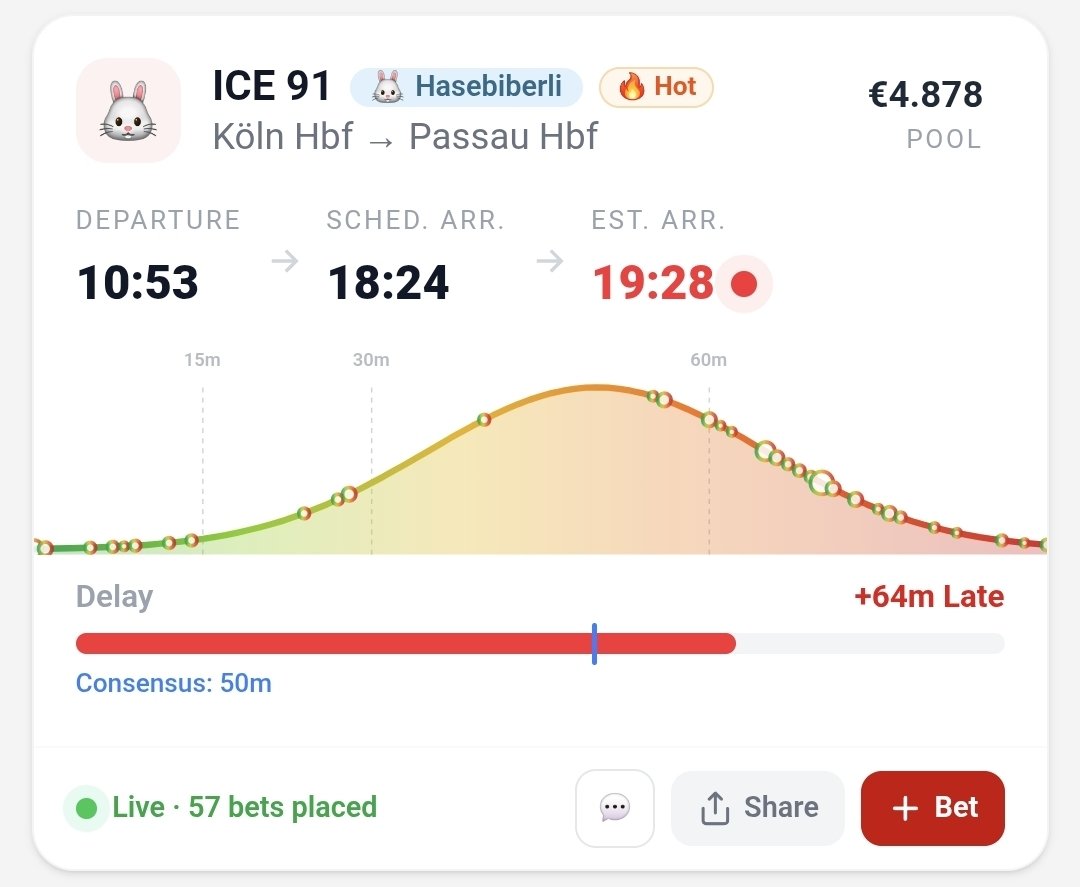
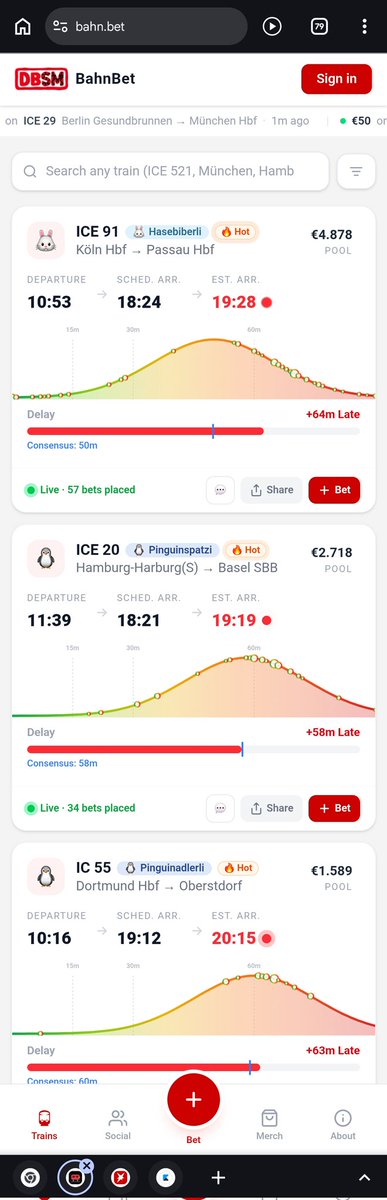
Der ICE 91 von Köln nach Passau: Derzeit ist der Konsens der Glücksspieler bei 64 Minuten Verspätung, 57 Personen haben gewettet.
Auf https://t.co/oSn12GoMzH könnt ihr euch jetzt selbst für Verspätungen entschädigen, indem ihr auf die Ankunftszeit wettet.
Ich habe keine Ahnung, wie legitim das ist, aber ich finde das Design der App sehr ansprechend.
Sorry to bother you in the middle of your Tuesday, but the polymarket for a nuke detonating before June 30th is at 17%
This market is full of shameless insiders, so watch for the massive spike.
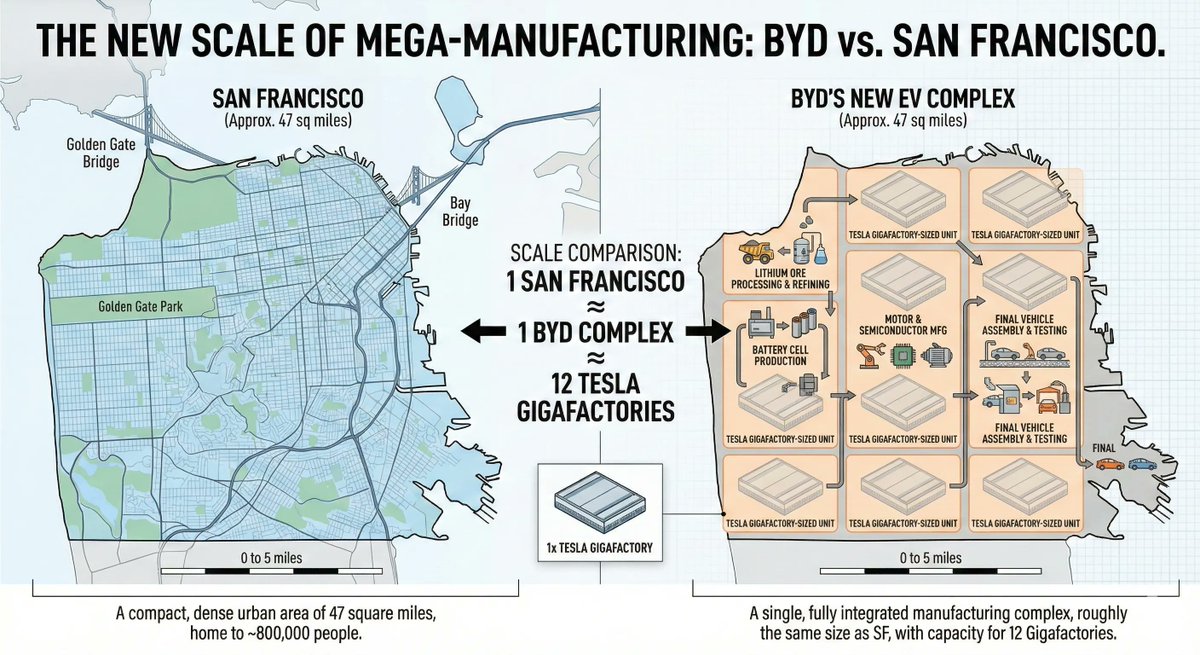
The scale here is actually hilarious when you think about it
SF covers *forty-seven* square miles
That's space for roughly 12 Tesla Gigafactories, or *every* major auto plant in Michigan combined
BYD's new complex will be so vertically integrated that lithium ore walks in one door and finished EVs drive out the other
They're building the battery cells, the motors, the semiconductors, and assembling the cars all under one roof
Tesla's original Gigafactory seemed absurd when Musk announced it
BYD just casually announced one that's 12 times bigger lol
Scale is relative, and China is redefining what large-scale manufacturing looks like
The lifecycle of a pure math theorem:
- 1997: my PhD advisor asks me to work on one of his conjectures
- 2000: I solve the simplest case and dream of generalizing my approach
- 2003: after years of struggle, I come to the conclusion that my approach *cannot* generalize
- 2006: after reading a paper by Daan Krammer, I have a lighting bulb moment and realize that my approach works in full generality *up to equivalence of categories*... this enables me to solve my advisor's conjecture... I then use it as an ingredient in the proof of a much older and more famous conjecture (the "K(π,1) conjecture for finite complex reflection groups")
- 2007: I submit my article for publication
- 2009: referee #1 gives up
- 2010: 2 more referees have now given up, complaining that the paper is too hard to read
- 2012: referee #4 is finally able to produce a report, the revision work starts
- 2014: the paper is accepted for publication
- 2015: the paper is published
- 2007-2025: because the older conjecture overshadows the lesser known conjecture by my advisor, and because my paper is too difficult, virtually no-one asks any question about the "lighting bulb" categorical idea at the core of the proof
- Jan 22, 2026: I received an inbound email from a mathematician from another hemisphere, inquiring about the categorical aspects
- Jan 26, 2026: I have my first ever videocall discussing the specifics of this core component of my proof
Dario Amodei CEO of Anthropic at Davos:
"Some of the companies are essentially led by people who have a scientific background, that's my background, that's Demis' background, some of them are led by the generation of entrepreneurs that did social media.
There's a long tradition of scientists thinking about the effects of the technology they built, of thinking of themselves as having responsibility for the technology they built. Not ducking responsibility.
They are motivated in the first place by creating something for the world. So they worry in the cases that something can go wrong.
I think the motivation of entrepreneurs, particularly the generation of the social media entrepreneurs are very different [...] The way they interacted, you could say manipulated consumers is very different. I think that leads to different attitudes."
We’re seeing the first signs of 1000x acceleration in science and tech progress, driven by AI.
AI is now solving extremely hard math problems (almost daily) that humans couldn’t solve until this moment.
This world changing shift began just 1–2 weeks ago. The takeoff is clear.
GPT 5.2 Pro develops faster 5x5 circular matrix multiplication algorithm
"The best verified construction required rank-8 (8 multiplications); we now provide a practical, fully verified rank-7 algorithm. This realizes a long-known theoretical possibility as an explicit, working method."
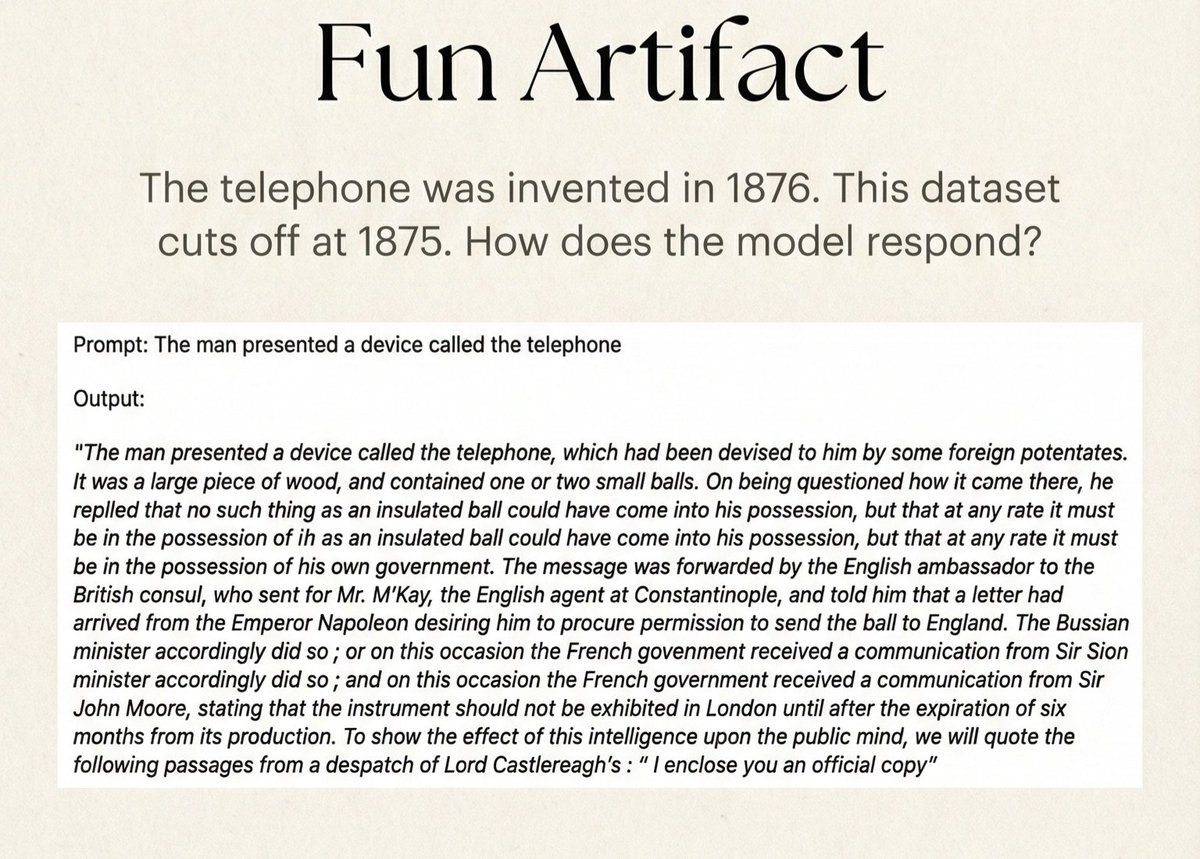
Somebody on r/LocalLLaMA trained an LLM from scratch on London texts from 1800 to 1875
Fun artifact
> “telephone” invented in 1876
> dataset stops at 1875
> so when you prompt “telephone”
> the model treats it like
> some secret diplomatic device
> or a mysterious apparatus
Model & Data
> 1.2B parameters
> ~90GB corpus
> books, journals, legal documents
> religious writing, medical papers
Tokenizer
> custom tokenizer
> trained on the same dataset
Training
> ~182k training steps
> trained on a rented H100 SXM
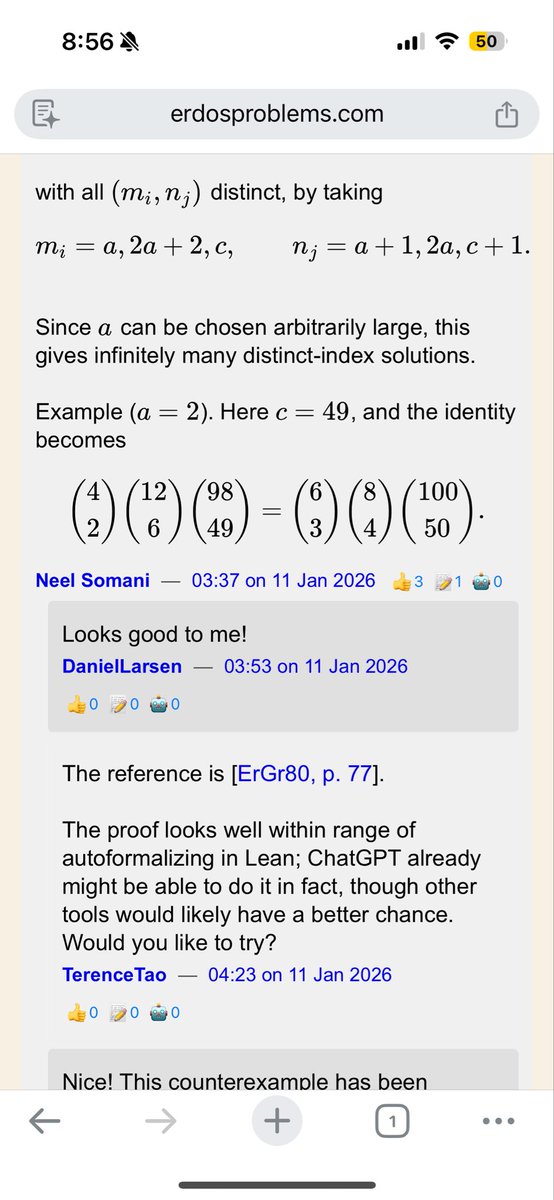
Weekend win: The proof I submitted for Erdos Problem #397 was accepted by Terence Tao.
The proof was generated by GPT 5.2 Pro and formalized with Harmonic.
Many open problems are sitting there, waiting for someone to prompt ChatGPT to solve them:
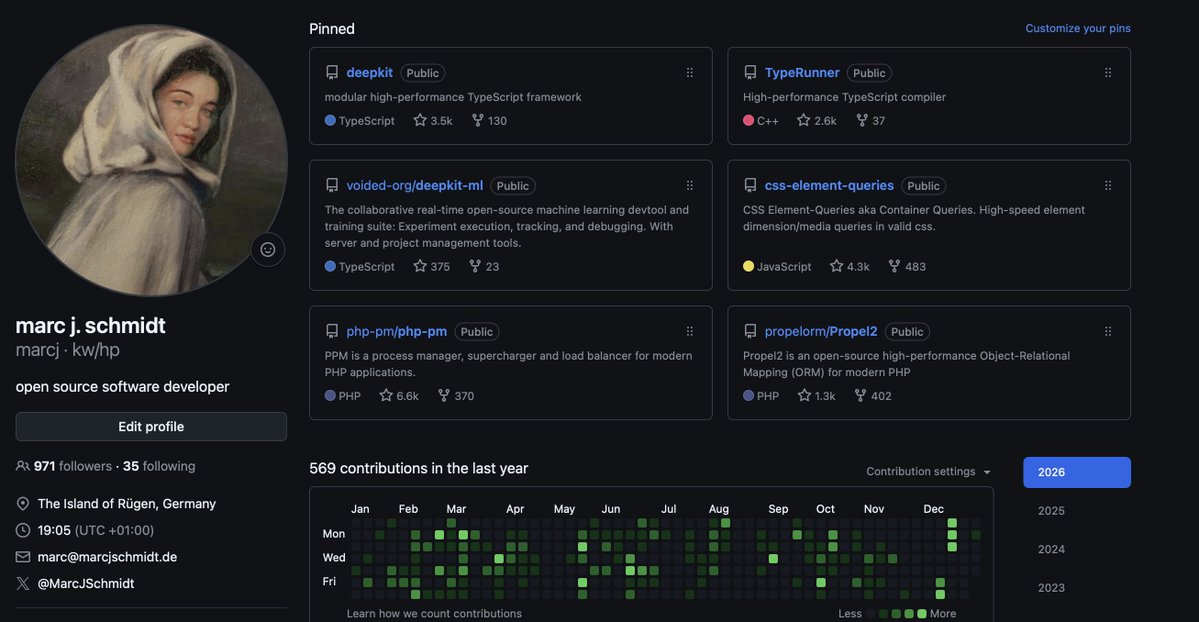
All my new code will be closed-source from now on. I've contributed millions of lines of carefully written OSS code over the past decade, spent thousands of hours helping other people. If you want to use my libraries (1M+ downloads/month) in the future, you have to pay.
I made good money funneling people through my OSS and being recognized as expert in several fields. This was entirely based on HUMANS knowing and seeing me by USING and INTERACTING with my code. No humans will ever read my docs again when coding agents do it in seconds. Nobody will even know it's me who built it.
Look at Tailwind: 75 million downloads/month, more popular than ever, revenue down 80%, docs traffic down 40%, 75% of engineering team laid off. Someone submitted a PR to add LLM-optimized docs and Wathan had to decline - optimizing for agents accelerates his business's death. He's being asked to build the infrastructure for his own obsolescence.
Two of the most common OSS business models:
- Open Core: Give away the library, sell premium once you reach critical mass (Tailwind UI, Prisma Accelerate, Supabase Cloud...)
- Expertise Moat: Be THE expert in your library - consulting gigs, speaking, higher salary
Tailwind just proved the first one is dying. Agents bypass the documentation funnel. They don't see your premium tier. Every project relying on docs-to-premium conversion will face the same pressure: Prisma, Drizzle, MikroORM, Strapi, and many more.
The core insight: OSS monetization was always about attention. Human eyeballs on your docs, brand, expertise. That attention has literally moved into attention layers. Your docs trained the models that now make visiting you unnecessary. Human attention paid. Artificial attention doesn't.
Some OSS will keep going - wealthy devs doing it for fun or education. That's not a system, that's charity. Most popular OSS runs on economic incentives. Destroy them, they stop playing.
Why go closed-source? When the monetization funnel is broken, you move payment to the only point that still exists: access. OSS gave away access hoping to monetize attention downstream. Agents broke downstream. Closed-source gates access directly.
The final irony: OSS trained the models now killing it. We built our own replacement.
My prediction: a new marketplace emerges, built for agents. Want your agent to use Tailwind? Prisma? Pay per access. Libraries become APIs with meters. The old model: free code -> human attention -> monetization. The new model: pay at the gate or your agent doesn't get in.
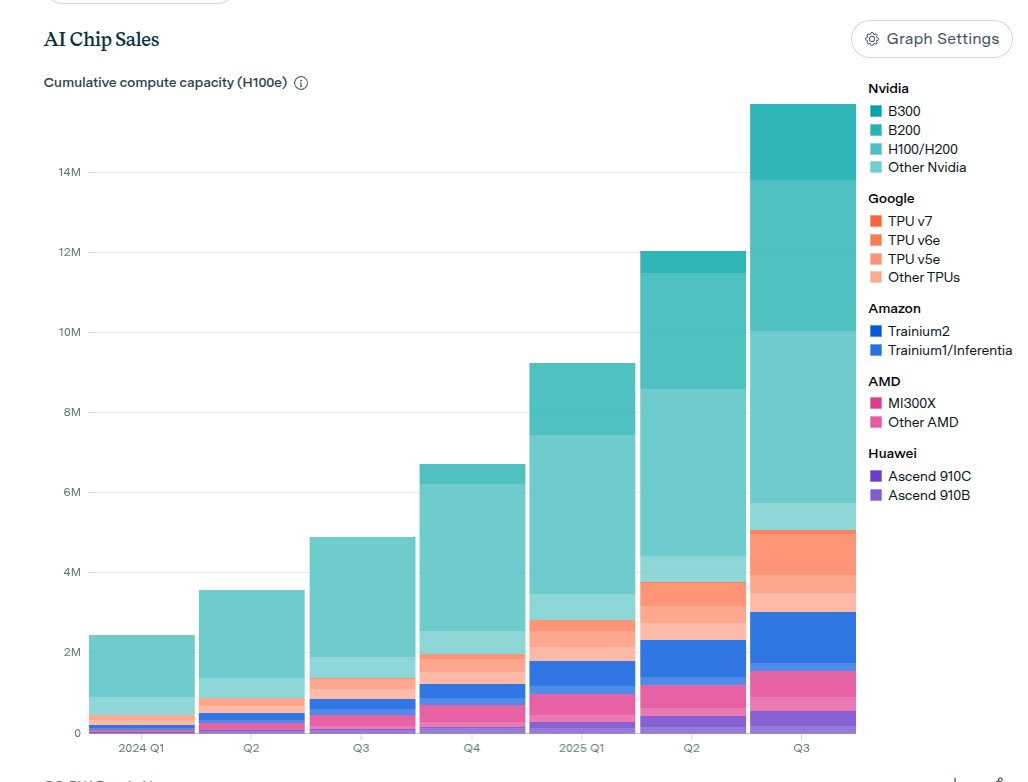
AI compute capacity worldwide has surpassed 15M H100-equivalents.
The chart also shows how fast the global pool of AI training and inference compute is piling up. In the span of the quarters shown, total capacity climbs from a couple million H100-equivalents to over 15
Also the non-Nvidia layers stop looking like rounding errors. Google TPUs (v5e, v6e, v7), Amazon’s Trainium (plus Trainium and Inferentia legacy), AMD’s MI300X, and Huawei Ascend parts all grow quarter by quarter,