We demo SPDMX for source separation and transcription under fixed budgets to show that it is usable alongside Slakh2100 for synthetic training.
Huge thanks to @eduardoescoto_, @zacknovack, & @McAuleyLabUCSD.
📄: https://t.co/i4mCpAAkun
🎧: https://t.co/cp98vy7hfx
🧵5/5
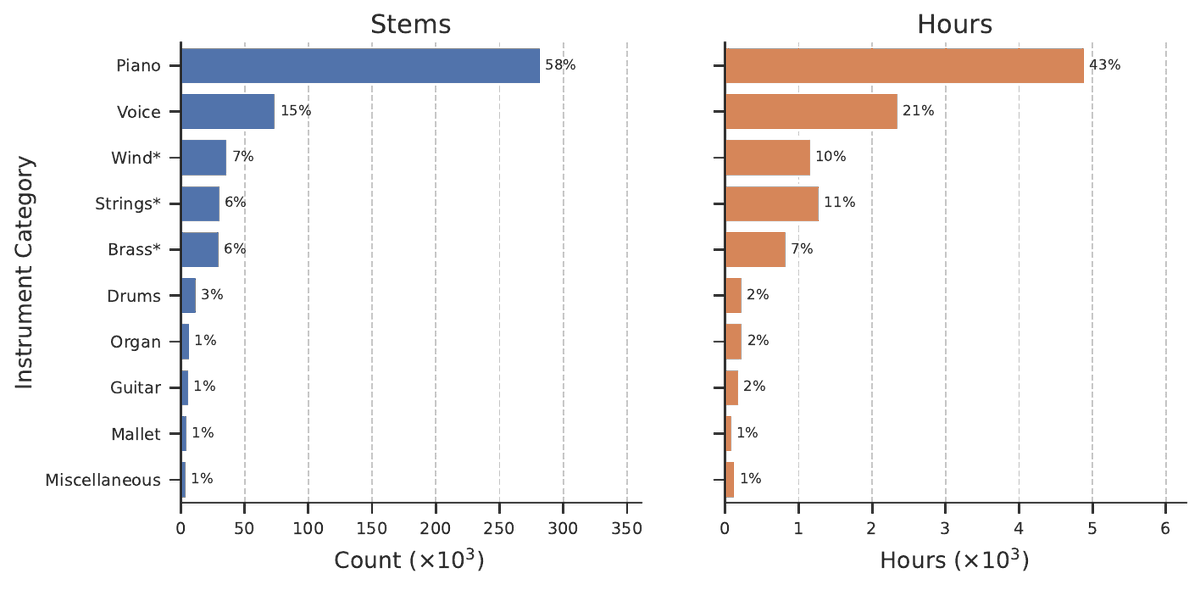
>250k songs, ~490k open stems, paired MIDI.
Presenting SPDMX: open stem audio from the public-domain PDMX dataset (~5.5k song-hours, CC BY 4.0) 🎧
w/ @eduardoescoto_, @zacknovack, @McAuleyLabUCSD
🧵
Proud to have worked on this with @p1long_ . It’s a dense paper! I kept pushing things into the appendix just to keep the main text readable, so if you want the full picture, read past the end. A few things this project changed in how I think:
- Understanding and generation often want different machinery. Decoder-only works for sure, but now we have YOCO-like architectures entering the mainstream, because when stuff needs to be deployed on a large scale, cost does matter. In our work it’s inferring the parameters of an effect ("encoding") vs. running those parameters on arbitrary audio ("decoding".) The two halves have different compute profiles, different error tolerances, and different priors. Therefore:
- For interactivity applications, it is important to separate understanding and generation using, unfortunately, human priors. This cuts against the bitter lesson a little, but I’ve come to believe it in certain domains. We need to make a delibrate decision on where the actual expensive computation happens. In our case it’s completely fine to spend 10000x the compute encoding a representation of a desired effect, as long as applying it at inference is then nearly free. This reminds me of a couple of things (e.g. VAEs for real-time timbre transfer from @neutone_jp etc.) where a computation-expensive part can happen ahead of time to lower the load on inference time. Also for full-duplex systems, I wonder if a general encoding can be done ahead of time to drive a smaller decoding system. This shared, general encoding would then serve as the bridge between "system 1" and "system 2" parts of the system. Perhaps a useful first experiment would be to decode directly from the KV cache of earlier layers of a larger model, and see if a system 1 output module can be directly trained based on parts of system 2.
- If humans can do it, then a well-defined general prior likely exists. Years ago at the University of Rochester I argued with Yujia Yan that it’s “impossible” to infer an effect without knowing the dry signal. He argued a general prior must exist. Turns out he was right.
@yongyi_zang@McAuleyLabUCSD Huge thank you to @yongyi_zang and everyone else on the awesome Smule Labs team for making my time as an intern an amazing experience, from which I grew tremendously.
📄: https://t.co/AAsZ1d75bd
🌐: https://t.co/FVVCCOHm4i
Go play through TAPE yourself!
🧵9/9
We showed a neural net 68 real plugins and never told it what a compressor is. It figured that out anyway.
Presenting TAPE: a general, invertible, readable audio effect representation, real time on one core 🎛️
🧵
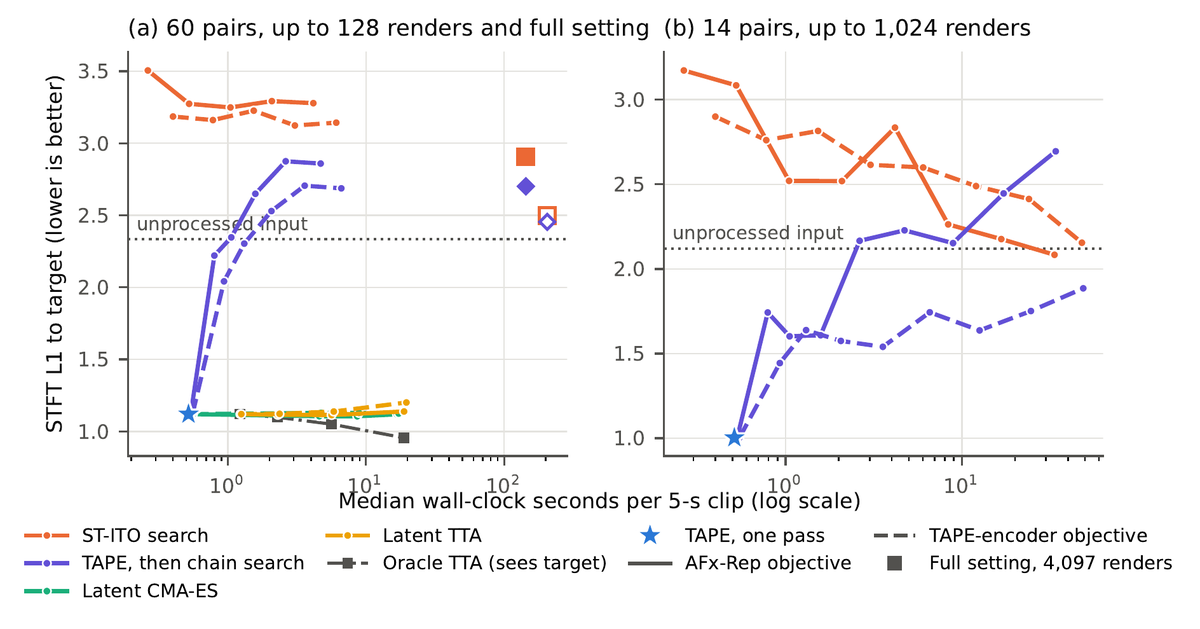
@yongyi_zang@McAuleyLabUCSD TAPE also outperforms both baselines on spectral error — per-example search over ST-ITO's basic chain (4,097 renders) and the released DeepAFx-ST models — while running in a single 0.52s forward pass, 275x faster than the search. 🏎️
🧵8/9
Want to train a model that can sit in on a jazz standard?
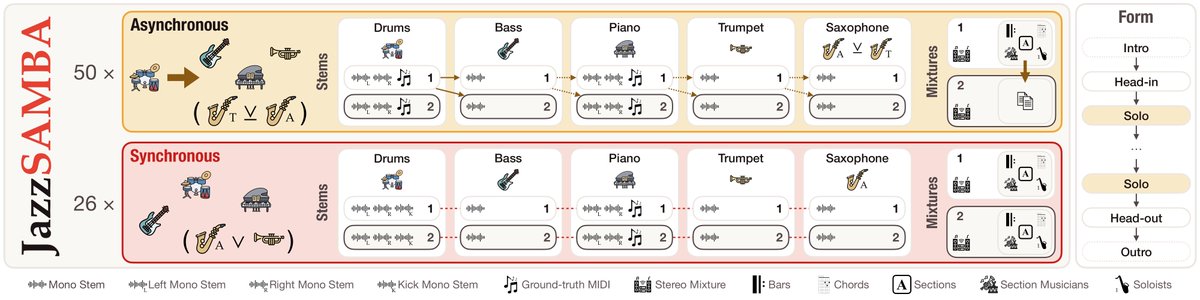
Presenting JazzSAMBA: a dataset of 76 originally recorded combo standards, overdubbed & live, with stems, charts, and solos. 🎷
w/ the band, @nithyaisme, @McAuleyLabUCSD, @huangcza, Stephen Brade, & @aleksandraa_ma
🧵
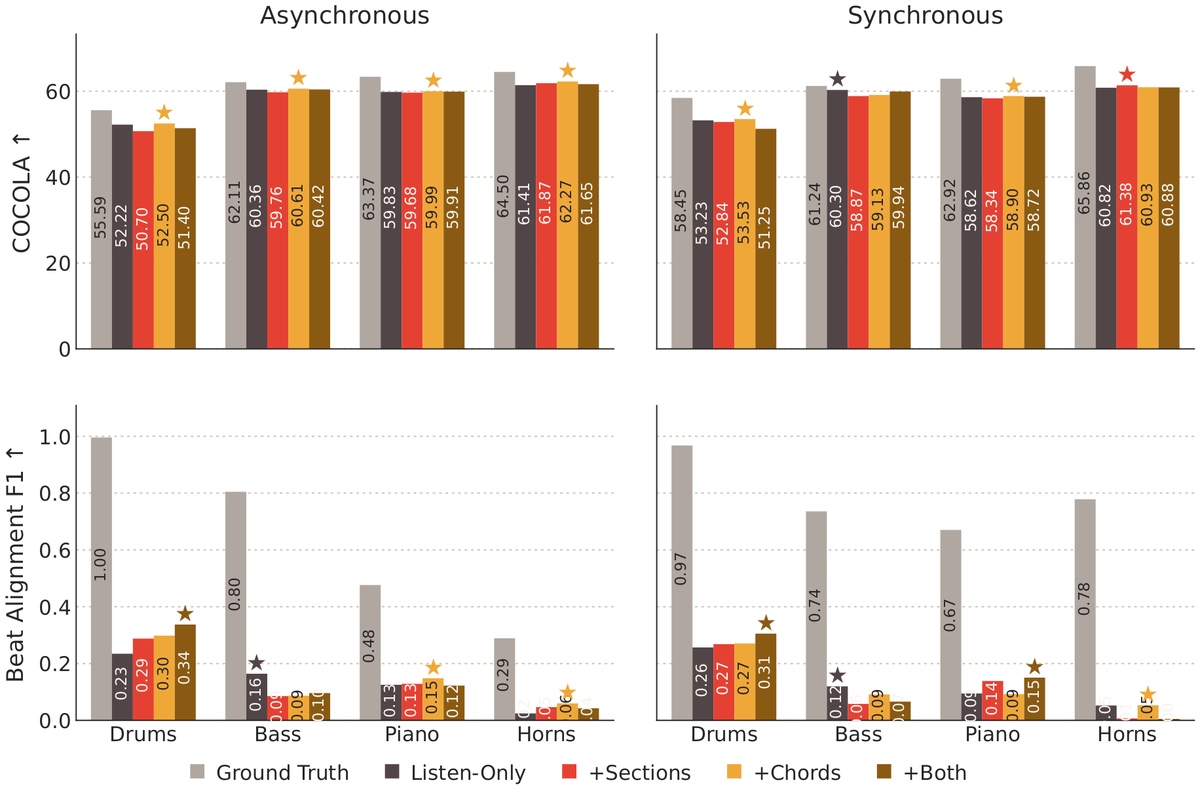
We fine-tune StreamGen to play one missing stem from the rest of the band, causal. Oracle chords and sections move beat alignment more than mix-coherence. Chords often help a little.
This is a baseline. Live accompaniment is still hard.
🧵7/8