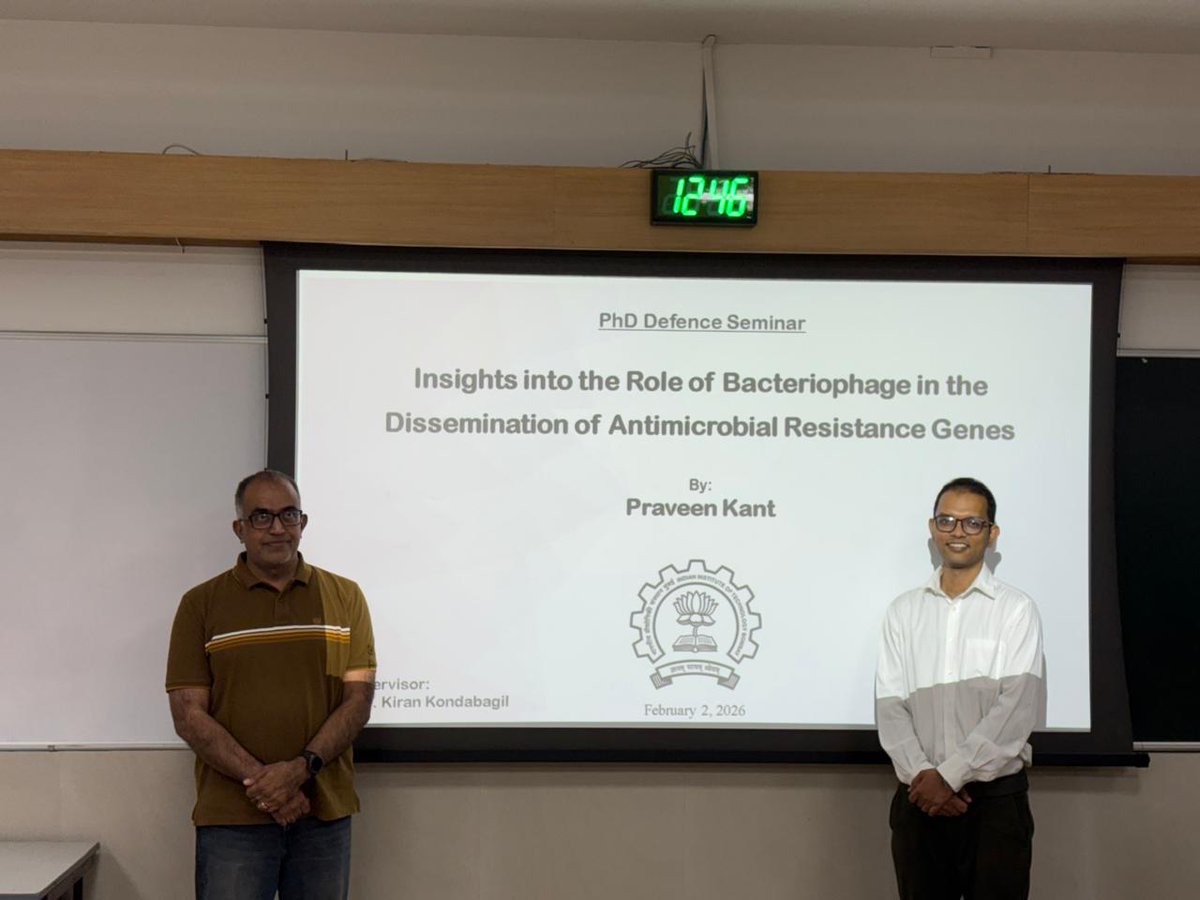
@p_kant defended his PhD thesis on "Insights into the Role of Bacteriophages in the Dissemination of Antimicrobial Resistance Genes". Many congratulations to Praveen and his thesis advisor @KiranKondabagil! #theBSBEgrad@iitbombay (1/3)
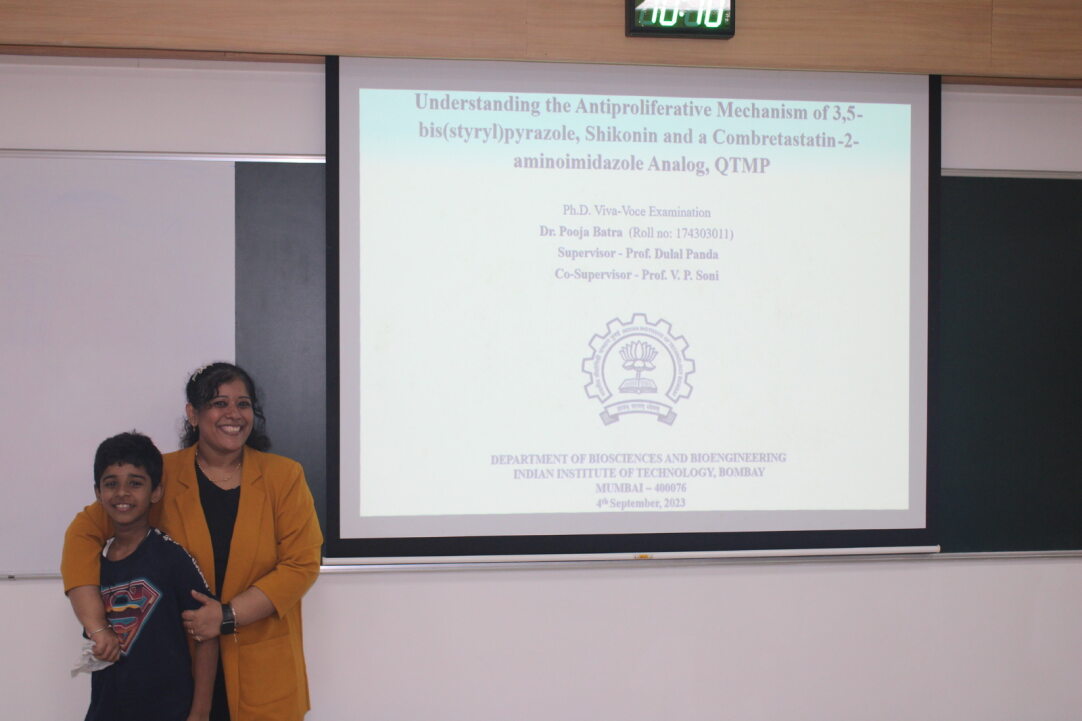
Consider this situation:
Few months before birth of her child a girl lost her husband.
She resumed study after a break of ~6 years
Cleared all exams for PhD admission in 1st attempt.
She is bringing up her child alone and completed PhD simultaneously.
@abhiandniyu This is the most underrated place in the whole would. Travelling "inward" and exploring our oneself. Undoubtedly, nothing better than this.
One can try advanced meditation program by @ArtofLiving
Calling all NGS #LaboratoryProfessionals! Did you know the NGS Quality Initiative has released new free tools for all 12 #CLSI QSEs that can help your laboratory develop a complete #QMS or enhance an existing one? Download now: https://t.co/2fokWzNa28
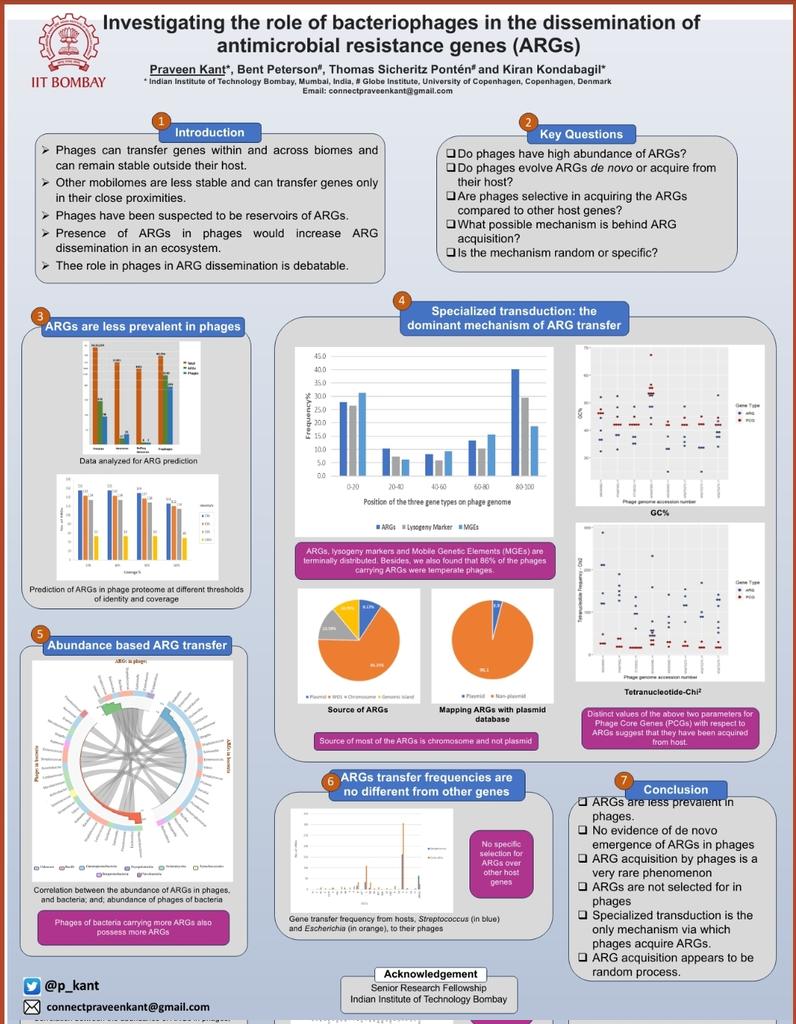
Role of phages in dissemination of antimicrobial resistance genes has been debatable.
I am presenting a detailed work at poster number W177. Would love to discuss my work with everyone. #fems2023#excited
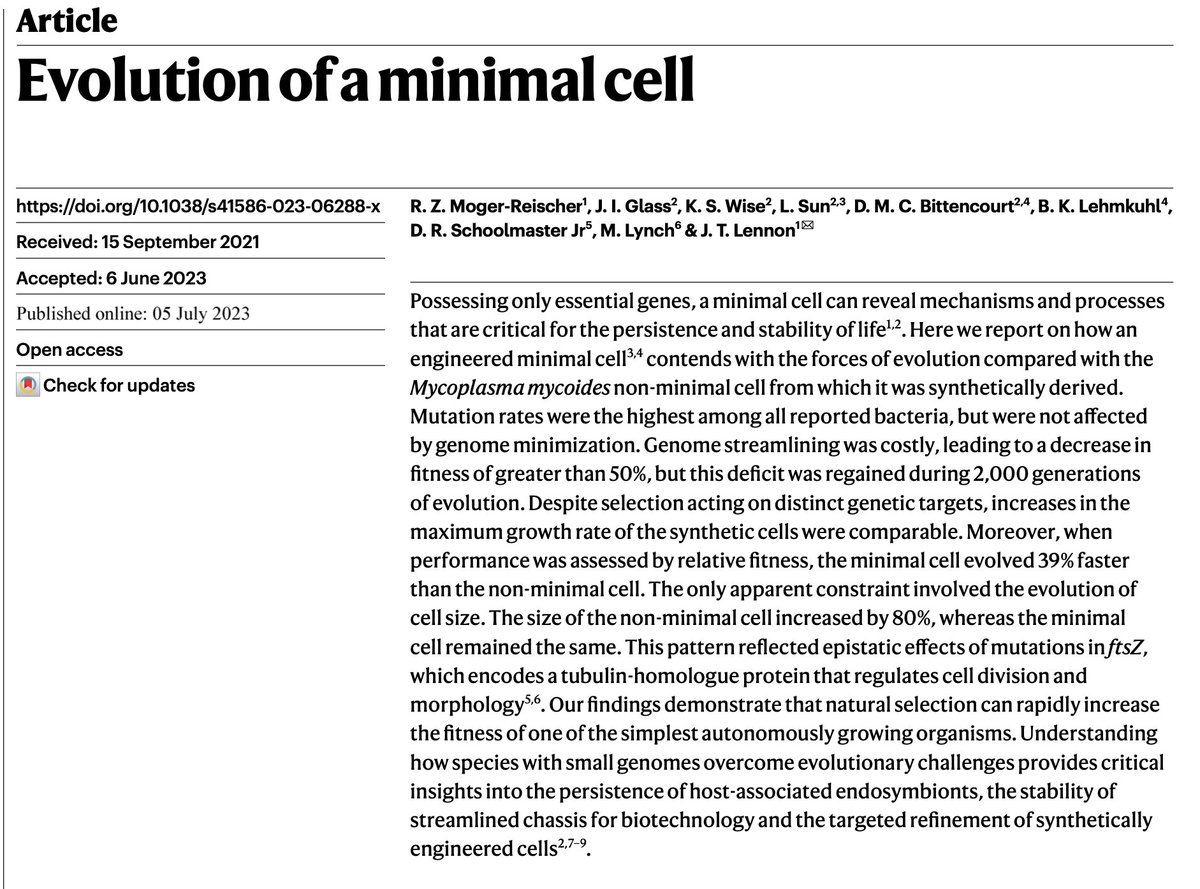
A mind-blowing paper has come out today in @Nature
In 2016, JC Venter Institute scientists trimmed a bacterial genome to its barest minimum required for life to synthesize what they called a "minimal genome" (https://t.co/Rk8oZJ0bUj).
Today, a group of scientists from Indiana University reports how that minimal genome evolved over 2000 generations in comparison to the non-minimal genome.
The authors found that even when you reduce a bacterial genome to its absolute minimum where every nucleotide matters, the genome undergoes mutational events generation after generation as much as the non-minimal genome. One simply cannot stop the evolution.
Just over 300 days of evolution (equivalent to 40,000 years in humans) the minimal cell has gained everything it lacked in fitness on day one in comparison to the non-minimal cell.
When comparing the evolved traits between the minimal and non-minimal cells, the scientists found something striking. The evolutionary process increased the cell size of non-minimal cells but not that of the minimal cell. But that is not the striking part.
The scientists were able to identify the key mutation that resulted in cell size evolution. And it turned out that the mutation that helped the non-minimal cells to grow bigger is the same that helped the minimal cells to stay smaller. Growing bigger had a survival advantage for non-minimal cells and not growing bigger had a survival advantage for minimal cells. So, the mutation had a context-dependent effect. This just demonstrates that the evolutionary effects on traits have no absolute direction. All that matter is what is beneficial for the organism's survival.
The conclusion of the paper is metaphorically a quote from the Jurassic Park movie:
“Listen, if there’s one thing the history of evolution has taught us is that life will not be contained. Life breaks free. It expands to new territories, and it crashes through barriers painfully, maybe even dangerously, but . . . life finds a way". (https://t.co/UlxRlb86CT)
https://t.co/zA9OAqSoAu
Last week was beautiful ❤️. Went through Advance Meditation Program by @ArtofLiving at scenic @Triveni_Ashram Pune taken by @swamianandv ji and @Anjana_gala ji. Would highly recommend for people who want to take a break from city life or stressful state of mind