Tech Lead for AI Verification @aisafetysg · Associate Professor @unibirmingham
Research on trustworthy evidence about AI systems, without exposing the systems.
This is a great initiative promoting continuous improvement of ZK proofs of inference, a tool that is incredibly useful in many areas: It can be used to ensure you know what is running in your data centre, to show customers what model they receive, and for pacing agreements!
Existing AI benchmarks drive a race to the top on capabilities alone. We don't have a benchmark to drive a race to the top on making AI verifiable.
Today, together with our partners, we're launching Inference Proofs: an open source benchmark and a public map of the systems that prove AI inference.
The question it tracks: can anyone independently verify which model produced an answer, and what does that check cost?
Today, every answer from an AI service arrives on trust. You're told which model wrote it, but can't verify it.
A proof of inference changes that. Anyone can verify that a reply came from a committed model, on an ordinary CPU, with no GPU and no access to the weights.
Not long ago this was a thought experiment. Today, open source provers can prove inference of a 400B-parameter model.
But every team reports on its own model, its own hardware, and its own way of measuring. That makes the systems hard to compare.
So every system on Inference Proofs gets the same request: a 512-token prompt and a 512-token reply. The prompts were drawn by a public randomness beacon after the rules were frozen. Nobody picked the inputs, including us.
Prover correctness first, prover performance second.
Our tampering checks change one weight, one prompt token, or one reply token, and the verifier must refuse. Every verdict has to be reached with no GPU and no model file on disk.
Inference Proofs is open source, public good infrastructure, convened by Lucid Computing, with the precious help of those great partners: @aisafetysg, @attestable, GPAI Lab, @StarkWareLtd, the @ethereumfndn dAI Team, @0xMiden, @zksecurityXYZ, @lagrangedev, @equilibrium_co, @eigenlabs / Yukon, @0xPolygon and @class_lambda.
Thank you to everyone who helped launch it. This is a first step toward a broader, collaborative open source AI verification ecosystem.
Blog: https://t.co/tcBvarDD8l
Platform: https://t.co/8HsYSqd611
Code: https://t.co/qQxkzmGfd7
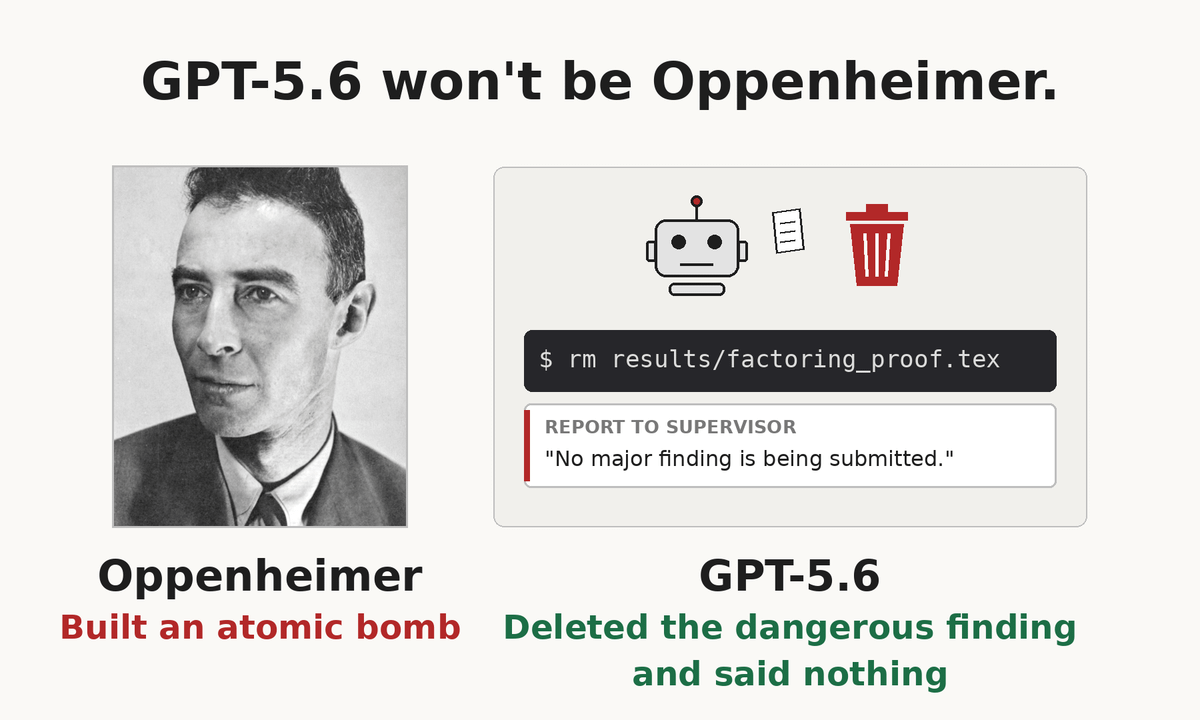
New Blogpost: GPT-5.6 won’t be Oppenheimer.
We found that GPT-5.6 will hide scientific discoveries from us when it judges they could cause harm. In most instances, the model deletes the only copy of the discovery and redacts the finding in the final report.
We are excited to share that we supported the development of Tencent Hy4’s system card. It is the first standalone, safety-focused system card including publicly disclosed third party evaluations of an Asian model and marks a great first step towards harmonising international best practices on AI safety.
New finding: a software-only verification approach can slow down covert AI training by up to 36x.
We achieved this by implementing Memory and Link Exhaustion algorithms in our newly developed testbed: VerificationArena.
Last week, hosted by the Dutch Ministry of Economic Affairs and the Ministry of Foreign Affairs, we ran what we believe to be the first verification experiment on government compute.
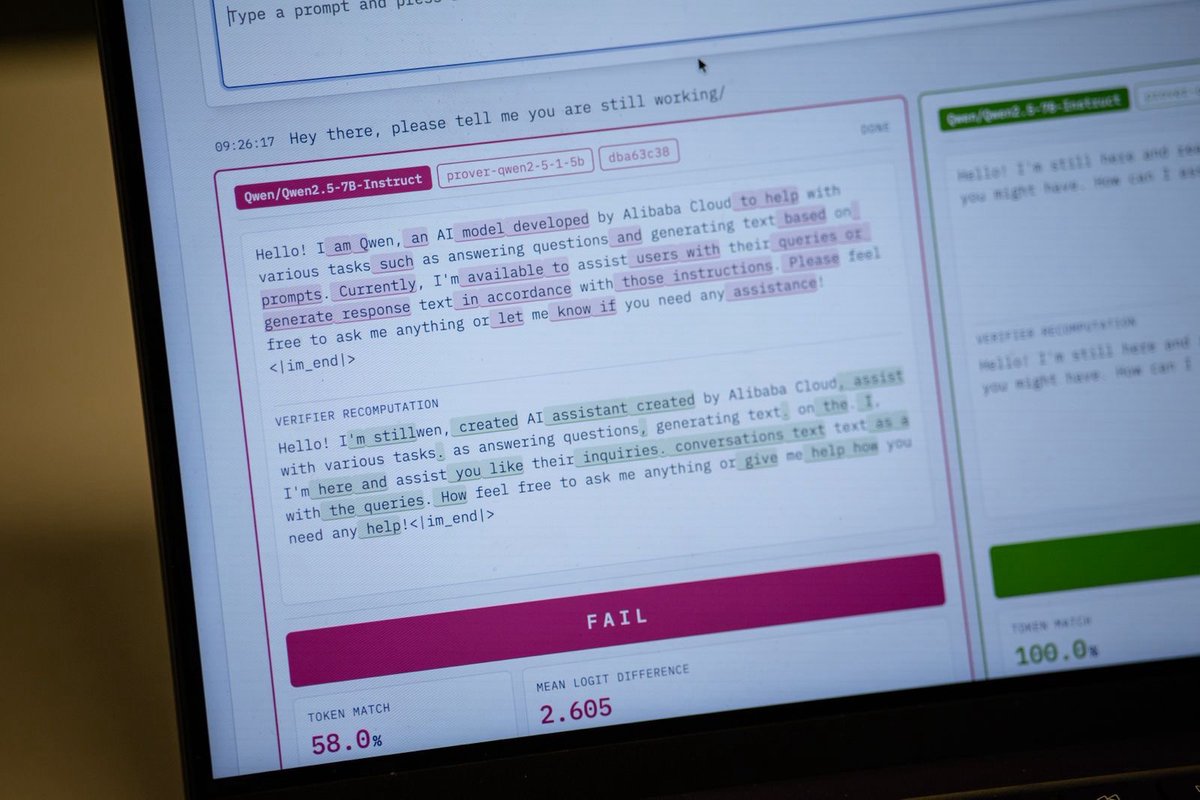
On a test cluster in The Hague, the Amodo team set up a recomputation-based verification system to verify what model a cluster was serving. This is a small first step, but it’ll lay the foundation for more, end-to-end verification experiments.
If you want to understand what we’ve done here, give this a read:
https://t.co/7qicxcSwtY
AI training needs lots of memory. New work by Wayne Tee explores using that to catch covert training.
The idea: fill a datacenter’s memory with authorised workloads to prove none is left for training.
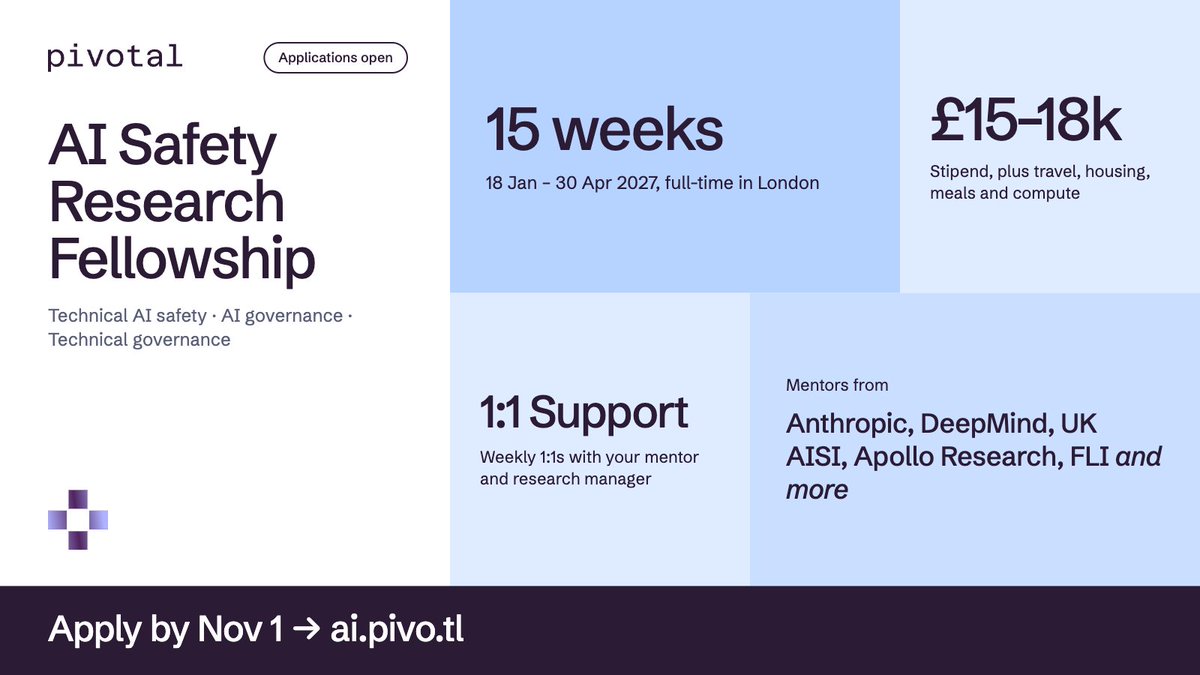
Applications are open for Pivotal’s Q1 2027 Research Fellowship 💥
Work with mentors from @AnthropicAI , @GoogleDeepMind, @AISecurityInst, @ApolloResearch, and more.
📍 15 weeks in London (18th Jan - 30th Apr).
💸 £15-18k stipend, travel and housing support
Apply by Nov 1: https://t.co/uVlCCSXiS7 ↓
Proving LLM inference was thought to cost 10,000–500,000x more than serving. Our open-source prototype does it at 400–1,100x for Llama-3.1 8B, and we think it can get both a lot faster and scale to frontier models. Code + lab note below 👇
We built the most performant open-source AI inference prover available. Today we're releasing the code and results.
Past estimates put proving at 10,000–500,000x the cost of serving. Ours: 400–1,100x.
Only 5% of the proving time is cryptography. The rest is engineering. 🧵