In a conversation with K2.0, Augustin Palokaj discusses the stagnation of the Kosovo-Serbia dialogue, Kosovo's relations with the EU, the integration of the Serb community, and the need for internal political consensus.
https://t.co/2EYDO0GuQN
Kosovo will vote for the third time in 16 months. While elections typically center on who will win, the frequency of Kosovo's trips to the polls — and the impasses that have followed — now raises a far more pressing question: what comes after?
https://t.co/yHYHuV9Lvu
In a conversation with K2.0, @AgonMaliqi discusses the EU-mediated dialogue, the mythologizing of the Association, the costs of governing the north and the risk of Kosovo remaining outside the Euro-Atlantic security umbrella.
https://t.co/m8naytZuRg
The Ohrid Agreement was seen as a turning point in the EU-mediated dialogue between Kosovo and Serbia. Three years on, dialogue is at a standstill. K2.0 spoke with @AgonMaliqi, Augustin Palokaj and Tatjana Lazarević to examine how the momentum was lost.
https://t.co/4VApFuKeZy
Në një bisedë për K2.0, @AgonMaliqi flet për dialogun, mitologjizimin e Asociacionit, kostot e qasjes ndaj veriut dhe rrezikun që Kosova të mbetet jashtë ombrellave kolektive të sigurisë.
https://t.co/MXCS5XYUZV
Kosovo didn't qualify for the World Cup. But, for Kosovo's citizens, no scoreline could take away what the night meant.
Shortly before the match, K2.0 spoke with some of the fans who had gone out to celebrate.
https://t.co/9wO0yDb1hP
Why does Kosovo rank so high in the World Happiness Report?
K2.0 examines the statistics and factors that may help explain Kosovo’s surprisingly high ranking.
https://t.co/RaiaehCtuE
I really want people to see the story above the story here, which is that whether you're reading Citrini, or listening to Jamie Dimon at a cocktial party, the conversation about AI is a marketplace of competing science fiction narratives.
That's not to say I think the technology is a parlor trick. But rather that the level of uncertainty is so high, and the quality and supply of real-world, real-time information about AI's macroeconomic effects so paltry, that very serious conversations about AI are often more literary than genuinely analytical.
And I think that observation sets up another important point: I feel lucky to be able to have conversations about the frontier of AI with executives and builders at frontier labs; economists at AI conferences; investors in AI; and other AI folks at off-the-record dinners where important truths can theoretically be shared without risk. I can't emphasize enough that "nobody knows anything" is about as close to the reality here as three words are going to get you.
Nobody what's going to happen this year, or next year, or the year after that. There is no secret cigar-filled room of people who have unique access to some authentic postcard from the future. When you drill down underneath the bluster, the boosterism, the fear, the anxiety, what's there at the bottom is genuine uncertainty, a vacuum into which storytelling is flooding. The frontier labs don't really know what they're building exactly, and economists don't really know how to model the thing they claim they're building (genuine recursively self-improving AI agency isn't really analogous to something we know about).
I wish more people talked about and thought about this subject thru that sort of lens: We're trying to model the economy-wide effects of a technology whose properties the frontier labs can't even really describe yet. Whatever you think about AI today, be prepared to change your mind soon.
It has been almost a year since the President of the United States, Donald Trump, signed an order to cut funding and downsize the U.S. Agency for Global Media, jeopardizing the functioning of the Voice of America and Radio Free Europe.
As this unfolded, people from different countries began sharing their memories of these radio stations.
The article “Voices of America” traces the legacy of these two broadcasters from the end of World War II to the war in Kosovo, seeking to understand how these stations balanced their role as professional media organizations and their function as instruments of American soft power.
https://t.co/9xfuOSTJgJ
“Until we build an all-powerful but distant God, the agency problem remains. AIs are not capable of directing themselves; most people aren’t either.”
Sam Kriss reports from San Francisco on the next generation of AI technologists.
https://t.co/ANuwXBdLq2
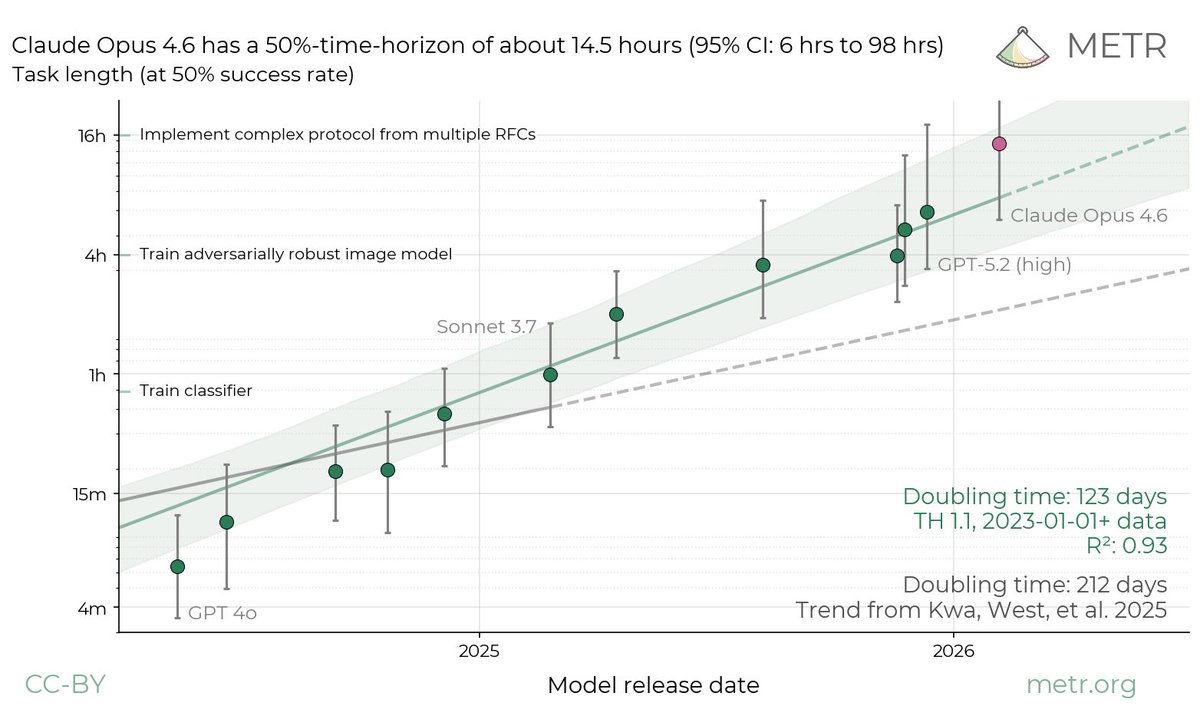
We estimate that Claude Opus 4.6 has a 50%-time-horizon of around 14.5 hours (95% CI of 6 hrs to 98 hrs) on software tasks. While this is the highest point estimate we’ve reported, this measurement is extremely noisy because our current task suite is nearly saturated.
With three elections held in a single year — two of which were parliamentary — attention in Kosovo now shifts beyond the ballot box. VV has a limited but clear window of opportunity to translate its electoral mandate into institutional stability; it’s now time to move on.
https://t.co/Czleg58EvW
New newsletter: THERE ARE ONLY 12 FACTS IN THE ENTIRE AI BUBBLE DEBATE
Last week, I noticed something funny about the AI bubble discussion: Every conversation is the same. Every CNBC panel, every tech podcast, every Twitter fight, every Goldman and JPM research note quotes the same dozen ideas, back and forth:
"It's a bubble: Look at these crazy circular deals"
"It's not a bubble: Look at Nvidia's P/E ratio"
"I'll bet you've never read that MIT study showing AI doesn't work"
"I'll bet you haven't read that METR study on AI task length doubling!"
"Don't forget that other METR study on how coders using AI are less productive!"
The whole discussion emerges from a very narrow playbook with just 12 stats.
So I went to @binarybits and I said: "Hey, just in time for Thanksgiving, should we just publish a ~5k word deep-dive into all 12 stats, so everybody can go home and talk 'like an expert' about AI with their family?"
So, that's today's piece.
https://t.co/Q5MG58pZfb
A few people have asked me recently why I'm bullish on the macro/societal implications of AI, especially outside of the phenomenon of "kids cheating in school."
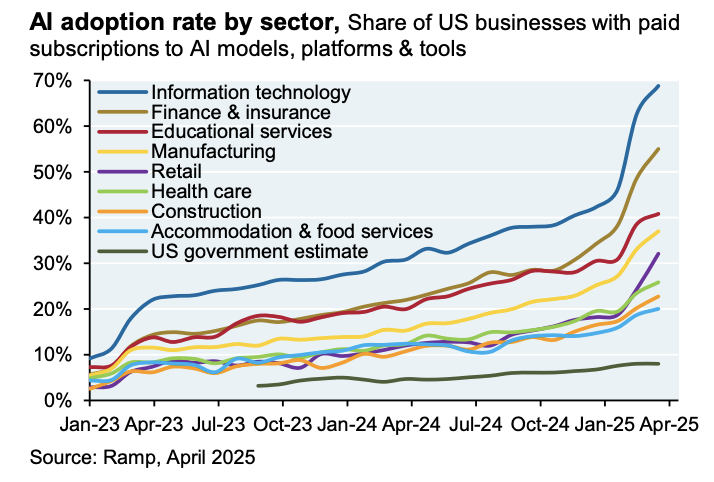
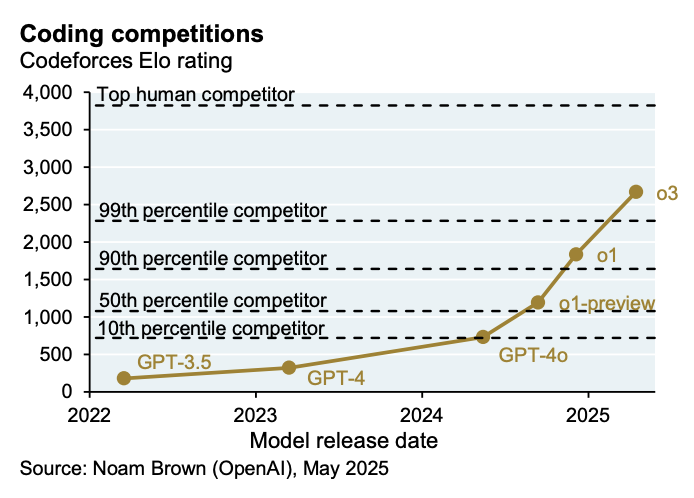
I think these four graphs from JPM's Cembalest do a great job summarizing the bull case.
1. Adoption accelerating
2/3. Performance at normal corporate tasks—reading, understanding complex questions, answering complex questions, coding—is still improving.
4. Task complexity is rising linearly. "It's just bespoke Wikipedia search" is an adequate description of the technology ... from about 18 months ago. The newer models can do stuff now that takes smart people hours to accomplish.
Are you passionate about independent journalism? Do you know all about #Kosovo and the #Balkans?
We’re looking for an English language #editor to join our team as we look to build on our award-winning #journalism.
https://t.co/7QYi3zwP2V
#Kosovo - New members of Kosovo Police force attend the graduation ceremony of the 59th generation of the Kosovo Police, in Pristina.
📷 @armend_nimani#AFP