Computational biologist | Genomics | Data science and visualization | @Stanford and @UNAM alumni. I believe science should be for everyone and by everyone
Proud to be part of an amazing group of engineers, scientists, and program officers contributing to developing CELLxGENE to further cell bio research.
Now with gene expression for >85M cells, our free and open-source tools enable cell biologists to advance their research.
Chan Zuckerberg CELL by GENE Discover aims to be a one-stop shop for single-cell RNA sequencing data storage, access and analysis https://t.co/naZoWjzmYg
I'm excited to announce that starting this week CELLxGENE Census supports categorical variables for cell metadata of the now 59M cells . Fetching data will now utilize less memory!! However in some cases the change may break existing code. Details here: https://t.co/RWscBKi7Va
I'm honored to have worked with an amazing team at @cziscience and comp bios to deliver the first marketplace of models and embeddings along one of the largest aggregations of standardized #singlecell data from #CELLxGENE Census.
Explore the models! https://t.co/hGCL4seVa4
🚨1/ New to CZ #CELLxGENE: models & embeddings that integrate up to 36M cells in the Census corpus.
Use embeddings to explore the corpus directly, or download the models to run your own data through them to enable direct comparisons to the reference. 🧵
https://t.co/VILS665Gnl
@vallens@JCoolScience@lelandtlr We have additional information in the metadata of the embedding matrix `census["census_data"]["homo_sapiens"].ms["RNA"].obsm["scvi"].metadata` which also has a link to a longer description here https://t.co/x7yFAbELHJ
@vallens@JCoolScience@lelandtlr "columns" refers to the number of columns in the embedding matrix. The number of genes used for modeling varies per method, eg for scVI 8000 highly-variable genes, Geneformer tokenizes up to 2048 top expressed genes. For more on other methods you can refer to their publications.
1/6 The @cziscience team’s preprint on how CZ #CellxGene Discover serves as a centralized hub for standardized, interoperable and openly available #SingleCell matrices is out!
Really proud of what we’re building to address the community’s needs https://t.co/mHZMjjmpAc 🧵
New to CZ #CELLxGENE Census: A normalized expression layer & gene and cell stats for all 33M cells!
In Python and R you can work with #SingleCell CPM values and quickly filter genes and cells, for example get all cells with more than 100 expressed genes.
https://t.co/PK8CRlMSRQ
🚨New #CZCellxGene Census Python package alert: Now you can calculate average & variance gene expression and find highly variable genes across 33M+ cells with just a standard laptop 💻!
Get started streaming large scale #SingleCell analyses:
https://t.co/7Bh2pXF65P
@BabuuDx@JCoolScience@Bioconductor@scverse_team@python_spaces The Python package cellxgene-census let's you connect the Census data with the scverse ecosystem by exporting slices as AnnData objects.
You can find more information about this in the Census doc-site at https://t.co/jwJS3OlVlZ
@vitaliikl@JCoolScience@Bioconductor Yes! We released the Python package cellxgene-census back in May. You can find more information in the Census doc-site at https://t.co/jwJS3OlVlZ
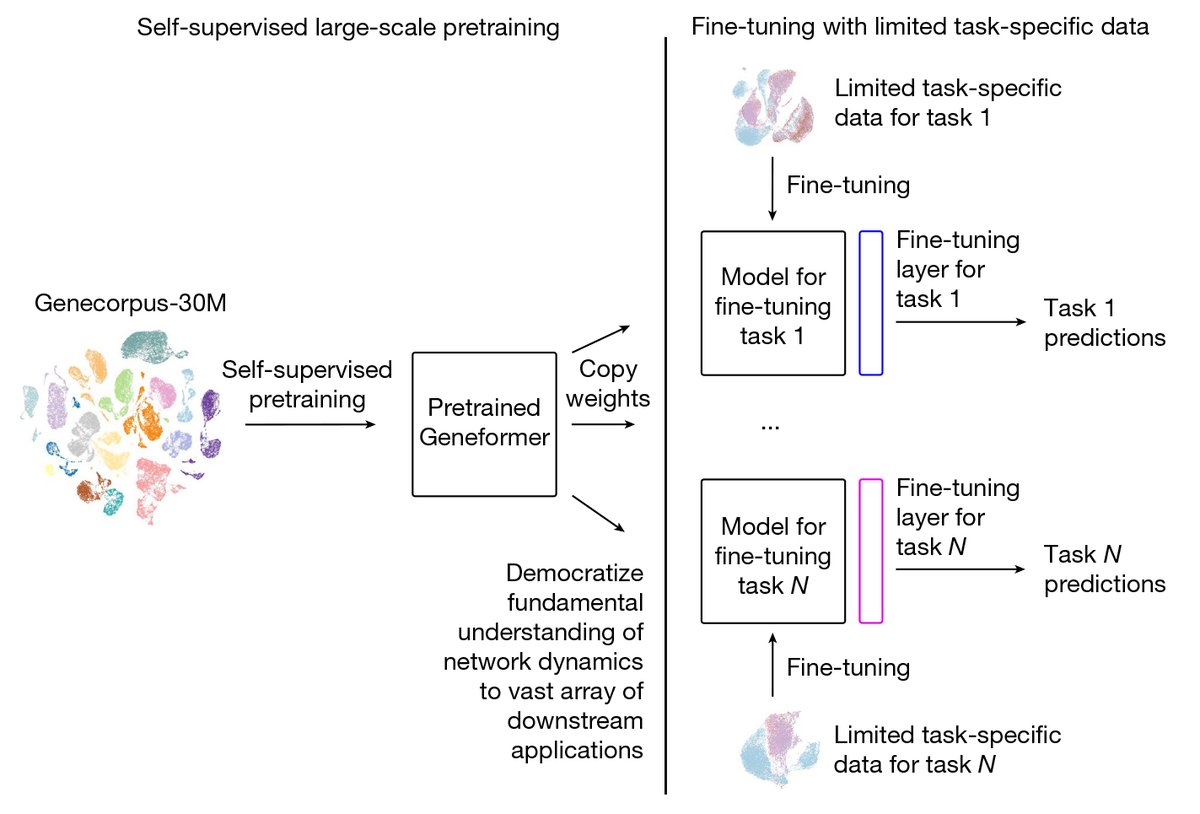
We are excited to share Geneformer, our foundation model pretrained on 30 million single cell transcriptomes to enable predictions in network biology.
Manuscript: https://t.co/IV98JyvJSr
Model: https://t.co/wrbFABoKhf
Pretraining corpus: https://t.co/KsQHz4qXjG
I am beyond excited to share that SIMBA, a versatile single-cell graph embedding method, has been published @naturemethods https://t.co/QyKZA8vRur (1/6)
Excited for the new opportunities that the #CZCellxGene Census opens up to the Single-Cell community. Made from community-contributed data, e.g. @humancellatlas, the Census expedites single-cell data access!
I am so proud of the Census team at CZI to get this out in the open.
Big News🚨: #CZCellxGene Discover Census launched today! https://t.co/GRjBDnKWS5
Built from >500 datasets, Census gives you efficient access to the largest aggregation of #SingleCell RNA data that’s immediately ready for analysis with harmonized labels for cell and gene metadata
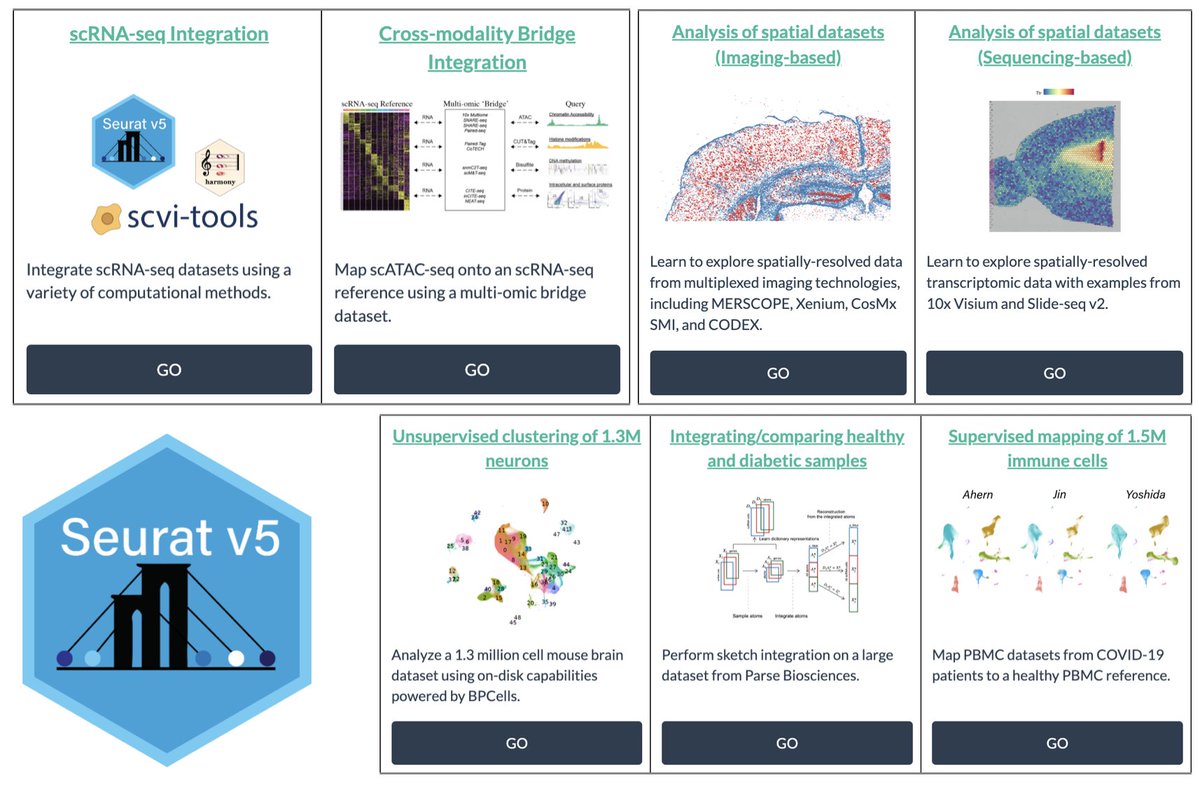
We are excited to release Seurat v5- with new methods for multimodal, spatially resolved, and massively scalable single-cell analysis. https://t.co/7BMGF7x1wV
Happy to share our latest work (w/ @tagasovska, @stephenrra, @kchonyc, @jkpritch and Aviv Regev) about learning causal representations of single-cell perturbation data sets https://t.co/ou0aWOpWWW.
We had seen embryonic expression of transposable elements as means of protecting the genome of plants before. Amazing to see a similar process in humans!!
Super excited and thankful to finally see my graduate work out in the wild. https://t.co/1kKLkxo3nV
We wanted to know if ancient viral protein-coding sequences that are embedded within our genomes can protect us from infection by circulating viruses. (1/8)
Amazing week for #DeepLearning in #spatial#singlecell biology, with 2🔥new Graph Neural Networks methods!
1.STELLAR🇺🇸 @jure: a cell type annotation & discovery atlas-type framework
2.NCEM🇪🇺 @fabian_theis: an approach to infer cellular communication patterns
Deep dive below🧵