If you've tried meditation, journaling, coaching...
and your trading months repeatedly look like:
+$
+$
TILT... back to zero
You don't need a better strategy.
You need to seriously fix the TILT that gets you back to zero.
Here's how:
https://t.co/EK148tNqzt
Don't trade naked. Every trade you make exposes your capital to risk, drawdowns, volatility. Put the odds in your favor with the correct tools, time-tested experience, and proven results. https://t.co/D11Z9lG3WQ
I’ve published a complete guide to trading with probabilistic thinking on my blog.
I also created a free simulator you can try directly in your browser, so give it a try👇
https://t.co/6D0xCk1qA5
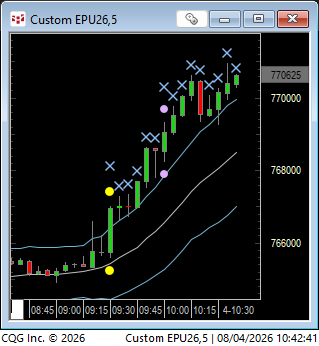
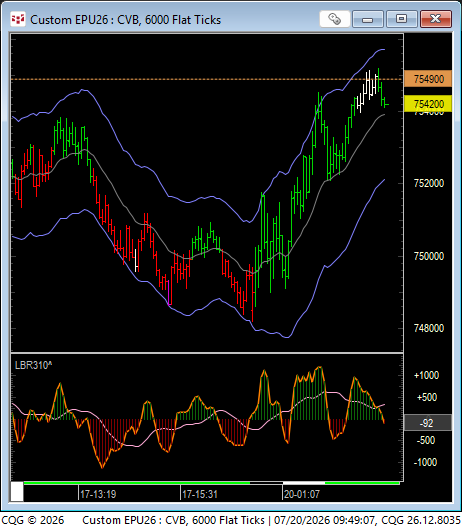
WHEAT - still continuation patterns. Note: 3 days ago it made new momo highs on the ROC, Now it has push outside KC, at which point, this will be a climax bar or it will continue to climb the walls of the KC. There are very strong fundamentals behind this upside move.
Very proud of Glen and Pratik. Shows what you can achieve when you implement my trading pod concept 👊
Nothing like a $3.7b month to make @RealSimpleAriel@traderkylec and @thelaptoplegend feel like total pikers.
Now that I’m done optimizing their pod, I’m always looking for new elite 10-figure traders to work with. DM me.
【Most Traders Break Their Rules With Perfect Discipline】
Every time you break your rules, you think, "I lack discipline."
But that is wrong.
You do not lack discipline.
If anything, you keep breaking your rules every time with "impressive discipline."
Because people follow what they truly believe.
■ You Do Not Lack Discipline
Many traders think this after breaking their rules.
"I failed to stay disciplined again."
"I lost to my emotions again."
"Next time, I will follow my rules properly."
But that way of thinking itself is wrong.
The problem is not that you lack discipline.
You are already extremely consistent toward something.
When unrealized profit shrinks, you immediately want to protect it.
When a loss comes close, you want to avoid the stop loss.
When losses continue, you want to change the rules.
When price moves slightly against you after entry, you begin thinking, "Maybe this time is different."
These may look like separate behaviors.
But the root is the same.
You value protecting the win or loss in front of you more than following your rules.
And you follow that value with surprising consistency.
So you do not lack discipline.
You are disciplined toward the wrong thing.
■ People Follow What They Truly Believe
You need to understand this.
People do not follow what they say is important.
They follow what they truly believe.
Even if you say, "Rules are important," if you break your rules to avoid the loss in front of you, then what you truly believe in is not the rules.
"This loss should be avoided."
"This profit should be protected."
"This losing streak is dangerous."
"I need to do something about this one trade right now."
These are the values you actually believe.
So you act according to them.
This is not a personality problem.
It is not weakness of will.
It is a problem of what you recognize as success in that moment.
A person who truly believes that following the rules is success will follow the rules.
A person who believes that avoiding the loss in front of them is success will act to avoid that loss.
Both are following what they believe.
So the problem is not whether you have discipline.
The problem is where your discipline is pointing.
■ "But Isn't Discipline Necessary"
Here, you will think this.
"But isn't discipline necessary in trading."
Of course it is.
But what most people call discipline is not the discipline trading requires.
Enduring unpleasant emotions while forcing yourself to follow the rules.
Suppressing the desire to win and forcing yourself to obey.
Clicking through fear with mental strength.
That is not completed discipline.
That is a state where what you believe inside is colliding with the rules you are trying to follow on the surface.
True discipline is not forcing yourself to obey while enduring.
Following these rules is what leads to success.
Not the win or loss in front of me, but positive expectancy that appears beyond repeating the same behavior across a large sample size.
Rule based losses, losing streaks, and drawdowns are all part of that structure.
When you can believe this from the bottom of your heart, the same behavior begins to continue naturally.
In that state, discipline is not endurance.
Following the rules becomes the most natural action for you.
■ Discipline Is Not The Starting Point
Most people have the order wrong.
They think that if they first develop discipline, they will be able to follow their rules.
But in reality, it is the opposite.
You define your rules precisely.
You test them across a large sample size.
You practice them again and again through your own hands.
You pass through rule based losses, losing streaks, and drawdowns.
You confirm through your own hands that positive expectancy remains beyond repetition.
Only beyond that is trust built.
And only beyond that trust does discipline appear naturally.
Discipline is not something you create at the beginning through intensity.
It is something that appears later as the result of preparation.
That is why blaming yourself by saying, "I need more discipline," every time you break your rules does not change the root.
What you truly need to look at is why you still believe the win or loss in front of you more than your rules.
In most cases, the answer is insufficient preparation.
Your rules are vague.
You have not tested enough.
You have not practiced through your own hands.
You have not passed through variance.
You still do not truly believe what happens when you keep repeating those rules.
That is why the win or loss in front of you looks stronger during live trading.
That is why you follow it.
You are simply calling that "lack of discipline."
■ Redirect Your Discipline
What you need is not to tighten yourself harder.
What you need is to redirect your discipline.
The discipline working to avoid the loss in front of you.
The discipline working to protect unrealized profit.
The discipline working to escape a losing streak.
The discipline working to feel safe in this one trade right now.
All of it needs to be redirected toward repeating the rules.
And that direction does not change through words.
It does not change through willpower.
It does not change because you decide, "Next time, I will follow the rules."
It changes only when you have prepared enough to truly trust those rules.
When you have defined the rules, tested them, practiced them through your own hands, passed through variance, and come to believe in the structure where positive expectancy remains even with losses and losing streaks included.
Only then does your discipline finally point in the right direction.
Following the rules stops being an effort.
Deviating from the rules begins to feel worse than taking a loss.
Protecting a large sample size begins to feel more natural than protecting the one trade in front of you.
That is when you finally stop trying to "have discipline."
Discipline works on its own toward what you truly believe.
So stop thinking you have no discipline.
You already have discipline.
It is simply pointing in the wrong direction.
📚 Content for serious traders
https://t.co/ZxU7qo6RTO
Thank you for reading.
【"If You Lose, Take A Break" Solves Nothing】
The moment your stop loss is executed, heat rises deep in your chest.
Your heart starts beating faster, regardless of your will.
You have been told many times, "When that happens, step away from the chart for a while."
So you leave your seat and take a deep breath.
And yet, when you come back, the same emotion hits you again.
You get heated again, and you leave your seat again.
No matter how much time passes, you cannot get out of this loop.
That is not because your way of resting is not enough.
It is because this advice has never solved anything from the very beginning.
■ A Break Only Lowers The Temperature
The only thing "if you lose, take a break" appears to solve is the temperature of the heat.
It never touches the source that is producing that heat.
It is the same as wiping the floor without closing the faucet.
No matter how good you get at wiping, the water does not stop.
"Take a break" is only teaching you how to wipe the floor.
No one tells you where the faucet is.
■ The Faucet Is Behind The Voice In Your Head
Then why does heat rise from a loss?
Right after a loss, these voices run through your head.
"They got me."
"That one trade wiped out today's profit."
"I have to make it back on the next one."
"If I had not done that, I could have won."
All of these are voices giving meaning to the single trade in front of you.
These voices appear because you are playing "the win or lose game."
But inside someone who understands from the bottom of their heart that one rule based loss is nothing more than one sample inside a large sample size, these voices do not arise in the first place.
If the voices do not arise, the heat does not arise either.
If the heat does not arise, there is no temperature to lower.
The faucet is not your emotions.
It is the perception that gives meaning to the single trade in front of you and produces those voices.
■ "But If I Trade While My Head Is Still Hot, I Will Take A Huge Loss"
Here, someone will always say this.
"But realistically, if I trade while my head is still hot, I will take a huge loss.
Isn't resting the right thing to do?"
That is true.
Rather than continuing while heated, you should leave your seat.
But think about it.
The very fact that you need to leave your seat to protect yourself from yourself is proof that your preparation is not finished.
No matter how many years you keep executing "take a break," those voices do not change by even one millimeter.
■ The Goal Is To Become Someone Who Does Not Need To Rest
What you should aim for is not a version of yourself who can skillfully leave the seat when heated.
It is a state where a rule based loss no longer produces those voices.
And that state is never built by repeating "the result of one trade is random" in your head.
In a system with positive expectancy, a rule based loss is part of the distribution that leaves profit.
Only inside someone who has passed through this fact over and over, not as knowledge, but through verification and practice with their own hands, does the single trade in front of them begin to lose its meaning.
In that state, even when your stop loss is executed, you do not stand up from your chair.
Your heart beats at its normal speed.
Your hand does not shake when you close the chart.
You take another sip of coffee and simply wait quietly again for the next condition to appear.
"If you lose, take a break" can be used as first aid.
But the moment you mistake it for the solution, you enter a life of wiping the floor forever.
What must be closed is the faucet.
Not your emotions, but the perception that gives meaning to the single trade in front of you and produces those voices.
📚 Content for serious traders
https://t.co/tMFssKR6Oz
Thank you for reading.
Ms. (or is it Mr..) Russ: a close around here would set up power ful OD/ID breakout formation. (can go in either direction). We tested this patter with Moore Research Center 3 decades ago and it still is one of the most powerful breakout patterns.
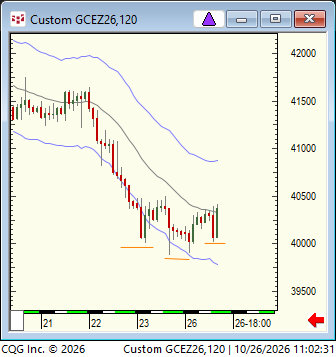
GC getting first close outside of daily KC on "leg 2" down on weeklies. IF it takes out today's high the next two trading days, the model will give a buy. Otherwise, "ride the rails" on the KC to downside.