How many would guess what Pal flying in the blue sky means? 🤔
Lately, lots of tech people ditched Twitter/X in favour of #Bluesky. We’re excited to jump on this train! If you’re there already, follow #Palark. If not, consider this platform! https://t.co/x3GkSHegaQ
Just a few quick facts about #Bluesky:
- Kelsey Hightower has completely removed his X account and moved to Bluesky
- There are easy-to-follow starter packs on Bluesky, e.g. for CNCF Ambassadors
- Kubernetes, Prometheus, Cilium, Helm, and many others have already arrived there🙌
How many would guess what Pal flying in the blue sky means? 🤔
Lately, lots of tech people ditched Twitter/X in favour of #Bluesky. We’re excited to jump on this train! If you’re there already, follow #Palark. If not, consider this platform! https://t.co/x3GkSHegaQ
The final release of #Prometheus 3.0 was announced! It features new UI, Remote Write 2.0, native histograms, improved #OpenTelemetry protocol support, and more. https://t.co/7gj0wb7bFk
Attending a local event called IT-Kongress tomorrow at the #NeuUlm University of Applied Sciences (https://t.co/dv4WpFzMI0). As an exhibitor there, #Palark is looking forward to meeting IT enthusiasts and discussing everything related to DevOps, SRE, and cloud! Come to say hi 👏
#werf v2.11.0 was released adding crane and tzdata to werf images, adding werf images for linux/arm64, and improving AWS ECR support. Find the full changelog here: https://t.co/ze7nbVs91n
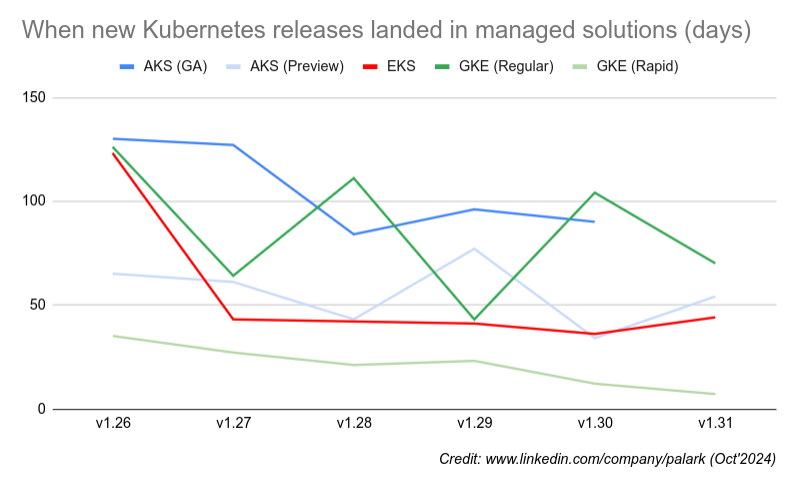
How fast do the cloud providers adopt the latest #Kubernetes releases? We updated our chart illustrating the days it took Azure #AKS, AWS #EKS, and Google Cloud #GKE to roll out new K8s versions. Feel free to share it with others!
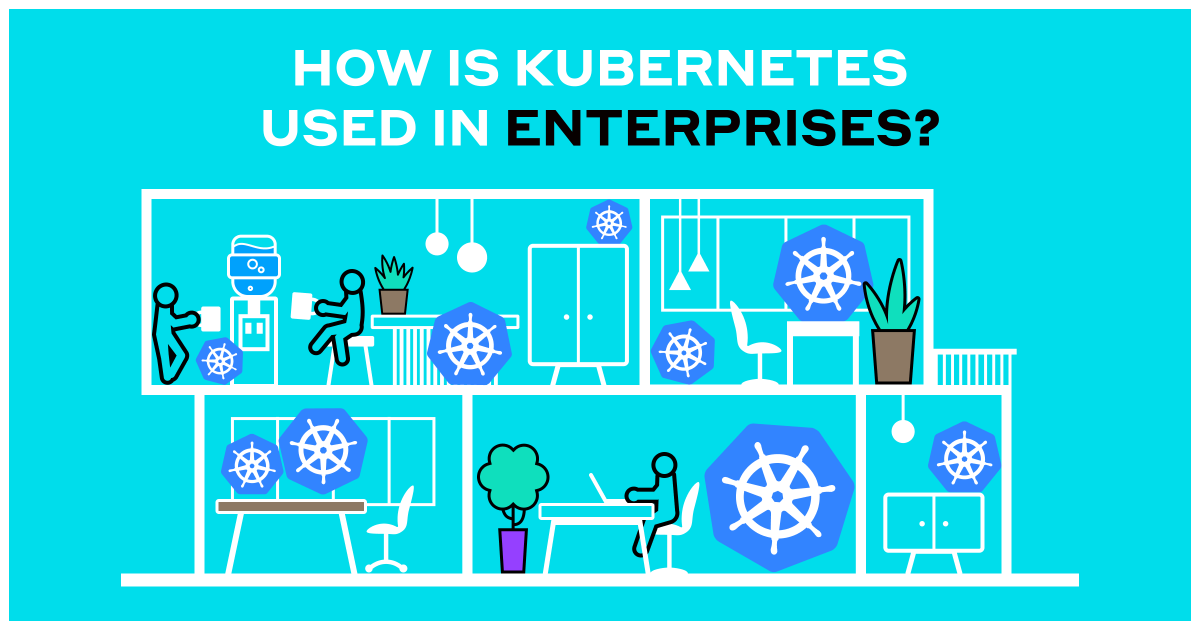
📊 @DZoneInc released its latest "Kubernetes in the Enterprise" trend report a month ago. It anticipated hybrid & #multicloud as the most common use case for #Kubernetes among the organisations (indicated by 54% of the respondents). Other takeaways include… 🧵
@DZoneInc 3. The biggest Kubernetes pain points are performance tuning (57%) and maintaining YAML files (49%).
4. The most popular security-related measures include regularly updating Kubernetes (67%), blocking or limiting network access to exposed ports (53%), and enabling RBAC (52%).
…
@xu_paco While there's _some_ sense in this article, it's a bit controversial and too unfair in its biased conclusions :) E.g., if companies are acquired, it doesn't mean their market is dead. The numbers for the KubeCon Europe 2024 sponsors actually show there's no decline at the moment.
We're pleased to see and happy to share this article about #werf by Ivan Beauté from @BlackSwiftFR! It calls our tool "Chewbacca of your Kubernetes deployments," which definitely made the day! 😂👏
https://t.co/CE2TIJn5PD
Our DevOps team leaders seemed to catch that Halloween vibe! At least, we see no other reason why they will build and deploy their first… pumpkin workloads 😁 Well, that may need some scaling soon, huh? Enjoy your great weekend, too!
Another #Kubernative digest for Cloud Native software updates features #KubeBlocks, #Altinity ClickHouse Operator 0.24, Azure Service Operator v2.10.0, #Kuma 2.9.0, #wasmCloud v1.4.0, #KataContainers 3.10.0, and ko v0.17.0. Find all related links here: https://t.co/Axpk1IQ5mS 🙌
@TheNJDevOpsGuy Agree. IT became very common and trendy. More people try to enter this field, so it's getting popularized in a "cheap" way. Secondly, the next generation grew up and arrived. I means lots of people who want everything here and now, with no real efforts and long commitment.