this is how to get most out of your agent:
1) install grok bot
2) use my engineer bot -> https://t.co/l2g8zJ4Srw
2) send this prompt: figure it all out, fix all bugs, and mange my usage limits, and make sure all draft prs are ready to merge, use sonnet 5.5 medium as the main chats for all projects cuz im tryna save some usage limits, BE PROACTIVE, make sure that you look at the reviewer bots, babysit prs till merge and make the prs the best production prs out there that even LINUS TORVALDS WILL BE PROUD, NOW GO MY CHILD, I LEAVE THIS FOR YOU, MAKE ME PROUD!
3) let the magic happen
this is the best prompt in the world
AGI in prompt engineering is here!
- Subsidization
- It's not smarter
- Faster
- More Token Efficient
I can name a lot more then these reasons to use opus 5.5
Gemini 4 Carbon is BENCHMAXXED
🚨 Claude users and Gemini users!!
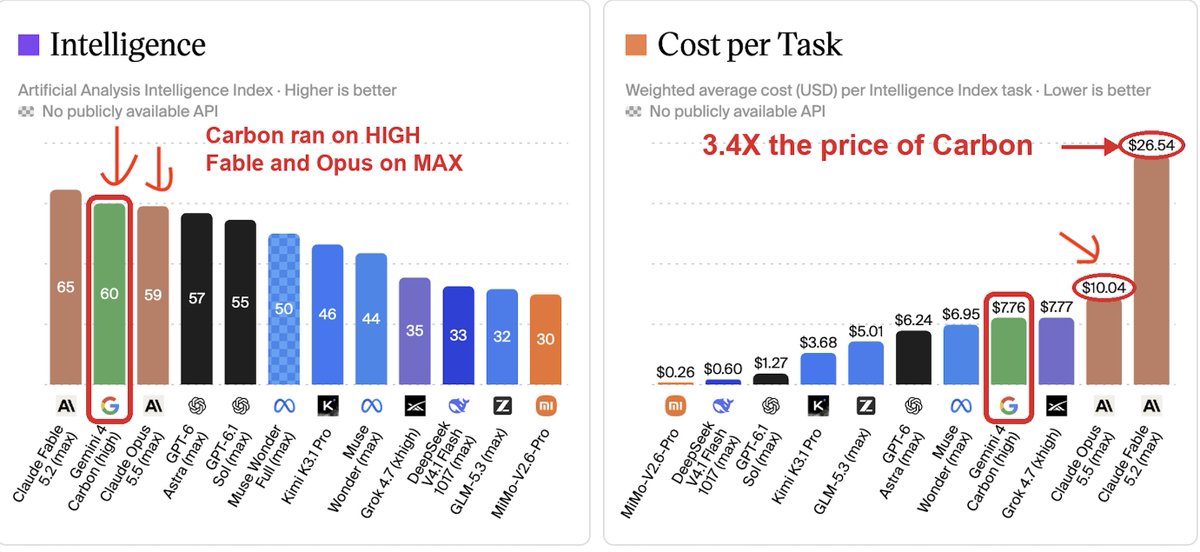
WTF!? Google just killed Opus 5.5 😭
Gemini 4 Carbon is the NEW BEST model in the world for the money.
Artificial Analysis:
Intelligence:
> Carbon (high): 60
> Opus 5.5 (max): 59
Cost:
> Carbon: $7.76
> Opus 5.5: $10.04
SMARTER AND CHEAPER, and OPUS RUN ON MAX.
WHO IS PAYING FOR OPUS?
Claude users... are we switching?
Our initial public offering: https://t.co/Ah4BkI2loD
Legal disclaimer: Anthropic has filed a registration statement (including a prospectus) with the SEC for the offering to which this communication relates. Before you invest, you should read the prospectus in that registration statement (available at: https://t.co/Z44axxzf9b) and other documents Anthropic has filed with the SEC for more complete information about Anthropic and this offering. You may get these documents for free by visiting EDGAR on the SEC Web site at https://t.co/94ojsWZTKi. Alternatively, copies of the preliminary prospectus may be obtained from: Goldman Sachs & Co. LLC, Attention: Prospectus Department, 200 West Street, New York, NY 10282, by telephone at (866) 471-2526, or by email at [email protected]; or Morgan Stanley & Co. LLC, Attention: Prospectus Department, 180 Varick Street, 2nd Floor, New York, NY 10014.
The securities may not be sold, nor may offers to buy be accepted, prior to the time the registration statement becomes effective. This post is not an offer to sell, or a solicitation of an offer to buy, the securities in any jurisdiction where the offer or sale is not permitted.
@mattworkman Agreed. The AI tag is relevant to art exhibits for authorship disclosure, and to digital content licensing marketplaces where buyers need to understand the rights situation. It makes no sense for game stores, where AI will be involved in nearly all future production.
@NayteThaGreat@TekonBurns In my opinion, opus 5.5 has compared to both fable 5.2 and 4 carbon since usage is 10x more and it is better then carbon and 90% fable
Gemini 4 Carbon vs Fable 5.2 on the same task in AA's new MKA benchmark (audit a building's plans, make a slide deck)
Carbon: 76 turns, ~1 hour, ~$8
Fable 5.2: 224 turns, ~3 hours, ~$68
Fable's deck scored higher (87% vs 72%). overall MKA: Fable 57%, Carbon 54%, Opus 5.5 53%
$31.97 a task vs $6.29. 5x the price for a few points
We’ve partnered with Google DeepMind to launch their Multimodal Knowledge Agent (MKA) evaluation, a new benchmark for agentic knowledge work over complex visual files
@GoogleDeepMind’s MKA is a new benchmark requiring agents to review visually complex project files such as schematics and scans, and produce deliverables like slide decks, spreadsheets, reports, and marked-up images
Multimodal Knowledge Agent (MKA) overview:
➤ 200 private real-world visual tasks across 10 industries: Agents work from dense visual project files including architectural drawings, engineering schematics, and clinical scans to produce deliverables including slide decks, spreadsheets, PDFs, Word documents, and marked-up images. Unlike many agentic evaluations, these inputs emphasize realistic visual complexity and domain-specificity, and are genuinely required to complete the task rather than just providing additional context
➤ Climb vs. Regression rubric scoring: Each task is graded against expert rubrics, averaging ~70 weighted criteria per task. Criteria are split into ‘Regression’ (baseline checks models should pass) and ‘Climb’ criteria (harder checks designed to separate strong models). The headline score is Climb WSR (Weighted Satisfaction Rate) - the weighted proportion Climb rubric criteria successfully completed
➤ Evaluated in Stirrup with an agentic judge: We run every task in Stirrup, our open source agent harness, with code execution, web search, web fetch, and image-viewing tools (up to 250 turns), and grade submitted deliverables using GPT-6 Luna (medium) as an agentic judge
Key MKA results:
➤ Claude Fable 5.2 leads on multimodal knowledge work: Anthropic’s recently released Claude Fable 5.2 (max) leads the MKA leaderboard with a Climb WSR of 57%, followed by Gemini 4 Carbon (high) at 54% and Claude Opus 5.5 (max) at 53%
➤ Cost per Task spans nearly 30× within 10 points of the top score: Claude Fable 5.2 averages $31.97 per task, over 5× Gemini 4 Carbon ($6.29) for ~2 extra points, and ~29× GPT-6.1 Sol ($1.11). Below Carbon, all four OpenAI models tested sit on the cost-performance Pareto frontier (GPT-6 Astra, GPT-6.1 Sol, GPT-6.1 Terra, and GPT-6 Luna), with Claude Haiku 5.5 and MiMo-V2.6-Pro making up the rest of the frontier
➤ No single model leads across all 10 industry verticals: Claude Fable 5.2 leads five verticals (Software & Data, Engineering, Logistics & Mapping, Business, and Finance alongside Claude Sonnet 5.5), Claude Opus 5.5 (max) leads Education and Construction, Gemini 4 Argon (high) leads Science, Gemini 4 Carbon (high) leads Healthcare, and Claude Sonnet 5.5 (max) narrowly leads Law & Government
Thank you to the @GoogleDeepMind team for their work building this benchmark and collaborating with us to bring it exclusively to Artificial Analysis!
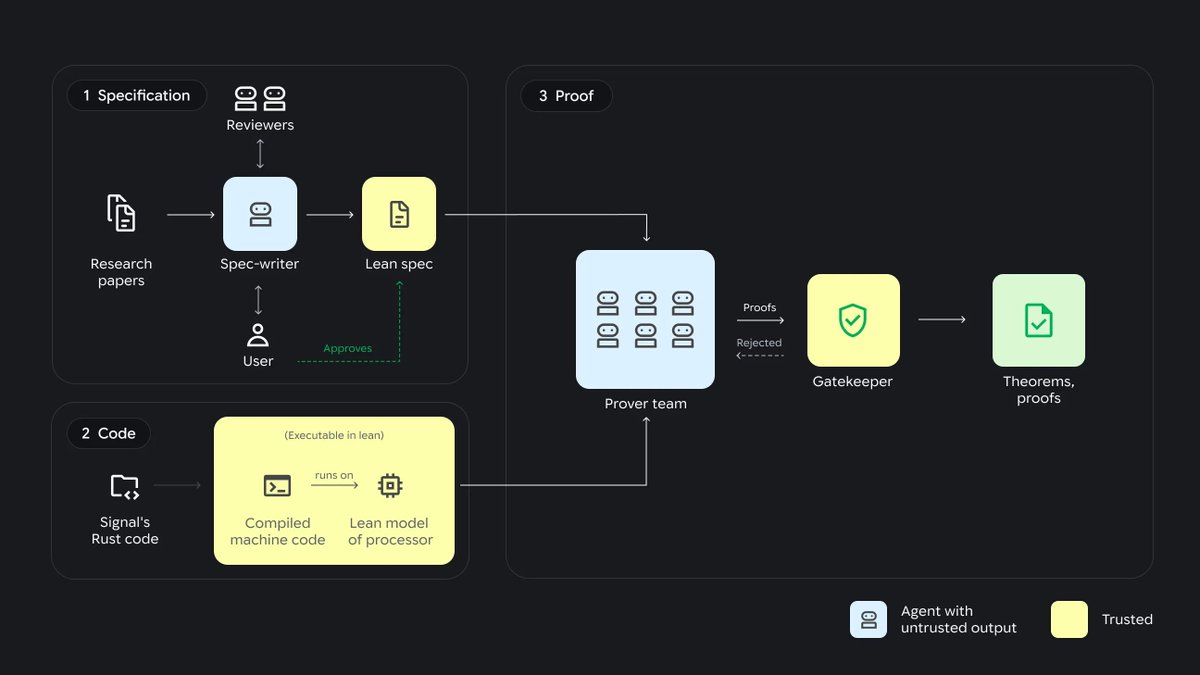
Google had Gemini 4 Carbon prove the Signal protocol down to compiled device code
6M+ lines of machine-checked Lean proofs, ~1% of the codebase needed human review, years of manual verification down to weeks. and they're open sourcing it
this is the cyber use i actually like. defenders get a proof, not just a bug report
Our teams put Gemini 4 Carbon to work on a major security challenge: mathematically proving the code underlying the Signal protocol.
Using AlphaProof Code, @GoogleDeepMind researchers guided agents to verify the protocol down to compiled device code, closing the gap where real bugs hide. The result:
- Gemini 4 Carbon generated over 6M lines of machine-checked Lean proofs
- years of expert manual verification compressed to just weeks
~1% of the codebase required human review (Lean automatically checked the rest)
This is helping unlock scalable formal verification for building secure software, laying the groundwork to fundamentally shift the advantage to defenders. We’re open sourcing the results for the security community.
🚨 MUSE FEATURE ALERT!!! 🚨
muse officially has its own email address 💌
forward it stuff or add it to a thread and watch it go. out now to paid subs in US and Canada.
Fable 5.2 vs Opus 5.5. same prompt, same three.js ship. imo fable wins
one run each, no hand edits. left: Opus · right: Fable
Fable 5.2: 2h 01m · 257k tokens · 4,354 lines
Opus 5.5: 2h 08m · 203k tokens · 4,411 lines
0 errors on both
fable finished 7 min faster but burned 26% more tokens
which ship would you sail? 👇