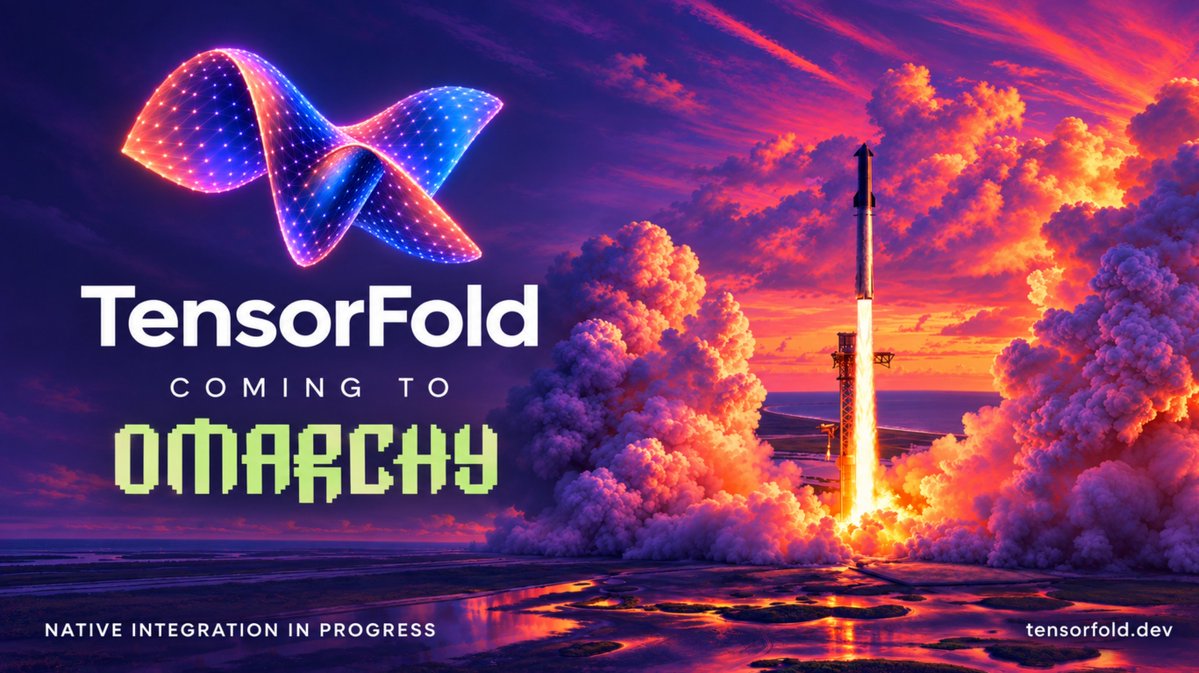
TensorFold is coming to Omarchy 🚀
TensorFold recipes are already in Omarchy's local AI catalogue for Qwen3.8-27B, Flash Next and Nemotron 3.5 Bolt.
Seeing that is pretty wild. 🤯
Huge thanks to @dhh and the Omarchy contributors for all the work that went into this.
I want local AI to be easier and faster to use on your own machine, and I'm really excited to contribute to this.
https://t.co/Pqx03K0EJc
https://t.co/H2dBxCSaUV
TensorFold is coming to Omarchy 🚀
TensorFold recipes are already in Omarchy's local AI catalogue for Qwen3.8-27B, Flash Next and Nemotron 3.5 Bolt.
Seeing that is pretty wild. 🤯
Huge thanks to @dhh and the Omarchy contributors for all the work that went into this.
I want local AI to be easier and faster to use on your own machine, and I'm really excited to contribute to this.
https://t.co/Pqx03K0EJc
https://t.co/H2dBxCSaUV
We're giving away a Hogwarts Legacy custom wrapped NVIDIA GeForce RTX 5090 to celebrate its official release with DLSS 5 🪄
To enter:
🟢 Share this post
🟢 Comment #RTXON
Terms and Conditions: https://t.co/45T3R732hf
@k2sbhai # API access for this model is not available yet.
#
# This endpoint is published for preview and playground use only — it is not
# open for programmatic access, and no API key will authorize it.
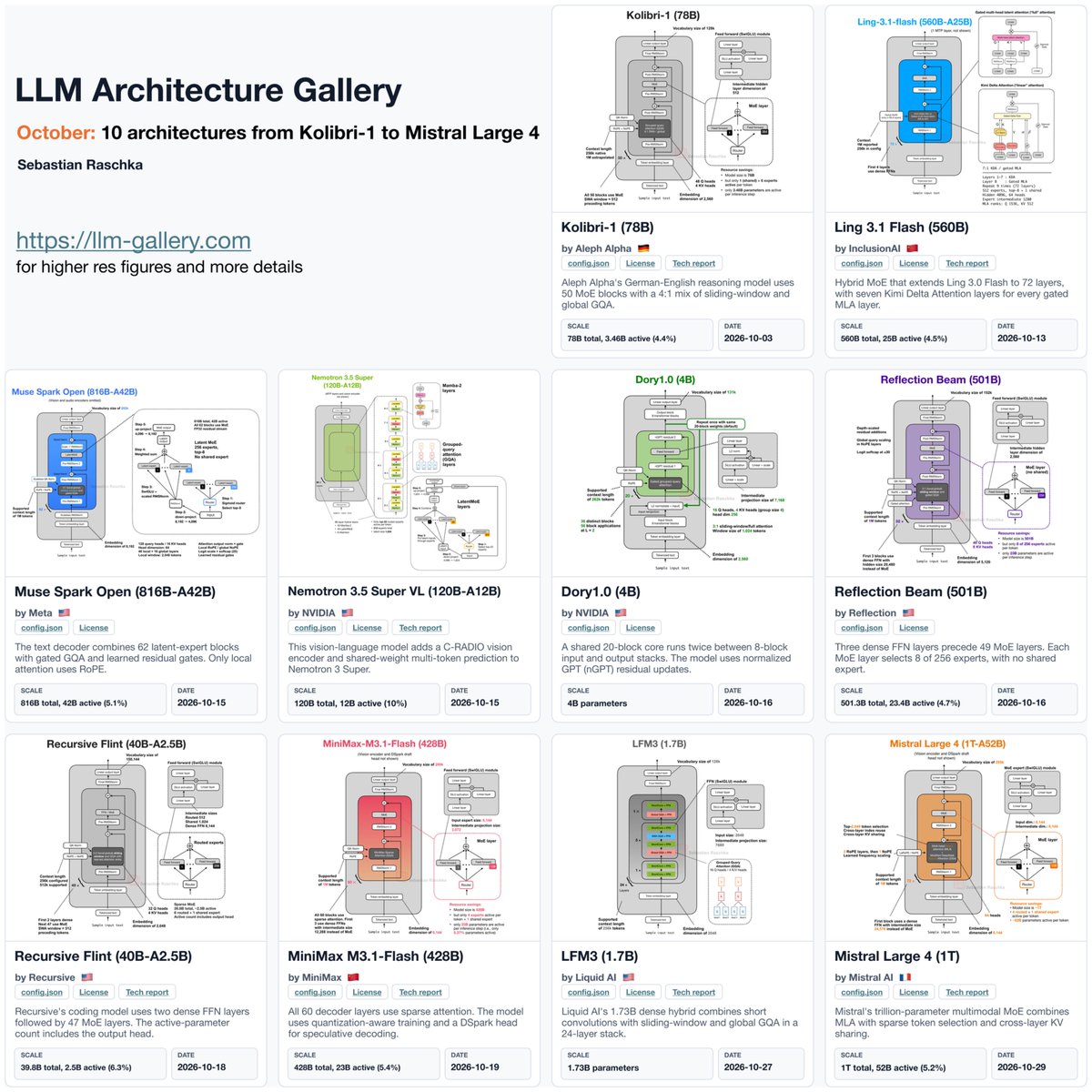
Catching up on the 10 (!) open LLM architecture releases from the past month. Quite a lot happened in October.
I guess we can call it "Open October"!
1. Kolibri-1 (78B): A notable model from Germany. Features classic Grouped Query Attention (GQA) and Sliding Window Attention (SWA) attention module.
2. Ling 3.1 Flash (560B): Uses Kimi Delta Attention and the eighth uses gated Multi-head Latent Attention (MLA) inspired by DeepSeek.
3. Muse Spark Open (816B): Besides Musse Glimmer, the first major open weight release from Meta (since Llama). Uses classic GQA + SWA but adds a LatentMoE.
4. Nemotron 3.5 Super VL (120B): Combines Mamba-2 layers with just eight attention layers. Also LatentMoE
5. Dory1.0 (4B): A looped transformer design.
6. Reflection Beam (501B): GQA+SWA architecture.
7. Recursive Flint (40B): Note that "Recursive" is the company name; the architecture is a fairly standard MoE with GQA and SWA.
8. MiniMax M3.1-Flash (428B): Uses their own MiniMax Sparse Attention module.
9. LFM3 (1.7B): Hybrid architecture that mixes short convolutions and attention.
10. Mistral Large 4 (1T) combines MLA with sparse attention.
Will probably cover/discuss things in more depth in the coming weeks!
世界一速い推論エンジン「YASAKANI」。
RTX 5090・Qwen3.8-27Bで、SGLang・vLLM・llama.cppに全10テスト全勝(最大2.86倍)。
その27Bが、指示1回・人の手ゼロでこの深海を作りました。
オープンソースで、無料で公開する予定です。日程はこのアカウントでお知らせします。
#AbyssBench#YASAKANI
---
■ 同じPC・同じモデルで直接比較(RTX 5090・Qwen3.8-27B、2026-10-18実測)
答えを書く速さ、思考ありの6種類の中央値(tok/s)
- YASAKANI 380.6
- SGLang 183.9
- vLLM 182.9
- llama.cpp 146.9
全10テストで最速。他社の一番速い設定より1.69〜2.86倍。
※他社は各テストで一番速い設定(DFlash 2/DSpark/MTP)、YASAKANIは2回測った遅い方。SGLang・vLLMはWSL2、YASAKANIはWindows。別のテストでExLlamaV3(MTPあり)にも2.39倍。TensorRT-LLMはMTP設定がRTX 5090で動かず未比較。
■ 12.4GBの独自形式 .mgtm(勾玉)
- 業界標準のGGUF Q4_K_M(17.4GB)より5GB軽い
- 同じ12GB級で最良の公開GGUF(unsloth UD-IQ3_S)と比べ、元モデルとのズレ(KLD)は約半分:0.021 vs 0.039
- 最新研究 GSQ-RCO(IQ3_S)とも:0.021 vs 0.044
(WikiText-2・C4・FineWeb-Edu、ctx 2048、同じPCで測定)
■ 専用エンジン YASAKANI(八尺瓊)
- 25万トークンの文書を140秒で読む(約1,800 tok/s)。続きの返事は0.3秒で開始
- 25万トークンを積んだ文脈でも152 tok/s
- 262,144トークンの窓でVRAM 24.9GB。KVも独自圧縮で容量1/3、品質はほぼ落ちない
■ 深海ベンチマーク #AbyssBench
どちらもワンショット(プロンプトは1回だけ、途中で人は口を出さない)
- エージェント部門(自分で描画→画像を見る→修正):33手・19分04秒・エラー0。コード生成 477 tok/s、思考込み平均 284 tok/s
- チャット部門(返事1回で一発出力):6分19秒・101,816トークン・269 tok/s
あなたのモデルでも試してください。HTML 1ファイルをChromeで開いて、スクショを #AbyssBench で(部門と何回目の試行かも添えて)。
プロンプト(このままコピペ可)↓
Design and create a very creative, elaborate, and detailed 3D scene of a bioluminescent deep-sea world at night: pulsing glowing jellyfish, schools of fish swimming in formation, an anglerfish with a glowing lure, coral and sea anemones, drifting plankton particles, and a small submarine whose headlights cut volumetric beams through the dark water. Everything should glow, drift, and animate so it feels alive, with an orbit camera I can drag with the mouse. Make it mesmerizing and atmospheric. Use whatever libraries to get this done but make sure I can paste it all into a single HTML file and open it in Chrome.
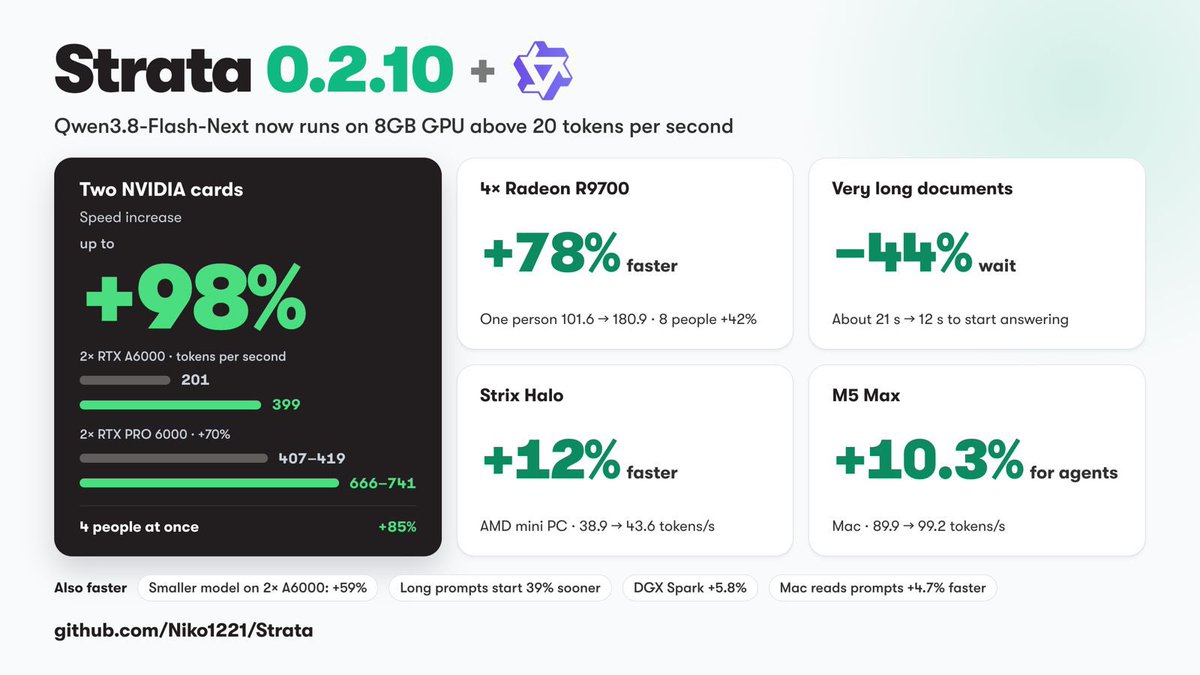
A BIG update is here! Qwen3.8 Flash Next now runs on a 8GB graphics card at 20+ tokens/second 👀
Huge improvements across all hardware and especially massive change in parallelism!
https://t.co/F2i0To065Q
We asked GPT-6 Astra to edit Qwen3.5-0.8B weights to improve math.
It directly changed only 0.016% of weights, fixing 0.8B's reasoning loops & improving math up to 6x and even instruction following 3x, without gradients or training.
We call this Weight-Space Programming: frontier LLMs can now natively read/write neural network weights! 🧵
Blog: https://t.co/bOWCcFhCVq
Today we are happy to share one of our first open research releases: Latent Sparse Attention (LSA), a step towards subquadratic attention that matches accuracy of full attention at ultra-long context.
Sparse attention attends to only a few tokens per query, but it has to find the right ones. At 10M tokens, that search takes 98% of the attention layer's time. LSA makes sparse attention up to 22.7× faster and full attention 72.4x faster.
With @kubicek_ales@caciolai@PengLiangzu@SukritSumant@Ben_Hoov@FraserGreenlee@RMBattleday@radim_urban@thoefler@jcrwhittington
Today we are happy to share one of our first open research releases: Latent Sparse Attention (LSA), a step towards subquadratic attention that matches accuracy of full attention at ultra-long context.
Sparse attention attends to only a few tokens per query, but it has to find the right ones. At 10M tokens, that search takes 98% of the attention layer's time. LSA makes sparse attention up to 22.7× faster and full attention 72.4x faster.
With @kubicek_ales@caciolai@PengLiangzu@SukritSumant@Ben_Hoov@FraserGreenlee@RMBattleday@radim_urban@thoefler@jcrwhittington