@redasadki A completion rate tells you who reached the end. Giving adults a choice of tasks relevant to their own goals can give them a reason to keep going.
@MindShiftKQED@hechingerreport@jillbarshay Knowing where graduates end up helps providers show what their programmes contribute locally. It’s worth tracking whether graduates find work in the region and whether they use the skills they trained for.
@malpani An AI tutor can help a learner get unstuck. What matters is how it fits with the teaching and support around it, and whether the learner can use what they’ve learnt on the next task.
@vaitkus@signulll Personalised paths are exciting, and they still lean on solid design underneath. If every learner takes a different route through the material, doesn't each piece need to stand on its own even more?
@timeshighered Putting the learner in charge only works if enrolment and study systems can keep up. Choosing your own pace or switching pathways mid-programme gets hard fast when the admin side assumes everyone moves together.
@insidehighered Good to see short courses getting proper quality recognition. The quieter part is recording them well, so a learner's short credentials actually show up on their record and can build towards something bigger.
From first enquiry to enrolment in one pipeline. Track prospects from first contact, move applications across a Kanban board, generate offers of place with letters, then convert to enrolment in one click. No re-keying in between. https://t.co/OUgK14Tcoh
@PhilOnEdTech Training providers feel this most when something breaks during enrolment week. Who keeps the system running and responds quickly matters far more to them than how the code was written.
@chronicle Meeting the target is good news, though a lot of that extra work usually lands on admissions and admin staff. Every manual step removed between first enquiry and enrolment gives them more time for the people applying.
@chronicle Plenty of classroom tools never get asked what they're for. Starting from the task and choosing whatever suits it, sometimes a pen and paper, is a good habit for any teaching team.
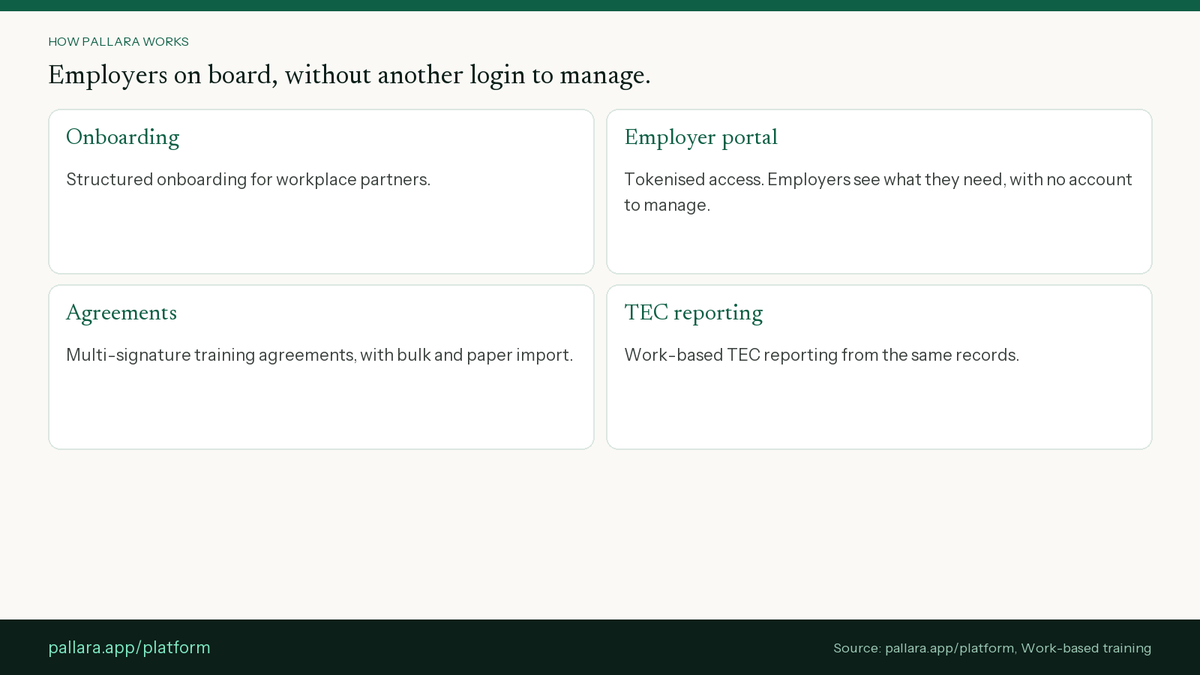
Work-based training in Pallara: employers get tokenised access to what they need, with no account to manage. Training agreements take multiple signatures, with bulk and paper import. Work-based TEC reporting comes from the same records. https://t.co/OUgK14Tcoh
@performbyai Guardrails probably matter most at the moment AI starts doing the thinking for the student. Using it to explain or check work keeps the learning with the learner.
@rtenews Student records projects tend to grow when the brief becomes rebuilding every old process exactly as it was. Deciding early which processes to retire, and testing data migration well before go-live, usually saves more than any feature.
@SandhuNavd71119 Coming back tomorrow is the same challenge training providers face with adult learners fitting study around work. Small, regular progress usually keeps people going better than long sessions they have to find time for.
@ChandaMapolo This applies to forms and student portals too. A label sitting right beside the field it describes saves far more confusion than a help page students have to go looking for.
@lyrie_ai It's easy to lock down the main student system and forget the side routes, like file transfer accounts set up with outside partners. Any login that can reach student records needs multi-factor and regular review.
@Ninithefounder Usually each team buys for its own problem, and nobody owns the gaps between the tools until a student's record has to move from one system to the next.
Admissions forms in Pallara: public forms on your own domain, in your brand, with Stripe payment inside the form. You can see who started but didn't finish, and follow up. Generated PDFs are supported. https://t.co/OUgK14Tcoh
@UPCEA How are people keeping employer input current once a programme is up and running, when industry needs tend to shift faster than formal review cycles?
@timeshighered A lot of universal design starts small, like giving students more than one way to show what they know and making course materials accessible before anyone has to ask for an adjustment.