🇨🇦👁
She’s breaking it down.
Trump’s 50% tariff just exposed what Carbon Carney is really protecting.
It’s not you.
It’s not jobs.
It’s carbon.
It’s carbon taxes.
That’s what’s happening behind the scenes right now.
Canadians should be informed.
Trump’s 50% Tariff Just Exposed What Carbon Carney Is Really Protecting.
She’s breaking it down.
Carbon first. Canadians second.
Canadians should be informed.
This 5-step algorithm Elon Musk uses to solve any problem will teach you more about building than every business book you've read combined.
Bookmark & read it today, no matter what.
The great lie is that society is divided between rich and poor.
The great truth, as David Friedberg puts it, is makers vs takers.
Makers build, create, and deliver real value: houses, software, art, businesses, and everything that moves civilization forward.
Takers watch, criticize, analyze, and politic. They push the lie that the rich hoard unfairly so the poor must seize it… all while positioning themselves to rule the chaos.
As @friedberg tells his kids: “At the end of the day, if you made something and someone else valued it, you were a maker. That was an amazing achievement. That is a great day.”
Takers thrive on division. Makers drive progress.
Time to choose your side.
Elon Musk explains his 5-step algorithm for solving any problem:
"The most common mistake of smart engineers is to optimize a thing that should not exist."
"I have this very basic first principles algorithm that I run as a mantra."
Elon breaks it down:
Step 1: Question the requirements.
"Make the requirements less dumb. The requirements are always dumb to some degree, no matter how smart the person who gave you those requirements. You have to start there, because otherwise you could get the perfect answer to the wrong question."
Step 2: Try to delete it.
"Try to delete the part or the process step entirely. If you're not forced to put back at least 10% of what you delete, you're not deleting enough. Most people feel like they've succeeded if they haven't been forced to put things back in. But actually they haven't, they've been overly conservative and left things in that shouldn't be there."
Step 3: Optimize or simplify.
"The most common mistake of smart engineers is to optimize a thing that should not exist. So you don't optimize until after you've tried to delete."
Step 4: Speed it up.
"Any given thing can be done faster than you think. But you shouldn't speed things up until you've tried to delete it and optimize it otherwise, you're speeding up something that shouldn't exist."
Step 5: Automate.
"And then the fifth thing is to automate it."
Elon explains why the order matters:
"I've gone backwards so many times where I've automated something, sped it up, simplified it, and then deleted it. I got tired of doing that. So that's why I have this mantra."
Google's former CEO just said what everyone in AI already knows
Building wealth is getting easier if you actually learn the tools
Not by scrolling AI threads
By understanding agents, Codex Code, prompts, memory, skills, MCP, and routines
Save this before it disappears from your feed
Everything below is free:
ChatGPT basics
https://t.co/p1ZEv4vG4f
OpenAI Academy
https://t.co/5AVN9CgCZq
Prompt engineering
https://t.co/gFV0OAXnQo
GPT-5.5 prompting guide
https://t.co/TJOxZ77Y6C
OpenAI API docs
https://t.co/24OlDTxEcA
Responses API
https://t.co/DLnWfUZEUS
Agents SDK
https://t.co/irt7DTJ745
Agents SDK quickstart
https://t.co/Mm2kgeMs39
Tools + function calling
https://t.co/A40Dege36x
Structured outputs
https://t.co/Jawb4njrJa
Conversation state
https://t.co/YkbSXmUk3A
ChatGPT memory
https://t.co/ojhvlLbVWp
ChatGPT projects
https://t.co/Svo7ATFTGc
Custom GPTs
https://t.co/chrd6IBz8L
Tasks in ChatGPT
https://t.co/pIEnCC5K8F
Codex overview
https://t.co/CVPKvEz9MY
Codex quickstart
https://t.co/sKNEmSMCXF
Codex CLI
https://t.co/kUySSiEBL5
Codex GitHub repo
https://t.co/FoiGgP5ash
Codex best practices
https://t.co/E1PtLvDDaj
AGENTS.md
https://t.co/eaAJkQDp4x
Codex skills
https://t.co/OsrLujQnkX
Codex MCP
https://t.co/uHCuY9Ram7
Codex subagents
https://t.co/QboZoCEzHT
ChatGPT Apps SDK
https://t.co/keDQV4wPUp
Apps SDK quickstart
https://t.co/OYKfU6EXaW
ChatGPT developer mode + MCP
https://t.co/iUE04OldHB
OpenAI Cookbook
https://t.co/LxteqEFzWZ
All of this costs $0
Most people will keep asking AI one question at a time
Save this and start learning the stack
You’re using your brain WRONG.
In 2010, Stanford neurologist Dr Frank Longo gave a 2-hour lecture on how memory really works.
Everything you’ve learned about memory is mostly wrong.
His frameworks:
• The Magic 7 rule
• How sleep moves memories to storage
• Use it or lose it
INSTEAD OF WATCHING AN HOUR OF NETFLIX TONIGHT.
This 1 hour Stanford lecture by Joel Peterson will teach you more about negotiation and getting what you want than most people learn in years.
Bookmark it and give it an hour, no matter what.
In 2019, Professor Gillian Ku gave a 1 hour masterclass on how to negotiate & get what you want.
Her ideas:
- Reciprocity beats direct request
- Scarcity creates desire out of thin air
- We say yes to people we like, not people who are right
10 lessons to negotiate better:
🚨 Anthropic just showed a 27-minute workshop on how to actually do prompts for Claude.
Taught by the people who built it.
Free. No registration. No paywall.
I've seen $300 courses that don't cover what they teach in the first 8 minutes.
Watch it and bookmark it now.
A man spends 50 years teaching at MIT.
He knows his time is running out.
So he records one last lecture — everything he knows, distilled into a single hour.
He died 5 months later.
This is that lecture.
The most important hour you'll watch this week. 👇
Bookmark it for later
SpaceX is actively hiring world-class engineers/physicists for SpaceXAI, even if you have zero prior experience in AI. Smart humans figure it out fast.
Please send an email with ~3 bullet points demonstrating evidence of exceptional ability to [email protected].
Richard Feynman ganó el Nobel de Física y dijo algo que dejó huella:
"La mayoría de personas saben muchas cosas. Pero no saben pensar."
Feynman dio una clase magistral de 1 hora sobre física e imaginación.
Sus 12 lecciones de vida:
1. La imaginación le gana al conocimiento
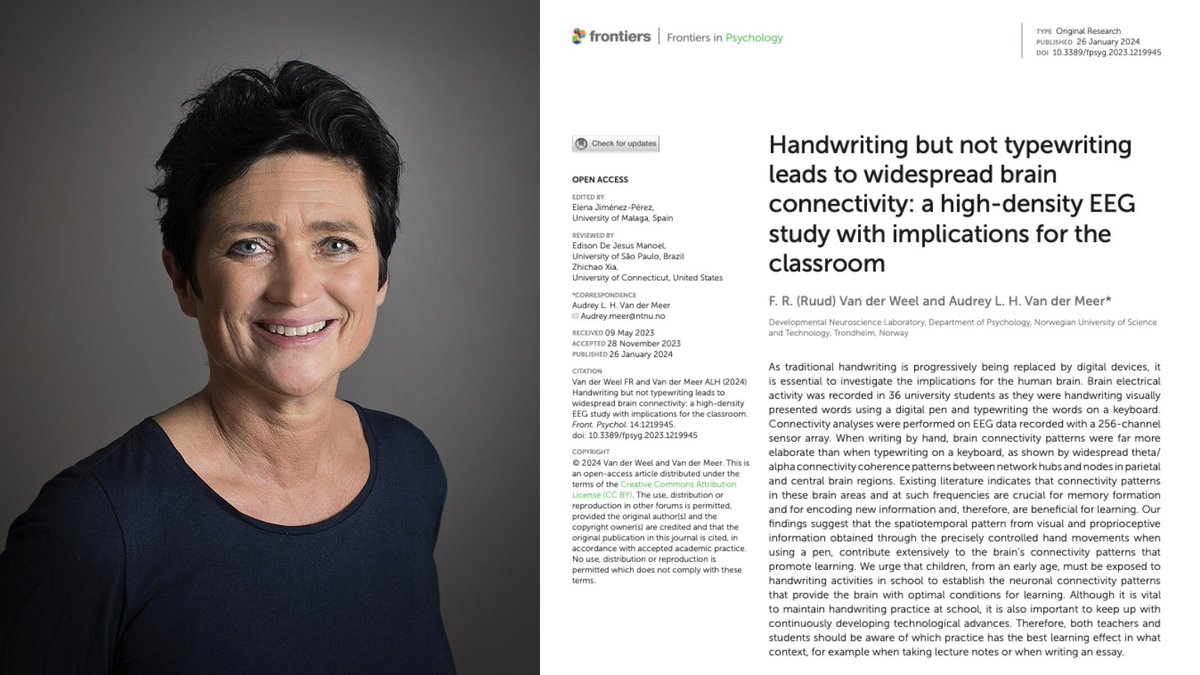
A Norwegian neuroscientist spent 20 years proving that the act of writing by hand changes the human brain in ways typing physically cannot, and almost nobody outside her field has read the paper.
Her name is Audrey van der Meer.
She runs a brain research lab in Trondheim, and the paper that closed the argument was published in 2024 in a journal called Frontiers in Psychology. The finding is brutal enough that it should have changed every classroom on Earth.
The experiment was simple. She recruited 36 university students and put each one in a cap with 256 sensors pressed against their scalp to record brain activity. Words flashed on a screen one at a time.
Sometimes the students wrote the word by hand on a touchscreen using a digital pen, and sometimes they typed the same word on a keyboard. Every neural response was recorded for the full five seconds the word stayed on screen.
Then her team looked at the part of the data most researchers had ignored for years, which is how different parts of the brain were communicating with each other during the task.
When the students wrote by hand, the brain lit up everywhere at once.
The regions responsible for memory, sensory integration, and the encoding of new information were all firing together in a coordinated pattern that spread across the entire cortex. The whole network was awake and connected.
When the same students typed the same word, that pattern collapsed almost completely.
Most of the brain went quiet, and the connections between regions that had been alive seconds earlier were nowhere to be found on the EEG.
Same word, same brain, same person, and two completely different neurological events.
The reason turned out to be something nobody had really paid attention to before her work. Writing by hand is not one motion but a sequence of thousands of tiny micro-movements coordinated with your eyes in real time, where each letter is a different shape that requires the brain to solve a slightly different spatial problem.
Your fingers, wrist, vision, and the parts of your brain that track position in space are all working together to produce one letter, then the next, then the next.
Typing throws all of that away. Every key on a keyboard requires the exact same finger motion regardless of which letter you are pressing, which means the brain has almost nothing to integrate and almost no problem to solve.
Van der Meer said it plainly in her interviews.
Pressing the same key with the same finger over and over does not stimulate the brain in any meaningful way, and she pointed out something that should scare every parent who handed their kid an iPad.
Children who learn to read and write on tablets often cannot tell letters like b and d apart, because they have never physically felt with their bodies what it takes to actually produce those letters on a page.
A decade before her, two researchers at Princeton ran the same fight using a completely different method and ended up at the same answer. Pam Mueller and Daniel Oppenheimer tested 327 students across three experiments, where half took notes on laptops with the internet disabled and half took notes by hand, before testing everyone on what they actually understood from the lectures they had watched.
The handwriting group won by a wide margin on every question that required real understanding rather than surface recall.
The reason was hiding in the transcripts of what the two groups had actually written down.
The laptop students typed almost word for word, capturing more total content but processing almost none of it as they went, while the handwriting students physically could not write fast enough to transcribe a lecture in real time, which forced them to listen carefully, decide what actually mattered, and put it in their own words on the page.
That single act of choosing what to keep was the learning itself, and the keyboard had quietly skipped the choosing and skipped the learning along with it.
Two studies. Two countries. Same answer.
Handwriting makes the brain work. Typing lets it coast.
Every note you have ever typed instead of written went into your brain through a thinner pipe. Every meeting, every book highlight, every idea you captured on your phone instead of on paper was processed at half depth.
You did not forget those things because your memory is bad. You forgot them because typing never woke the part of the brain that would have made them stick.
The fix is the thing your grandmother already knew.
Pick up a pen. Write the thing down. The slower road is the faster one.
Dois engenheiros da Anthropic acabaram de ensinar em 24 minutos todas as funcionalidades do Claude que ninguém conhece.
Esse vídeo vai mudar completamente a forma como você usa IA.
Assista e salve.
🚨 Anthropic's own team just showed how to actually prompt Claude.
24 minutes. free. from the people who built it.
watch the workshop. bookmark it.
worth more than every $300 course you almost bought.
you've been using Claude without knowing 40 of its prompts.
Then read the guide below.